Connect with us

Business

Before Maduro arrest, opposition leader Mariá Corina Machado said Venezuelans should run country

Published

on


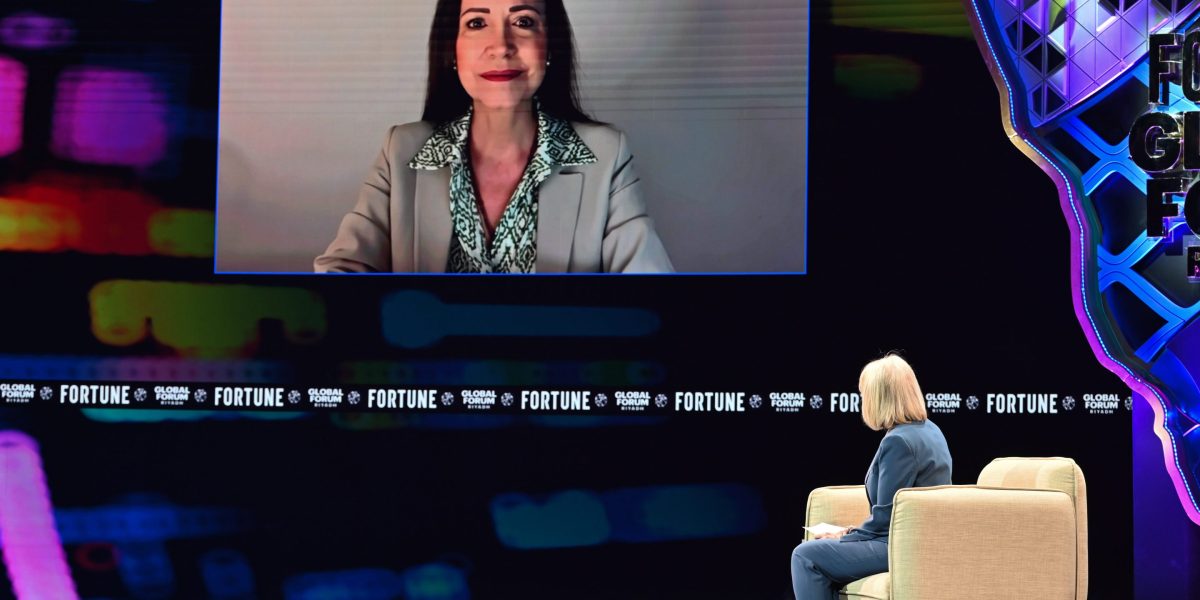
Good morning. A little over two months ago, I interviewed Venezuelan opposition leader and 2025 Nobel Peace Prize winner Mariá Corina Machado at the Fortune Global Forum. She spoke to us from an undisclosed location, later escaped to Norway, and remains in hiding. One of the most prominent advocates for reform in a country that was praised as a stable and affluent democracy just a generation ago, Machado was blocked from running for president in Venezuela’s 2024 election. Edmundo González ran in her place and won, according to independent observers. 

With Donald Trump’s surprise invasion of Venezuela to arrest President Nicolás Maduro and his wife on drug trafficking charges, many might have assumed that Machado would be chosen to lead. Instead, Trump picked Maduro’s deputy, Delcy Rodríguez, saying Machado lacked the respect needed.

Of course, much can change in the coming days. Rodríguez described Trump’s move as a criminal military intervention that violated international law while Machado thanked the U.S. for its action in a letter posted on X. But anyone who leads Venezuela right now faces a Faustian choice, as Trump has said the U.S. will temporarily “run” the country and boasted that Americans are “going to be taking a tremendous amount of wealth out of the ground” from the country’s vast oil reserves.

Rodríguez refuses to accept any violation of national sovereignty, despite Trump’s threats, and Machado won’t, either. The Nobel Prize winner said as much in her letter and was clearly hesitant to endorse the administration’s methods when we spoke in October. At that time, the U.S. was deploying war ships to the Caribbean and had blown up ten Venezuelan boats because of suspected drug trafficking. When I asked her if it was right for the U.S. to take such unilateral action, she deflected to accusing Maduro of criminal actions. While Machado welcomes U.S. support—“Maduro started the war; President Trump is ending the war”—she made it clear that Venezuelans could handle it from here.

“We are ready to take over; we know what we need to do,” she told me back in October, predicting a $1.7 trillion opportunity for foreign investors. “Venezuela will be the single biggest economic opportunity for decades to come in this region.” You can watch the full interview here. And be sure to check out Jeff Sonnenfeld’s memo to CEOs on the aftermath of U.S. action in Venezuela.

Contact CEO Daily via Diane Brady at diane.brady@fortune.com

Top news

Opportunity in Venezuela

Foreign investors are already circling Venezuela as the regime change promises to unlock business opportunities in the country. A former Chevron executive is raising $2 billion for Venezuelan oil projects while a group of American investors is planning to visit Venezuela in March. At the same time, the U.S. oil majors with enough resources and expertise to tap Venezuela’s proven oil reserves—the world’s largest—were reportedly blindsided by the Trump administration’s action, plus it’s unclear if the world has an appetite for more oil

How to ‘run’ Venezuela 

The urgent question following the U.S.’s ouster of Maduro is how the U.S. will “run” Venezuela, as Trump has promised to do. Trump suggested Sunday night that the U.S. has direct control of the country, while Secretary of State Marco Rubio has said the U.S. will coerce Venezuela’s new leadership to get what it wants. 

Bitcoin surges

Bitcoin hit a three-week high of just over $93,000 Monday following the U.S.’s arrest of Maduro. Investors seem to be regarding the top cryptocurrency as a safe haven amid geopolitical turmoil. Bitcoin ended 2025 down 6.5%. 

Is Greenland next?

The U.S.’s intervention in Venezuela is heightening tensions between Denmark and Washington as Trump and his allies suggest that they’re eyeing Greenland, a Danish territory, next. “We do need Greenland,” Trump said Sunday. Danish Prime Minister Mette Frederiksen has demanded that Trump stop his “threats against a historically close ally.”

The risk of ‘fiscal dominance’

Former Fed Chair Janet Yellen is warning that preconditions for “fiscal dominance”—in which the Federal Reserve maintains low interest rates to minimize debt servicing costs, rather than control inflation, due to the size of the federal debt—“are clearly strengthening.” If Trump succeeds in convincing the Fed to keep rates low for that reason, the U.S. could become a “banana republic,” Yellen says.

College matters again

As white collar hiring slows and companies dismantle DEI mandates, corporate recruiters are once again relying on university credentials as a way to screen potential candidates, favoring elite institutions. A survey of employers found that a quarter are now hiring from a shortlist of schools, up from 17% in 2022. 

BYD overtakes Tesla

China’s BYD is now the world’s largest seller of fully-electric vehicles after beating Tesla’s sales in 2025. BYD sold about 2.26 million battery-electric cars last year, nearly 28% more than in 2024, even as its overall auto business recorded its slowest annual growth in several years. Tesla, by contrast, has logged its second consecutive year of declining vehicle sales.

Another shutdown deadline

The U.S. Congress is back in session this week as the deadline for the next government shutdown looms less than four weeks away, though both Senate Minority Leader Chuck Schumer and Senate Majority Leader John Thune indicated over the holidays that another funding stalemate is unlikely.

The markets

S&P 500 futures were up 0.27% this morning. The last session closed up 0.19%. STOXX Europe 600 was up 0.36% in early trading. The U.K.’s FTSE 100 was up 0.13% in early trading. Japan’s Nikkei 225 was up 2.97%. China’s CSI 300 was up 1.90%. The South Korea KOSPI was up 3.43%. India’s NIFTY 50 was down 0.3%. Bitcoin was at $93K.

Around the watercooler

Behind glam luxury brands Michael Kors and Jimmy Choo lurks a troubled holding company losing millions by Amanda Gerut

Michael Saylor’s Strategy flirts again with the danger threshold at which his company is worth less than his Bitcoin by Jim Edwards

Even top CEOs check their phones first thing in the morning—these are the apps business executives are reaching for by Emma Burleigh

CEO of $90 billion Waste Management hauled trash and went to 1 a.m. safety briefings—‘It’s not always just dollars and cents’ by Amanda Gerut

Bosses are fighting a new battle in the RTO wars: It’s not about where you work, but when you work by Nick Lichtenberg

CEO Daily is compiled and edited by Joey Abrams, Claire Zillman and Lee Clifford.


Source link

Continue Reading

Business

Saks Global’s near bankruptcy is the result of risky dealmaking—and a neglect of business basics

Published

on


Good morning. The current travails of Saks Global, the one-year old holding company of Saks Fifth Avenue, Neiman Marcus and Bergdorf Goodman, are a timely reminder that the key to success in business is often quite simple: focus on your core business, not on financial engineering.

In late 2024, Saks Global executive chair and controlling shareholder Richard Baker, a real estate scion, landed his dream trophy in Neiman Marcus (which also owned Bergdorf), achieving his long-held ambition to combine the U.S.’s fanciest luxury department stores into one company. To pull this off, Saks Global borrowed $2.7 billion, an untenable debt load that has put the company on the precipice of a bankruptcy protection filing, or at least a major refinancing. (No one thinks Saks Global is going under, but this can only hurt its prospects as a retailer.)

The Saks-Neiman tie-up was the culmination of a plan Baker hatched in 2005 to snap up retailers with valuable real estate. Over the years, different iterations of the company, known for years as HBC, have included Lord & Taylor (his first big acquisition), and Canada’s Hudson’s Bay.

His bet was that the value of iconic properties like the Saks and Lord & Taylor flagships in Manhattan or The Bay in Toronto could be monetized so long as the underlying retail business remained steady.

But nothing about retail, especially department stores, has been stable. Lord & Taylor shut all its stores in 2019 after HBC sold the weakened retailer, and Hudson’s Bay in Canada liquidated last year, ending its 355-year run.

To be fair, Baker has made some good deals in the world of retail. (He sold Target the locations of its ill-fated Canadian expansion in 2011.) And department stores have been cratering for decades. 

But a constant churn of financial maneuvers (spinning off Saks’ e-commerce, creating co-working spaces in underutilized stores, all while being highly leveraged) brought some benefit but never obviated the need to invest more in basics. Saks Global has said it’s poured tons of money into its retailers, but it has not been enough. Its cash crunch has led some vendors to stop shipping to Saks: it’s very hard to sell merchandise you don’t have, ergo a 13% drop in sales last quarter.

A few months ago, I chronicled the comebacks at Macy’s, Bloomingdale’s, Nordstrom (all benefiting from Saks’ problems) alongside the consistent performance of Belk and Dillard’s. Such retailers have improved customer service, renovated stores, and stocked ample and new merchandise. A strong business boosts the value of their underlying real estate.

All that will be key for Baker to consider since he’s just become the new CEO of Saks Global, giving him a direct hand in running the company, not just yanking its financial levers. You can read my full story on the Saks saga here.

Contact CEO Daily via Diane Brady at diane.brady@fortune.com

Top news

How to get Venezuela’s oil 

One big question that looms over the Trump administration is how to obtain and monetize Venezuela’s oil, which the White House said it will control “indefinitely.” It’s reportedly considering exerting some control over state-owned producer Petróleos de Venezuela SA. Meanwhile, the U.S. oil industry is asking for legal and financial guarantees from Washington before it assumes the risk of investing in Venezuela. Trump has suggested that the U.S. may end up reimbursing oil companies for rebuilding Venezuela’s infrastructure.

ICE shooting sparks outrage

Video of an ICE agent shooting and killing a woman during an encounter in Minnesota spread rapidly online Wednesday. The incident stoked national tensions over the Trump administration’s immigration raids and sparked protests as far away as New York City. 

JPMorgan’s proxy platform

JPMorgan’s asset management unit, one of the world’s largest with more than $7 trillion in client assets, is ditching proxy-advisory firms in favor of an internal AI-enabled platform called Proxy IQ that will help cast votes on shareholder resolutions. 

Trump goes after big single-family home investors

In a post on Truth Social Wednesday, President Trump suggested that he will ban institutional investors and Wall Street firms from buying single-family homes as young people are finding it harder and harder to purchase homes. Analysts say the biggest investors in the space collectively own hundreds of thousands of homes.

Accessing Greenland’s minerals could take decades—and billions

Alexander Gray, who worked in President Trump’s first administration, recently told Fortune that the president’s threats to take over Greenland should be taken very seriously. Mineral experts, on the other hand, say that targeting the island’s natural resources will take billions of dollars across decades to see any return.

The great private equity consolidation 

Nearly half of all U.S. private equity capital raised last year through September went to the top 10 funds, their largest share in a decade, as institutional investors favor the top managers amid weak distributions. 

Are layoffs really because of AI?

A new report from Oxford Economics suggests that companies aren’t laying off workers and replacing them with AI, instead using the technology as a cover for standard headcount reductions. “We suspect some firms are trying to dress up layoffs as a good news story rather than bad news, such as past over-hiring,” the authors of the report wrote.

The markets

S&P 500 futures were down 0.2% this morning. The last session closed down 0.34%. STOXX Europe 600 was down 0.3% in early trading. The U.K.’s FTSE 100 was down 0.33% in early trading. Japan’s Nikkei 225 was down 1.63%. China’s CSI 300 was down o.82%. The South Korea KOSPI was flat. India’s NIFTY 50 was down 1.01%. Bitcoin was down to $90K.

Around the watercooler

The $38 trillion national debt is one thing 82% of Americans agree on: ‘Voters are understandably concerned,’ watchdog says by Nick Lichtenberg

Jensen Huang might be fine with a billionaires tax, but Google cofounder Larry Page is already dumping California by Sasha Rogelberg

OpenAI launches ChatGPT Health in a push to become a hub for personal health data by Sharon Goldman

‘It feels challenging to break through’: Most recruiters say they can’t find talent while 80% of job seekers feel unprepared to find a job by Jacqueline Munis

Netflix co-CEO says he doesn’t read business books—instead, he reads one 1902 novella about a ship and its captain ‘over and over again’ by Preston Fore

CEO Daily is compiled and edited by Joey Abrams, Claire Zillman and Lee Clifford.


Source link

Continue Reading

Business

The U.S. naval blockade of Venezuela has cost $700 million already—and is rising by $9 million daily

Published

on


The ongoing U.S. naval blockade of Venezuelan has cost an estimated $700 million and counting with two more oil tankers seized Jan. 7, as President Donald Trump aims to sell more Venezuelan crude oil to American refineries and convince U.S. oil companies to return to embattled nation.

Operating the USS Gerald R. Ford and its aircraft carrier strike group costs more than $9 million per day—adjusted for inflation—since being ordered to Latin American waters in October, according to a prior report from the Center for a New American Security. Those costs do not account for the boat strikes that began in late August—killing more than 100 people thus far—or the Jan. 4 attacks in Venezuela that resulted in the arrests of leader Nicolás Maduro and his wife.

Trump has argued the U.S. does not want a prolonged occupation so long as Maduro’s vice president and now-acting president, Delcy Rodríguez, defers to the U.S. And he is pushing for U.S. oil companies to work in Venezuela to rebuild the dilapidated industry and get oil and dollars flowing again.

The White House did not refute the financial numbers of the blockade nor provide additional information, with spokesperson Anna Kelly saying in a statement that Maduro’s arrest saves American lives, stops the flow of drugs and criminals, initiates a deterrence in the Western Hemisphere, and creates economic opportunities for Venezuelans and Americans.

 David Goldwyn, Atlantic Council fellow and State Department special envoy for international energy affairs in the Obama administration, told Fortune that Trump is operating with an “incoherent strategy.”

“A lot has been spent, and little has been gained,” Goldwyn said. “It’s really hard to see what the upside is. Maduro has been removed, but the rest of the regime are all still in place.”

“The prize he’s trying to manufacture of special access to resources for U.S. companies seems to be unwelcome by most.”

Indeed, Trump is scheduled to meet Jan. 9 with oil executives, including leaders from Chevron, Exxon Mobil, and ConocoPhillips. The companies did not respond to requests for comment.

Chevron is the only American oil company operating in Venezuela—under a special license—producing nearly 20% of the country’s oil.

Trump argued the American oil companies are “ready to go in” and spend billions of dollars to rebuild Venezuela’s energy infrastructure and dramatically increase the flow of oil to bring revenues back to Venezuela and the U.S.

But the reality is different. Once a major player churning out nearly 4 million barrels of oil daily, Venezuela’s volumes have plunged from 3.2 million barrels daily in 2000 down to fewer than 1 million barrels today from a combination of mismanagement, underinvestment, and escalating U.S. sanctions. More than doubling Venezuela’s current oil production likely would take until 2030 and cost about $110 billion, said research firm Rystad Energy.

Apart from Chevron, U.S. companies have previously expressed reservations about returning because of the political instability, high costs, and weaker oil prices. ConocoPhillips and Exxon are still owed billions of dollars from Venezuela from the 2007 expropriation of their assets resulting international tribunal rulings.

“We’ve been expropriated from Venezuela two different times. We’d have to see what the economics look like,” Exxon CEO Darren Woods told Bloomberg in November. “We have our history there.”

How Trump plans to profit from Venezuelan oil

In the meantime, Trump said on social media the U.S. will take between 30 million and 50 million barrels of Venezuelan crude over time to sell from the United States. The proceeds would be controlled by the White House, although the details remained vague.

Presumably, more oil would be sold to U.S. refineries that are configured to process the heavy grade of crude that comes from Venezuela, and Venezuelan state oil company PDVSA would receive most of the proceeds.

Depending on the number of barrels—and based on the current benchmark price for oil in the U.S.—that much oil could be worth between $1.6 billion and $2.8 billion.

PDVSA confirmed in a Jan. 7 statement that it is negotiating with the U.S. in a framework similar to those with Chevron and other international companies. “PDVSA ratifies its commitment to continue building alliances that promote national development in favor of the Venezuelan people and that contribute to global energy security.”

The effort implies the U.S. will auction the oil barrels through the U.S. Department of Energy and hold the proceeds in escrow as leverage for Venezuelan cooperation, said Matt Reed, vice president of the geopolitical and energy consultancy Foreign Reports. Most recently, about 80% of Venezuelan oil exports went to China and nearly 15% to the U.S.

“It sounds like a twist on the old, UN ‘oil for food’ program that allowed Iraq to sell oil but only tap revenue for essential goods like food and medicine. The difference this time is that Washington will decide where the oil goes. U.S. refiners will probably get priority depending on Gulf Coast demand,” Reed said. “It’s unclear how or whether the US will profit from this. Rather, Washington is counting on this leverage to twist arms in Caracas.”

As for the Trump oil summit with executives, Reed said, “Washington can offer incentives but only Caracas can convince American firms to take the plunge and invest over the long term.”


Source link

Continue Reading

Business

Lonely staff at a major pharmacy chain are being paid $100 to take time off and text a friend—welcome to Sweden’s ‘friendship hour’

Published

on


Loneliness is wearing down so many workers that it’s been deemed an “epidemic” by U.S. healthcare professionals. Across the pond in Europe, employees are grappling with the same issue; that’s why one Swedish employer is piloting a paid “friendship hour” to combat isolation.

Apotek Hjärtat, one of Sweden’s largest pharmaceutical chains, is trialing a “friendcare” program (“vänvård” in Swedish), where staff are allotted one hour per month, or 15 minutes every week during working hours, to connect with old or new friends.

The year-long scheme was first launched last April, according to reporting from BBC. Volunteers could register for the initiative if they were lonely, or simply wanted to get closer to people struggling with isolation—just 11 out of 4,000 employees opted in 

The business has not only set aside work hours to test the initiative, it’s also been footing the bill for connection. 

All participants are paid 1,000 kronor (around $100) to cover activities with their companions. But the “friendship hour” doesn’t have to be spent dining out for lunch, or biking around town; staffers can use the time for the simplest relationship pastimes, such as chatting on the phone or catching up over text. 

Improving workers’ wellbeing is actually a tax benefit for the company

Monica Magnusson, the CEO of Apotek Hjärtat, told BBC the “friendship hour” scheme came about out of genuine curiosity: the company wanted to see if this allotted employee time would improve staff wellbeing. 

“We try and see what the effects are from having the opportunity to spend a bit of time every week on safeguarding your relationships,” Magnusson told the BBC. 

The program is likened to Sweden’s broader “friskvård” benefit: an annual tax-exempt stipend covering employee wellness activities, such as fitness classes and massages. Magnusson said the “friendship hour” is “a reflection on that, but targeting loneliness and relationships instead.”

But even Apotek Hjärtat employees not participating in the pilot can still benefit emotionally from another initiative; the business provides online training for all its staffers on how to recognize and handle loneliness. 

Fortune reached out to Apotek Hjärtat for comment.

The $154 billion employee loneliness problem

Loneliness has swept through offices across the U.S.; around 79% of white-collar employees have felt lonely as a result of their role within the past month, according to a 2024 study from BSG in partnership with TheLi.st and Berlin Cameron. The issue not only leads to higher turnover, weakened company culture, and sluggish employee morale—it’s also costing businesses billions of dollars every year. 

It’s estimated that loneliness among U.S. staffers results in a $154 billion loss annually, or about $4,200 in lost workdays per staffer each year, according to a 2022 study from Project Connect.

However, there’s hope that these employer-led initiatives could help turn the tide on loneliness—and there’s a business imperative to do so. Employees are 3.5 times more likely to reach their full potential when they feel connected, according to a 2019 study from the Harvard Business Review. When staffers are connected, they also perform better on the job: around eight in 10 workers believe a sense of community would help them be better at work, according to a 2025 Randstad report.

If employers choose to turn a blind eye to their isolated staffers, it could hurt them in the long run. About 55% of professionals would consider quitting if they didn’t feel a sense of belonging on the job, a massive increase from 37% who said the same in 2024, according to the Randstad report


Are you a CEO intentionally combating post-pandemic workplace loneliness? Fortune wants to hear from you! Reach out at emma.burleigh@fortune.com


Source link

Continue Reading

Trending

Copyright © Miami Select.