Connect with us

Politics

As legal betting booms, James Uthmeier, lawmakers target shadow gambling economy
Published

on


Hundreds of millions of dollars in legal sports betting revenue are flowing into Florida each year, but a growing shadow gambling economy is siphoning money away from the state and its taxpayers.

Attorney General James Uthmeier is working to rein it in. He’s also asking the state lawmakers to raise the stakes by steepening penalties.

A key objective for Uthmeier in 2026 is to address the rapid expansion of illegal and legally ambiguous gambling activities across the state, particularly as they intersect with the Seminole Tribe’s Gaming Compact.

While the Seminole Tribe’s legal, state-sanctioned sports betting platform, Hard Rock Bet, has generated hundreds of millions of dollars for Florida, a parallel and largely unregulated ecosystem has emerged with it. This includes illegal brick-and-mortar casinos, offshore gambling platforms, sweepstakes-style gaming apps, fantasy sports platforms whose offerings blur into sports betting and federally regulated prediction markets like Kalshi and Polymarket.

Each of those developments presents problems. Together, they have complicated enforcement and raised questions about compliance with state law and the 2021 Gaming Compact, which expanded Seminole-exclusive gambling across the state, including online sports betting operations projected to yield Florida $4.4 billion through 2030.

“We stand by the Compact with the Seminole Tribe,” Uthmeier told Florida Politics. “It’s been a huge success, and it’s a great way to ensure that Florida taxpayers are getting the benefit of a significant revenue share to the state, moving through an application and gaming apparatus that is highly regulated, safe and free from illicit activities.”

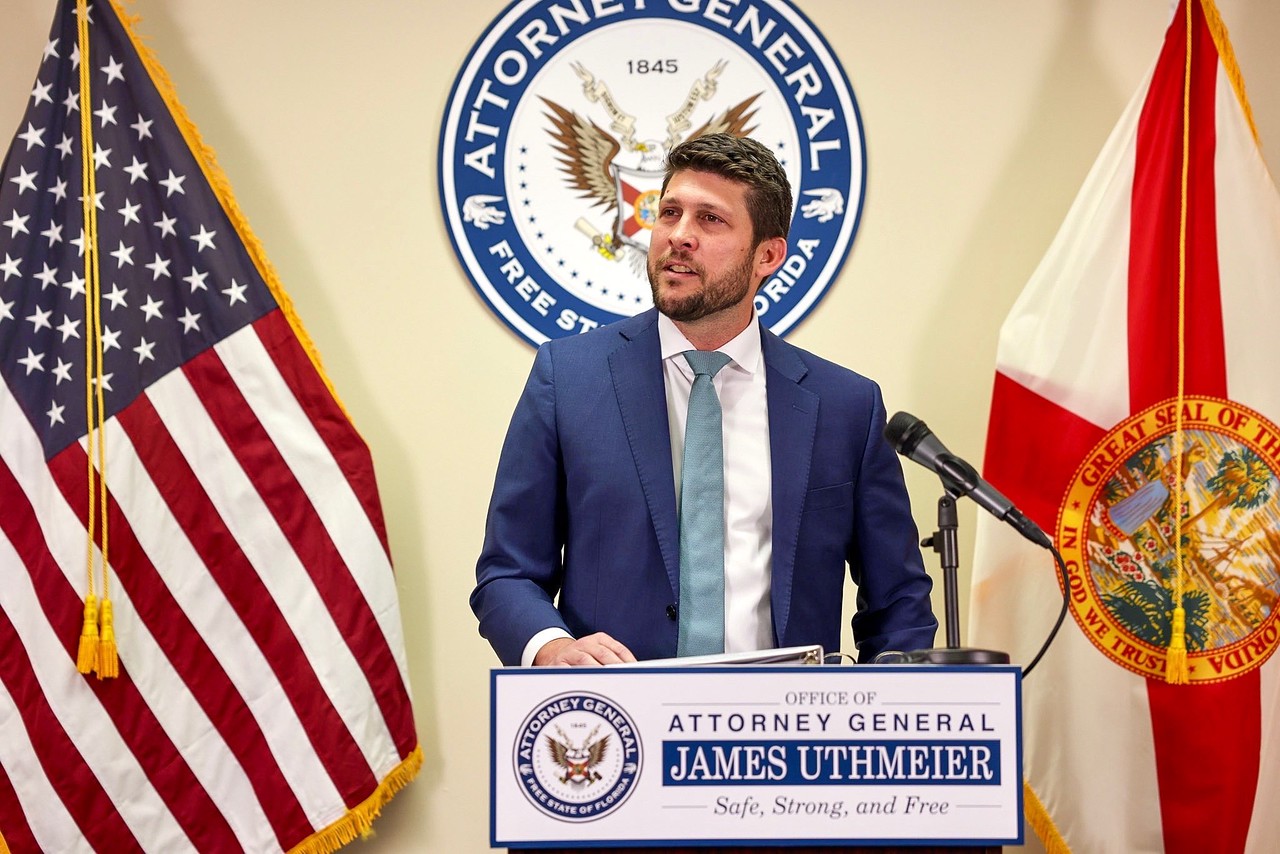
James Uthmeier, now almost 11 months into his appointment as Florida Attorney General, is making a statewide clampdown on illegal gambling a cornerstone of his 2026 agenda. Image via the State Attorney’s Office.

Uthmeier hasn’t been idle. He said he’s taken down numerous large-scale gambling operations over the past year. The highest-profile takedown occurred in June, when Uthmeier’s Office of Statewide Prosecution charged Osceola County Sheriff Marcos López and others in what it called a “massive Central Florida illegal gambling operation.”

The arrest followed an investigation by Uthmeier’s Office in collaboration with the U.S. Department of Homeland Security and the Florida Department of Law Enforcement. López, whom Gov. Ron DeSantis suspended on the same day of his arrest, faces racketeering and conspiracy charges for alleged crimes that generated nearly $22 million in illicit proceeds.

Uthmeier has said such illegal gambling operations are frequently tied to money laundering, human trafficking and other serious financial crimes beyond gambling violations.

To tackle online gambling platforms that operate from overseas, like Bovada and MyBookie, Uthmeier is looking into disrupting payment processor servers, web hosts that facilitate unlicensed gambling and access via virtual private networks (VPNs). It’s not an easily scalable effort — Uthmeier describes it as something of a “whack-a-mole” challenge — but it will be a big priority in 2026.

For fantasy- and sweepstakes-focused platforms, the Attorney General’s Office has issued subpoenas to several companies. Uthmeier and his staff plan to meet with leaders from those companies and others early in the year to exchange information, allow the companies to present their cases and inform them of the strict guidelines by which they must abide to continue doing business in the state.

Some fantasy sports and sweepstakes operators have publicly disputed characterizations of their offerings as illegal gambling, but said they’d work with regulators and lawmakers to ensure compliance with state law.

Meanwhile, operators of federally regulated prediction markets argue their products fall under the Commodity Futures Trading Commission’s jurisdiction, setting up a potential legal battle over whether state gambling laws apply to these platforms.

Alongside Uthmeier’s efforts, the Florida Gaming Control Commission (FGCC) has been ramping up enforcement operations through partnerships with local, state and federal law enforcement agencies.

In 2025, the FGCC said it seized nearly $14.5 million and 6,725 slot machines from illegal casinos — up from $7.1 million and 1,287 slot machines in 2024. The Commission said it also entered into 29 new memoranda of understanding with various law enforcement bodies.

New legislation to back it up

Uthmeier is also backing 2026 bills to strengthen penalties for illegal gambling and related advertising, both online and in physical locations. Many of the penalties in statute now are misdemeanors and, he said, insufficient and “make the risk-reward analysis very imbalanced.”

“We’re not doing enough to disincentivize people from engaging in this behavior,” he said. “People stand to make tens of millions of dollars through these operations, and getting a misdemeanor is really just a slap on the wrist.”

One measure now advancing in the House (HB 189) would institute a sweeping overhaul of Florida’s gambling laws, dramatically expanding criminal penalties, regulatory authority and enforcement tools across nearly all forms of wagering.

(L-R) Sen. Jennifer Bradley and Reps. Berny Jacques and Dana Trabulsy — all Republicans — are each carrying bills that would steepen penalties for illegal gambling, though to varying degrees of severity. Images via Florida Politics and the Florida House.

The bill, sponsored by Fort Pierce Republican Rep. Dana Trabulsy, targets illegal casinos, online gambling, fantasy sports, slot machine trafficking, advertising and even transportation tied to illegal gambling.

It would also tighten ethics rules, add felony penalties for repeat or large-scale violations and strengthen the authority of the FGCC, which assisted in a multicounty seizure of hundreds of illegal gambling machines last month through a crackdown initiative dubbed “Operation Funny Money.”

Another bill (SB 204) by Fleming Island Republican Sen. Jennifer Bradley is narrower and more procedural, focusing primarily on amusement games and slot machines.

The bill, which awaits its first Committee hearing in the Legislature’s upper chamber, would require specific organizations — especially veterans’ groups — to seek advance approval from the FGCC when legality is unclear.

It would also clarify when slot machine shipments are lawful, including on tribal lands, and modestly strengthen penalties for unlawful possession. Unlike the House bill, SB 204, in its current form, would not broadly expand criminal categories or address online gambling, fantasy sports, or advertising.

There’s also Seminole Republican Rep. Berny Jacques’ proposal, HB 591, which would dramatically overhaul Florida’s gambling enforcement framework, reclassifying many existing gambling-related crimes into higher felony tiers and creating new felony offenses for internet gambling, advertising gambling, transporting gamblers and manipulating games.

Unlike HB 189, which strengthens existing enforcement authorities while maintaining a focus on gaming integrity and compliance, HB 591 would pre-empt local regulation entirely, expanding the FGCC’s influence across nearly all gambling-related activity.

Some lawmakers and advocacy groups, including veterans’ organizations, have warned that broad felony expansions could unintentionally sweep in lawful activities or charitable events and need clearer definitions to avoid unintended consequences.

Jeremy Redfern, Uthmeier’s Deputy Chief of Staff, told Florida Politics that those who run unlawful gambling markets while providing no avenue for transparency or accountability to Florida consumers face a tough road ahead.

“Our office is working with the Florida Legislature to increase penalties and the Gaming Commission to take down illicit markets,” he said. “2026 will be a record year in the fight against illegal gambling and the other major crime it brings to our state.”


Source link

Continue Reading

Politics

Ben Albritton, following Gov. DeSantis’ lead, wants wait-and-see approach with congressional redistricting

Published

on


Senate President Ben Albritton said the upper chamber of the Legislature isn’t moving yet on congressional redistricting. But he is working with Gov. Ron DeSantis while closely following court developments.

“As I’ve previously stated, there is no ongoing work regarding mid-decade redistricting taking place in the Senate at this time,” Albritton said in a memo to all Florida Senate members. “I’ll continue to monitor legal developments and will keep you updated.”

He sent the message the same day DeSantis proclaimed a Special Session on redistricting, effective April 20.

That incidentally is just four days before the expected qualification day for federal candidates, but DeSantis’ proclamation also moved qualifying week for congressional contenders to June 8 through 12, the same as candidates for the Florida Legislature.

As timing goes, DeSantis has always eyed Spring for drawing new cartography. But that has put him on a different page with House Speaker Daniel Perez, who already appointed a House Redistricting Committee that has held two meetings in hopes of crafting a map during the regular Legislative Session.

Perez earlier this week told Florida Politics, “Members can expect the process will unfold thoughtfully, deliberately and transparently.” His office offered no further comment after the Governor issued his call for a Special Session. Perez spokesperson Amelia Englehart said she was informed of the coming proclamation on Wednesday morning.

DeSantis has cited a pending U.S. Supreme Court case from Louisiana that could provide more explicit guidance on the redistricting process.

Albritton signaled he supports patience and wants to follow the Governor’s lead on the process.

“The Governor stated the Legislature should wait as long as feasible before redrawing Florida’s congressional district boundaries in order to take advantage of any further guidance from the United States Supreme Court,” Albritton wrote.

In the meantime, he urged lawmakers to be careful about any public statements about the process.

“Senators should be aware that in prior cycles, significant litigation has followed passage of new maps. The Florida Supreme Court has previously limited the scope of legislative privilege when it comes to redistricting,” he wrote.

“Sitting legislators may be compelled to produce records or be subject to questioning under oath about conversations with colleagues, with legislative staff, or with outside parties who may attempt to persuade the Legislature to pass maps that favor or disfavor a political party or incumbent.”

On the Democratic side, Senate Minority Leader Lori Berman on Wednesday blasted DeSantis’ mid-decade redistricting push as “clearly illegal.”


Source link

Continue Reading

Politics

Last Call for 1.7.26 – A prime-time read of what’s going down in Florida

Published

on


Last Call – A prime-time read of what’s going down in Florida politics.

First Shot

One week into 2026, and it’s already time to check a “car wreck” off the list.

On Wednesday, Gov. Ron DeSantis announced a Special Session to redraw Florida’s congressional map — and strongly suggested it won’t be the last time lawmakers are summoned back to Tallahassee this year.

The redistricting Session is set to convene at noon on April 20 and adjourn by the end of that week, with a narrowly tailored agenda: produce a new congressional map and set aside money to defend it in court.

The timing is no accident.

DeSantis says he’s waiting on an upcoming U.S. Supreme Court decision that could upend minority-protected districts nationwide, a ruling he argues may clear the way for Florida to revisit lines he believes are “malapportioned.”

The Governor has already credited his current map, which produced a 20-8 split in the state’s U.S. House delegation, with delivering Republicans the majority and hinted that population shifts justify an even redder redraw.

But before lawmakers can pack up their maps, they may be asked to return to tee up a ballot proposal to eliminate homestead property taxes.

DeSantis said the Regular Session’s 60-day sprint may be the wrong venue for an issue he believes needs singular focus and clean language to survive Election Day.

Flipping the table also aligns with the Governor’s growing frustration with how the Legislature, particularly the House, has handled the proposal so far. He has said the multi-question “some, all, or none” approach represents an attempt to “kill anything on property taxes.”

Translation: the Governor wants this done his way, and he’s more than willing to flex his authority to make sure lawmakers get the message.

Evening Reads

—”South Florida takes center stage in U.S. politics after Nicolás Maduro’s capture” via Patricia Mazzei of The New York Times

—“Marco Rubio offers threefold plan for future of Venezuela, including release of political prisoners” via Jacob Ogles of Florida Politics

—“U.S. vows to control Venezuela oil sales ‘indefinitely’” via Evan Halper of The Washington Post

—“The wrath of Stephen Miller” via Ashley Parker, Michael Scherer, and Nick Miroff of The Atlantic

—”Venezuela is the first big test for the Pentagon’s influencer press corps — and it’s failing” via Makena Kelly of WIRED

—“How the Minnesota fraud scandal could upend American child care” via Anna North of Vox

—”DOJ admits it has still not released 99% of Jeffrey Epstein files, violating law” via Judd Legum and Rebecca Crosby of Popular Information

—“Why I cover Donald Trump the way I do” via Chris Cillizza of So What

—”Florida failed to give due process to thousands kicked off Medicaid, court finds” via Christopher O’Donnell of the Tampa Bay Times

—”Anti-vax discrimination, behind-the-counter ivermectin access bill filed in the House” via Christine Sexton of the Florida Phoenix

Quote of the Day

“No matter what pretext the Governor offers for mid-decade redistricting — and he has offered nearly half a dozen in an attempt to find one that sticks — what he wants the Legislature to do is clearly illegal.”

— Senate Democratic Leader Lori Berman, on DeSantis’ call for a redistricting Session.

Put it on the Tab

Look to your left, then look to your right. If you see one of these people at your happy hour haunt, flag down the bartender and put one of these on your tab. Recipes included, just in case the Cocktail Codex fell into the well.

The Judicial Nominating Commission delivered six names to succeed Charles T. Canady on the Supreme Court, but the Governor will serve only one of them a Backbone.

According to new analyses, our neighbors to the north could use a Canadian Punch as they brace for a right hook from Florida’s housing market.

Glades-area mental health and literacy advocacy groups are enjoying a Sugar Pop after the region’s biggest economic engine shipped over a burst of cash.

Breakthrough Insights

Tune In

Injury-riddled Magic face Nets

The Orlando Magic can take a step up in the standings as they face the Brooklyn Nets tonight (7:30 p.m. ET, FanDuel Sports Network – Florida)

Despite leading the Southeast Division, the Magic (20-17) are in seventh place in the Eastern Conference standings. The top six teams in each conference earn automatic playoff spots, while teams seven through 10 must qualify through a play-in format.

Orlando sits 7.5 games out of first place in the conference but just a half game behind both the Philadelphia 76ers and the Cleveland Cavaliers, so an Orlando win tonight could shake up the standings.

The Magic are coming off a 120-112 loss at the Washington Wizards. Orlando nearly overcame a 26-point deficit before falling.

Franz Wagner and Paolo Banchero, Orlando’s two leading scorers, have both missed significant time this season. Banchero missed 10 games in November and early December with a groin injury. He returned on Dec. 5 only to see Wagner go down with an injury two days later. Wagner has missed the last 23 games for Orlando. If both can stay on the floor together in the season’s second half, Orlando can be a dangerous team.

Brooklyn (11-22) has struggled this season and ranks 13th among 15 Eastern Conference teams.

After tonight’s game, the Magic return home for six straight games at home starting with a matchup with the 76ers on Friday.

___

Last Call is published by Peter Schorsch, assembled and edited by Phil Ammann and Drew Wilson, with contributions from the staff of Florida Politics.


Source link

Continue Reading

Politics

Lori Berman blasts Gov. DeSantis’ redistricting push as ‘clearly illegal,’ citing 2010 amendment

Published

on


Gov. Ron DeSantis’ just-announced confirmation that he will pursue mid-decade redistricting through a Special Session drew a swift rebuke from Senate Democratic Leader Lori Berman, who argued such a move would violate the Florida Constitution.

Berman, a Boca Raton lawyer, pointed to the Fair Districts Amendment, which 63% of voters approved in 2010 to ban partisan or discriminatory gerrymandering. The amendment requires fair, compact, voter-respecting legislative districts. That’s the antithesis of what DeSantis and other GOP policymakers are proposing, Berman said.

“No matter what pretext the Governor offers for mid-decade redistricting — and he has offered nearly half a dozen in an attempt to find one that sticks — what he wants the Legislature to do is clearly illegal,” Berman said in a statement Tuesday, shortly after DeSantis said he’ll reconvene lawmakers on the matter in April.

“Florida’s Fair Districts Amendment strictly prohibits any maps from being drawn for partisan reasons, and regardless of any bluster from the Governor’s office, the only reason we’re having this unprecedented conversation about drawing new maps is because Donald Trump demanded it.”

Trump’s administration began calling for redistricting in mid-2025 to give Republicans a better chance to flip Democrat-held seats by the 2026 Midterms. Efforts to follow through on the President’s demands are now playing out in one form or another across 15 states, including Missouri, Ohio and Texas, while Democrat-led states like California and New York are weighing retaliatory or defensive redistricting moves.

Florida already has a 20-8 Republican advantage in its congressional delegation through maps the Governor’s Office drew based on 2020 Census data, which DeSantis called “flawed” in October. That same month, he said his proposed “political gerrymandering” is “likely” to survive court challenges, since the U.S. Constitution “says nothing” about it.

But the Florida Constitution does. The Fair Districts Amendment, added to Section 20, Article III, states: “No apportionment plan or individual district shall be drawn with the intent to favor or disfavor a political party or an incumbent; and districts shall not be drawn with the intent or result of denying or abridging the equal opportunity of racial or language minorities to participate in the political process or to diminish their ability to elect representatives of their choice; and districts shall consist of contiguous territory.”

DeSantis said Florida is awaiting a U.S. Supreme Court ruling on a case concerning Section 2 of the Voting Rights Act, which has been used to draw majority-minority congressional districts almost exclusively led by Democrats.

The Court’s 2019 ruling on Rucho v. Common Cause provided that while partisan gerrymandering may be “incompatible with democratic principles,” there is no clear, manageable legal standard for federal courts to determine when partisan line-drawing goes too far.

However, the court did leave the door open for challenges under state constitutions and state courts, noting that states are free to adopt anti-gerrymandering rules — such as Florida’s Fair Districts Amendment — and enforce them independently of federal courts.

A majority of Florida’s electorate opposes mid-decade redistricting, according to polling Common Cause commissioned late last year, which found 55% of voters are against political parties changing district boundaries mid-decade. That included 62% of Democrats, 60% of third- and no-party voters, and a plurality (45%) of Republicans.

“An overwhelming majority of Floridians voted in favor of the Fair Districts Amendment and their voices must be respected,” Berman said. “The redistricting process is meant to serve the people, not the politicians.”

The Florida Democratic Party and League of Women Voters of Florida expressed similar disdain for the redistricting push, calling it “a desperate attempt to rig the system” and “an affront to Florida voters,” respectively.


Source link

Continue Reading

Trending

Copyright © Miami Select.