Connect with us

Business

Rubio suggests the U.S. won’t govern Venezuela day-to-day

Published

on


Rubio’s statements on TV talk shows seemed designed to temper concerns about whether the assertive American action to achieve regime change might again produce a prolonged foreign intervention or failed attempt at nation-building. They stood in contrast to Trump’s broad but vague claims that the U.S. would at least temporarily “run” the oil-rich nation, comments that suggested some sort of governing structure under which Caracas would be controlled by Washington.

Rubio offered a more nuanced take, saying the U.S. would continue to enforce an oil quarantine that was already in place on sanctioned tankers before Maduro was removed from power early Saturday and use that leverage as a means to press policy changes in Venezuela.

“And so that’s the sort of control the president is pointing to when he says that,” Rubio said on CBS’ “Face the Nation.” “We continue with that quarantine, and we expect to see that there will be changes, not just in the way the oil industry is run for the benefit of the people, but also so that they stop the drug trafficking.”

The blockade on sanctioned oil tankers — some of which have been seized by the U.S. — “remains in place, and that’s a tremendous amount of leverage that will continue to be in place until we see changes that not just further the national interest of the United States, which is number one, but also that lead to a better future for the people of Venezuela,” he added.

Leaders in Venezuela have so far pushed back, at least publicly, calling on the Trump administration to release Maduro.

Even before the operation that nabbed Maduro, experts were already questioning the legality of aspects of the administration’s pressure campaign on Venezuela, including the deadly bombing of boats accused of trafficking drugs that some scholars said stretched the boundaries of international law.

Trump repeated vow US would ‘run’ Venezuela

Trump’s vow to “run” Venezuela, repeated more than half a dozen times at a news conference in Florida on Saturday, sparked concerns among some Democrats. It also drew unease from parts of his own Republican coalition, including an “America First” base that is opposed to foreign interventions, and also from observers who recalled past nation-building efforts in Iraq and Afghanistan.

Rubio dismissed such criticism, saying that Trump’s intent had been misunderstood.

“The whole foreign policy apparatus thinks everything is Libya, everything is Iraq, everything is Afghanistan,” Rubio said. “This is not the Middle East. And our mission here is very different. This is the Western Hemisphere.”

Rubio also suggested the U.S. would give Maduro’s subordinates now in charge time to govern, saying, “We’re going to judge everything by what they do.” And though he did not rule out boots on the ground in Venezuela, Rubio said the U.S, which has built up its presence in the region, was already capable of stopping drug boats and sanctioned tankers.

A day earlier, Trump told reporters, “We’re going to run the country until such time as we can do a safe, proper and judicious transition.” He later pointed to his national security team with him, including Rubio and Defense Secretary Pete Hegseth, and said it would be done for a period of time by “the people that are standing right behind me. We’re gonna be running it we’re gonna be bringing it back.”

The White House declined to comment beyond what Trump said Saturday.

Maduro’s arrival

Maduro landed late Saturday afternoon at a small airport in New York City’s northern suburbs following the middle-of-the-night operation that extracted him and his wife, Cilia Flores, from their home in a military base in the capital city of Caracas — an act that Maduro’s government called “imperialist.” The couple faces U.S. charges of participating in a narco-terrorism conspiracy.

The dramatic seizure of the Maduros capped an intensive Trump administration pressure campaign on Venezuela’s autocratic leader and months of secret planning, resulting in the most assertive American action to achieve regime change since the 2003 invasion of Iraq. Legal experts raised questions about the lawfulness of the operation, which was done without congressional approval.

Venezuela’s vice president, Delcy Rodriguez, demanded that the U.S. free Maduro and called him the country’s rightful leader as her nation’s high court named her interim president. So did the country’s defense minister, General-in-Chief Vladimir Padrino López, who said Sunday that the country’s armed forces “categorically reject the cowardly kidnapping.”

Maduro is due to make his first appearance Monday in Manhattan’s federal court.

Maduro and other Venezuelan officials were indicted in 2020 on narco-terrorism conspiracy charges, and the Justice Department released a new indictment Saturday of Maduro and his wife that painted his administration as a “corrupt, illegitimate government” fueled by a drug-trafficking operation that flooded the U.S with cocaine. The U.S. government does not recognize Maduro as the country’s leader.

The Trump administration spent months building up American forces in the region and carrying out attacks on boats in the Caribbean Sea and eastern Pacific Ocean for allegedly ferrying drugs. Last week, the CIA was behind a drone strike at a docking area believed to have been used by Venezuelan drug cartels — the first known direct operation on Venezuelan soil since the U.S. campaign began in September.

Quiet falls in Venezuela after US operation

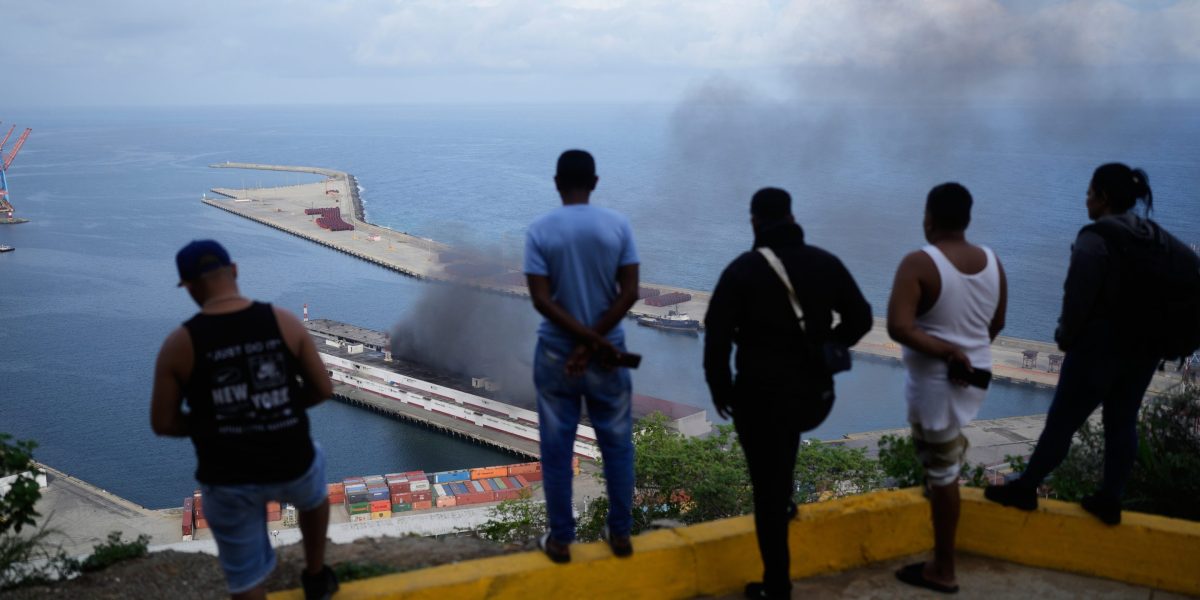
Venezuela’s capital remained unusually quiet Sunday with few vehicles moving around and convenience stores, gas stations and other businesses closed. A road typically filled with runners, cyclists and other fitness enthusiasts on Sundays only had a handful of people working out.

The presidential palace was guarded by armed civilians and members of the military. At a nearby plaza, only a street sweeper and a soldier stood, and across the street, a church remained close for a second day in a row.

Under Venezuelan law, Rodríguez would take over from Maduro. Rodriguez, however, stressed during a Saturday appearance on state television that she did not plan to assume power, before Venezuela’s high court ordered that she assume the interim role. Trump told The Atlantic in an interview Sunday that Rodríguez could “pay a very big price” if she doesn’t do what he thinks is right for Venezuela.

That contrasted with the Republican president’s comments about Rodríguez on Saturday when he said Rubio had spoken with her and she was willing to do what the U.S. thinks is needed to improve the standard of living in Venezuela.

Trump told the magazine that “if she doesn’t do what’s right, she is going to pay a very big price, probably bigger than Maduro.”

Trump told the New York Post in an interview Saturday that the U.S. wouldn’t need to station troops in Venezuela if she “does what we want.”

Caracas resident David Leal arrived to the lot where he parks vehicles for a living only to quickly realize that he would likely not see any clients for a second day.

“People are still shaken,” said Leal, 77.


Source link

Continue Reading

Business

Iran threatens U.S. and Israel as protests enter third week

Published

on


Tehran warned the US and Israel against any intervention over nationwide protests in Iran while it sought to placate its citizens, as demonstrations entered their third week and fatalities mounted. 

Saturday marked the third night of intensified nationwide demonstrations, following calls by Reza Pahlavi, the exiled son of Iran’s former shah, to seize city centers and stage strikes. Since the unrests first began on Dec. 28, Donald Trump has repeatedly warned the Iranian regime not to fire on demonstrators, with the US president receiving a briefing in recent days on new options for military strikes.

The Oslo-based Iran Human Rights group said on Sunday it had confirmed the deaths of at least 192 protesters, including nine individuals under 18. Separately, the US-based Human Rights Activists News Agency said deaths linked to the recent unrest had reached 116, with most killed by live ammunition or pellet gunfire. 

On Sunday, Iran’s President Masoud Pezeshkian struck a conciliatory tone in a state TV interview, offering condolences to families affected by the “tragic consequences” of the unrest.

“Your protests must be heard, and we must address your concerns. Let’s sit down together, hand in hand, and solve the problems,” he said, without offering details on how that would be done. “I promise the dear people, perhaps ninety percent of whom have concerns, that we will address their worries. We will get through this crisis.”

Still, Pezeshkian accused the US and Israel of bringing in “terrorists from abroad,” whom he claimed had set mosques and markets on fire, “beheaded some, and burned others alive.” Other officials took an even harder line. 

“In the event of a US military attack, both the occupied territories and US military and shipping centers will be legitimate targets for us,” Iran Parliament Speaker Mohammad Bagher Ghalibaf said in remarks broadcast on state television earlier on Sunday. 

He reiterated a warning that Iran could act preemptively against potential threats. “Within the framework of legitimate self-defense, we do not limit ourselves to responding only after an attack,” he said.

Trump has been briefed in recent days on a range of options for military strikes in Iran, including nonmilitary sites, a White House official said, confirming an earlier New York Times report. The US president is seriously considering authorizing an attack, according to the official.

Israel’s Army Radio reported Sunday that the country’s security establishment views it as unlikely that Iran will attack Israel at this stage. “No such immediate willingness is identified in Israel — but rather an Iranian focus on internal matters,” it said, citing unidentified defense officials. 

Footage from Iranian cities suggests that hundreds of thousands, including many elderly, are defying stern warnings from authorities to stay off the streets, despite a nationwide internet blackout and severe telecommunications restrictions that have blocked calls and text messages since Thursday.

The NetBlocks internet‑monitoring group said in a posting on X early Sunday that internet connectivity in Iran “continues to flatline around 1% of ordinary levels.”

Still, multiple social media videos, reportedly from a warehouse in southern Tehran, show people searching through dozens of corpses in body bags, lined up on the ground and on stretchers. Wailing can be heard as individuals bend over the bags, trying to identify their loved ones.

A video published later on Sunday by the state-run IRIB News appeared to show scenes from the same warehouse — one of the first glimpses by official media into the scale of the fatalities. In the video, a reporter described the site as a complex of the state forensic organization in Tehran, with dozens of bodies inside a large indoor facility. Outside, dozens of people are seen huddling around ambulances and the back of what appears to be a refrigerated truck, searching for their relatives.

Protests erupted last month among pockets of traders in Tehran over worsening economic and living conditions but have since grown into the largest anti-regime demonstrations to grip the country since 2022, when the death in custody of Mahsa Amini triggered nationwide anger and mass protests.

Read more: How Sanctions and a Currency Crash Fueled Iran Unrest: QuickTake

Other videos, reportedly from west of Tehran on Saturday night, show thousands of protesters packed into the streets, waving phone flashlights in the dark as city lights remain shut down, amid whistles and chants of “Death to the dictator.” A truck was seen on fire in Mashhad, while footage purportedly from Sunday shows a state tax administration building burned out overnight in eastern Tehran. Bloomberg couldn’t independently verify any of the footage. 

In an X post on Sunday, Pahlavi urged protesters to continue their demonstrations through the weekend. He described Trump as “the leader of the free world” who is observing the unrest and “is ready to help you.”

Late on Saturday, Iran’s Foreign Minister Abbas Araghchi accused the US and Israel of fueling violent unrest and warned against any action directed at Tehran.

“The only ‘delusional’ aspect of the current situation is the belief that arson does not ultimately burn the arsonists,” Araghchi said.

Alongside those killed, another 2,638 people had been detained, the Human Rights Activists organization said. Some of those killed included medical personnel, and seven of the victims were under 18, it added.

Iran’s prosecutor general warned on Saturday of swift trials and death penalty charges against detainees, a day after Supreme Leader Ayatollah Ali Khamenei said the security apparatus won’t tolerate “vandalism” or “people acting as mercenaries for foreign powers.”


Source link

Continue Reading

Business

Florida man who grabbed Nancy Pelosi’s podium during Capitol riot runs for county office

Published

on


A man who grabbed then-House Speaker Nancy Pelosi’s podium and posed with it for photographs during the U.S. Capitol riot is running for county office in Florida.

Adam Johnson filed to run as a Republican for an at-large seat on the Manatee County Commission on Tuesday. That was the fifth anniversary of the Jan. 6 riot, where he was photographed smiling and waving as he carried Pelosi’s podium after the pro-Trump mob’s attack on Jan. 6, 2021.

Johnson told WWSB-TV that it was “not a coincidence” that he filed for office on Jan. 6, saying “it’s definitely good for getting the buzz out there.” His campaign logo is an outline of the viral photograph of him carrying the podium.

He’s far from the first person implicated in the Jan. 6 riot to run for office. At least three ran unsuccessfully for Congress in 2024 as Republicans. And there are signs that the Republican Party is welcoming back more people who were convicted of Jan. 6 offenses after Trump pardoned them.

Jake Lang, who was charged with assaulting an officer, civil disorder and other crimes before he was pardoned, recently announced he is running for Secretary of State Marco Rubio’s vacant U.S. Senate seat in Florida.

Johnson placed the podium in the center of the Capitol Rotunda, posed for pictures and pretended to make a speech, prosecutors said. He pleaded guilty in 2021 of entering and remaining in a restricted building or ground, a misdemeanor that he equated to “jaywalking” in the interview.

“I think I exercised my First Amendment right to speak and protest,” Johnson said.

After driving home, Johnson bragged that he “broke the internet” and was “finally famous,” prosecutors said.

Johnson served 75 days in prison followed by one year of supervised release. The judge also ordered Johnson to pay a $5,000 fine and perform 200 hours of community service.

Johnson told U.S. District Judge Reggie Walton at sentencing that posing with Pelosi’s podium was a “very stupid idea” but now says he only regrets his action because of the prison sentence.

“I walked into a building, I took a picture with a piece of furniture, and I left,” he now says.

Four other Republicans have filed to run so far in the Aug. 18 primary in what’s a deeply Republican county. The incumbent isn’t seeking reelection.

In March 2025, Johnson filed a lawsuit against Manatee County and six of its commissioners, objecting to the county’s decision not to seek attorney’s fees from someone who sued the county and dropped the lawsuit. The county has called Johnson’s claims “completely meritless and unsupported by law.”

Johnson said he objects to high property taxes and overdevelopment in the county south of Tampa, claiming current county leaders are wasteful.

“I will be more heavily scrutinized than any other candidate who is running in this race,” Johnson said. “This is a positive and a good takeaway for every single citizen, because for once in our life, we will know our local politicians who are doing things.”


Source link

Continue Reading

Business

‘We don’t want to be Americans, we don’t want to be Danes, we want to be Greenlanders’: Local politicians reject Trump

Published

on


Greenland’s party leaders have rejected President Donald Trump’s repeated calls for the U.S. to take control of the island, saying that Greenland’s future must be decided by its people.

“We don’t want to be Americans, we don’t want to be Danes, we want to be Greenlanders,” Greenland Prime Minister Jens-Frederik Nielsen and four party leaders said in a statement Friday night.

Trump said again on Friday that he would like to make a deal to acquire Greenland, a semiautonomous region that’s part of NATO ally Denmark, “the easy way.” He said that if the U.S. doesn’t own it, then Russia or China will take it over, and the U.S. does not want them as neighbors.

“If we don’t do it the easy way, we’re going to do it the hard way,” Trump said, without explaining what that entailed. The White House said it is considering a range of options, including using military force, to acquire the island.

Greenland’s party leaders reiterated that “Greenland’s future must be decided by the Greenlandic people.”

“As Greenlandic party leaders, we would like to emphasize once again our wish that the United States’ contempt for our country ends,” the statement said.

Officials from Denmark, Greenland and the United States met Thursday in Washington and will meet again next week to discuss the renewed push by the White House for the control of the island.

Danish Prime Minister Mette Frederiksen has warned that an American takeover of Greenland would mark the end of NATO.

The party leaders’ statement said that “the work on Greenland’s future takes place in dialogue with the Greenlandic people and is prepared on the basis of international laws.”

“No other country can interfere in this,” they said. “We must decide the future of our country ourselves, without pressure for quick decision, delay or interference from other countries.”

The statement was signed by Nielsen, Pele Broberg, Múte B. Egede, Aleqa Hammond and Aqqalu C. Jerimiassen.

While Greenland is the largest island in the world, it has a population of around 57,000 and doesn’t have its own military. Defense is provided by Denmark, whose military is dwarfed by that of the U.S.

It’s unclear how the remaining NATO members would respond if the U.S. decided to forcibly take control of the island or if they would come to Denmark’s aid.

This story was originally featured on Fortune.com


Source link

Continue Reading

Trending

Copyright © Miami Select.