Connect with us

Business

‘I want nice, thin blood pouring through my heart'”: Trump talks health concerns, saying he takes more aspirin than recommended

Published

on


President Donald Trump defended his energy and health in an interview with The Wall Street Journal and disclosed that he had a CT scan, not an MRI scan, during an October examination about which he and the White House delayed offering details.

Trump, in the interview published Thursday, said he regretted undergoing the advanced imaging on his heart and abdomen during an October visit to Walter Reed National Military Medical Center because it raised public questions about his health. His physician said in a memo the White House released in December that he had “advanced imaging” as a preventative screening for a man his age.

Trump had initially described it as an MRI but said he didn’t know what part of his body he had scanned. A CT scan is a quicker form of diagnostic imaging than an MRI but offers less detail about differences in tissue.

The president’s doctor, Navy Capt. Sean Barbabella, said in a statement released Thursday by the White House that Trump underwent the exam in October because he planned to be at Walter Reed to meet people working there. Trump had already undergone an annual physical in April.

“President Trump agreed to meet with the staff and soldiers at Walter Reed Medical Hospital in October. In order to make the most of the President’s time at the hospital, we recommended he undergo another routine physical evaluation to ensure continued optimal health,” Barbabella said.

Barbabella said he asked the president to undergo either a CT scan or MRI “to definitively rule out any cardiovascular issues” and the results were “perfectly normal and revealed absolutely no abnormalities.”

White House press secretary Karoline Leavitt said in a statement Thursday that the president’s doctors and the White House have “always maintained the President received advanced imaging” but said that “additional details on the imaging have been disclosed by the President himself” because he “has nothing to hide.”

“In retrospect, it’s too bad I took it because it gave them a little ammunition,” Trump said in the interview with The Wall Street Journal. “I would have been a lot better off if they didn’t, because the fact that I took it said, ‘Oh gee, is something wrong?’ Well, nothing’s wrong.”

The 79-year-old became the oldest person to take the oath of office when he was sworn in as president last year and has been sensitive to questions about his health, particularly as he has repeatedly questioned his predecessor Joe Biden’s fitness for office.

Biden, who turned 82 in the last year of his presidency, was dogged by scrutiny of his age and mental acuity at the end of his tenure and during his abandoned attempt to seek reelection.

But questions have also swirled around Trump’s health this year as he’s been seen with bruising on the back of his right hand that has been conspicuous despite a slathering of makeup on top, along with noticeable swelling at his ankles.

The White House this summer said the president had been diagnosed with chronic venous insufficiency, a common condition among older adults. The condition happens when veins in the legs can’t properly carry blood back to the heart and it pools in the lower legs.

In the interview, Trump said he briefly tried wearing compression socks to address the swelling but stopped because he didn’t like them.

The bruising on Trump’s hand, according to Leavitt, is from “frequent handshaking and the use of aspirin,” which Trump takes regularly to reduce the risk of heart attack and stroke.

He said he takes more aspirin than his doctors recommend but said he has resisted taking less because he’s been taking it for 25 years and said he is “a little superstitious.” Trump takes 325 milligrams of aspirin daily, according to Barbabella.

“They say aspirin is good for thinning out the blood, and I don’t want thick blood pouring through my heart,” Trump said. “I want nice, thin blood pouring through my heart. Does that make sense?”

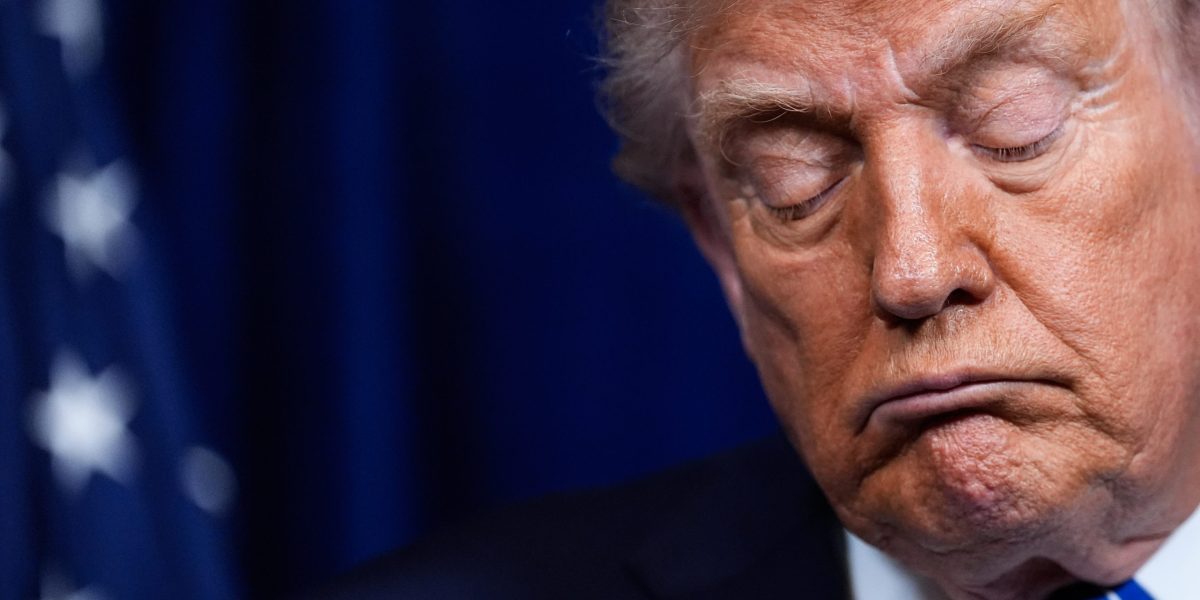
Trump, in the interview, denied he has fallen asleep during White House meetings when cameras have caught him with his eyes closed, instead insisting he was resting his eyes or blinking.

“I’ll just close. It’s very relaxing to me,” he said. “Sometimes they’ll take a picture of me blinking, blinking, and they’ll catch me with the blink.”

He said that he’s never slept much at night, a habit he also described during his first term, and said he starts his day early in the White House residence before moving to the Oval Office around 10 a.m. and working until 7 p.m. or 8 p.m.

The president dismissed questions about his hearing, saying he only struggled to hear “when there’s a lot of people talking,” and said he has plenty of energy, which he credited to his genes.

“Genetics are very important,” he said. “And I have very good genetics.”

This story was originally featured on Fortune.com


Source link

Continue Reading

Business

This is the next Trump construction project, joining the White House ballroom, Rose Garden replacement and others

Published

on


President Donald Trump has spent much of his two-week vacation in Florida golfing. But when he gets back to the White House, there’s a military golf course that he’s never played that he’s eyeing for a major construction project.

Long a favored getaway for presidents seeking a few hours’ solace from the stress of running the free world, the Courses at Andrews — inside the secure confines of Joint Base Andrews in Maryland, about 15 miles (24 kilometers) from the White House — are known as the “president’s golf course.” Gerald Ford, Ronald Reagan, George H.W. Bush, Bill Clinton, George W. Bush and Joe Biden have spent time there, and Barack Obama played it more frequently than any president, roughly 110 times in eight years.

Trump has always preferred the golf courses his family owns — spending about one of every four days of his second term at one of them. But he’s now enlisted golf champion Jack Nicklaus as the architect to overhaul the Courses at Andrews.

“It’s amazing that an individual has time to take a couple hours away from the world crises. And they’re people like everybody else,” said Michael Thomas, the former general manager of the course, who has golfed with many of the presidents visiting Andrews over the years.

Andrews, better known as the home of Air Force One, has two 18-hole courses and a 9-hole one. Its facilities have undergone renovations in the past, including in 2018, when Congress approved funding to replace aging presidential aircraft and to build a new hangar and support facilities. That project was close enough to the courses that they had to be altered then, too.

Trump toured the base by helicopter before Thanksgiving with Nicklaus, who has designed top courses the world over. The president called Andrews “a great place, that’s been destroyed over the years, through lack of maintenance.”

Other golfers, though, describe Andrews’ grounds as in good shape, despite some dry patches. Online reviews praise the course’s mature trees, tricky roughs, and ponds and streams that serve as water hazards. The courses are mostly flat, but afford views of the surrounding base.

‘They all like to drive the cart’

The first president to golf at Andrews was Ford in 1974. Thomas began working there a couple years later, and was general manager from 1981 until he retired in 2019.

He said the Secret Service over the years used as many as 28 golf carts — as well as the president’s usual 30-car motorcade — to keep the perimeter secure.

“It’s a Cecil B. DeMille production every time,” said Thomas, who had the opportunity to play rounds with four different presidents, and with Biden when he was vice president.

He said the commanders in chief generally enjoyed their time out on the course in their own unique ways, but “they all like to drive the cart because they never get an opportunity to drive.”

“It’s like getting your driver’s license all over again,” Thomas laughed.

Trump golfs most weekends, and as of Friday, has spent an estimated 93 days of his second term doing so, according to an Associated Press analysis of his schedules.

That tally includes days when Trump was playing courses his family owns in Virginia, around 30 miles (48 kilometers) from the White House, and near his Florida estate Mar-a-Lago, where he’s spending the winter holidays. It also includes 10 days Trump spent staying at his golf club in Bedminster, New Jersey, where his schedule allowed time for rounds of golf.

Trump has visited Andrews in the past, but the White House and base have no record of him playing the courses.

Another of Trump construction projects

Andrews’ military history dates to the Civil War, when Union troops used a church near Camp Springs, Maryland, as sleeping quarters. Its golf course opened in 1960.

The White House said the renovation will be the most significant in the history of Andrews. The courses and clubhouse need improvements due to age and wear, it said, and there are discussions about including a multifunctional event center as part of the project.

“President Trump is a champion-level golfer with an extraordinary eye for detail and design,” White House spokesman Davis Ingle said in a statement. “His vision to renovate and beautify Joint Base Andrews’ golf courses will bring much-needed improvements that service members and their families will be able to enjoy for generations to come.”

Plans are in the very early stages, and the cost of — and funding for — the project haven’t been determined, the White House said. Trump has said only that it will require “very little money.”

The Andrews improvements join a bevy of Trump construction projects, including demolishing the White House’s East Wing for a sprawling ballroom now expected to cost $400 million, redoing the bathroom attached to the Lincoln bedroom and replacing the Rose Garden’s lawn with a Mar-a-Lago-like patio area.

Outside the White House, Trump has led building projects at the Kennedy Center and wants to erect a Paris-style arch near the Lincoln Memorial, and has said he wants to rebuild Dulles International Airportin northern Virginia.

On Wednesday, meanwhile, the Trump administration ended a lease agreement with a non-profit for three public golf courses in Washington — which could allow the president to further shape golfing in the nation’s capital. The White House, however, said that move isn’t related to the plans for Andrews.

Presidential perks of golfing at Andrews

When the president is golfing, Andrews officials block off nine holes at a time so no one plays in front of him, allowing for extra security while also ensuring consistent speed-of-play, Thomas said.

That’s relatively easily done given that the courses aren’t open to the public. They’re usually reserved for active or retired members of the military and their families, as well as some Defense Department-linked federal employees.

Thomas remembers playing a round with the older President Bush, a World Golf Hall of Fame inductee known for fast play, while first lady Barbara Bush walked with Millie, the first couple’s English Springer Spaniel. George W. Bush also played fast, Thomas said, and got additional exercise by frequently riding his mountain bike before golfing.

When he wasn’t golfing at Andrews, Obama tried to recreate at least part of the experience back home. He had a White House golf simulator installed after then-first lady Michelle Obama asked Thomas how they might acquire a model that the president had seen advertised on the Golf Channel. Thomas gave her a contact at the network.

Obama famously cut short a round at Andrews after nine holes in 2011 to hustle back to the White House for what turned out to be a top-secret review of final preparations for a Navy SEAL raid on the compound of Osama bin Laden.

But, while Thomas was golfing with presidents, he said he never witnessed play interrupted by an important call or any major emergency that forced them off the course mid-hole. There also were never any rain-outs.

“If there was rain coming, they’d get the weather forecast before we would,” Thomas said. “They would cancel quick on that.”

This story was originally featured on Fortune.com


Source link
Continue Reading

Business

Cash machines in former communist country issue euros for first time after joining currency union

Published

on


Bulgarians began withdrawing euros for the first time on Thursday after the former communist nation joined the euro currency union as its 21st member.

Cash machines in the capital, Sofia, dispensed brand new euro banknotes, replacing the lev, which will still be in use for cash payments in January. However, people will receive only euros in change.

The country of nearly 6.7 million people was one of the poorest when it first became a member of the European Union in 2007. Joining the European single-currency system means deeper EU integration after its 1989 transition from a Soviet-style economy to democracy and free markets.

However, the historic milestone arrives amid political instability, with the conservative-led government forced to resign earlier this month following nationwide anti-corruption protests, and skepticism among ordinary people, fueled by fears of price rises.

The government had to beat down inflation to 2.7% earlier this year to comply with EU rules and win approval from EU leaders. But its resignation left the country without a regular budget for next year, hampering reforms and the use of the 27-member bloc’s support funds, fueling protests.

Nationalist and pro-Russian groups in Bulgaria have also exploited fears that the switch to the euro will allegedly lead to more poverty and loss of national identity.

Countries that join the EU commit to the euro, but actually joining can take years and some members are in no hurry. Croatia was the last to join in 2023.

Join us at the Fortune Workplace Innovation Summit May 19–20, 2026, in Atlanta. The next era of workplace innovation is here—and the old playbook is being rewritten. At this exclusive, high-energy event, the world’s most innovative leaders will convene to explore how AI, humanity, and strategy converge to redefine, again, the future of work. Register now.


Source link

Continue Reading

Business

Down Arrow Button Icon

Published

on


Bridgewater Associates’ flagship money pool posted record gains, while D.E. Shaw & Co.’s strategies soared as much as 28% to rank among the biggest hedge fund winners of 2025 when tariff-fueled market uncertainty presented a fertile hunting ground for traders.

Bridgewater’s Pure Alpha II macro fund returned 34% last year, its best ever, while the All Weather strategy rose 20%, a person with knowledge of the matter said, asking not to be identified discussing private information. D.E. Shaw’s flagship multistrategy Composite hedge fund gained18.5% and Oculus made an estimated 28.2%. 

Michel Massoud’s event-driven Melqart Opportunities Fund surged 45%, another person said. Millennium Management, the $83.5 billion multistrategy hedge fund firm, gained 10.5% last year. ExodusPoint, which has been building out its equities group to complement its fixed-income operations led by co-founder Michael Gelband, gained 18%, the most since its founding in 2017. The firm manages about $12 billion.

Citadel’s flagship hedge fund posted a 10.2% increase in 2025, according to a person familiar with the matter, who asked not to be identified citing private information. It was the first year that Millennium outperformed Citadel’s Wellington fund since 2020.

Read More: Citadel’s Flagship Hedge Fund Climbed 10.2% Last Year 

The initial estimates show hedge funds overall posted strong gains with industry returns on track to be the best in at least five years as surging US stocks, precious metals and volatility in bond and currency markets spurred by President Donald Trump’s trade wars helped. 

Bridgewater, the 50-year-old firm, posted double-digit returns across strategies. The money manager has been in reboot mode since Nir Bar Dea became sole chief executive officer in 2023 and made sweeping personnel changes and cut assets in a bid to boost performance. Westport, Connecticut-based Bridgewater’s billionaire founder, Ray Dalio, has completely exited the firm, selling his remaining stake and stepping down from the board last year.

Bridgewater’s Pure Alpha II fund’s gains last year represent a rebound from annualized returns of less than 3% between 2012 and 2024, Bloomberg has previously reported. The firm’s AIA Labs fund that uses machine learning as the primary basis of its decision-making, has raised more than $5 billion and was up 11% last year, the person added.

In the world of quantitative investing, AQR Capital Management’s multistrategy offering returned 19.6% in 2025, according to a person familiar with the matter who declined to be identified as the information is private.

Read More: AQR’s Multistrategy Apex Gains 19.6% in Turbulent Quant Year

Here’s how other hedge funds fared last year based on initial estimates:

Hedge Fund Strategy 2025 Return
Melqart Opportunities Event-Driven 45.1%
Bridgewater Asia  Macro 37
Discovery  Macro 35.6
Bridgewater Pure Alpha II Macro 34
Bridgewater China Macro 34
DE Shaw Oculus Multistrategy 28.2
Soroban Opportunities Equity Long/Short 25
AQR Adaptive Quant Equity Market Neutral 24.4
Anson Investments Master Equity 21.2
Bridgewater All Weather Risk Parity 20
AQR Apex Quant Multistrategy 19.6
Citadel Tactical Trading Multistrategy 18.6
DE Shaw Composite Multistrategy 18.5
Dymon Multistrategy 18.1
ExodusPoint Multistrategy 18.04
Kite Lake Special Opportunities Event-Driven 17.9
AQR Delphi Quant Equity Long/Short 16.8
Balyasny Multistrategy 16.7
Schonfeld Fundamental Equity Multimanager equity 16.5
Walleye Multistrategy 15.5
Citadel Equities Equities 14.5
LMR Partners Multistrategy 13.5
Schonfeld Strategic Partners Multistrategy 12.5
Marshall Wace Eureka*/Equity Long/Short 11.6
Pinpoint Multi-Strategy Multistrategy 11.6
Bridgewater AIA  Quant Macro 11
Taula Macro 11
Millennium  Multistrategy 10.5
Citadel Wellington Multistrategy 10.2
FIFTHDELTA Equity 10.3
New Holland Tactical Alpha Multistrategy 9.8
Citadel Global Fixed Income Fixed Income 9.4
Winton Quant multistrategy 7.4
     
Source: Bloomberg reporting    
*as of Dec. 30    

A representative for Bridgewater, which managed $92 billion as of September, declined to comment. Massoud, who manages about $1.4 billion, as well as representatives for the hedge funds mentioned in the table declined to comment.


Source link

Continue Reading

Trending

Copyright © Miami Select.