Connect with us

Business

Don’t fixate so much on Fed rates, but the loss of its independence will be punished, BofA CEO says

Published

on


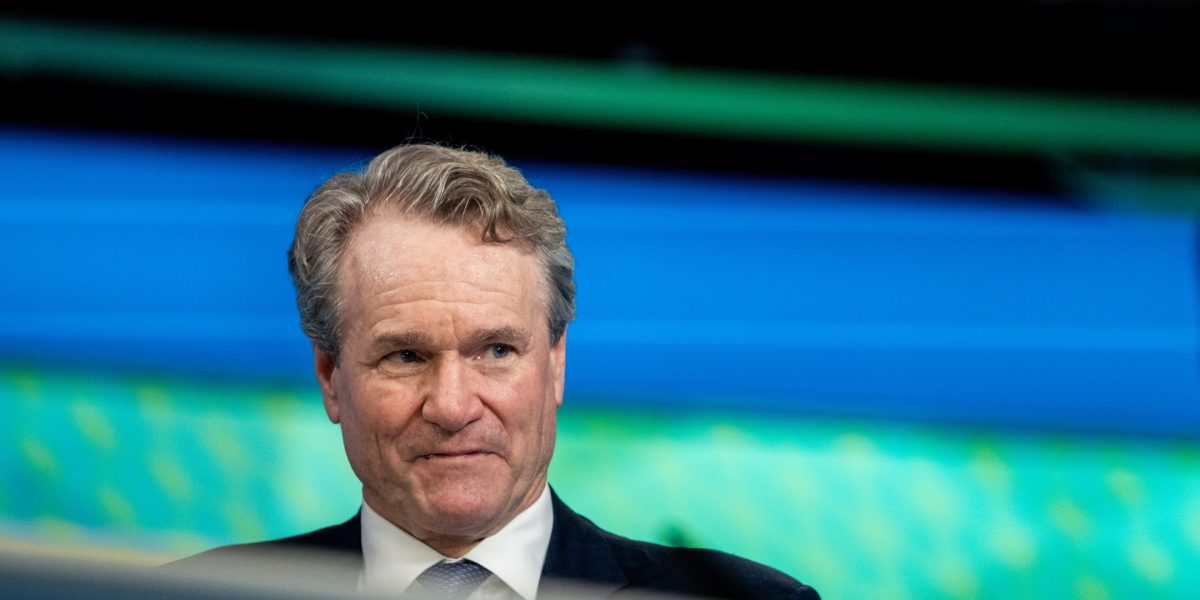
Bank of America CEO Brian Moynihan pointed out the U.S. economy is much bigger than the Federal Reserve, which shouldn’t merit so much attention.

In an interview with CBS News’ Face the Nation that aired Sunday, he was asked about President Donald Trump’s upcoming nomination of a new Fed chair to replace Jerome Powell and what it means for consumers.

“There’s too much fascination with the Fed,” Moynihan said.

The economy is driven by the private sector, which includes small, medium, and large companies as well as entrepreneurs, he added.

“The idea that we are, like, hanging on the thread by the Fed moving rates 25 basis points, it seems to me we’ve gotten out of whack,” he said.

The interview was recorded on Dec. 17, a week after the central bank lowered rates by a quarter point for a third consecutive meeting amid mounting signs of weakness in the labor market.

While the bank chief doesn’t think most Americans should fixate so much on the Fed’s rate moves, Wall Street has been counting on more easing to keep the stock market rally going.

Moynihan also acknowledged the Fed is the lender of last resort and plays a key role in stabilizing the economy, markets, and prices in times of extreme stress, such as during the financial crisis and the COVID-19 pandemic.

“But other than that, you shouldn’t know they exist, quite frankly,” he said.

However, when pressed about political interference worries at the Fed when a new chair takes over, he replied: “The market will punish people if we don’t have an independent Fed.”

That’s as Trump has continued to demand steeper rate cuts since he returned to the White House this year while applying extreme pressure on policymakers. He has relentlessly insulted Powell for not easing more, considered firing him, threatened to sue over cost overruns on the Fed’s headquarters renovation, and is still attempting to oust Fed Gov. Lisa Cook.

More recently, administration officials have suggested new conditions ought to be placed on the Fed’s regional presidents, raising fears of a purge. 

But earlier this month, the Fed reappointed those bank presidents a bit earlier than usual, surprising Wall Street and reducing concerns about threats to its independence.

That likely sets up Powell to step down from the Fed with more reassurance when his term as chair expires in May.

But Trump may still clash with his hand-picked replacement because the economy may prevent the central bank from lowering rates as much as he would like, according to Capital Economics.

The investment surge led by artificial intelligence is just the start of a multiyear boom in capital spending. As a result, GDP will grow at a robust rate of 2.5% in both 2026 and 2027, even after accounting for a weaker job market that will slow consumption, according to a recent note.

“With core inflation remaining above the 2% target for some considerable time, we think the Fed will cut its policy rate by only 25 [basis points] in 2026, putting the new Fed chair and President Trump at loggerheads almost immediately,” Capital Economics predicted.


Source link

Continue Reading

Business

OpenAI is hiring a head of preparedness, who will earn $555,000

Published

on


OpenAI is looking for a new employee to help address the growing dangers of AI, and the tech company is willing to spend more than half a million dollars to fill the role.

OpenAI is hiring a “head of preparedness” to reduce harms associated with the technology, like user mental health and cybersecurity, CEO Sam Altman wrote in an X post on Saturday. The position will pay $555,000 per year, plus equity, according to the job listing.

“This will be a stressful job and you’ll jump into the deep end pretty much immediately,” Altman said.

OpenAI’s push to hire a safety executive comes amid companies’ growing concerns about AI risks on operations and reputations. A November analysis of annual Securities and Exchange Commission filings by financial data and analytics company AlphaSense found that in the first 11 months of the year, 418 companies worth at least $1 billion cited reputational harm associated with AI risk factors. These reputation-threatening risks include AI datasets that show biased information or jeopardize security. Reports of AI-related reputational harm increased 46% from 2024, according to the analysis.

“Models are improving quickly and are now capable of many great things, but they are also starting to present some real challenges,” Altman said in the social media post.

“If you want to help the world figure out how to enable cybersecurity defenders with cutting edge capabilities while ensuring attackers can’t use them for harm, ideally by making all systems more secure, and similarly for how we release biological capabilities and even gain confidence in the safety of running systems that can self-improve, please consider applying,” he added.

OpenAI’s previous head of preparedness Aleksander Madry was reassigned last year to a role related to AI reasoning, with AI safety a related part of the job. 

OpenAI’s efforts to address AI dangers

Founded in 2015 as a nonprofit with the intention to use AI to improve and benefit humanity, OpenAI has, in the eyes of some of its former leaders, struggled to prioritize its commitment to safe technology development. The company’s former vice president of research, Dario Amodei, along with his sister Daniela Amodei and several other researchers, left OpenAI in 2020, in part because of concerns the company was prioritizing commercial success over safety. Amodei founded Anthropic the following year.

OpenAI has faced multiple wrongful death lawsuits this year, alleging ChatGPT encouraged users’ delusions, and claiming conversations with the bot were linked to some users’ suicides. A New York Times investigation published in November found nearly 50 cases of ChatGPT users having mental health crises while in conversation with the bot. 

OpenAI said in August its safety features could “degrade” following long conversations between users and ChatGPT, but the company has made changes to improve how its models interact with users. It created an eight-person council earlier this year to advise the company on guardrails to support users’ wellbeing and has updated ChatGPT to better respond in sensitive conversations and increase access to crisis hotlines. At the beginning of the month, the company announced grants to fund research about the intersection of AI and mental health.

The tech company has also conceded to needing improved safety measures, saying in a blog post this month some of its upcoming models could present a “high” cybersecurity risk as AI rapidly advances. The company is taking measures—such as training models to not respond to requests compromising cybersecurity and refining monitoring systems—to mitigate those risks.

“We have a strong foundation of measuring growing capabilities,” Altman wrote on Saturday. “But we are entering a world where we need more nuanced understanding and measurement of how those capabilities could be abused, and how we can limit those downsides both in our products and in the world, in a way that lets us all enjoy the tremendous benefits.”


Source link

Continue Reading

Business

YouTube’s cofounder and former tech boss doesn’t want his kids to watch short videos

Published

on


  • YouTube cofounder Steve Chen is one of the latest tech trailblazers to warn against social media’s impact on kids. Chen warned in a talk short-form video “equates to shorter attention spans” and said he wouldn’t want his own kids to exclusively consume this type of content. Companies that distribute short-form video (which includes the company he cofounded, YouTube) should add safeguards for younger users, he added.

A YouTube cofounder who helped pave the way for our modern, content-obsessed world is the latest tech whiz to come out against short-form videos because of their effects on kids. 

Steve Chen, who served as YouTube’s former chief technology officer before it was acquired by Google in 2006, railed against the TikTok-ification of online life in a talk earlier this year at Stanford Graduate School of Business.

“I think TikTok is entertainment, but it’s purely entertainment,” Chen said during the talk, which was published on YouTube Friday. “It’s just for that moment. Just shorter-form content equates to shorter attention spans.”

Chen, who has two children with wife, Jamie Chen, said he wouldn’t want his kids only consuming short-form content, and then not be able to watch something longer than 15 minutes. He said he knows of other parents who force their kids to watch longer videos without the eye-catching colors and gimmicks that hook especially younger users. This strategy works well, he claims.

“If they don’t get exposure to the short-form content right away, then they’re still happy with that other type of content that they’re watching,” he said. 

Many companies have had to rush to offer short-form content after the rise of TikTok, he said, but these companies now have to balance their motivations for monetization and attracting users’ attention with content that’s “actually useful.” 

Companies that distribute short-form video, which includes his former company YouTube, could face problems with addictiveness. These companies should add safeguards for kids on short-form content, such as age restrictions for apps and limits on the amount of time some users can use them, he said. 

Chen joins fellow tech trailblazers Sam Altman of OpenAI and Elon Musk in sounding the alarm about social media’s impact on children. In a podcast interview, Altman specifically called out social media scrolling and the “dopamine hit” of short-form video for “probably messing with kids’ brain development in a super deep way.”

Musk, who owns the social network X (née Twitter), said in 2023 he doesn’t have any restrictions on social-media use for his children, but added this “might have been a mistake,” and encouraged parents to take a more active role in their kids’ social-media habits.

“I think, probably, I would limit social media a bit more than I have in the past and just take note of what they’re watching, because I think at this point they’re being programmed by some social media algorithms, which you may or may not agree with,” Musk said.

A version of this story originally published on Fortune.com on July 29, 2025.

Join us at the Fortune Workplace Innovation Summit May 19–20, 2026, in Atlanta. The next era of workplace innovation is here—and the old playbook is being rewritten. At this exclusive, high-energy event, the world’s most innovative leaders will convene to explore how AI, humanity, and strategy converge to redefine, again, the future of work. Register now.


Source link

Continue Reading

Business

$25,000 per month: the cost of Trump tariffs on small business importers, revealed

Published

on


A stark new economic analysis reveals the Trump administration’s trade policies are extracting a heavy toll from Main Street, with small-business importers paying approximately $25,000 more per month in tariff costs since April 2025. The report, published Dec. 17 by the Center for American Progress (CAP), a left-wing think tank, details how a “chaotic approach” to trade and the elimination of key import exceptions have created a financial crisis for entrepreneurs during the critical holiday season.

According to the analysis by Michael Negron and Mimla Wardak, the administration’s “Liberation Day” tariff announcement triggered a sharp increase in duties collected from American businesses. From April through September 2025, CAP estimated, the roughly 236,000 small-business importers in the U.S. paid an average of more than $151,000 in additional tariffs compared to the same period in 2024. (CAP cited the centrist Chamber of Commerce’s research on the small-business importer sector of the economy.)

“The Trump administration’s broad, costly, and frequently shifting policies threaten to undermine one of the strongest engines of the American economy,” Negron said in a statement to Fortune. “A season of opportunity for small businesses has turned into one of uncertainty.”

The burden is not limited to larger enterprises. The report found “mom-and-pop” businesses—those with fewer than 50 employees—paid, on average, over $86,000 more per business during this six-month window than they did the previous year. The outlook for the immediate future is equally grim: CAP projects that if current monthly costs persist, the typical small business will face a tariff bill exceeding $500,000 in 2026, potentially resulting in additional layoffs, bankruptcies, and delayed investments. For the holidays, CAP concludes the tariffs are a “costly lump of coal” in American small business’ collective, proverbial Christmas stocking.

Administrative red tape stifles growth

Beyond direct financial costs, small business owners are struggling with a sudden increase in bureaucratic red tape. The administration eliminated the de minimis exception, which previously allowed low-value shipments to enter the U.S. without duties or extensive paperwork. This policy change has forced businesses to prepay new tariff rates and complete complex customs forms for millions of shipments that were formerly exempt.

Jyoti Jaiswal, founder of OMSutra, a small business selling sustainable fashion and home goods, told CAP the changes have forced her to consolidate shipments and block more capital upfront. Jaiswal noted her company now spends 10 to 15 hours on tariff-related administrative work per shipment, up from eight to 10 hours previously, preventing her from passing costs on to consumers without losing competitiveness.

Similarly, Legrand Lindor, CEO of LMI Textiles, told CAP his medical supply company went from spending zero time on tariff paperwork to spending four to five hours per transaction. Facing a 20% increase in product costs—roughly $80,000 in additional spending—Lindor was forced to scrap plans to open a new warehouse in 2025.

The rising costs appear to be cooling the labor market for small firms. Data from payroll provider ADP shows that businesses with fewer than 50 employees laid off 120,000 workers in November 2025, the highest number of small-business layoffs in five years.

While the administration claimed foreign nations would pay these costs, the report emphasizes tariffs are taxes paid by American importers. Goldman Sachs calculated that of August 2025, businesses had absorbed 51% of the cost of tariffs, though they had passed 37% onto consumers through higher prices. A survey by Small Business Majority from late 2025 indicated 74% of small-business owners are now worried about their business surviving the next 12 months.

Compounding financial pressures

The tariff crisis coincides with other financial headwinds. The report highlights the expiration of enhanced Affordable Care Act premium tax credits in 2026 threatens to double premiums for millions of entrepreneurs and small-business employees.

With the holiday season typically accounting for at least one-quarter of annual revenue for retailers, the convergence of high tariffs and administrative confusion has delivered what the report describes as “a decidedly unhappy holiday season” for the nation’s 236,000 small-business importers. Without a change in policy, these businesses face the prospect of escalating costs and reduced investment heading into the new year.

For this story, Fortune journalists used generative AI as a research tool. An editor verified the accuracy of the information before publishing.

This story was originally featured on Fortune.com


Source link

Continue Reading

Trending

Copyright © Miami Select.