Connect with us

Business

Management professors who studied the dreaded work offsite say think twice about skipping it this year

Published

on


What do you do when an announcement about an “offsite” hits your work inbox? Chances are you might sigh and begrudgingly add the event to your calendar.

These events, also called retreats, bring colleagues together for a mix of structured activities and free time – freeing them from their regular work obligations. For one or two days, employees take a mandatory break from their normal routines at work and at home. Participants spend a lot of that time making small talk with colleagues, as well as engaging in structured interactions that may include awkward icebreakers.

Although networking is one of these events’ main purposes, some people find that networking for the purpose of meeting professional goals can feel transactional, uncomfortable or even dirty. Unsure about whether it will be worth the time and effort, you might ask: What’s in it for me?

We are management professors who study how professional networks help information and resources move across organizations and create opportunities. Our research findings suggest participating in an offsite could be well worth the time and hassle.

And it might quietly reshape your working relationships in unexpected ways.

Taking time and costing money

While these gatherings have become relatively common, we were surprised to learn how little research there is on whether they work. In particular, few scholars have dug into their effectiveness in helping people forge new connections.

Offsites can help with strategic planning, team development and goal setting. They’re often held once or twice a year. The timing varies from one employer to the next. But the period from December through March is becoming more popular.

They tend to bring people together who rarely interact through their work – particularly at large employers with offices spread across the country or even the world, and in organizations with remote-first work arrangements.

Retreats help people get better acquainted in many informal ways, whether it’s sharing meals, exchanging ideas or chatting in hallways. Those interactions and the more structured ones, such as brainstorming exercises conducted in previously assigned groups, make it easier to connect with colleagues.

After years of remote work when people mainly gathered over Zoom, employers continue to look for ways to rebuild connections and to address a surge in disengagement.

These retreats for professionals have apparently become more popular following the COVID-19 pandemic, as part of the larger rebound in business-related travel. A survey of 2,000 full-time employees from a range of industries found that the percentage of companies hosting no offsites at all fell to 4% in 2024, from 16% in 2019.

Further, many companies are allocating larger budgets for offsites and budgeting more time during off-site retreats for social purposes, the same survey found.

Mapping a law firm’s networking patterns

When we spoke with managers from several large firms about their off-site practices, we were surprised that they simply assumed collaboration was an inevitable outcome.

To test whether that was true, we studied the working relationships of more than 700 partners in a large U.S. law firm, which we agreed not to name to access its data. Over eight years, from 2005 to 2012, these partners attended – or skipped – the firm’s annual retreats.

We tracked the partners’ attendance and their collaborative work for the firm’s clients before and after the offsites. Because lawyers at this firm – and elsewhere – record their work in 6-minute increments, it was possible to analyze billing records for the partners’ collaboration on client projects.

The results of this mapping exercise surprised us. And they may change your feelings about whether retreats are worth your time and energy.

Helping partners get noticed

We found that after participating in an offsite, partners were more likely to reach out to other partners whom they had not worked with previously.

To our surprise, we found that even workers who didn’t attend an offsite acted more collaboratively afterward. Having received the message that collaboration is important to the firm, they made up for missing out by finding other ways to start collaborating with more colleagues.

But building a successful career also depends on something harder to control than whether you reach out to new colleagues and clients: You need your colleagues to think of you when opportunities arise. And that likelihood can increase when you participate in offsites.

Getting 24% more requests to collaborate

We found an increase in newly formed connections across the law firm after these events. New collaborations on billable work increased, generating more revenue for the firm. And the targets of these new collaborations tended to be the people who took part in the offsite.

The partners who attended the offsite became more visible and had 24% more new requests to collaborate on work for a client in the two months following the retreat than those who did not. Importantly, these relationships were not superficial. Almost 17% of these new working relationships continued over the next two years.

While we analyzed only the relationships that formed shortly after the offsite, it is likely that colleagues remember those they meet at these events. The people who attend them continue to reap network-based benefits beyond what we found in the data.

We also found that offsites helped attorneys forge connections with lawyers in the firm’s other practice groups more than with those on their own team.

Overall, lawyers who went to an offsite made more new connections – about one per month – after an offsite than the ones who didn’t go.

Bridging silos at work

In the course of day-to-day work, people tend to interact most with the colleagues they already know.

This pattern seems to be even stronger in remote work. Offsites helped to break that pattern by giving professionals opportunities to engage with colleagues they don’t know. Sometimes, they end up eager to collaborate with people they meet this way.

These more distant connections can help people obtain diverse information, resources and perspectives and create opportunities to productively brainstorm.

When you work for a big employer, it can be hard to meet colleagues on other teams. Offsites may provide a significant opportunity to build networks and stand out among peers.

While offsites may never be your favorite way to spend a few days, our research shows that they can serve an important function for employers and employees alike.

Madeline Kneeland, Assistant Professor of Management, Babson College and Adam M. Kleinbaum, Professor of Leadership and Organizations, Dartmouth College

This article is republished from The Conversation under a Creative Commons license. Read the original article.



Source link

Continue Reading

Business

Winter storm cancels more than 1,000 flights in the Northeast and Great Lakes regions as state of emergency declared in N.Y., N.J.

Published

on


More than a thousand flights were canceled or delayed across the Northeast and Great Lakes regions due to snow as thousands took to U.S. roads and airports during the busy travel period between Christmas and New Year’s.

As of Saturday morning, New York City had received just under three inches of snow — roughly half of what some forecasts had predicted. At least 1,500 flights were canceled from Friday night into Saturday, according to flight-tracking service FlightAware.

Newark Liberty International Airport, John F. Kennedy International Airport and LaGuardia Airport posted snow warnings on the social media platform X on Friday, cautioning that weather conditions could cause flight disruptions.

The National Weather Service warned of hazardous travel conditions from the Great Lakes through the northern mid-Atlantic and southern New England, with the potential for tree damage and power outages. Forecasters said the storm was expected to weaken by Saturday morning.

Ahead of the storm, New York Gov. Kathy Hochul declared a state of emergency for more than half of the state. Acting New Jersey Gov. Tahesha Way declared a state of emergency for all of New Jersey, “due to a severe winter storm causing dangerous weather conditions, including heavy snow, sleet, and freezing rain.”

“This storm will cause dangerous road conditions and impact holiday travel,” Way said in a statement. “We are urging travelers to avoid travel during the storm and allow crews to tend to the roads. Drivers should plan their travel accordingly, monitor conditions and road closures, and follow all safety protocols.”

This story was originally featured on Fortune.com


Source link

Continue Reading

Business

California drops lawsuit to reinstate federal bullet train funding as high-speed rail authority seeks private investors

Published

on


California this week dropped a lawsuit officials filed against the Trump administration over the federal government’s withdrawing of $4 billion for the state’s long-delayed high-speed rail project.

The U.S. Transportation Department slashed funds for the bullet train aimed at connecting San Francisco to Los Angeles in July. The Trump administration has said the California High-Speed Rail Authority had “ no viable plan ” to complete a large segment of the project in the farm-rich Central Valley.

The authority quickly filed a lawsuit, with Democratic Gov. Gavin Newsom calling the federal government’s decision “a political stunt to punish California.”

The authority said this week that it would focus on other funding sources to complete the project, which is estimated to cost more than $100 billion.

“This action reflects the State’s assessment that the federal government is not a reliable, constructive, or trustworthy partner in advancing high-speed rail in California,” an authority spokesperson said in a statement.

The Transportation Department did not respond to a request for comment. President Donald Trump and Transportation Secretary Sean Duffy have both previously criticized the project as a “train to nowhere.”

“The Railroad we were promised still does not exist, and never will,” Trump said on his social media platform Truth Social in July. “This project was Severely Overpriced, Overregulated, and NEVER DELIVERED.”

The authority’s decision to drop the lawsuit comes as the group seeks private investors to support the bullet train. The project recently secured $1 billion in annual funding from the state’s cap-and-trade program through 2045.

The program sets a declining limit on total planet-warming emissions in the state from major polluters. Companies must reduce their emissions, buy allowances from the state or other businesses, or fund projects aimed at offsetting their emissions. Money the state receives from the sales funds climate-change mitigation, affordable housing and transportation projects, as well as utility bill credits for Californians.

The rail authority said its shift in focus away from federal funding offers “a new opportunity.”

“Moving forward without the Trump administration’s involvement allows the Authority to pursue proven global best practices used successfully by modern high-speed rail systems around the world,” a spokesperson said in a statement.

This story was originally featured on Fortune.com


Source link

Continue Reading

Business

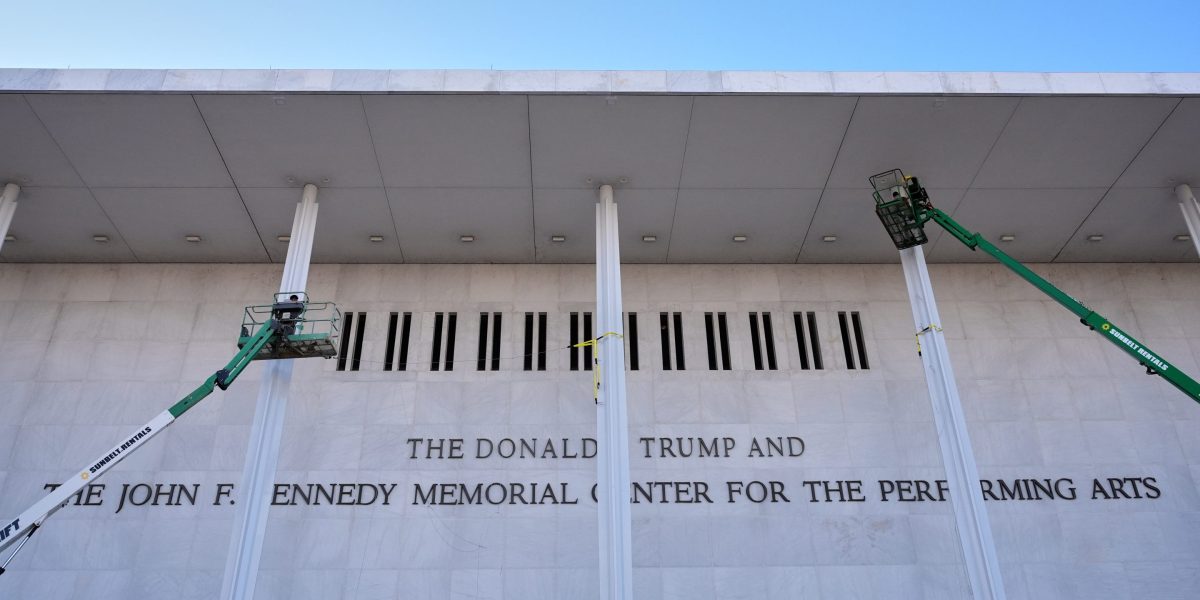
Kennedy Center seeks $1 million in damages from musician who canceled show after Trump name added

Published

on


The president of the Kennedy Center on Friday fiercely criticized a musician’s sudden decision to cancel a Christmas Eve performance at the venue days after the White House announced that President Donald Trump’s name would be added to the facility.

“Your decision to withdraw at the last moment — explicitly in response to the Center’s recent renaming, which honors President Trump’s extraordinary efforts to save this national treasure — is classic intolerance and very costly to a non-profit Arts institution,” the venue’s president, Richard Grenell, wrote in a letter to musician Chuck Redd that was shared with The Associated Press.

In the letter, Grenell said he would seek $1 million in damages “for this political stunt.”

Redd did not immediately respond to a request for comment.

A drummer and vibraphone player, Redd has presided over holiday “Jazz Jams” at the Kennedy Center since 2006, succeeding bassist William “Keter” Betts. In an email Wednesday to The Associated Press, Redd said he pulled out of the concert in the wake of the renaming.

“When I saw the name change on the Kennedy Center website and then hours later on the building, I chose to cancel our concert,” Redd said. He added Wednesday that the event has been a “very popular holiday tradition” and that he often featured at least one student musician.

“One of the many reasons that it was very sad to have had to cancel,” he told the AP.

President John F. Kennedy was assassinated in 1963, and Congress passed a law the following year naming the center as a living memorial to him.

Grenell is a Trump ally whom the president chose to head the Kennedy Center after he forced out the previous leadership. According to the White House, Trump’s handpicked board approved the renaming, which scholars have said violates the law. Kennedy niece Kerry Kennedy has vowed to remove Trump’s name from the building once he leaves office, and former House historian Ray Smock is among those who say any changes would have to be approved by Congress.

The law explicitly prohibits the board of trustees from making the center into a memorial to anyone else, and from putting another person’s name on the building’s exterior.


Source link

Continue Reading

Trending

Copyright © Miami Select.