Connect with us

Business

Why you feel so anxious and stressed during the holidays, even though you’re probably just sitting around, watching TV and eating

Published

on


The holiday season is often painted as an idyllic vision of rest, conjuring images of warm beverages and bountiful time with loved ones. But many people have trouble unwinding at this time of year. Why do the December holidays offer the promise of respite but never seem to deliver? And is more restorative rest possible during this busy season?

I am a psychologist who studies how rest supports learning, creativity and well-being. Sleep is often the first thing that many people associate with rest, but humans also require restorative downtime when awake. These active rest periods include physical, social and creative experiences that can occur throughout the day – not just while mindlessly scrolling on the couch.

When holiday stresses begin to snowball, rest periods replenish depleted psychological resources, reduce stress and promote well-being. But reaping the full benefits of rest and leisure requires more than a slow morning or a mug of hot cocoa. It’s also about intentionally scheduling active recovery periods that energize us and leave us feeling restored.

That’s because good rest needs to be anticipated, planned and refined.

Holiday stress

The winter holiday season can take a toll on well-being. Financial stress increases, and daily routines are disrupted. Add the stress of travel, plus a dash of challenging family dynamics, and it’s not surprising that emotional well-being declines during the holiday season.

Quality rest and leisure periods can buffer these stressors, promoting recovery and well-being. They also can help reduce psychological strain and prolong positive emotions as people return to work.

Effective rest comes in many forms, from going outdoors for a walk to socializing, listening to music or engaging in creative hobbies. These activities may feel like distractions, but they serve important mental health functions.

For instance, research finds that walking in nature results in diminished activation in the area of the brain associated with sadness and ruminating thoughts. Walks in nature are also associated with reduced anxiety and stress.

Other studies have shown that activities such as playing the piano or doing calligraphy significantly lower cortisol, a stress hormone. In fact, some of the most promising interventions for depression involve participation in pleasant leisure activities.

Not all idle time is restorative

So why does it feel so hard to get good rest during the holidays?

One of the most robust findings from psychologists and researchers who study leisure is that the effectiveness of rest periods depends on how satisfying they feel to the individual. This might sound obvious, but people often spend their free time doing things that are not satisfying.

For example, a famous 2002 study of how people spent their time found that the most popular form of leisure was watching television. But participants also rated TV time as their least enjoyable activity. Those who watched more than four hours of TV a day rated it as even less enjoyable than those who watched less than two hours a day.

A few years ago, my colleagues and I collected data from college students and found that students reported turning to mindless distractions, such as social media, at the end of the day, but that it usually did not leave them feeling reenergized or restored. Although this study was specifically about college students, when I presented the findings to the larger research team, one of my collaborators said, “It really makes you think about yourself, doesn’t it?” There were silent nods around the room.

Planning for good rest

To combat the pitfall of poor rest cycles, science suggests planning for active rest and pleasant activities, and carrying through with those plans. A large body of research shows that designing, scheduling and engaging in enjoyable activities is effective at lowering symptoms of depression and anxiety.

For the holiday season, this might mean following an afternoon of shopping with a recovery period reading a book in a quiet place, or going for a walk after opening gifts instead of immediately shifting into cleaning mode. By following a schedule, not a mood, research suggests that people can break cycles of poor rest and inactivity and achieve greater recovery and well-being.

Wrestling with guilt

Even with perfectly planned and executed rest periods, guilt can loom. Leisure guilt is a psychological construct that encompasses feelings of distress about spending time doing things that are relaxing rather than productive. It can reduce enjoyment of leisure, undercutting one of the mechanisms that link rest with well-being.

During the holidays, this problem may become even more pronounced. The season brings changes to daily routines, daylight levels and temperature, and diets. All of these shifts can deplete people’s energy levels. High expectations during the holidays may make guilt an even bigger threat to rest.

If the answer to poor-quality rest cycles is planned active rest periods, then what is the solution to feelings of guilt?

Lower expectations, immersive rest and acceptance

Research on leisure guilt is in its infancy, but my own struggles have shown me a few ways to resist the pressure to be productive every spare minute. Here are some tips to fight back against the flawed belief that rest is just laziness in disguise, during the holidays and beyond.

First, I work to convince myself and my family members to lower expectations for our seasonal activities. Not every baked cookie needs to be individually frosted and decorated, and not every gift has to be wrapped with a perfect bow. By agreeing to lower our expectations, we eliminate extraneous work and the guilt of feeling that there is more to be done.

Second, I’ve found that restful activities that provide a strong feeling of immersion – playing video games, going for walks and playing with my young nieces and nephews – are a lot more restorative than scrolling on my phone or watching TV on the couch. These diversions require my full attention and prevent me from thinking about things such as my overflowing email inbox or unfinished household chores.

Finally, when I do experience leisure guilt, I accept the feeling and try to move on. During high-stress situations, accepting negative emotions rather than avoiding them can reduce depressive symptoms.

Humans need restorative periods of downtime during the holidays and beyond, but this does not always come easily or naturally to everyone. Through small adjustments and intentional actions, good rest can be within reach this holiday season.

Stacy Shaw, Assistant Professor of Social Science & Policy Studies, Worcester Polytechnic Institute

This article is republished from The Conversation under a Creative Commons license. Read the original article.


Source link

Continue Reading

Business

U.S. launches strikes against Islamic State group in Nigeria after attacks target Christians

Published

on


President Donald Trump said the United States launched a “powerful and deadly” strike against forces of the Islamic State group in Nigeria, after spending weeks accusing the West African country’s government of failing to rein in the targeting of Christians.

In a Christmas evening post on his social media site Thursday, Trump did not provide details or mention the extent of the damage caused by the strikes in the northwestern state of Sokoto.

A Defense Department official, who insisted on anonymity to discuss details not made public, said the U.S. worked with Nigeria to carry out the strikes and that they’d been approved by Abuja.

Nigeria’s Ministry of Foreign Affairs said the cooperation included exchange of intelligence and strategic coordination in ways “consistent with international law, mutual respect for sovereignty and shared commitments to regional and global security.”

The Associated Press could not confirm the extent of the strikes’ impact.

Nigeria fights several armed groups

Nigeria is battling multiple armed groups, including at least two affiliated with IS, an offshoot of the Boko Haram extremist group known as the Islamic State West Africa Province in the northeast, and the less-known Lakurawa group prominent in the northwestern states, where the gangs use large swathes of forests as hideouts.

Security analysts said the target of the U.S. strikes could be the Lakurawa group, which in the last year has increasingly become lethal in the region, often targeting remote communities and security forces.

“Lakurawa is a group that is actually controlling territories in Nigeria, in Sokoto state and in other states like Kebbi,” said Malik Samuel, a Nigerian security researcher at Good Governance Africa. “In the northwest, there has been the incursion of violent extremist groups that are ideologically driven,” he said, blaming the incursion on the near absence of the state and security forces in hot spots.

Violence affecting Nigerians

Trump said the airstrikes were launched against IS militants “who have been targeting and viciously killing, primarily, innocent Christians.” Residents and security analysts have said Nigeria’s security crisis affects both Christians, predominant in the south, and Muslims, who are the majority in the north.

“Terrorist violence in any form, whether directed at Christians, Muslims or other communities, remains an affront to Nigeria’s values and to international peace and security,” the Nigerian Ministry of Foreign Affairs said.

Nigeria’s government has previously said in response to Trump’s criticisms that people of many faiths, not just Christians, have suffered attacks at the hands of extremist groups.

US measures affecting Nigeria

Trump ordered the Pentagon last month to begin planning for potential military action in Nigeria to try and curb what he called Christian persecution. The State Department recently announced it would restrict visas for Nigerians and their family members involved in killing Christians there.

And the U.S. recently designated Nigeria a “country of particular concern” under the International Religious Freedom Act.

Trump said U.S. defense officials had “executed numerous perfect strikes, as only the United States is capable of doing” and added that “our Country will not allow Radical Islamic Terrorism to prosper.”

Nigeria’s population of 220 million is split almost equally between Christians and Muslims. The country has long faced insecurity from various fronts, including Boko Haram, which seeks to establish its radical interpretation of Islamic law and has also targeted Muslims it deems not Muslim enough.

But attacks in Nigeria often have varying motives. There are religiously motivated ones targeting both Christians and Muslims, clashes between farmers and herders over dwindling resources, communal rivalries, secessionist groups and ethnic clashes.

The U.S. security footprint has diminished in Africa, where military partnerships have either been scaled down or canceled. U.S. forces likely would have to be drawn from other parts of the world for any larger-scale military intervention in Nigeria.

Trump has nonetheless kept up the pressure as Nigeria faced a series of attacks on schools and churches in violence that experts and residents say targets both Christians and Muslims.

Defense Secretary Pete Hegseth posted Thursday night on X: “The President was clear last month: the killing of innocent Christians in Nigeria (and elsewhere) must end.”

Hegseth said that U.S. military forces are “always ready, so ISIS found out tonight — on Christmas” and added, “More to come…Grateful for Nigerian government support & cooperation” before signing off, “Merry Christmas!”

This story was originally featured on Fortune.com


Source link

Continue Reading

Business

Seniors relive their days of wanderlust and thrill-seeking with virtual reality

Published

on


Like many retirement communities, The Terraces serves as a tranquil refuge for a nucleus of older people who no longer can travel to faraway places or engage in bold adventures.

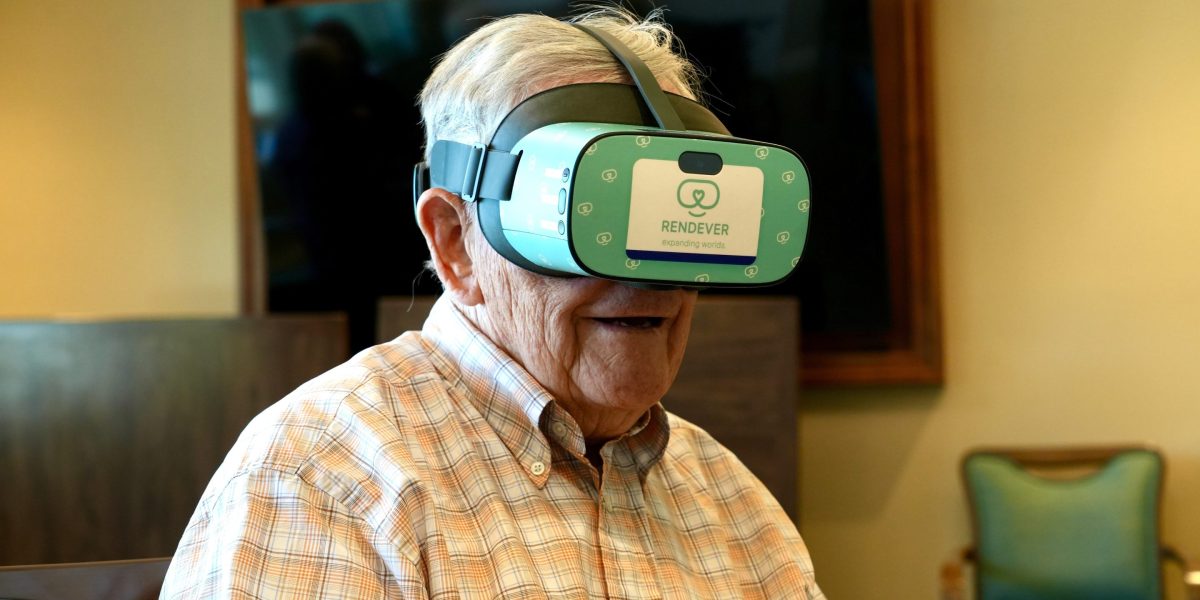
But they can still be thrust back to their days of wanderlust and thrill-seeking whenever caretakers at the community in Los Gatos, California, schedule a date for residents — many of whom are in their 80s and 90s — to take turns donning virtual reality headsets.

Within a matter of minutes, the headsets can transport them to Europe, immerse them in the ocean depths or send them soaring on breathtaking hang-gliding expeditions while they sit by each other. The selection of VR programming was curated by Rendever, a company that has turned a sometimes isolating form of technology into a catalyst for better cognition and social connections in 800 retirement communities in the United States and Canada.

A group of The Terraces residents who participated in a VR session earlier this year found themselves paddling their arms alongside their chairs as they swam with a pod of dolphins while watching one of Rendever’s 3D programs. “We got to go underwater and didn’t even have to hold our breath!” exclaimed 81-year-old Ginny Baird following the virtual submersion.

During a session featuring a virtual ride in a hot-air balloon, one resident gasped, “Oh my God!” Another shuddered, “It’s hard to watch!”

The Rendever technology can also be used to virtually take older adults back to the places where they grew up as children. For some, it will be the first time they’ve seen their hometowns in decades.

A virtual trip to her childhood neighborhood in New York City’s Queens borough helped sell Sue Livingstone, 84, on the merits of the VR technology even though she still is able to get out more often than many residents of The Terraces, which is located in Silicon Valley about 55 miles south of San Francisco.

“It isn’t just about being able to see it again, it’s about all the memories that it brings back,” Livingstone said. “There are a few people living here who never really leave their comfort zones. But if you could entice them to come down to try out a headset, they might find that they really enjoy it.”

Adrian Marshall, The Terraces’ community life director, said that once word about a VR experience spreads from one resident to another, more of the uninitiated typically become curious enough to try it out — even if it means missing out on playing Mexican Train, a dominoes-like board game that’s popular in the community.

“It turns into a conversation starter for them. It really does connect people,” Marshall said of Rendever’s VR programming. “It helps create a human bridge that makes them realize they share certain similarities and interests. It turns the artificial world into reality.”

Rendever, a privately owned company based in Somerville, Massachusetts, hopes to build upon its senior living platform with a recent grant from the National Institutes of Health that will provide nearly $4.5 million to study ways to reduce social isolation among seniors living at home and their caregivers.

Some studies have found VR programming presented in a limited viewing format can help older people maintain and improve cognitive functions, burnish memories and foster social connections with their families and fellow residents of care facilities. Experts say the technology may be useful as an addition to and not a replacement for other activities.

“There is always a risk of too much screen time,” Katherine “Kate” Dupuis, a neuropsychologist and professor who studies aging issues at Sheridan College in Canada, said. “But if you use it cautiously, with meaning and purpose, it can be very helpful. It can be an opportunity for the elderly to engage with someone and share a sense of wonder.”

VR headsets may be an easier way for older people to interact with technology instead of fumbling around with a smartphone or another device that requires navigating buttons or other mechanisms, said Pallabi Bhowmick, a researcher at the University of Illinois Urbana-Champaign who is examining the use of VR with older adults.

“The stereotypes that older adults aren’t willing to try new technology needs to change because they are willing and want to adapt to technologies that are meaningful to them,” Bhowmick said. “Besides helping them to relieve stress, be entertained and connect with other people, there is an intergenerational aspect that might help them build their relationships with younger people who find out they use VR and say, ‘Grandpa is cool!’”

Rendever CEO Kyle Rand’s interest in helping his own grandmother deal with the emotional and mental challenges of aging pushed him down a path that led him to cofound the company in 2016 after studying neuroengineering at Duke University.

“What really fascinates me about humans is just how much our brain depends on social connection and how much we learn from others,” Rand said. “A group of elderly residents who don’t really know each other that well can come together, spend 30 minutes in a VR experience together and then find themselves sitting down to have lunch together while continuing a conversation about the experience.”

It’s a large enough market that another VR specialist, Dallas-based Mynd Immersive, competes against Rendever with services tailored for senior living communities.

Besides helping create social connections, the VR programming from both Rendever and Mynd has been employed as a possible tool for potentially slowing down the deleterious effects of dementia. That’s how another Silicon Valley retirement village, the Forum, sometimes uses the technology.

Bob Rogallo, a Forum resident with dementia that has rendered him speechless, seemed to be enjoying taking a virtual hike through Glacier National Park in Montana as he nodded and smiled while celebrating his 83rd birthday with his wife of 61 years.

Sallie Rogallo, who doesn’t have dementia, said the experience brought back fond memories of the couple’s visits to the same park during the more than 30 years they spent cruising around the U.S. in their recreational vehicle.

“It made me wish I was 30 years younger so I could do it again,” she said of the virtual visit to Glacier. “This lets you get out of the same environment and either go to a new place or visit places where you have been.”

In another session at the Forum, 93-year-old Almut Schultz laughed with delight while viewing a virtual classical music performance at the Red Rocks Amphitheatre in Colorado and later seemed to want to play with a puppy frolicking around in her VR headset.

“That was quite a session we had there,” Schultz said with a big grin after she took off her headset and returned to reality.




Source link

Continue Reading

Business

Dominion Energy Virginia sues over Trump order to halt offshore wind project, calling it ‘arbitrary and capricious’

Published

on


The developers of a Virginia offshore wind project are asking a federal judge to block a Trump administration order that halted construction of their project, along with four others, over national security concerns.

Dominion Energy Virginia said in its lawsuit filed late Tuesday that the government’s order is “arbitrary and capricious” and unconstitutional. The Richmond-based company is developing Coastal Virginia Offshore Wind, a project it says is essential to meet dramatically growing energy needs driven by dozens of new data centers.

The Interior Department did not detail the security concerns in blocking the five projects on Monday. In a letter to project developers, Interior’s Bureau of Ocean Energy Management set a 90-day period — and possibly longer — “to determine whether the national security threats posed by this project can be adequately mitigated.”

The other projects are the Vineyard Wind project under construction in Massachusetts, Revolution Wind in Rhode Island and Connecticut and two projects in New York: Sunrise Wind and Empire Wind. Democratic governors in those states have vowed to fight the order, the latest action by the Trump administration to hobble offshore wind in its push against renewable energy sources.

Dominion’s project has been under construction since early 2024 and was scheduled to come online early next year, providing enough energy to power about 660,000 homes. The company said the delay was costing it more than $5 million a day in losses solely for the ships used in round-the-clock construction, and that customers or the company would eventually bear the cost.

Dominion called this week’s order “the latest in a series of irrational agency actions attacking offshore wind and then doubling down when those actions are found unlawful.”

The Bureau of Ocean Energy Management didn’t immediately respond to an email seeking comment.

U.S. District Judge Jamar Walker set a hearing for 2 p.m. Monday on Dominion’s request for a temporary restraining order.

This story was originally featured on Fortune.com


Source link

Continue Reading

Trending

Copyright © Miami Select.