Connect with us

Business

Cursor CEO warns vibe coding builds ‘shaky foundations’ and eventually ‘things start to crumble’

Published

on


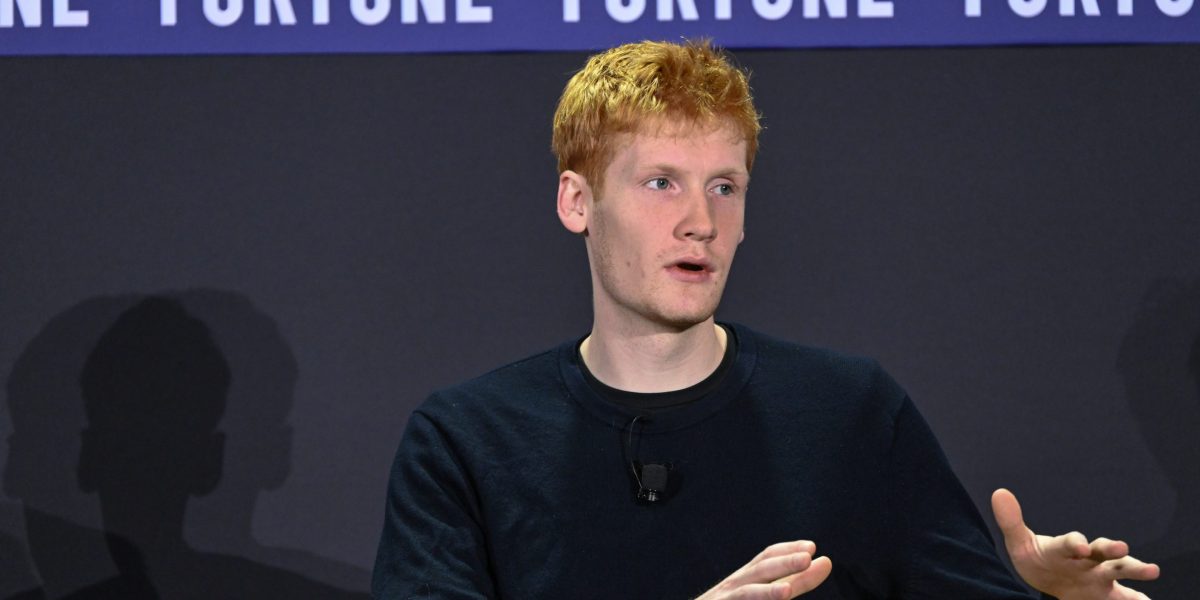
Cursor may utilize AI to help programmers code, but just don’t call it vibe coding, CEO and cofounder Michael Truell said.

Ten years ago, programming meant typing code into a blank word processor and editing it manually. But with the advent of generative AI, this type of programming is quickly becoming a thing of the past, he explained.

“More and more, you can take a step back from the code, and you can ask an AI to go do end-to-end tasks for you,” Truell said at the Fortune Brainstorm AI conference earlier this month. 

Yet programmers may not want to step back too far, he added, pointing out that there’s levels to AI-assisted coding. 

The oft-repeated term “vibe coding” may seem to encapsulate all AI coding assistants. In reality, it suggests amateur builders or inexperienced AI users trying to bring an idea to life without necessarily looking under the hood.

“Vibe coding refers to a method of coding with AI where you kind of close your eyes and you don’t look at the code at all and you just ask the AI to go build the thing for you,” he said.

Truell likened it to building a house by putting up four walls and a roof without knowing what’s going on under the floorboards or with the wiring.

This coding method may be perfect for AI users looking to quickly mock up a game or website, but when it comes to more advanced programming, things have the potential to go wrong, he warned.

“If you close your eyes and you don’t look at the code and you have AIs build things with shaky foundations as you add another floor, and another floor, and another floor, and another floor, things start to kind of crumble,” he said. 

With Cursor, by contrast, programmers can embed AI directly into the integrated development environment where programmers write their code. By using the context of the existing code, or even an entire code base, it can often predict the next line. The tool includes everything from multi-line-autocomplete to full function generation. It can also help a programmer debug their code and explain errors.

Despite being only 25 years old, Truell’s take on AI coding carries real weight. He and three other graduates from the Massachusetts Institute of Technology created what would become Cursor as a project in 2022.

Since then, Cursor has become one of the most popular coding assistants out there, with a reported 1 million daily users as of earlier this year, Bloomberg reported. Since it launched, the company has reached $1 billion in annualized revenue and amassed 300 employees, according to CNBC.

Cursor received its first $8 million investment from OpenAI’s Startup Fund in 2023. It later raised more millions from some of the biggest venture capitalists in Silicon Valley, including Andreessen Horowitz. Fast forward to 2025, and the company has closed on a $2.3 billion funding round at a $29.3 billion post-money valuation.

While vibe coders may be flying blind, Truell said the Cursor coding assistant is the best of both worlds, helping its expert customers get into the nitty gritty details of their code.

“But then in the places where you want to take a step back and you want to ask the AI to do something end-to-end you can do that too,” he said.


Source link

Continue Reading

Business

Chinese billionaire who has fathered more than 100 children hopes to have dozens of U.S.-born boys to one day take over his business

Published

on


Billionaires like Telegram founder Pavel Durov and Tesla CEO Elon Musk have fathered legions of children who are slated to inherit their empires. Now, an ultra-wealthy Chinese businessman is doing the same in the U.S., in hopes of producing around 20 U.S.-born children to inherit his video game fortune. 

Xu Bo is the founder and chairman of Guangzhou Duoyi Network: one of China’s largest mobile gaming companies. Despite the 48-year-old entrepreneur growing his company in Guangzhou, he’s not looking to pass down his $1.1 billion fortune to a child born in his home country. A Wall Street Journal investigation into Xu’s surrogacy history in the U.S. found that the Chinese billionaire was seeking parental rights to at least four unborn children, and had previously fathered and was actively fathering at least eight more surrogacy kids. There could be dozens more.

The billionaire’s video game company had also reportedly stated that Xu has more than 100 children born through surrogates based in the U.S., according to WSJ reporting. He was allegedly seeking “50 high-quality sons,” according to accounts linked to Xu on Chinese microblogging website Weibo, and said that “having more children can solve all problems.” During a 2023 court hearing, Xu also said he hoped to have around 20 U.S.-born children to one day take over his business, according to WSJ. He also fantasized about his American kids marrying Musk’s children in the future. Last month, Xu’s ex-girlfriend also alleged that he had 300 children living around the world—a claim his company denied. 

Xu’s Duoyi Network has since made a statement against the Journal, stating the publication had “deliberately confused the facts and fabricated false information,” and that only 12 of the alleged 100-plus children were born in the U.S.

Another billionaire fathering 100+ heirs: Telegram founder Pavel Durvo 

Xu is among a growing number of ultra-rich men parenting dozens of children to shepherd their companies and expand their legacies. And just like Xu, the video game billionaire, Telegram founder Pavel Durvo has helped conceive over 100 babies across 12 countries. 

Officially, the entrepreneur worth $14.2 billion has six “official” children with three different partners. In addition to this parentage, Durov has also been donating to a sperm clinic for the past 15 years, which told him has led to more than 100 pregnancies. 

“I wrote my will very recently,” Durov told French publication Le Point in an interview this June. “I make no difference between my children: There are those who were conceived naturally and those who come from my sperm donations. They are all my children and will all have the same rights! I don’t want them to tear each other apart after my death.”

Join us at the Fortune Workplace Innovation Summit May 19–20, 2026, in Atlanta. The next era of workplace innovation is here—and the old playbook is being rewritten. At this exclusive, high-energy event, the world’s most innovative leaders will convene to explore how AI, humanity, and strategy converge to redefine, again, the future of work. Register now.


Source link

Continue Reading

Business

PayPal senior VP: We’re now in the ‘intelligence era’ and companies should be focused on tokens

Published

on


In the middle of the 20th century, the world entered the age of information, the shift of industry to information technology. The era began with the miniaturization of computers and culminated with the invention of the World Wide Web, which put the ability to access information at nearly everyone’s fingertips. Now, with the rise of AI, that age is over, according to some tech leaders, and a new age of technology has begun.

“We have transitioned from [an] information era to intelligence era,” Prakhar Mehrotra, PayPal senior vice president and global head of AI, said at the Fortune Brainstorm AI conference earlier this month.

This “intelligence era” is marked by industries transitioning away from the model of storing and retrieving data, Mehrotra told Fortune reporter Sharon Goldman. Instead, because of the capabilities of AI, data can be more spontaneously generated, with the ultimate goal of achieving autonomy in some parts of the workplace.

Companies are racing to apply AI—with its promises of increased productivity and output—to their respective workplaces, but their successes have been mixed. An August MIT study found 95% of enterprise AI workplace initiatives failed to reach rapid revenue acceleration.

“It’s going to be a journey…You have to go through this crawl, walk, and run,” Mehrotra said. “I think that adage has been true 10 years back, is also true in this era.”

The future of AI factories

Marc Hamilton, Nvidia’s vice president of solutions architecture and engineering who was interviewed alongside Mehrotra at the conference, said the future of building out AI in the workplace will be investing in AI factories, on a business’s premises or in the cloud. That’s because data needed to run companies will no longer be primarily retrieved by humans or computers, but rather generated by AI.

“When you go and say, ‘Generate a PowerPoint slide that says this,’ or ‘I’m working on this coding function, can you go in and generate code?’ It’s not retrieving it from the database, it’s taking a model and generating that data,” Hamilton said. 

Mehrotra noted in order for companies to effectively build out the computational power needed to create this data, there needs to be a new atomic unit prized by firms: tokens, or the fundamental component of text AI needs to understand and process a language. Tokens are both the snippet of information used to train data, as well as what is generated by AI after a model receives a prompt.

“Every company has to think about their data in terms of tokens, because then [they] can derive that intelligence from it,” Mehrotra said.

A measure of input and output, token generation has become a key metric for tech companies in particular. In May, Nvidia boasted that Microsoft, which uses Nvidia’s chips, generated more than 100 trillion tokens in the first quarter of this year, a five-fold year-over-year increase. These indications of output can help these AI companies sell themselves to investors and boost valuations, though data shows tokens’ correlation with demand and profits are weaker than tech companies would suggest. 

Mehrotra and Hamilton agreed that many companies today see the value of tokens in boosting AI capabilities, but are weighing how to best fit them into their needs, such as which tokens should be acquired or bought, what should be generated in-house, and for what purpose? Every company then has their own AI factory of sorts, both taking in tokens and outputting tokens that have value.

“I see it as just building that muscle,” Mehrotra said. “Like if all the employees start thinking in terms of tokens, in terms of generating process, then, yeah, it’s a different company.”


Source link

Continue Reading

Business

The global empathy crisis that confronts us this Christmas

Published

on


“One-armed beggars selling pencils, but we cannot spare a dime,” goes Bobby Goldboro’s song, “Does anyone know it’s Christmas?” “Save it for the parking meter or we’ll have to pay a fine.” That classic came to mind as I scanned the current global landscape and observed an alarming shortage of empathy.

I know a little about charity and compassion. I’ve had the privilege over the last 15 years of leading a nonprofit private sector organization that specializes in helping communities and businesses cope with natural disasters and crises caused by humans. 

The global humanitarian system and virtually every nongovernmental organization and United Nations entity are facing hard times and funding shortages. The shutdown of the United States Agency for International Development has closed hundreds of aid groups and slashed funding for programs that fed the hungry and provided help during disasters. According to OXFAM, healthcare services will be unavailable for up to 95 million people and some 23 million children will lose access to education. 

A quarter of a billion people need aid, reports Tom Fletcher, head of the Office for the Coordination of Humanitarian Affairs at the United Nations. But funding has dropped to $12 billion, the lowest in a decade. Only 20% of UN appeals for contributions are supported, he says. Our own organization, the Philippine Disaster Resilience Foundation, lost $1.5 million this year in programs aimed at beefing up preparedness in the Philippines’ Office of Civil Defense and various local governments. As a result, staffing and funding at various UN agencies working in disaster response and economic development were cut by 20 to 50 percent. Other agencies, focused on health and human rights, suffered 100 percent cuts. 

Only one in every three Americans feels compassion toward marginalized groups, with 61% of those surveyed saying empathy has decreased over the last four years. So found the 2025 Compassion Report from the Muhammad Ali Center. Empathy levels diminished 14% across the United States after the pandemic, with the steepest drop among millennials, according to a 2022 survey of 1,000-plus Americans by United Way of the National Capital Area. 

Nor does this phenomenon of empathy burnout appear to be entirely new. A 2010 meta-analysis led by a University of Michigan researcher reported that over a 30-year period, empathy levels among American university students had plummeted 48%. The study attributed the generational decrease in empathy to a rise in narcissism, xenophobia, racism and misogyny. 

The current occupant of the White House embodies this disturbing trend. His influence over other world leaders compounds the problem, with crackdowns on undocumented “aliens” now a contagion across Europe and elsewhere. 

Still, a counter trend is happening in, of all places, the private sector. Social investors and even social investment funds have increased in both number and size. These groups are prepared to make less in profit if their money is used for “good” causes – providing clean water, housing disaster victims. For example, the Connecting Business Initiative, launched at the World Humanitarian Summit in Istanbul in 2016 to focus on helping out in disasters, has grown into a network of 22 business groups.  The latest figures report that it has lent a hand in 213 crises, helped more than 6 million people and generated $144 million in aid. 

When I was growing up in Manila, one of my boyhood heroes was Bobby Kennedy. His words inspired in me an idealism and an ambition to help people that persist to this day. It is his voice I often hear now. 

“Poverty is indecent, Illiteracy is indecent,” he once said. “We cannot afford to forget that the real constructive force in this world comes not from tanks or bombs but from the imaginative ideas, the warm sympathies and the generous spirit of a people.” 

“What we need in the United States,” he said soon after Martin Luther King Jr. was assassinated, was neither division nor hatred nor violence nor lawlessness, but, rather, “love and wisdom and compassion toward one another and a feeling of justice towards those who still suffer.”  

How do we cultivate compassion? Political and religious leaders can inspire and appeal to our better instincts. Community engagement initiatives such as Beyond Us & Them can foster social connection and build resilient communities. Schools can heighten awareness of the problem and integrate empathy in the curriculum. The Jesuits have an immersion program where high school students spend days living with poor people. Canada has a Roots of Empathy initiative that brings infants into the classroom where students can engage with them. Values are learned when we are young. Parents and even the movies and sports play a role in developing who we are as people. 

By using these channels and strategies, we can work together to fight against a decline in empathy and carve out a future characterized by understanding and compassion. 

Empathy gives meaning to our lives. It’s part of what makes us human. We can’t afford to let it die. 

The opinions expressed in Fortune.com commentary pieces are solely the views of their authors and do not necessarily reflect the opinions and beliefs of Fortune.


Source link

Continue Reading

Trending

Copyright © Miami Select.