Connect with us

Business

Down Arrow Button Icon

Published

on


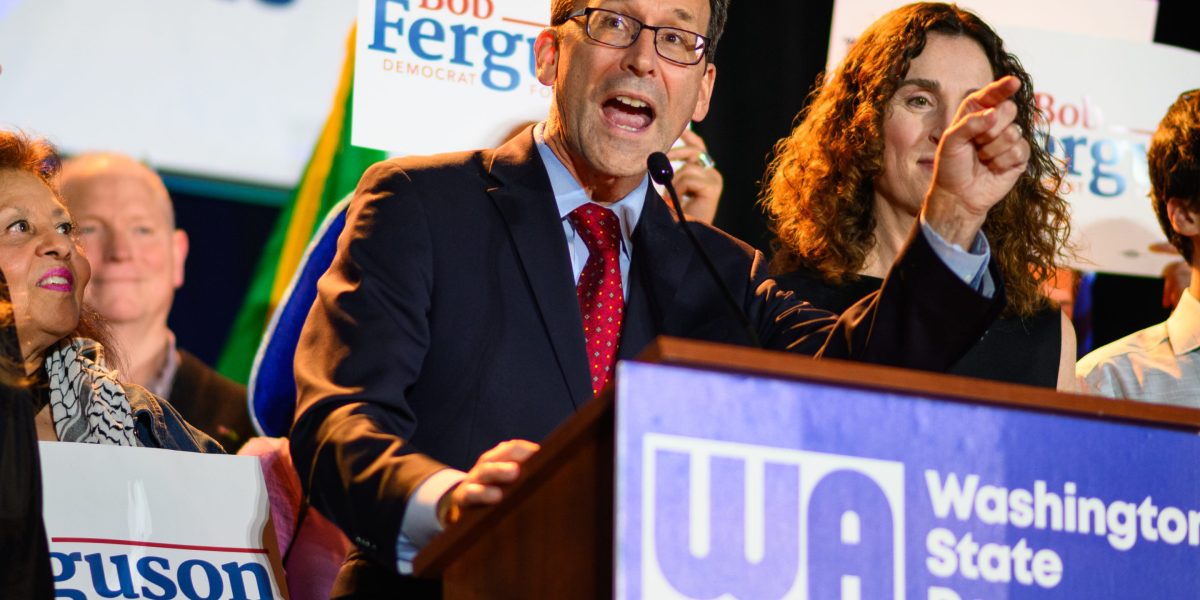
When Washington Governor Bob Ferguson proposed the state’s first income tax in modern history, he said the word “affordability” five times. 

Ferguson on Tuesday asked the legislature to craft a 9.9% tax on personal income over $1 million, which would revolutionize a state revenue system heavily reliant on sales and property tax. Although his fellow Democrats have for decades failed to push through an income tax, Ferguson said it’s “a different time right now.”

“We are facing an affordability crisis,” Ferguson said. “It is time to change our state’s outdated, upside-down tax system. To serve the needs of Washingtonians today, to make our taxes the more fair, millionaires should contribute toward our shared prosperity.”

Democrats across the US are increasingly exploring taxes as a way to capture the populist moment and address the country’s widening wealth gap. If “affordability” was the issue highlighted by Democrats who outperformed expectations in the off-year elections of 2025, the slogan next year could very well be “tax the rich.”

It’s an opening Democrats see as the Trump administration this year paired tax cuts for high earners with reductions in Medicaid and supplemental food assistance. Raising taxes on the wealthy could also help solve a fiscal problem for states dedicating more resources to plug the holes from federal cuts.

“We have a federal government that has gone into super-villain mode, seeming to deliberately take from the poor and middle class to give to the rich,” said Darien Shanske, a tax professor at UC Davis School of Law. “This unnecessary emergency is laying down a gauntlet for states: Will they let this suffering come to pass and, if not, how will they pay for the triage? Taxes on the best-off are not just fair but also efficient.”

Read more: Millionaire Tax That Mamdani Loves Fuels a $5.7 Billion Haul

Progressive tax advocates often point to Massachusetts’ 4% surtax on incomes over $1 million, which brought in roughly $5.7 billion in fiscal 2025, far exceeding revenue projections in its third year of collection. 

New York Mayor-elect Zohran Mamdani campaigned on raising the city’s income tax on millionaires by 2 percentage points to 5.9%, which critics said would lead to an exodus of wealthy people.

Colorado voters this year approved a measure to limit deductions for taxpayers earning at least $300,000. The revenue will fund a program providing free meals for all public school students. Colorado officials also advanced a ballot measure to change the state’s 4.41% flat rate to a graduated income tax, potentially raising more than $4 billion. That will likely go before voters in 2026. 

Michigan residents could also face a ballot initiative next year to change the state’s flat 4.25% tax rate to add a 5% surcharge on individuals earning more than $500,000 and couples making more than $1 million.

Romney’s Call

Even 2012 Republican Presidential candidate Mitt Romney has joined the call. Last week, the former US senator from Utah penned an essay in the New York Times calling for rich people to pay more, mostly in the form of closing loopholes the wealthy use to minimize tax obligations.

“It would help us avoid the cliff ahead,” Romney said, pointing to government funding shortfalls, “and might tend to quiet some of the anger that will surely grow as unemployed college graduates see tax-advantaged multibillionaires sailing 300-foot yachts.”

Most of the populist proposals coming from the states would raise taxes on income. But the tricky thing about some wealth is that it doesn’t come from a paycheck and thus is harder to tax. Even a levy on capital gains depends on a taxpayer selling assets to realize that increased value. 

For example, former Microsoft Chief Executive Officer Steve Ballmer’s net worth increased by $706.5 billion on Monday, according to the Bloomberg Billionaires Index. Even though his mansion sits across the lake from downtown Seattle, those gains wouldn’t be subject to an income tax. 

That’s why some Washington state Democrats are still pushing for the US’s first wealth tax on unrealized gains. Under a proposal passed by the state Senate last year, portfolios of some publicly traded asset classes worth at least $50 million would be taxed at 0.5%. 

Ferguson panned the wealth tax proposal last year, saying it would be irresponsible to balance the budget on a measure that would certainly face legal challenges. 

One of the most common warnings from tax opponents is that once legislators have a new tax mechanism, they’ll either increase the rate or lower the threshold at which it would apply. Ferguson in his income-tax proposal nodded to that concern, saying the $1 million level should increase with inflation and be included in the statute or perhaps even a constitutional amendment.

Read More: Vegas Lures Millionaires Fleeing Wealth Tax in Washington State

State taxes are also easier to avoid than federal taxes, because it’s relatively easy to move a primary residency. Washington used to attract taxpayers fed up with California’s high rates, but that has changed since the Evergreen State started taxing capital gains. Next year could be the year of the millionaire’s tax — in Washington state and across the US. 


Source link

Continue Reading

Business

Tesla faces NHTSA probe over Model 3 emergency door handles

Published

on


Tesla Inc.’s door handles are facing renewed scrutiny in the US after federal auto safety regulators opened a probe into the emergency releases in certain Model 3 vehicles.

The National Highway Traffic Safety Administration said it’s evaluating claims that the mechanical door release “is hidden, unlabeled, and not intuitive to locate during an emergency,” according to a filing on the agency’s website. The move stems from a petition filed by Kevin Clouse, a Tesla owner in Georgia who says he was trapped in his vehicle in 2023 and requested a defect investigation. NHTSA said it hasn’t decided whether to grant or deny the petition.

Read More: Tesla Doors Can Trap People Desperate to Escape

The probe covers an estimated 179,071 Model 3 sedans from the 2022 model year.

Tesla and NHTSA didn’t immediately respond to requests for comment.

The move expands on the federal examination of Tesla door problems following a monthslong investigation into the issue by Bloomberg, which uncovered a series of incidents in which people were severely injured or died after becoming trapped in their Teslas. In September, NHTSA opened an investigation into whether the doors are defective in certain Model Y SUVs amid reports of children stuck in vehicles when the 12-volt battery dies. The Model 3 and Model Y are by far Tesla’s top-selling vehicles.

The automaker was a pioneer of electrically powered handles, which can stop functioning without warning, particularly after a crash. A Bloomberg analysis this week found at least 15 deaths in a dozen incidents over the past decade in which occupants or rescuers were unable to open the doors of a Tesla that had crashed and caught fire. 

Bloomberg separately reported that potential safety issues with electric handles were raised with Chief Executive Officer Elon Musk during the development of the Model 3, and that he insisted on the futuristic design, which would include manual releases to mitigate power-loss problems.

Read More: Elon Musk Demanded Tesla’s Electric Doors Despite Safety Worries

Clouse filed a petition last month over a 2023 incident in which he says he had to kick his way out of his burning Model 3 when the doors wouldn’t open. Bloomberg previously cited details of Clouse’s case.

“I was unaware of the location of the hidden mechanical emergency door release because it is not visibly labeled, not explained upon delivery, and not intuitive in an emergency,” he said in a complaint filed with NHTSA. “I was forced to climb to the back seat and break the rear passenger window with my legs to escape while the interior was burning.”

Tesla shares fell 0.7% as of 11:41 a.m. Wednesday in New York.

This story was originally featured on Fortune.com


Source link

Continue Reading

Business

Trump administration bars Europeans from U.S. for pressuring tech firms to ‘censor’ American speech

Published

on


The Trump administration has barred five Europeans from entering the U.S., accusing them of pressuring American tech companies to censor or suppress American speech online. The individuals—Thierry Breton, Imran Ahmed, Josephine Ballon, Anna-Lena von Hodenberg, and Clare Melford—are all leading figures in European efforts to regulate harmful or illegal content on social media platforms.

The five were barred under a May policy targeting foreign nationals deemed responsible for suppressing speech protected under U.S. law.

“For far too long, ideologues in Europe have led organized efforts to coerce American platforms to punish American viewpoints they oppose,” Secretary of State Marco Rubio posted on X. “The Trump administration will no longer tolerate these egregious acts of extraterritorial censorship.

“We stand ready and willing to expand this list if others do not reverse course,” he added.

The EU’s Digital Services Act, which came into force across the European Union in 2023, appears to be a significant flash point for tensions. In a series of social media posts, Sarah Rogers, the U.S. undersecretary of state for public diplomacy, referred to former European Commissioner for Internal Market Thierry Breton as the “mastermind” of the Digital Services Act. 

The act requires that large online platforms such as Meta’s Facebook and Elon Musk’s X take greater responsibility for content posted on their services, mandating that companies remove illegal content such as hate speech and child sexual abuse imagery. It also prohibits platforms from targeting users with advertising based on sensitive personal data including race, religion, gender, or age, and bans targeting children with ads. And it requires platforms to be more transparent about their content moderation decisions and algorithmic recommendations. 

Critics—particularly in the U.S. tech industry—have long claimed the act gives governments too much power to define what constitutes illegal speech and forces American companies to comply with European standards.

Rogers also accused Breton of using the act to “threaten” Musk before an interview with President Trump. In response to the visa ban, Breton shared a message on X, stating: “To our American friends: Censorship isn’t where you think it is.”

Also banned were Von Hodenberg and Ballon of HateAid, a German organization that the State Department said helped enforce the DSA. In a joint statement shared with Fortune, they said: “We are not surprised. It is an act of repression by a government that is increasingly disregarding the rule of law and trying to silence its critics by any means necessary. This marks a new escalation: The U.S. government is clearly questioning European sovereignty.

“We will not be intimidated by a government that uses accusations of censorship to silence those who stand up for human rights and freedom of expression,” they added.

Melford, who leads the U.K.-based Global Disinformation Index (GDI), along with Ahmed, CEO of the Center for Countering Digital Hate, a nonprofit that works to counter hate and misinformation online, were similarly handed bans.

A GDI spokesperson told Fortune: “The visa sanctions announced today are an authoritarian attack on free speech and an egregious act of government censorship … GDI exists so that the public can understand and evaluate the information they find online. We fight speech with more speech. If only the federal government were brave enough to do the same.”

The move has also sparked a diplomatic backlash across Europe. German Foreign Minister Johann Wadephul said on X that the sanctions were “not acceptable.” French Foreign Minister Jean-Noël Barrot condemned the visa restrictions and defended the DSA, stating that it ensures “what is illegal offline is also illegal online.”

Emmanuel Macron, the president of France, said in a post on X that “France condemns the visa restriction measures taken by the United States against Thierry Breton and four other European figures.” He called the bans “intimidation and coercion aimed at undermining European digital sovereignty.”

The European Commission said in a statement that it had requested “clarifications” from the U.S. and warned: “If needed, we will respond swiftly and decisively to defend our regulatory autonomy against unjustified measures.”

Representatives for Breton and Ahmed did not immediately respond to Fortune’s request for comment.


Source link

Continue Reading

Business

When SNAP payments stopped, a fast-moving $50 cash program rushed in—and kept families fed

Published

on


Finances already looked tight for Jade Grant and her three children as she entered the year’s final months.

“Everyone’s birthday is back-to-back,” the 32-year-old certified nursing assistant said. “You have holidays coming up. You have Thanksgiving. Everything is right there. And then, boom. No (food) stamps.”

Grant is among the nearly 42 million lower-income Americans who get help buying groceries from the Supplemental Nutrition Assistance Program, or SNAP. When the federal shutdown began in October, she wasn’t worried about losing her benefits — she said she is used to government “foolishness.”

But circumstances got dicey when the budget impasse entered its second month and President Donald Trump took the unprecedented step of freezing November SNAP payments. With one child who eats gluten free and another with many allergies, specialty items already drove up her grocery bill. Now Grant wondered how she’d put food on the table — especially with her youngest’s 6th birthday approaching.

Then Grant logged into Propel, an app used by 5 million people to manage their electronic benefits transfers, where she saw a pop-up banner inviting her to apply for a relief program. Within a minute she’d completed a survey and about two days later she got a virtual $50 gift card.

The total didn’t come close to her monthly SNAP allotment. But the Palm Bay, Florida, resident said it was enough to buy a customized “ Bluey ” birthday cake for her son.

Nearly a quarter of a million families got that same cash injection from the nonprofit GiveDirectly as they missed SNAP deposits many need to feed their households. The collaboration with Propel proved to be the largest disaster response in the international cash assistance group’s history outside of COVID-19; non-pandemic records were set with the $12 million raised, more than 246,000 beneficiaries enrolled and 5,000 individual donors reached.

Recipients are still recovering from the uncertainty of last month’s SNAP delays. Company surveys suggest many are dealing with the long-term consequences of borrowing money in early November when their benefits didn’t arrive on time, according to Propel CEO Jimmy Chen. At a time when users felt the existing safety net had fallen through, they credit the rapid payments for buoying them — both financially and emotionally.

“It’s not a lot. But at the same time, it is a lot,” Grant said. “Because $50 can do a lot when you don’t have anything.”

A ‘man-made disaster’ forces partners to try something new

It’s not the first partnership for the antipoverty nonprofit and for-profit software company. They have previously combined GiveDirectly’s fast cash model with Propel’s verified user base to get money out to natural disaster survivors — including $1,000 last year to some households impacted by Hurricanes Milton and Helene.

“This particular incident with the shutdown we saw as akin to a natural disaster,” Chen said, “in the sense that it created a really sudden and really acute form of hardship for many Americans across the country.”

The scope differed this time. The “man-made disaster,” as GiveDirectly U.S. Country Director Dustin Palmer put it, was not geographically isolated. The benefits freeze impacted more people than they usually serve. SNAP costs almost $10 billion a month, Palmer said, so they never expected to raise enough money to replace the delayed benefits altogether.

But 5,000 individual donors — plus $1 million gifts from Propel and New York nonprofit Robin Hood, as well as other major foundations’ support — provided a sizable pot. Palmer found that the issue resonated more than he expected.

GiveDirectly reports that the median donation was $100. Palmer took that response as a sign the issue hit close for many Americans.

“You and I know SNAP recipients. Maybe we’ve been SNAP recipients,” Palmer said. “So that was not a disaster in Central Texas where I’ve never been, but something in our communities.”

The greatest question revolved around the total sum of each cash transfer. Should they reach more people with fewer dollars or vice versa? Los Angeles wildfire survivors, for example, got $3,500 each from a similar GiveDirectly campaign. But that’s because they wanted to provide enough to cover a month’s worth of lodging and transit to those who lost their houses.

They settled on $50 because Palmer said they wanted a “stopgap” that represented “a meaningful trip to the grocery store.” To equitably focus their limited resources on the that would be missing the most support, Palmer said they targeted families with children that receive the maximum SNAP allotment. Propel’s software allowed them to send money as soon as the app detected that a family’s benefits hadn’t arrived at the usual time of the month.

Recipients decided whether their prepaid debit cards arrived physically, which might allow them to take cash out of an ATM, or virtually, which could be used almost immediately. The split is usually pretty even, according to Palmer, but this time more than 90% of recipients went with the virtual option.

“To me, that speaks to the speed and need for people,” Palmer said. “Just saying, ‘Oh yeah, I just need food today. I don’t want to wait to get it mailed.’”

Recipients lost trust when closely watched benefits were disrupted

Dianna Tompkins relies on her SNAP balance to feed her toddler and 8-year-old child.

“I watch it like a hawk, honestly,” she said.

But she said she entered “panic mode” when she missed what is usually a $976 deposit last month. She’s a gig worker, completing DoorDash and Uber Eats orders when she finds the time.

Her pantry is always stocked with non-perishables — canned goods, pastas, sauces — in case her unreliable van stops working and she can’t get to the store. But she couldn’t risk running out as uncertainty continued over the shutdown’s length and future SNAP payments.

GiveDirectly’s $50 bought her milk and bread — not much but a “big help,” she said. Her local food pantries in Demotte, Indiana, had proven inconsistent. One week they gave far more than expected, she said, but the following week they were “so overwhelmed” that it almost wasn’t worth visiting.

She said it’s “scary” the government “can just decide to not feed so many people.”

“At least I have my safety net but not everybody’s lucky,” she said. “I’ve never trusted the government and that’s just a new solid reason why I don’t trust them.”

Chen, the Propel CEO, said his company’s research suggests that November’s freeze damaged many recipients’ confidence in the government. Even with SNAP funded through the next fiscal year, Chen said, many respondents are concerned about another shutdown.

“Now it’s introduced this seed of doubt for people that this really fundamental thing that they use to pay for food may not be there when they need it,” Chen said.

The gap persists for many. Propel estimates that just over half of SNAP recipients got their benefits late last month. GiveDirectly launched an additional “mop-up” campaign to distribute cash retroactively for more than 8,000 people still reeling.

The delay disrupted the financial balancing act that Grant had going. She put off payments for her electricity bill and car insurance.

“Government shuts down and that just throws everything completely off,” she said.

___

Associated Press coverage of philanthropy and nonprofits receives support through the AP’s collaboration with The Conversation US, with funding from Lilly Endowment Inc. The AP is solely responsible for this content. For all of AP’s philanthropy coverage, visit https://apnews.com/hub/philanthropy.


Source link

Continue Reading

Trending

Copyright © Miami Select.