Connect with us

Business

Millennial designer spent months building ‘The Holiday’ cottage replica. It’s renting at $499/night


Published

on


Everyone has must-watch holiday movies that they binge during the festive season, from Love Actually to Home Alone. But few actually get the chance to step inside the world of their favorite comfort flicks—that is, until now. Superfans of The Holiday can now rent out a replica of the quaint English cottage where fictional Hollywood bigwig Amanda Woods (played by Cameron Diaz) was charmed by heartthrob British book editor Graham (played by Jude Law). They’ll have to wait four months, and make the trek to Georgia instead of the Cotswolds. 

Home designer Lucy Small put The Holiday Cottage up for short-term rentals this October after a nine-month build—and a fan frenzy quickly ensued. The 37-year-old has spent the past six years designing homes in the Blue Ridge Mountains; she’s worked on three dozen houses, from bathroom and kitchen rebuilds to hardcore construction projects. But nothing could have prepared her for the rush of attention that came with her latest project: replicating the cozy Rosehill Cottage featured in The Holiday, from the ground up. After all, nearly two decades after the movie’s release, it continues to be a top-watched festive flick—in 2023, The Holiday was streamed 2.3 million times, according to an analysis from Samba TV.

As it turned out, the house featured in the 2006 film—owned by Kate Winslet’s character Iris, who home-swapped with Amanda’s L.A. mansion for the Christmas season—never actually existed in real life. It was a big undertaking, but Small saw a potential hit on her hands. 

“The Holiday Cottage was really a fun thing. I was like, ‘Hey, why don’t I do this? I have everything at my disposal to be able to do it, I know how to build, and I can find land,’” Small tells Fortune, adding she’s a fan of the iconic movie. “Honestly, it was just one of those situations where I had this wacky idea, and everyone got excited about it, and no one stopped me.”

David Cannon Photography/Courtesy of Lucy Small

Before the foundation of the two-bedroom, two-and-a-half bath home was even built, Small had attracted attention from thousands of customers. She first announced her plan to build the cottage in 2022, and fan fervor started pouring in. The entrepreneur says they only had digital renders of the cottage at the time, but people were already sending her handwritten letters about how they couldn’t wait to stay there. Around 4,000 people left their emails on a website Small threw together to update the public on its availability. Now, just two months after going live on the market, the short-term stay is fully booked out until March 2026. 

“People have really loved it, and every time I get one of those letters of, ‘This means so much to me, thank you so much for making it possible,’ that’s just way more worthwhile to me than anything else,” Small continues. “Anyone can build a house, have it be a good investment, and sell it to an investor. But this seems to really have meaning to people, and that makes it important.”

The nine-month process to bring The Holiday cottage to life

It’s no easy feat bringing a piece of cinema into the real world—especially when you’re up against a home that’s impossible to replicate. In truth, the Rosehill Cottage featured in The Holiday was just a bit of movie magic; the home’s weathered facade was built in an open field, while the interior was filmed on sets. Home-makers might hesitate at the idea of building an unbuildable home—but Small was actually excited by the premise. 

“I found out that the house never actually existed in real life, which, for me, is a big deal. Because if you can actually go visit the Brady Bunch house, or the Home Alone house, me building another one is less interesting,” she explains. “But if it never existed, if it’s a set that was torn down 20 years ago, that’s a lot more interesting, because there is literally nothing else in the world like it.”

Small put the project into motion several years ago, but quickly ran into some time-consuming roadblocks. Georgia, a popular tourist getaway and filming location, was slow to issue more short-term rental licenses as temporary stays flooded the market. Heavy taxes and fees also had to be factored into the price, as counties wanted in on the industry’s growing success. Finding the right land to build on was a struggle—but once they settled on a plot in North Georgia, it was off to the races. 

David Cannon Photography/Courtesy of Lucy Small

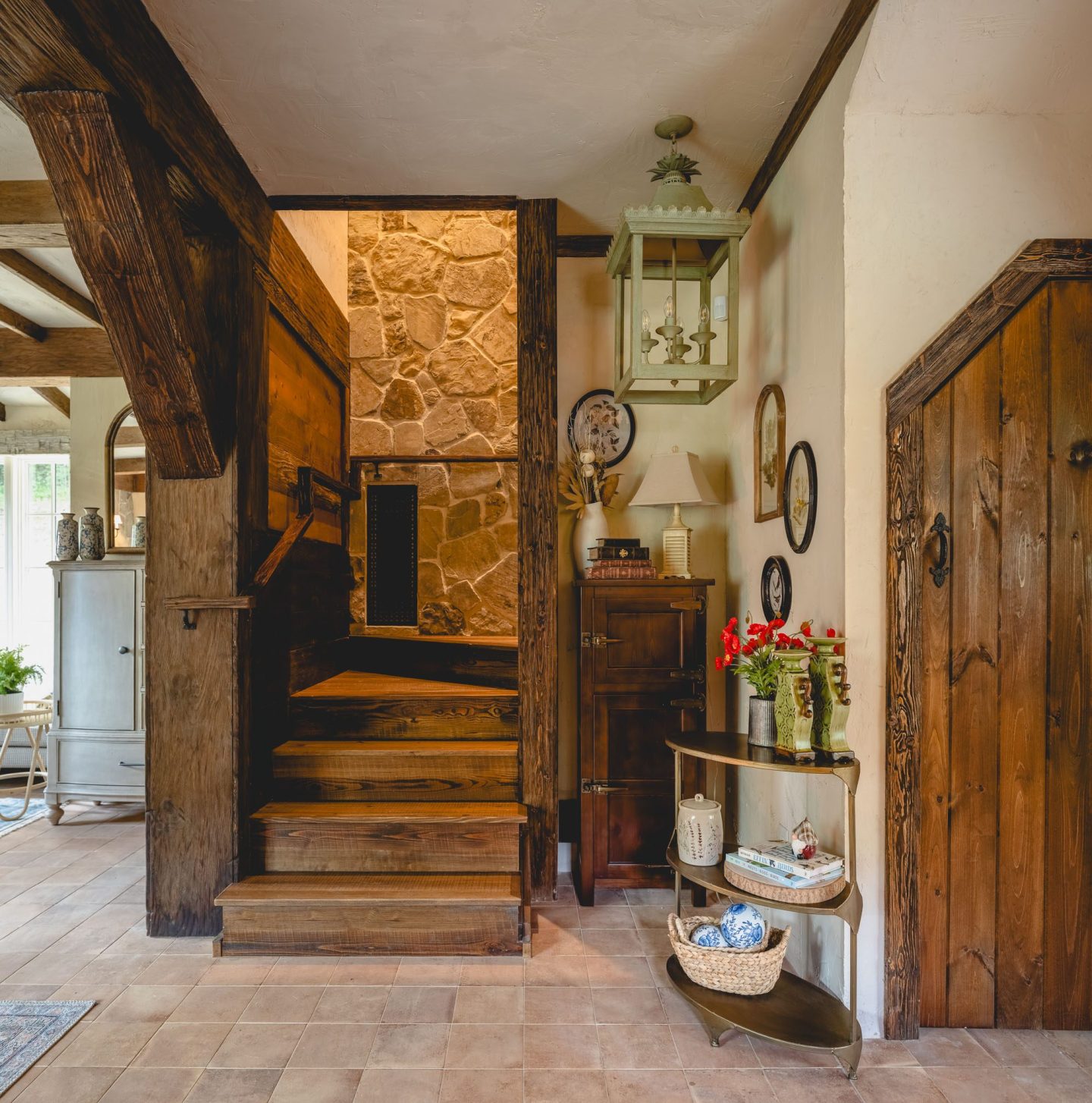
In total, it took nine months to build The Holiday Cottage, from breaking ground to putting in the final flourishes. Small worked with an architectural designer, watching the romcom together “1,000 times” to try and get it right. The first hurdle: They realized the house would never meet code. When trying to build at scale, they discovered the ceilings would be too low, standing at only seven feet tall, based on where the windows were positioned in the movie. The film version of the cottage had only two chimneys but featured three fireplaces; the bathroom floor was sloped; and, in reality, one window would cut halfway through the kitchen cabinet. Small and her team did everything to match the same aesthetic, even setting up fake walls and slopes.

Replicating the home’s furnishings proved to be a bit pricey, too. Despite the quaint movie cottage, seemingly adorned with humble, second-hand furniture, the kitsch decor was beyond Small’s budget. Using Google image reverse search, she tracked down antiques identical to the ones in the set, which ran upwards of $30,000 each. The bamboo umbrella tree shown in the cottage entryway, for example, was priced at over $15,000. Eventually, Small was able to parallel the same warm, charming atmosphere with similar decor. She declines to share how much the entire build set her back, or even when she’ll recoup on costs. Small says she rents out the home at a modest price—$399 per night during the low season, and $499 during high season—and is adamant The Holiday Cottage has been a worthwhile investment. 

“It’s not like we were totally surprised and totally blew the budget. We knew what it would be—we don’t charge a stupid amount,” Small says. “And so it’s still been a good investment, given that we did not like cheap out on the build at all.”

Having 4,000 eager fans lined up—and why Small is fine being a ‘one-hit-wonder’

With 4,000 eager renters already waiting for the pin to drop, The Holiday Cottage’s instant success wasn’t a huge surprise. However, Small wasn’t used to her projects getting so much attention. 

“As someone who, frankly, does not know how to use social media at all, who doesn’t have it, who’s pretty private, I’m usually unable to get eyeballs on any of my projects,” she continues. “For this one, [attention has] just been pouring in completely, even though I haven’t gone out to seek it, which has been a very new position for me as a designer.”

Once The Holiday Cottage booking site went live on Oct. 4, Small says dates started filling up “immediately.” And media attention only riled up more interest; the millennial home designer says she “can’t think of a magazine” that hasn’t covered her new build. And just in time for the holidays, it’s proved to be the perfect place to get into the festive spirit. Currently, there is only one open day in March, a few available slots in April, and just one in May. The Holiday Cottage isn’t available for a multi-day booking until June 2026—the house is nearly booked out for six straight months.
David Cannon Photography/Courtesy of Lucy Small

Small’s latest project has proved a huge success, and she says renters have so far been loving it. Travelers leave their stories in the home’s guest book; a trio of sisters brought their mother, a big fan of The Holiday, along for the ultimate dream stay; another visitor used to watch the movie with her mom every Christmas, and after her passing, rented the place with her dad. For the people who stay there, the short-term rental is more than a place to crash. It’s the chance to be immersed in romcom nostalgia and reconnect with loved ones. 

When asked if she is planning another movie-related build, Small says she’s perfectly happy being the homeowner of this one viral sensation. Right now, she has no other ideas—all she knows is she will only take projects like this, where people are excited about the result. Plus, Small believes there’s no other home built that can replicate the same magic as The Holiday Cottage. 

“Honestly, I’m fine being a one-hit-wonder,” Small says. “I don’t need it to be a big money-maker or big success, because a lot of the things that make this house—The Holiday Cottage—so special, I don’t think can be replicated.”

A version of this story originally published on Fortune.com on November 28, 2025.

Join us at the Fortune Workplace Innovation Summit May 19–20, 2026, in Atlanta. The next era of workplace innovation is here—and the old playbook is being rewritten. At this exclusive, high-energy event, the world’s most innovative leaders will convene to explore how AI, humanity, and strategy converge to redefine, again, the future of work. Register now.


Source link

Continue Reading

Business

Southern California in ‘great danger’ from Christmas flooding

Published

on


Residents of Southern California were bracing Wednesday for a powerful winter storm forecast to bring dangerous flooding as well as rock and mudslides to the region, threatening property and snarling holiday travel plans.

Peak rainfall in parts of the region is expected to reach as high as 1.5 inches per hour, according to the National Weather Service. The foothills and mountains south of Point Conception, which include parts of Los Angeles and Santa Barbara, are projected to receive up to nine inches (25 centimeters) of rain by 10 p.m. local time on Christmas Eve. The rain will continue to fall on Thursday, Christmas Day, and a total of 14 inches could soak the region (35 centimeters) by Friday.

“Severe, widespread flash flooding is expected,” the US Weather Prediction Center said in a forecast early Wednesday. “Lives and property are in great danger.”

Coastal regions of Southern California will receive multiple months’ worth of rain in a span of one to three days, according to AccuWeather.

Some Los Angeles County residents have already been ordered to evacuate areas that are vulnerable to mudslides and officials warned of possible road closures, airport delays and flight cancellations.

Read more: Southern California Faces ‘High Risk’ Floods as Storm Hits

Forecasters were also urging Californians to drive with care and never attempt to drive through flooded roadways. 

Join us at the Fortune Workplace Innovation Summit May 19–20, 2026, in Atlanta. The next era of workplace innovation is here—and the old playbook is being rewritten. At this exclusive, high-energy event, the world’s most innovative leaders will convene to explore how AI, humanity, and strategy converge to redefine, again, the future of work. Register now.


Source link

Continue Reading

Business

The K-shaped economy is carrying a ticking time bomb into 2026

Published

on


The U.S. economy grew at a 4.3% annual rate in the third quarter, blowing past economists’ expectations and delivering the kind of headline that signals strength heading into the new year. Consumers went on an unusually strong spending tear while corporations cinched $166 billion in capital gains. President Donald Trump and his team wasted no time celebrating, taking a victory lap over those dour economists who had warned of doom and gloom, declaring the “Trump economic golden age is FULL steam ahead.”

Well, slow down, those dour economists replied. There’s something missing in this boom: the jobs. Hiring this year, at best, has stalled, and at worst has collapsed: unemployment has climbed to 4.6%, and even Fed Chair Jerome Powell has warned recent data may be overstating job gains. 

This is the puzzle economists are now trying to reconcile. In a typical recovery, strong GDP growth shows up first in hiring, then in paychecks, and finally in consumer spending. But in this quarter, it’s reversed: spending is here without jobs. So how does an economy grow at a 4.3% annual rate when households aren’t actually earning more, and in fact, still fighting sticky inflation?

“I’ve never seen anything like it,” KPMG’s chief economist Diane Swonk told Fortune. “To have this stagflation in the inflation and unemployment rate, and to not have it in growth is highly unusual, and something’s got to give.”

A tale of two economies

There are two parts of the story of how the economy arrived here. The first is that households are spending without income growth. Real disposable income was essentially flat in the third quarter—literally 0% growth. Americans did not gain purchasing power. Yet, they made up the difference through savings drawdowns, credit, or by absorbing costs they cannot avoid. The GDP report itself points to where that pressure is concentrated: mostly in services, and within services, healthcare was a leading driver.

Americans spent the most on healthcare last quarter since the Omicron wave of 2022, Swonk said. Outlays on outpatient care, hospital services, and nursing facilities rose at one of the fastest paces in years, reflecting aging demographics and higher medical prices, but also the growing use of costly GLP-1 weight-loss drugs, which continue to push up spending even after adjusting for inflation. 

This was not a classic discretionary splurge, then. It was spending families had little ability to defer. That distinction matters, because spending driven by necessity behaves very differently from spending driven by rising paychecks. When households are paying more for healthcare, insurance, child care, or elder care, they are not signaling confidence; rather, they are absorbing pressure. And with real disposable income flat, those costs are not being met by wage growth, but by thinner savings and deferred choices elsewhere, Swonk said. 

The problem, then, is when that pressure eases in early 2026 as tax refunds surge and withholding changes put more cash temporarily back into paychecks, the boost could act as a “sugar high”: a short-term lift to spending that does not fix the underlying problem of weak job creation and stagnant real income. 

“We will feel more broad-based gains as we get into 2026,” Swonk said, “but at what price?” 

The concern, she added, is that stimulus layered on top of already elevated service-sector inflation could make price pressures “stickier,” not relieve them.

The second part of the story—and the one most Fortune readers will already recognize—is that this economy is no longer moving as a single system. It is splitting into a “K-shape,” and what looks like resilience at the top increasingly masks fragility underneath.

The GDP report makes that divergence hard to miss. Alongside surging consumer spending, corporate profits from current production jumped by $166 billion in the third quarter, a dramatic acceleration from the prior period. At the same time, investment fell, led by a sharp drawdown in private inventories as businesses got rid of their pandemic-era hoarding. Businesses are not broadly expanding capacity, or hiring aggressively, or even hiring at all. They are extracting margins, managing costs, and in many cases waiting. They have learned how to grow without hiring, Swonk said.

“We are seeing most of the productivity gains we’re seeing right now as really just the residual of companies being hesitant to hire and doing more with less,” she said. “Not necessarily AI yet.” In other words, businesses are squeezing output from a fixed or shrinking workforce, not expanding payrolls to meet new demand.

The K-shaped economy, fully matured

On one side of that K are affluent households and asset holders, whose spending continues to be supported by strong equity markets in jubilation after an historic year of AI spending, elevated home values, and corporate profit growth. On the other side are workers and lower- and middle-income households, whose spending, as already mentioned, is increasingly shaped by constraint rather than confidence, accounting for the consistent “affordability crisis.” The headline GDP number combines both groups into a single figure, but the lived economy does not.

Swonk noted that recreational services—travel, leisure, premium experiences—remain a bright spot, but are overwhelmingly carried by higher-income households. Even there, the data reveals stress beneath the surface. Vacation activity in August, she said, was the second-lowest on record for that month, trailing only August 2020. Airlines and hotels are still filling premium seats, but that demand is increasingly concentrated at the top.

The danger, Swonk argued, is that these two engines behave very differently over time. Spending supported by asset appreciation can persist as long as markets cooperate. Spending driven by necessity, however, cannot. 

“When you’re carrying an economy by wealth effects and affluent households, as opposed to employment gains and generating new paychecks, you’re vulnerable if there’s any correction in equity markets,” Swonk said. She described how quickly that channel can reverse: foot traffic slows, discretionary spending pulls back, and high-end demand evaporates far faster than headline GDP data would suggest.

“When you divorce growth from employment gains, you’ve got a problem,” Swonk said. “And this is before the real effects of AI have even set in.”


Source link

Continue Reading

Business

The biggest Powerball jackpots in history—and where the winning tickets were sold

Published

on


The Powerball jackpot has grown to an estimated $1.7 billion for Wednesday night’s drawing after lottery officials said no ticket matched all six numbers drawn Monday night.

The U.S. has seen more than a dozen lottery jackpot prizes exceed $1 billion since 2016. Here is a look at the largest U.S. jackpots won and the places where the winning tickets were sold:

1. $2.04 billion, Powerball, Nov. 7, 2022. The winning ticket was sold at a Los Angeles-area gas station.

2. $1.787 billion, Powerball, Sept. 6, 2025. The winning tickets were sold in Missouri and Texas.

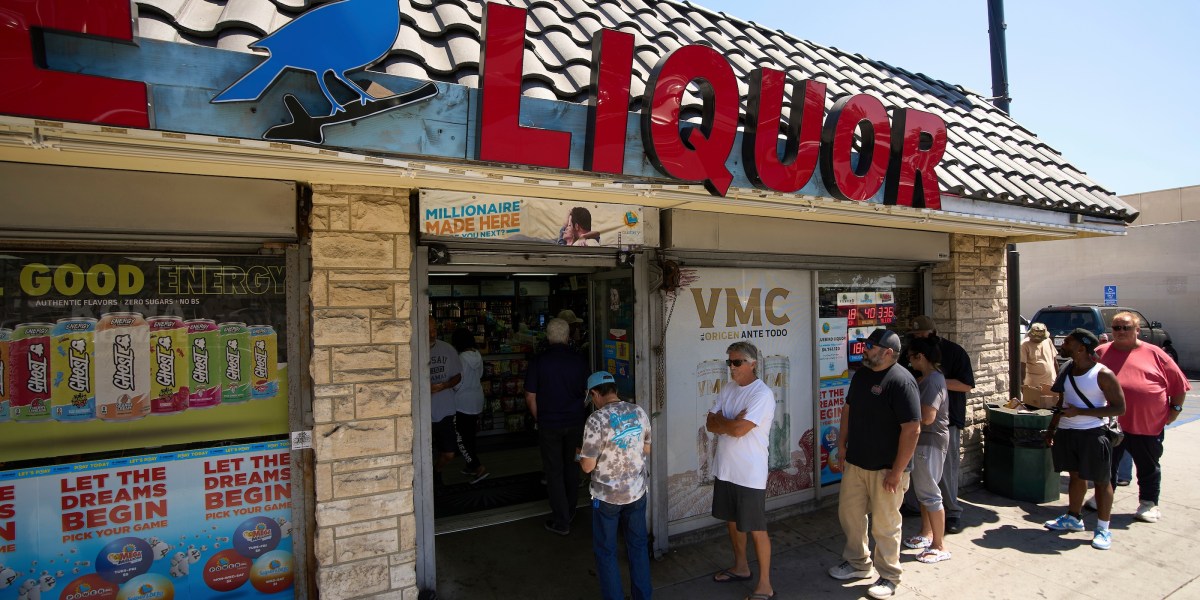
3. $1.765 billion, Powerball, Oct. 11, 2023. The winning ticket was sold at a liquor store in a tiny California mountain town.

4. $1.602 billion, Mega Millions, Aug. 8, 2023. The winning ticket was sold at a supermarket in Neptune Beach, Florida.

5. $1.586 billion, Powerball, Jan. 13, 2016. The winning tickets were sold at a Los Angeles-area convenience store, a Florida supermarket and a Tennessee grocery store.

6. $1.537 billion, Mega Millions, Oct. 23, 2018. The winning ticket was sold at a South Carolina convenience store.

7. $1.348 billion, Mega Millions, Jan. 13, 2023. The winning ticket was sold at a Maine gas station.

8. $1.337 billion, Mega Millions, July 29, 2022. The winning ticket was sold at a Chicago-area gas station.

9. $1.326 billion, Powerball, April 7, 2024. The winning ticket was sold at an Oregon convenience store.

10. $1.269 billion, Mega Millions, Dec. 27, 2024. The winning ticket was sold at a gas station in Northern California.


Source link

Continue Reading

Trending

Copyright © Miami Select.