Connect with us

Business

CEOs reveal their 2026 New Year’s resolutions: 8-day bike races, AI training, 7 hours of sleep

Published

on


The end of the year is approaching, offices are thinning out and auto-replies are being set as companies wind down for the holiday season. It’s a time that business leaders reflect on their 2025 performance, while also speaking their 2026 ambitions into existence. The same goes for their personal lives—and CEOs have already drummed up their New Year’s resolutions. 

Chief executives leading the likes of American genealogy giant Ancestry, $2.4 billion wellness platform Wellhub, ticketing business Eventbrite, and facial chain Glowbar are all weighing in on their goals. Each has their own distinct target—whether that be finally getting seven hours of shut-eye, or racing mountain bikes across South Africa for eight days. One is intent on getting a leg-up in the AI race, while another wants to revive a family tradition from her childhood. 

Beyond the boardroom, CEOs are setting goalposts for their own growth. Here’s what they’re hoping to achieve in 2026: 

8-day mountain biking race

“I’m an obsessive planner in that I set specific new goals for friends/family, my profession (CEO or Virta), personal health, and adventures I want to do. Next year, I’m doing an 8-day mountain biking stage race in South Africa with a partner.

For personal ‘health,’ I might also add a short meditation retreat—meditation is something I’ve found very helpful since 2013.”

Sami Inkinen, the cofounder and CEO of Virta Health Group.

Walking 20,000 steps every day

“On a personal level, I’m an avid walker. I love walking and try to walk as much as I can. So, for me, one New Year’s resolution I am really trying to stay strong on is walking at least 20,000 steps per day. Some days that is more accomplishable than others, but that is something as we head into the new year that I will be trying to conquer every day.

To get those 20,000 steps a day, I try to walk everywhere I can. And luckily for me, New York and Philadelphia are two great walking cities where I spend a majority of my time. And it also helps when I’m visiting a city where we have multiple Insomnia Cookies bakeries, so all that walking will be part of my strategy to get to 20,000 steps per day. 

And on a business level, continuing to expand our Insomnia Cookies unparalleled reach across the globe to deliver our warm, delicious cookies to more Insomniacs.”

Seth Berkowitz, the CEO and founder of Insomnia Cookies.

Live presently and embrace the little moments

“My resolution is to live presently and embrace both the big and small IRL moments that build life’s memories—whether that’s creating new experiences through travel, spending time with loved ones, or exploring my own interests in culture and entertainment.”

Julia Hartz, the CEO and cofounder of Eventbrite.

Vision board over New Year’s resolutions

“I don’t make New Year’s resolutions because historically I haven’t kept them, and it makes me feel discouraged. Instead, I create an updated virtual vision board for how I want the year to FEEL. I think a lot of times, we create resolutions that are specific to an action that it’s easy to lose track [of]. When you focus on how you want to feel for the year, it’s easier to see what fits into that, and what doesn’t.”

Rachel Liverman, the CEO and founder of Glowbar.

Preserve family memories to last for generations

“My dad passed away in late August after living an amazing 87 years. That’s gotten me focused on being more intentional about time with my family and staying rooted in the things that matter most. 

One of my resolutions is to go through all of his old slides and videos, scan and preserve them, and add them to our family tree so we can share those memories together. My only regret is not doing it sooner—we should all take the time to capture these stories while our parents and grandparents are still here to help us understand the moments behind the photos. It’s a meaningful way to stay connected and ensure those memories live on for future generations.”

Howard Hochhauser, the CEO and President of Ancestry.

Stay ahead on AI 

“Professionally, I want to stay ahead of the curve in AI and identity. The industry is moving so fast that staying updated is almost a sport. You cannot just follow trends. You have to understand which ones will define the next decade and which ones are just noise. 

I also want AI to flourish on a fairer and safer ground, so society can benefit from its breakthroughs without sacrificing trust or accountability. Personally, my resolution is to grow as a father and partner while raising two children. Balancing family and work is not something you master once. It is a daily commitment. I want my children to grow up in a world that is fair and democratic, and that starts with how I show up at home.”

Ricardo Amper, the CEO and founder of Incode.

7+ hours of sleep and 4 trips without kids

“Like most people, my resolutions are all about wellbeing. And yes, I’m very much being a CEO about it, treating [wellness] like business objectives with clear targets and tracking. Sleep is honestly where I’ve been struggling most, so that’s my main focus: 7+ hours with good recovery scores at least five nights a week, tracked through one of Wellhub’s partner apps. 

I’m also keeping up with 240 minutes of cardio and strength training weekly, which breaks down to one hour, four days a week that I can squeeze in between meetings and family time. And personally, I want to take four trips with my wife without the kids. Even short ones count. That quality time together is everything.”

Cesar Carvalho, CEO and cofounder of Wellhub.

Reviving a childhood tradition and staying grounded

“My resolution is to reconnect with things that ground me. For example, I moved to LA for easy access to nature, yet I don’t always take advantage of it, even though I know I feel 100 times better when I disconnect outside; so, in 2026 I want to commit to a weekly hike or beach walk. I know prioritizing that time will be a gift to my mental and physical health. 

I’m also bringing back a childhood tradition: Friday night family dinners at home. Growing up, it was a ritual we all looked forward to, and I want to create that same end of week celebration with my family.”

Loren Brill Castle, CEO and founder of Sweet Loren’s.


Source link

Continue Reading

Business

Down Arrow Button Icon

Published

on


Merry Christmas. The economy is recovering. 

In assessing our economy or, really, any economy, you want to know if the economy is growing, that there are enough jobs for people, that people can borrow at reasonable rates and that the dollar you hold today is worth about the same as it did a year ago. If those four metrics are solid, we are good. Using Pareto’s 80/20 principle—the idea that 20% of any set of numbers constitutes 80% of the value of the entire set—we know that real GDP, the unemployment rate, interest rates and inflation drive the vast majority of what is important.

If those four numbers are excellent and all other economic metrics are falling apart, we still get a B grade. If all other numbers are great and those four numbers are bad, we get an F.

These four pillars are the best antidote to the idea of the “vibecession”—a state defined by persistent negative “vibes” and a sense of malaise about the economy due to factors like high grocery prices and housing costs, with no regard to what the hard data says.

When rhetoric gets loud in politics, look at the basic math. First, consider gross domestic product (GDP). GDP is simply the value of all the goods and services a country produces within a time period. Think of GDP as a country’s sales or revenue, just like the top line for a company. After a minus 0.6% growth rate at the start of the year, the second quarter bounced back with a 3.8% increase. New data this week showed third-quarter GDP growth accelerating to 4.3%—the highest rate in two years. Historically, a real GDP growth rate above 3% is outstanding. Real GDP—check.

In contrast, unemployment sits at 4.6%, the highest since 2021. But look at context: Since 1950, the average U.S. unemployment rate has been about 5.7%. In 2020, it spiked to 14.8%. By any historical measure, if you want a job in America today, the math is on your side. Employment—check.

Next, interest rates. The Federal Reserve recently set a target range of 3.5% to 3.75%. Historically, 30-year mortgages run two to three percentage points higher than that rate, and they currently sit around 6.3%. We are in a cooling-off period after mortgage rates peaked near 8% in late 2023. If you are anchored to the sub-3% rates of 2020—a once-in-a-century anomaly—6.3% doesn’t feel so good. But the historical average since 1971 is 7.4%. We are currently borrowing at low rates compared to the last five decades. Interest rates—check.

Finally, the annual inflation rate is currently around 2.7%, higher than the Federal Reserve’s 2% target but well below the 75-year average of 3.5%. Remember, the COVID-era high was 9.1% in June 2022. Things still “feel” bad around inflation because groceries can cost $150 for two bags and because of what has occurred over the past five years. Prices aren’t dropping, but the speed of their increase has significantly slowed. We are still paying for the 24% total price hike endured since 2021, but the bleeding has stopped. At 2.7%, the engine is cooling to a healthy temperature. Inflation—check.

The answer: Despite the “vibecession” narrative, the economy is recovering. I think we get an A-minus, no matter who the teacher is—Democrat or Republican.

One last item. Who drives all these metrics? Certainly not the politicians. It is the small-business person. They create the jobs and the growth. A healthy economy is built by small businesses. They create about 65% of all new jobs and the vast majority of innovation. These businesses have been operating in a fog of mixed information and a quickly changing policy environment. Predictability is the oxygen needed for entrepreneurs because their lives are already upside down with risk. They need the certainty to plan, hire and invest. So, people, let’s not confuse the creators. It is time to move past the noise and get back to business. The math says we’re going to be just fine.

The opinions expressed in Fortune.com commentary pieces are solely the views of their authors and do not necessarily reflect the opinions and beliefs of Fortune.


Source link

Continue Reading

Business

Why gold went through the roof this year

Published

on


The S&P 500 closed up 0.46% yesterday to hit a new record of 6,909.79. The index is now up 17.48% for the year. With only the quiet Christmas week left before the end of the year it’s likely that investors will mark this down in their spreadsheets as a very good year.

Unless, of course, they have a friend who bought gold at or before the beginning of 2025. The price of gold is up an astonishing 71% year-to-date, and is currently hovering around $4,514 per troy ounce. That friend is now laughing at you, the foolish stock investor, for wasting your money on trivia like the Magnificent Seven.

There’s a hackneyed narrative explaining why gold went up: We had a volatile year with President Trump’s tariffs disrupting global trade; Russia’s ongoing invasion of Ukraine; there’s a bubble in AI-related tech stocks; Bitcoin went nowhere this year (it’s down 7%); inflation is trending up; and gold is the safe-haven investment for nervous investors who want a hedge against pretty much all of that. 

In fact, that is only partially true, according to newish research from Claude Erb and Campbell Harvey of the Fuqua School of Business at Duke University. The reality, they say, is that the introduction in 2004 of gold exchange-traded funds—which make buying gold as easy as buying stocks—has permanently pushed up the price of gold.

“Total North American gold ETFs have almost $200 billion, and ETFs outside the U.S. account for another $175 billion in gold,” they said in an October 2025 research paper.

This chart shows the apparent effect on the price of gold following the introduction of gold ETFs. The chart shows the “real” price of gold, which discounts inflation from its price:
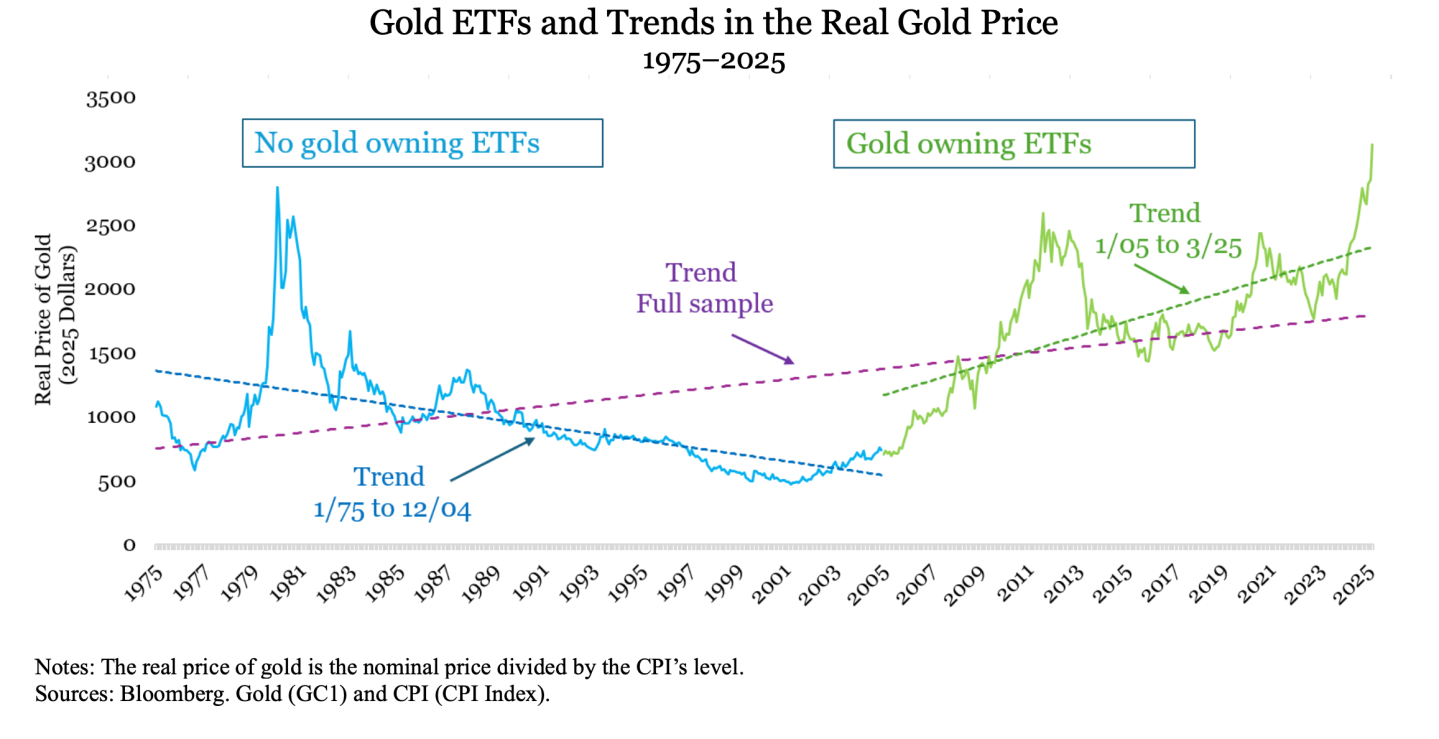
The more recent introduction of tokenized gold stablecoins—crypto tokens backed by gold reserves and thus pegged to the price of gold, which can be “staked” or locked up as investments in other risk assets like bonds—is likely to push the price up further, they say.

But don’t get too excited.

Gold isn’t actually a great hedge against inflation over the long run, Erb and Harvey argue. The price of gold has high volatility, whereas inflation is a low-vol phenomenon. Gold investors can thus spend years losing money if they are trying to beat inflation:

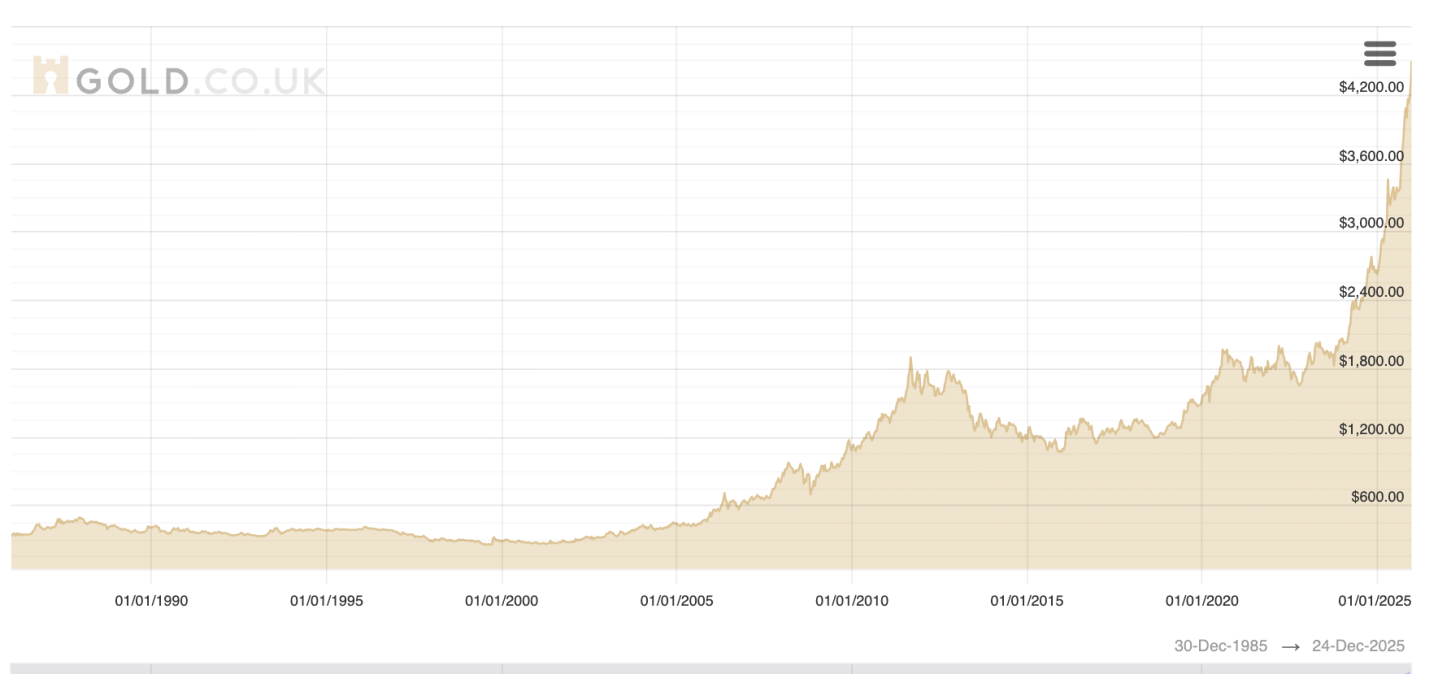
And then there is the performance of gold generally, in nominal dollars, versus stocks. This chart shows the price of gold over the last 40 years. Note that gold can spend years and years in long-term price declines:
And here is the Comex continuous contract for gold versus the S&P 500 index over the last 20 years. Clearly, the winner ain’t gold:
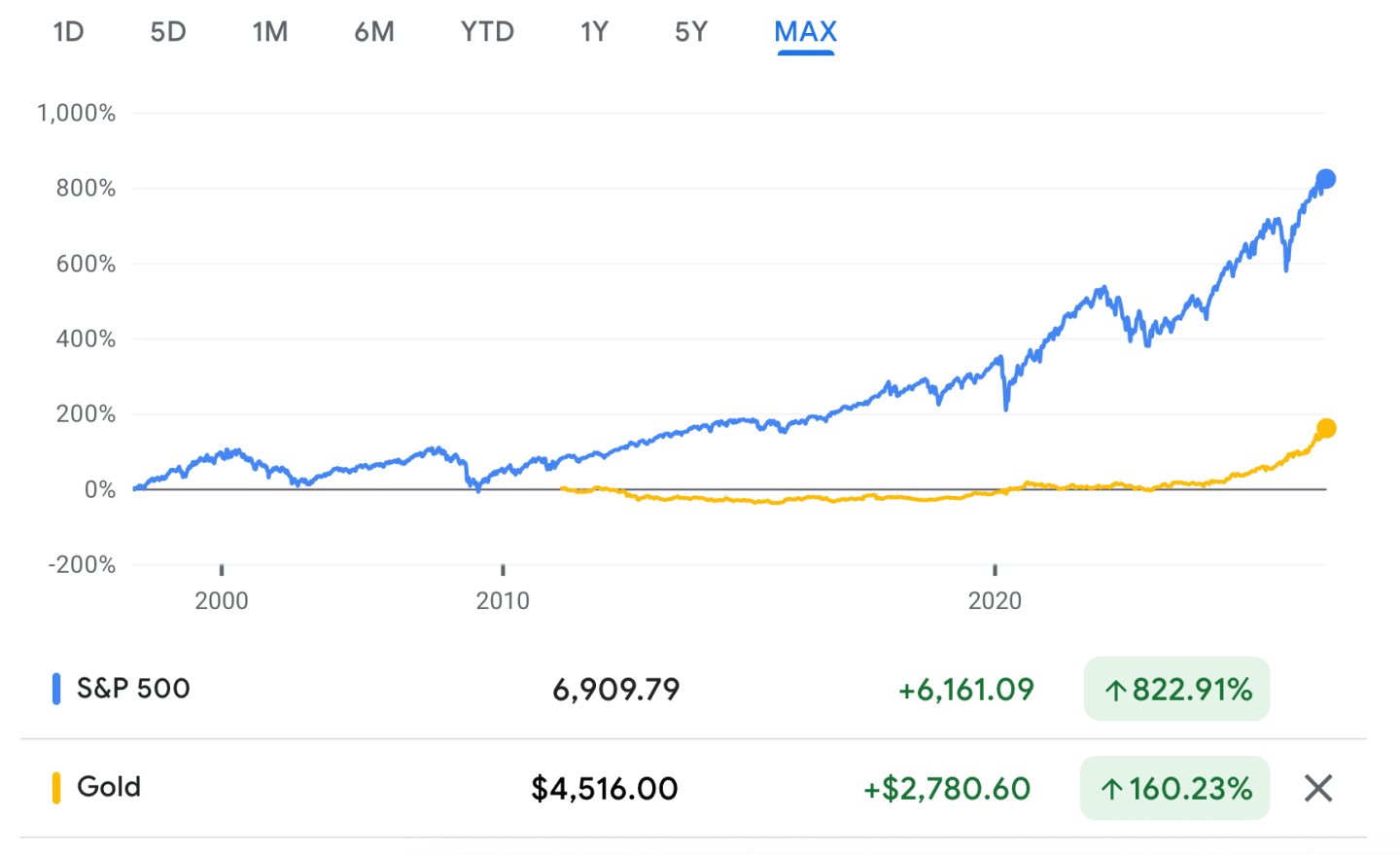
So has gold peaked? No one knows, obviously. But it is interesting that investment banks like Société Générale, Morgan Stanley, and Mitsui have all expanded their precious metal trading teams this year, and other banks are exploring getting back into the “vault” business of storing gold reserves, the Financial Times reports.

Here’s a snapshot of the markets ahead of the opening bell in New York this morning:

  • S&P 500 futures were flat this morning. The last session closed up 0.46% to hit a new record of 6,909.79. 
  • STOXX Europe 600 was up 0.39% in early trading. 
  • The U.K.’s FTSE 100 was down 0.12% in early trading. 
  • Japan’s Nikkei 225 was down 0.14%. 
  • China’s CSI 300 was up 0.29%. 
  • The South Korea KOSPI was down 0.21%. 
  • India’s NIFTY 50 was down 0.14%. 
  • Bitcoin was at $87K.
Join us at the Fortune Workplace Innovation Summit May 19–20, 2026, in Atlanta. The next era of workplace innovation is here—and the old playbook is being rewritten. At this exclusive, high-energy event, the world’s most innovative leaders will convene to explore how AI, humanity, and strategy converge to redefine, again, the future of work. Register now.


Source link

Continue Reading

Business

How AI is redefining finance leadership: ‘There has never been a more exciting time to be a CFO’

Published

on


Good morning. This year has shown that AI isn’t just a buzzword anymore—it’s redefining finance. 

In covering AI, I’ve spoken with CFOs across industries who are focused on value creation and developing real-world use cases for AI to reshape everything from forecasting and financial planning to strategic decision-making. As data moves faster than ever, finance leaders are asking a new question: not what AI could do, but how it can truly transform the enterprise. I’ve also talked with industry experts and researchers about topics ranging from the ROI of AI to “prompt-a-thons” and debates over whether AI will turn CFOs into chief capital officers.

Finance chiefs are signaling the next big evolution—2026 will be the year of enterprise-scale AI. Pilot programs and proofs of concept are giving way to avenues for full-scale deployment as CFOs expect AI to deliver measurable value: faster decisions, leaner operations, and predictive insights that can provide a competitive edge. However, that level of transformation comes with new demands—governance, data integrity, and human oversight matter more than ever.

I recently asked finance chiefs from leading companies how they expect AI to redefine what it means to lead in finance. For instance, Zane Rowe, CFO at Workday, told me: “There has never been a more exciting time to be a CFO with AI unlocking new opportunities for value creation through unprecedented data and insights. Most of the focus has been on experimentation and discovering the art of the possible, but this year, leaders will shift from ‘What can AI do?’ to ‘How do we build the foundation for scale?’ They will manage a more nuanced AI portfolio that balances launching pilots with rolling out proven solutions, and they will prioritize the unglamorous but critical work of data governance, process redesign, and maintenance of new technologies. Success in 2026 will be defined by how we mature our AI strategy to ensure it is both agile, durable, and enterprise-grade.”

Shifting from the perspective of a major tech company to a beauty and cosmetics leader, Mandy Fields, CFO at e.l.f. Beauty offered this prediction: “From where a CFO sits, AI simultaneously helps broaden our view to get a better macro picture and can help put a sharper focus on very specific points of interest. e.l.f. Beauty is growing globally, and AI has visibility across it all. Going into next year, we’ll continue to explore how we best leverage AI in finance to lean into its strengths. It’s a pretty similar approach to our high-performance teamwork culture in which we encourage the team to pursue and thrive in the areas where they have expertise, learn continuously and move at e.l.f. speed.”

You can read more insights from over a dozen CFOs on how AI will shape finance in 2026 in my complete article here.

This is the final CFO Daily of 2025. The next issue will land in your inbox on Jan. 5. Thank you for your readership—and wishing you a wonderful holiday season. See you in 2026!

Sheryl Estrada
sheryl.estrada@fortune.com

This story was originally featured on Fortune.com


Source link

Continue Reading

Trending

Copyright © Miami Select.