Connect with us

Business

Move over caviar, the hottest luxury ingredient is crab

Published

on


It’s a perplexing time in the world of luxury ingredients. Prestigious products have become inextricably tied to fast food. Caviar now adorns chicken nuggets; truffle features in supermarket hummus and Starbucks egg bites; wagyu beef is getting smashed into burgers and has made the menu at Burger King in the UK. Even lobster—bright red and festive—has gone from attention-getting centerpiece to mac-and-cheese mix-in. 

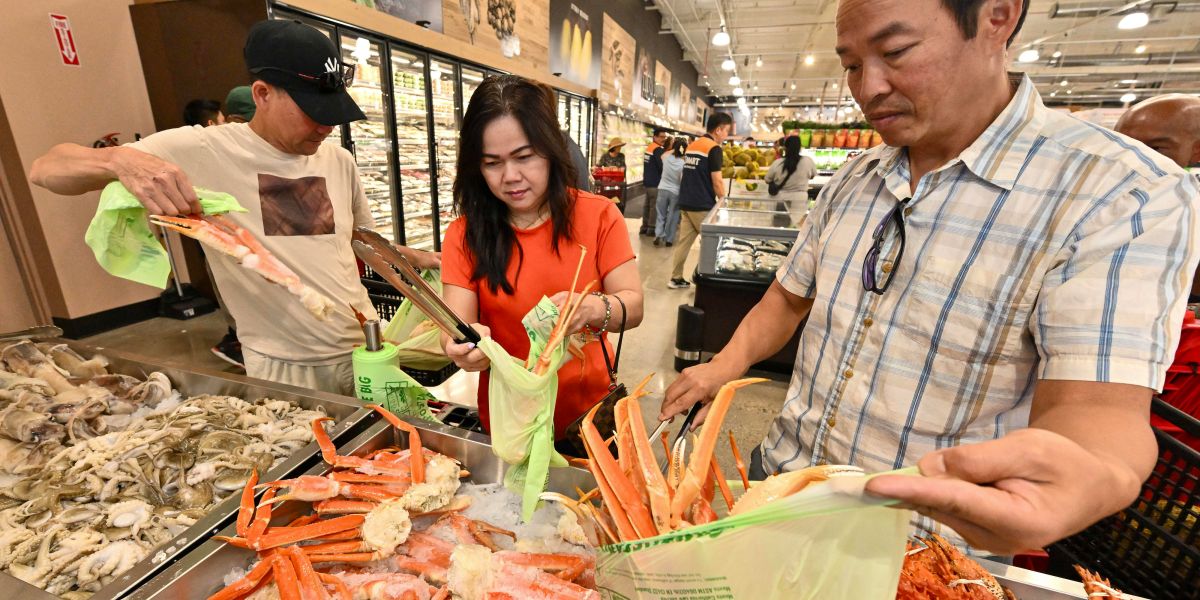
Yet crab retains its mystique. It’s beloved for its delicately flavored, finely textured meat—and for its fatty, rich roe and tomalley, culinary categories unto themselves. Now large, live specimens from the far corners of the world, like snow crab from Japan and red king crab from Norway, are this season’s luxury signifiers.

“Even the cheapest crab that we sell is typically double the price of what Maine or Nova Scotia lobster costs,” says Ian Purkayastha, founder of Regalis Foods. “King crab pricing is definitely at an all-time high.” Because their stocks and availability have been harshly affected by political and ecological upheavals, the crustaceans now wholesale for $70 to $85 a pound, he said. Retail consumers could spend upward of $1,200 to have a single, live 10-pound Norwegian red king crab delivered to their homes from Regalis. That, believe it or not, is the good news, he adds: “It’s just going to continue to go up and up and up in price. It’s not like you can farm a king crab.” He won’t be surprised if wholesale king crab prices top $100 a pound within five years.

The $888 Menu 

Take stock of current splurge-worthy dishes and dinners, and you’ll see: American diners and restaurant operators are embracing the luxury of crab. With the explosion of omakase-style dining, quality is trumping quantity more than ever. Take, for instance, Sushidokoro Mekumi. Newly opened in New York’s Hudson Square, this outpost of a two-Michelin-star restaurant in Kanazawa, on Japan’s west coast, offers a crab-centric omakase dinner for $888 per person, excluding drinks, for a few weeks this winter.

The meal’s current star is male snow crab, transported from Kanaiwa, a port town in Ishikawa prefecture, to New York in two days, at a wholesale cost of as much as $675 each. Three are needed for each evening’s seating of eight people. All December seatings are sold out, but January spots are available.

Mekumi’s chef Hajime Kumabe keeps it simple to convey just how good the ingredient is: “We almost never add anything else—just a little salt as seasoning.” Among the 18 to 20 courses are kani gayu, a delicate rice porridge made only from crab, crab broth, rice and salt; mokuzugani, or Japanese mitten crab, simply grilled over binchotan charcoal; and kobako gani, a female snow crab boiled immediately after it’s caught by fishermen in Japan, trained to do it to the restaurant’s specifications. Its meat is arranged with both its internal and external roe and served in its shell.

(An even more precious, and expensive, crab will splash into New York at the end of the year. Taiza gani, a snow crab from the cold waters off Kyoto is so rare that even in Japan it’s known as the “phantom crab.” Only five boats are permitted to fish it. It will be served for two nights at the new Tribeca kaiseki restaurant Muku; the $1,295 menus quickly sold out.)

Crab’s preciousness doesn’t just stem from its pristine state or the distance it’s traveled; it’s also in the labor it takes to bring it to the plate. At Yamada, the New York kaiseki restaurant that just scored four stars from the New York Times, it can take chefs 45 minutes of concentrated work to extract the meat from just one 2-pound kegani, or horsehair crab—just one of the crustaceans likely to appear in its $295, 10-course early winter menu. You might also find Hokkaido snow crab on the chawanmushi, a savory egg custard, and Dungeness crab in the closing donabe course.

The $100 Rice 

Outside New York, crab features at the twice-a-week kaiseki-inspired Crab Experience at Kinkan, a Thai-Japanese restaurant in Los Angeles. “Crab is my favorite thing,” says chef-owner Nan Yimcharoen, who grew up cooking and eating it with her grandmother in Bangkok. Over the course of the 11-course, $250 dinner, she serves dishes like sake steamed live Hanasaki gani—a spiny king crab from Hokkaido—and open-face scallop-shrimp shumai, topped with snow crab and sawagani, a tiny Japanese river crab, fried and eaten whole. 

At Angler, the live-fire seafood restaurant on San Francisco’s Embarcadero, savvy diners know to order the $100 off-menu crab rice. The course is composed of two dishes; a crab shell filled with the meat covered in Angler’s XO sauce, and koshihikari seaweed rice with crab butter, sake-cured salmon roe and crispy garlic chips. The crab variety changes seasonally and with the day’s catch: King crab is on the horizon; box and Dungeness crabs have featured recently. (If they can’t get good ones from California’s waters, the dish just isn’t available.) 

Dungeness, which James Beard called “a meal that the gods intended only for the pure in palate,” is also a marquee attraction (and the highest priced menu item) at two of the country’s notable regional Indian restaurants. At Unapologetic Foods’ Semma in New York’s West Village, diners are advised to preorder the $145 Kanyakumari Nandu Masala for two, which features a 1- to 1.5-pound crab cooked with cumin, black pepper, coriander seeds “and other spices too numerous to mention,” says chef Vijay Kumar.

The crab comes with coconut rice and crisp-edged parotta, for sauce sopping and textural contrast to the silky crabmeat. (Crab is an obsession across Unapologetic Foods’ restaurants.) Meanwhile at Nadu, chef Sujan Sarkar’s new Chicago restaurant, about 15 diners per week order the Keralan Crab Milagu Fry, available in big and bigger sizes for $135 and $185. For it, a whole Dungeness crab is cooked with Tellicherry peppercorn-tomato sauce and served with ghee rice.

The $2,000 Crab Deal

And then there’s the ceremony around live king crab. This fall at Octo, a Korean-Chinese restaurant in midtown New York, Steve and Christina Jang (owners of nearby Koreatown stalwart New Wonjo BBQ) began offering a feast featuring the creature in three parts: steamed with butter, garlic, soy sauce, cabbage and mushrooms over vermicelli noodles; dry-fried Sichuan style; and as fried rice, with the tomalley. An 8-pound crab, enough for five or six people, recently went for $850, they said, adding that they’re keeping the price low while they get the word out. 

At Carbone Riviera, which opened in the Bellagio, Las Vegas, in November, food has to work overtime to compete with flash: along with artworks by Miró, Picasso and Renoir, the restaurant has Fortuna, a 33-foot-long Riva yacht to give select guests a better view of the hotel’s famous fountains.

The restaurant’s king crab might just be the crustacean for the job. It comes prepared “Mulberry Style,” to reflect the abundant Italian and Chinese flavors on Mulberry Street, running through New York’s Little Italy and Chinatown. Priced from $175 to $200 per pound, a large one could tip the scales at upwards of $2,000. It is, potentially, the most expensive item at a place that is, for many people, what luxury is all about.



Source link

Continue Reading

Business

Trump just declared Christmas Eve a national holiday. Here’s what’s open and closed?

Published

on


President Donald Trump delivered an early gift to the federal workforce, signing an executive order that effectively grants a five-day weekend to hundreds of thousands of government employees. The order, signed last Thursday, designates both Wednesday, Dec. 24, and Friday, Dec. 26, as federal holidays for 2025.

While the move is a boon for morale within the executive branch—closing non-essential agencies from Christmas Eve through the following Sunday—it creates a complex patchwork of operating hours for the private sector and quasi-governmental services.

“All executive departments and agencies of the Federal Government shall be closed and their employees excused from duty on Wednesday, December 24, 2025, and Friday, December 26, 2025,” the executive order says, although it includes a crucial caveat allowing agency heads to keep offices open for “reasons of national security, defense, or other public need.”

While the move is generous, it’s not without precedent. Presidents often issue executive orders closing the government on Christmas Eve when it falls mid-week. Trump did this in 2018, 2019, and 2020. President Barack Obama also closed the government on Dec. 26 in 2014. However, securing both surrounding days is a rarity. And crucially, Trump’s executive order does not not legally compel banks, markets, or private enterprises to close.

With all that said, here’s what’s open and closed on December 24th.

Government services & mail

While most federal offices—such as Social Security Administration field offices and passport agencies—will be dark, the U.S. Postal Service (USPS) is an exception. Despite being a federal establishment, USPS operations are largely funded by revenue rather than tax dollars. Post offices are expected to remain open on Christmas Eve (likely with shortened retail hours) and resume normal operations on Dec. 26. Mail will be delivered on both days, though not on Christmas Day.

Financial markets

Wall Street is not taking the extra days off. The New York Stock Exchange and Nasdaq will operate on a modified schedule:

  • Dec. 24: Open, with an early close at 1:00 p.m. ET.
  • Dec. 25: Closed.
  • Dec. 26: Open for a full trading day.

Banks

The Federal Reserve has not adopted the additional holidays for its banking operations. Consequently, most major banks (Chase, Bank of America, Wells Fargo) will remain open on Christmas Eve and Dec. 26. Customers should expect branches to close early on the 24th, but online banking and ATMs will function normally.

Shipping & logistics

For businesses rushing last-minute inventory, carriers have diverged on their post-Christmas plans:

  • FedEx: Expects to be fully operational on Dec. 26, though some freight services may run on a modified schedule.
  • UPS: Has announced no pickup or delivery service for Dec. 26, treating it effectively as a holiday extension alongside Christmas Day.

Private sector & retail

Major retailers like Walmart and Target are unaffected by the federal closure. They will generally be open for last-minute shoppers on Christmas Eve, closed Christmas Day, and fully open for returns and sales on Dec. 26.

This story was originally featured on Fortune.com


Source link

Continue Reading

Business

Down Arrow Button Icon

Published

on


As we wind down 2025, I’m doing what just about everyone else is doing—thinking about 2026. 

For the private markets, this means thinking about more AI, all the time. That said, I do think next year the rubber is going to meet the road for AI startups and giants alike. High compute costs, compressed margins, and soaring valuations and expectations will inevitably collide with reality. And for some, this will mean even more acquisitions and more acquihires than perhaps we’ve seen so far in the AI boom. 

I started asking around: Which startups would make smart acquisition targets for a tech giant in 2026?

“To unlock ‘real world’ AI like robotics, autonomous vehicles, smart factories, spatial computing, and embodied AI, tech giants need models that can reason about the real world in real time,” said Aidan Madigan-Curtis, Eclipse Ventures partner, via text. “Startups like Wayve, Physical Intelligence, WorldLabs, Bedrock Robotics, The Bot Company and GenesisAI, are already building simulation engines, sensor fusion stacks, and world models that learn from physical interaction—capabilities that would take incumbents years to replicate internally.” (Eclipse is an investor in Wayve.)

Madigan-Curtis gets at an essential question: In AI, when does it make more sense to acquire rather than build? Shensi Ding, CEO and cofounder at AI integration infrastructure startup Merge, points out an unconventional idea around finance (a widely touted AI use case): “Large AI players should acquire boutique investment banks and use historical financial models to train them. This work is highly specialized and requires domain expertise to really break through and build trust.”

Meanwhile, Morgan Blumberg, M13 principal, thinks that large foundation model companies will look to gobble up application layer companies with proven product-market fit. The obvious targets: coding tools, one of enterprise AI’s great 2025 success stories.

“In 2025, we saw Windsurf in the coding space attract strong interest,” said Blumberg via text. “While some like Cursor might choose to stay independent, I predict there will be attractive prices for assets like Factory, Codegen, Wrap, and others.”

Zach Lloyd, CEO and founder of agentic coding startup Warp, reinforced that developers are a key customer base: “AI giants should acquire an observability platform like Datadog or Sentry,” he said via email. “These tools sit where code meets reality (logs, errors, traces, and production failures) which is exactly the context AI needs to be genuinely useful to developers.”

This push to get enterprise right transcends foundation-model mainstays like OpenAI or Anthropic, and for some large companies, it might make perfect sense to buy a unicorn outright, said Jake Stauch, CEO and founder of Serval, which builds AI agents for IT. “They could look to acquire enterprise AI solutions in customer support or enterprise search, such as Sierra or Glean respectively,” he said. 

It’s worth saying: Pretty much any deals of this ilk coming to pass would be, well, a big deal. That said, any potential deal target deserves serious scrutiny. So much capital has flowed into so many of these AI businesses. And last time I checked, even in the most abundant situations, there are inevitably a finite number of generational public companies. 

This is the last Term Sheet of 2025, and when we’re back on January 5, it’ll be with our much-loved Crystal Ball prediction series. So, I’ll leave you with one prediction of my own: Next year, we’ll enter a period where the haze of flowing capital and buzzy rhetoric will clear just a little, and we’ll start to see who can actually go the distance. 

See you in 2026, 

Allie Garfinkle
X:
@agarfinks
Email: alexandra.garfinkle@fortune.com
Submit a deal for the Term Sheet newsletter here.

The deals section will return in 2026. Subscribe here.


Source link

Continue Reading

Business

CEOs reveal their 2026 New Year’s resolutions: 8-day bike races, AI training, 7 hours of sleep

Published

on


The end of the year is approaching, offices are thinning out and auto-replies are being set as companies wind down for the holiday season. It’s a time that business leaders reflect on their 2025 performance, while also speaking their 2026 ambitions into existence. The same goes for their personal lives—and CEOs have already drummed up their New Year’s resolutions. 

Chief executives leading the likes of American genealogy giant Ancestry, $2.4 billion wellness platform Wellhub, ticketing business Eventbrite, and facial chain Glowbar are all weighing in on their goals. Each has their own distinct target—whether that be finally getting seven hours of shut-eye, or racing mountain bikes across South Africa for eight days. One is intent on getting a leg-up in the AI race, while another wants to revive a family tradition from her childhood. 

Beyond the boardroom, CEOs are setting goalposts for their own growth. Here’s what they’re hoping to achieve in 2026: 

8-day mountain biking race

“I’m an obsessive planner in that I set specific new goals for friends/family, my profession (CEO or Virta), personal health, and adventures I want to do. Next year, I’m doing an 8-day mountain biking stage race in South Africa with a partner.

For personal ‘health,’ I might also add a short meditation retreat—meditation is something I’ve found very helpful since 2013.”

Sami Inkinen, the cofounder and CEO of Virta Health Group.

Walking 20,000 steps every day

“On a personal level, I’m an avid walker. I love walking and try to walk as much as I can. So, for me, one New Year’s resolution I am really trying to stay strong on is walking at least 20,000 steps per day. Some days that is more accomplishable than others, but that is something as we head into the new year that I will be trying to conquer every day.

To get those 20,000 steps a day, I try to walk everywhere I can. And luckily for me, New York and Philadelphia are two great walking cities where I spend a majority of my time. And it also helps when I’m visiting a city where we have multiple Insomnia Cookies bakeries, so all that walking will be part of my strategy to get to 20,000 steps per day. 

And on a business level, continuing to expand our Insomnia Cookies unparalleled reach across the globe to deliver our warm, delicious cookies to more Insomniacs.”

Seth Berkowitz, the CEO and founder of Insomnia Cookies.

Live presently and embrace the little moments

“My resolution is to live presently and embrace both the big and small IRL moments that build life’s memories—whether that’s creating new experiences through travel, spending time with loved ones, or exploring my own interests in culture and entertainment.”

Julia Hartz, the CEO and cofounder of Eventbrite.

Vision board over New Year’s resolutions

“I don’t make New Year’s resolutions because historically I haven’t kept them, and it makes me feel discouraged. Instead, I create an updated virtual vision board for how I want the year to FEEL. I think a lot of times, we create resolutions that are specific to an action that it’s easy to lose track [of]. When you focus on how you want to feel for the year, it’s easier to see what fits into that, and what doesn’t.”

Rachel Liverman, the CEO and founder of Glowbar.

Preserve family memories to last for generations

“My dad passed away in late August after living an amazing 87 years. That’s gotten me focused on being more intentional about time with my family and staying rooted in the things that matter most. 

One of my resolutions is to go through all of his old slides and videos, scan and preserve them, and add them to our family tree so we can share those memories together. My only regret is not doing it sooner—we should all take the time to capture these stories while our parents and grandparents are still here to help us understand the moments behind the photos. It’s a meaningful way to stay connected and ensure those memories live on for future generations.”

Howard Hochhauser, the CEO and President of Ancestry.

Stay ahead on AI 

“Professionally, I want to stay ahead of the curve in AI and identity. The industry is moving so fast that staying updated is almost a sport. You cannot just follow trends. You have to understand which ones will define the next decade and which ones are just noise. 

I also want AI to flourish on a fairer and safer ground, so society can benefit from its breakthroughs without sacrificing trust or accountability. Personally, my resolution is to grow as a father and partner while raising two children. Balancing family and work is not something you master once. It is a daily commitment. I want my children to grow up in a world that is fair and democratic, and that starts with how I show up at home.”

Ricardo Amper, the CEO and founder of Incode.

7+ hours of sleep and 4 trips without kids

“Like most people, my resolutions are all about wellbeing. And yes, I’m very much being a CEO about it, treating [wellness] like business objectives with clear targets and tracking. Sleep is honestly where I’ve been struggling most, so that’s my main focus: 7+ hours with good recovery scores at least five nights a week, tracked through one of Wellhub’s partner apps. 

I’m also keeping up with 240 minutes of cardio and strength training weekly, which breaks down to one hour, four days a week that I can squeeze in between meetings and family time. And personally, I want to take four trips with my wife without the kids. Even short ones count. That quality time together is everything.”

Cesar Carvalho, CEO and cofounder of Wellhub.

Reviving a childhood tradition and staying grounded

“My resolution is to reconnect with things that ground me. For example, I moved to LA for easy access to nature, yet I don’t always take advantage of it, even though I know I feel 100 times better when I disconnect outside; so, in 2026 I want to commit to a weekly hike or beach walk. I know prioritizing that time will be a gift to my mental and physical health. 

I’m also bringing back a childhood tradition: Friday night family dinners at home. Growing up, it was a ritual we all looked forward to, and I want to create that same end of week celebration with my family.”

Loren Brill Castle, CEO and founder of Sweet Loren’s.


Source link

Continue Reading

Trending

Copyright © Miami Select.