Connect with us

Business

The secrets of what Arnault knows: How Bernard Arnault built the impossible, and his timeless, transferable lessons of leadership 

Published

on


The history of the craftsmanship economy is littered with the ruins of fashion houses which lost their creative soul through founder absence, over-licensing, or managerial drift — as seen at once-iconic examples such as Halston, Pierre Cardin, Liz Claiborne, and Kate Spade — and internal turbulence (Gucci), as well as unsuccessful conglomeration efforts which proved incapable of preserving creative genius at scale. 

In contrast to such unraveled tapestries, Bernard Arnault has not merely defied that history; he has fortified quality brands and built something entirely new and unprecedented.  

Arnault did not merely preserve a single great house after a founder’s passing — a feat rare enough in creative industries. He has assembled, disciplined, and sustained an entire federation of once fragile maisons, each with its own lineage, mythology, tempo, and creative risk profile, transforming a constellation of independent brands into a pioneering global powerhouse, with LVMH the first European company to surpass a $500 billion valuation. Along the way, Arnault has become one of the rare titans whose vision has reshaped not just business, but culture and society more broadly. 

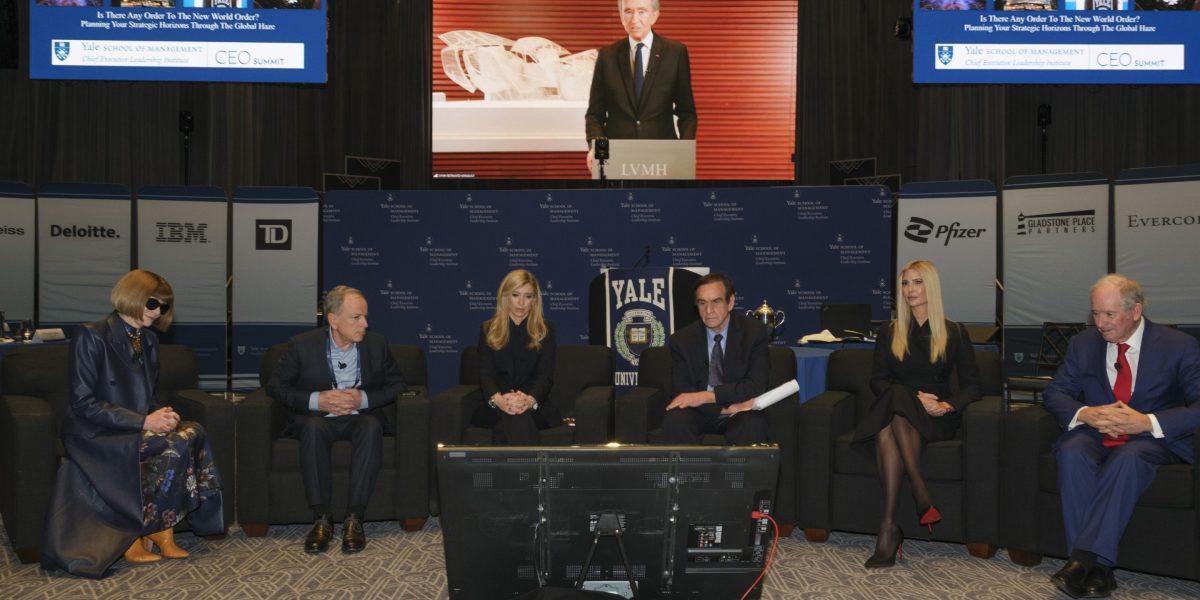
So how did Bernard Arnault achieve the impossible? This is a question we had a rare opportunity to explore publicly. At our recent Yale CEO Summit, we conferred the 2025 Yale Legend in Leadership Award upon Arnault, presented by Condé Nast global chief content officer and artistic director Dame Anna Wintour; Blackstone chairman and CEO Stephen Schwarzman; and entrepreneur and philanthropist Ivanka Trump, the entirety of which was broadcast live on CNBC TV and on CNBC.com. Afterward, Arnault subsequently engaged in some rare Q&A, moderated by CNBC anchor Sara Eisen, during which he cast some light on the secrets to his success, and at least three timeless and transferable lessons of leadership.  

That we had the opportunity to pick Arnault’s brain at all was exceedingly rare and unique. As his friend Steve Schwarzman reminded us during the award ceremony, he is “a most unusual person.” In a world of grandiose consumer goods promoters, it is rare to see a greatest brand builder also be a man of rare humble character.

Anna Wintour captured this paradox even more eloquently: “As many of you will have noticed, Bernard is not an easy man to get to know. I have been meeting with him for some four decades, and yet I still find him as fascinatingly enigmatic as Gerhard Richter’s Forest paintings — which, of course, are in Bernard’s collection. All I seem to have is traces and gestures, flickering from a person who has worked across the canvas at great speed.” 

Arnault’s lessons start with relentless focus. As he declared in his acceptance remarks, “My time as founder and CEO of LVMH since the late ‘80s has taught me that as the world evolves around us, we must evolve with it and embrace change while never losing sight of the core values and guiding principles upon which our businesses and institutions are built. Today, I suspect we can all agree that change is happening faster than ever, and that the way in which we live, communicate and transact is being constantly reshaped by the geopolitical environment, economic uncertainty, and seismic events of our time, and not least our fast-developing technologies. I also suspect we share that turbulence and uncertainty are not barriers to leadership. 

“In fact, quite the opposite. In turbulent times, we must anchor ourselves to our enduring values and principles. For LVMH, that anchor is clear: our commitment to exceptional craftsmanship, cultural heritage, and the relentless pursuit of excellence. These commitments are what our clients seek, what our brands are built on, and what ultimately stands the test of time. Staying true to those values in a volatile world is long-term stewardship.” 

Arnault’s focus is so relentless that, as Anna Wintour eloquently explained, “To say that Bernard is interested in his companies is like saying renowned pianist Glenn Gould was interested in Bach. He is an obsessive who feels the enterprise in every corner of his soul,” telling a humorous story of how, when the two of them had a spare afternoon in DC, Wintour suggested perhaps visiting a couple of museums along the National Mall, or seeing what was on at the Kennedy Center. “Bernard took on the unhappy expression of a man who had been asked to attend a three-hour lecture on soil erosion. His notion of a great day in the American capital, it turned out, was the same as his notion of a relaxing Saturday morning in Paris: visiting all the LVMH shops in town to see what they could be doing better.

A second lesson is the importance of loyalty, commitment, and family. As Ivanka Trump explained to us, “The quality I most admire in Bernard has nothing to do with business. It’s his devotion to family. Every Saturday, without exception, the entire Arnault family gathers together for lunch at the home of Bernard and his amazing wife Helene — all of his children and all of their children. In a world that moves quickly, Bernard chooses presence. In a life defined by innovation, he chooses ritual. That same consistency defines his relationship with his team. Bernard expects excellence, and he offers loyalty, mentorship, and trust in return. Many of LVMH’s senior leaders have spent decades under his guidance — a testament to a culture built on integrity, humility, and shared purpose”. 

Indeed, as Ivanka alluded to, Arnault defines family not strictly in the genetic sense. “My company is very much a family group, not only with my children, but it’s a way of managing a business. It’s not what we call in French, a societe anonyme — it’s the opposite. It’s a family. So everybody entering LVMH enters not only a big company, but a big family. They are members of the family, and we take care of them like family. Obviously, we have more than 200,000 people, so the relationship is not as close as in the small family, but it’s a family nonetheless. As for my children, I tried since their birth to explain to them that they are very lucky to be in a family that has a chance to manage such a group, but for getting responsibility, they have to merit the responsibility and to prove they can do it.”

A third lesson is the importance of a quality that Anna Wintour described as “brave and radical conviction,” or as Ivanka captured, “the right-brain/left-brain fusion to take the boldest risk, and still see around corners with uncanny business sense and precision.”

It is that visionary prescience which defines how Arnault has always perceived trends years before anyone else. As Steve Schwarzman noted, Arnault’s start in the luxury business was when he chose to retain “a small, unprofitable company called Christian Dior. He said he thought it had real potential — which I guess is one of the great understatements”. Though the group was bleeding cash at the time, Arnault knew it had value, as Ivanka related: “One of my favorite stories to tell Bernard tell is of his first trip to New York in the 1970s, when he asked a taxi driver if he knew the name of the French president. The cab driver said, no, but I know Christian Dior.”

That same visionary conviction to take big, bold bets holds true today, as Arnault perceived the shift towards premium experiences years before anyone else did. As Arnault describes it: “To give you one example: today people are looking not only for products, which I just described, but also for experiences. Over the years, we invested in many domains, we have some of the best hotels in the world — through Cheval Blanc and through Belmond. After COVID, the demand for these beautiful places has increased. People want to find the best qualities — the most extraordinary things. AI is very useful for some tasks. But AI cannot go in the kitchen very easily. AI cannot cook beautiful dishes.”

Similarly, as Anna Wintour points out, “today we are in the midst of a new moment of thrilling upheaval in fashion, and Bernard is once more at its core,” lifting and promoting a new generation of visionary young creatives and designers who blend innovation with tradition. 

That vision and conviction flow through directly from Arnault himself, unimpeded by bureaucracy. As Schwarzman described, “You would think with a company of this scale, that he has a large staff, and there’s constant deals put in front of him for approval. But as it works out, he doesn’t have a staff. He does everything himself. He works with just one person on every deal, and he’s done a huge number of deals in his life — almost all of which have a very interesting real-estate component, where he had his own success before this building of the luxury business. He’s a brilliant strategist as well as a tactician.”

***

Ultimately, Arnault’s success is a reflection of his singular qualities, but his leadership lessons are timeless and widely transferable. A generation prior, Charles Revson, the pioneering founder of Revlon, arrogantly declared “creative people are like a wet towel. You wring them out and pick up another one.” Perhaps that helps explain why Revlon has since declared bankruptcy as its luster faded, for such arrogance would be anathema to Arnault, whose personal humility masks a man who has had a singular impact on the world. 

As his trusted longtime deputy of five decades, Michael Burke, Chairman and CEO of LVMH Americas, declared to us: “Ladies and gentlemen, in June of 1963, a young boy in Frankfurt — myself — watched on a flickering black-and-white television as President Kennedy stood before half a million Berliners and, with fire in his voice, declared: Ich bin ein Berliner. On that day, something profound stirred within me. I sensed that a new era of boldness, freedom, and limitless possibility was dawning for the world. Thirteen years later, destiny led me to Paris. There, a young entrepreneur named Bernard Arnault looked at a nervous intern — again, myself — and chose to take a chance. Little did I know then that I had just entered the orbit of a man who would profoundly change the world — not through speeches, but through an unparalleled vision, unwavering courage, and an almost superhuman instinct for greatness. Today, as I stand before you to accept this esteemed award on his behalf, I feel a compelling urge to draw a parallel between that momentous day in 1963 and this moment. And so I proclaim: Bernard… Du bist ein Mensch.” 

The opinions expressed in Fortune.com commentary pieces are solely the views of their authors and do not necessarily reflect the opinions and beliefs of Fortune.

This story was originally featured on Fortune.com


Source link

Continue Reading

Business

Nvidia CEO Jensen Huang says humility is underrated: ‘You cannot show me a task that is beneath me’

Published

on


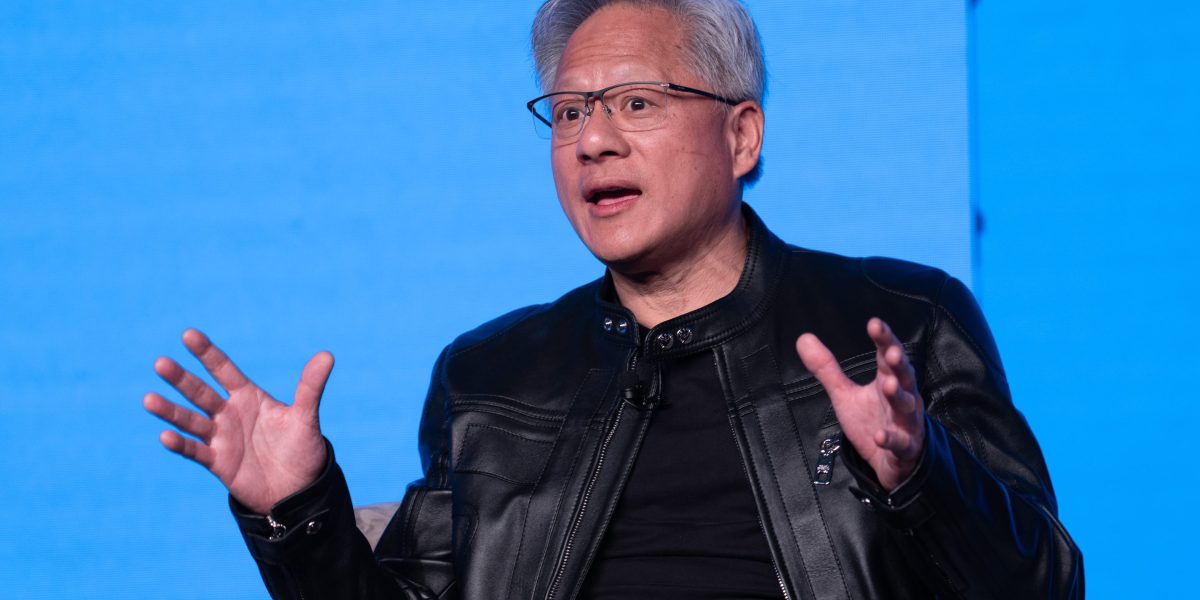
Nvidia’s CEO Jensen Huang has gone from the bottom to becoming a multi-billionaire, but that doesn’t mean he’s above doing the little tasks. 

The 62-year-old CEO of the world’s most valuable company said his humble roots as a dishwasher have, in fact, helped him learn to spurn no task. 

“You can’t show me a task that is beneath me,” he said in an interview with Stanford’s graduate school of business, which recently resurfaced on X.

Even in his most humble of jobs, the world’s ninth-richest man never shied away from the dirty work.

“I cleaned a lot of toilets. I’ve cleaned more toilets than all of you combined, and some of them you just can’t unsee,” he said.

If someone approaches Huang with a call for help, he said he tries to at least contribute. That way, at least, the person with the problem can see a new way of thinking about the problem, he added. 

“If you send me something and you want my input on it, and I can be of service to you, and in my review of it, share with you how I reason through it, I’ve made a contribution to you,” Huang said. “I’ve made it possible for you to see how I reason through something, and by reasoning, as you know, how someone reasons through something empowers you.”

These values have been fundamental to Huang’s leadership style and are partly why he is worth $161.8 billion, according to Forbes. Born in Taiwan, Huang moved to the U.S. at age 9 without his parents. As a teenager, he took a job as a dishwasher at Denny’s

It was actually at Denny’s where Nvidia, Huang’s future company, got its start, according to the Nvidia website

Years after he worked at the chain as a dishwasher, the Stanford graduate met with his future cofounders, Chris Malachowsky and Curtis Priem, to discuss the idea of a chip that would make 3D graphics possible on a PC. This idea sparked what would later become Nvidia, a chip empire that is now worth $4.5 trillion.

It wasn’t easy at first, according to Huang. When he presented the idea to his boss at LSI Logic, Wilfred Corrigan, he called it “one of the worst elevator pitches he’s ever heard.”

Still, Corrigan convinced Don Valentine, the founder of Sequoia Capital, to hear the pitch because of Huang’s strong work ethic.

Elon Musk, who actually played a role in Nvidia’s origin story, commented on the resurfaced Huang interview this week. 

“This is the way,” Musk wrote on X. When Nvidia introduced its first AI supercomputer, Musk was apparently the only one who reached out, saying he had a “a nonprofit AI lab” in need of such a product. Despite Huang’s skepticism that a nonprofit would buy a $300,000 computer, he personally delivered it to San Francisco to what he later realized was the OpenAI team behind ChatGPT. Musk left OpenAI in 2018.


Source link

Continue Reading

Business

The average worker would need to save for 52 years to claw their way of of the middle class

Published

on


The exact number of years of saving it’d take for the average worker to claw out of the middle class bracket has been revealed—and it’s nearly half a century.

Sobering new research from the think tank Resolution Foundation shows that for aspirational Brits looking to move up the wealth ladder, not even a lifetime of savings would be enough. 

In fact, the average worker would need to save their earnings for 52 years, to raise £1.3 million ($1.7 million), the amount needed to move from the middle and become as wealthy as the richest 10%.

And it gets worse: That’s with zero outgoings.

“Wealth gaps in Britain are now so large that a typical full-time employee saving all their earnings across their entire working life would still not be able to reach the top of the wealth ladder,” Molly Broome, senior economist at the Resolution Foundation and the lead author of the report, wrote.

And for those who happen to be born in the working class, the odds are increasingly stacked against them. 

“Wealth mobility in Britain is low—people that start life wealthy tend to stay wealthy, and vice versa,” Broome added.

As the saying goes, money makes money. The report revealed that the key driver of widening inequality is the so-called “passive” gains. Essentially, those who bought property and invested their money in pensions have seen their wealth balloon since 2010.

Workers in the U.S. would need to save for 70 years to unlock the American dream 

As inflation squeezes workers in a cost-of-living vise, paired with a job crisis that’s not been this bad since the financial crisis, and AI threatening to make it even worse, the salary it takes to be considered rich keeps climbing further out of reach. And the issue is transatlantic.

Even in the U.S., workers say they’d need at least $2.3 million to feel rich (up $100k from two years ago). Meanwhile, separate research highlights they’d need a staggering $4.4 million to achieve the American Dream—the house in the suburbs, two children, an annual vacation, and a new car in the drive.

In fact, Investopedia did the math and calculated that achieving those milestones would cost over $1 million more than most Americans will make in their lifetime.

With median weekly earnings of full-time workers averaging at $1,214, according to the Bureau of Labor Statistics, it would take 36 years of full-time work to feel rich with $2.3 million in the bank. That’s before a single bill is paid, and still $2.1 million short of affording the American Dream.

It would take the average American worker nearly 70 years without a single outgoing to reach that $4.4 million benchmark—far longer than most people will work in a lifetime, and that’s without even considering automation’s impact on the future of work, inflation, or any unexpected financial shocks.


Source link

Continue Reading

Business

Why restricting graduate loans will bankrupt America’s talent supply chain

Published

on


Federal Reserve Chair Jerome Powell said at his December 10 press conference that the U.S. labor market is becoming increasingly K-shaped: growth, opportunity, and resilience accrue to those with assets, while everyone else absorbs volatility.

What’s becoming clear is that this divide is no longer confined to the labor market. It’s now embedded in its foundation: education.

When access to advanced degrees depends not on ability or workforce demand, but on whether a household can absorb six figures of upfront cost, stratification accelerates. The upper branch compounds advantage through credentialed mobility. The lower branch absorbs risk, debt, and stalled progression.

That dynamic isn’t neutral. It’s destabilizing.

That is exactly what the restructuring of federal graduate student lending under the One Big Beautiful Bill Act (OBBBA) does. Framed as fiscal discipline, it quietly rewires who gets to advance in the American economy—and who pays more just to try.

A Two-Tiered Talent System

Beginning July 1, 2026, the OBBBA eliminates the Graduate PLUS loan program and replaces it with lifetime federal borrowing caps. Students in a narrow set of “professional degrees” may borrow up to $200,000. Everyone else, regardless of licensure requirements or labor-market demand, is capped at $100,000.

This distinction isn’t grounded in labor force need. It’s grounded in academic prestige.

Medical and law degrees qualify for the higher cap. Advanced nursing, social work, education, and public-health degrees do not, despite requiring licensure, despite severe labor shortages, and despite being the backbone of the care economy.

For many students, that $100,000 cap isn’t theoretical. It’s binding. Especially for those who already carry undergraduate debt, it can mean running out of federal aid before finishing a required degree.

That’s not cost containment. It’s credit rationing.

And when the federal backstop disappears, students don’t stop needing capital. They’re pushed into the private market, where interest rates are higher, protections are weaker, and access depends on credit history or family wealth.

From Merit to Capital

Yale Law Professor Daniel Markovits, author of The Meritocracy Trap, argues that our modern systems of advancement have created a new aristocracy, where the elite maintain dominance not through titles, but through the monopolization of expensive human capital.

Graduate education has now been folded directly into that system. In my recent discussion with Karen Boykin-Towns, Vice Chair of the NAACP National Board of Directors, and Keisha D. Bross, the NAACP’s Director of Opportunity, Race, and Justice, we identified how the OBBBA accelerates this dynamic, creating a capital-versus-merit system.

By capping federal loans while eliminating Grad PLUS, the government isn’t discouraging debt. It’s outsourcing access to private capital. Families with liquidity pay tuition directly. Everyone else pays interest, often at double the rate. This creates a sharp bifurcation:

  1. The Upper Branch: Students with “Capital” (generational wealth or family assets) can bypass the cap using private resources, continuing their upward trajectory into high-value careers.
  2. The Lower Branch: Students with only “Merit” (talent and drive but no family wealth), disproportionately Black women, are shut out.

The result isn’t meritocracy. It’s capital-screened mobility.

And when capital, not capability, determines who becomes a nurse practitioner, a clinical social worker, or a public-health leader, the economy doesn’t get leaner. It gets weaker.

The Intersectional Cost of ‘Money Out

These loan changes don’t hit all workers equitably.

Women dominate the fields most affected by the lower cap. At least 80% of degree holders in nursing, social work, and elementary education are women. These are precisely the programs now classified as “non-professional.”

Even within the same occupations, women earn less than men. Forcing them to finance advanced degrees with higher-cost private loans raises debt-to-income ratios at career entry, increasing default risk and long-term financial strain.

For Black women, the impact is sharper still.

Black women who attended graduate school hold approximately $58,000 in federal student debt on average, more than white women or Black men. Nearly half of the Black–white student debt gap is driven by graduate borrowing, reflecting how essential advanced degrees are for upward mobility in the absence of intergenerational wealth.

Black women are also heavily concentrated in healthcare and social services, fields now subject to the $100,000 cap. Remove Grad PLUS, and the math changes fast.

Federal graduate loans currently carry fixed rates under 9%. Private loans can soar as high as 18%, particularly for borrowers without prime credit or co-signers. That gap isn’t abstract. It’s interest compounding over decades. 

Consider a Black woman pursuing an MSW who needs $30,000 beyond the new federal cap to finish her degree. Forced into the private market, she trades a federally protected 9% rate for a predatory 18% rate.

This shift actively destroys the capacity to build generational wealth. This is also a multigenerational risk: Black women are the breadwinners in 52% of Black households with children. When we financially hobble the primary earner, we are not just restricting her mobility; we are capping the economic future of the 9 million children relying on those households.

We are cannibalizing future retirement security to pay for today’s policy experiment.

Educated, and Still Locked Out

Economic policy is never gender-neutral, and it is rarely race-neutral. The OBBBA financing caps disproportionately target Black women, a demographic that serves as a linchpin in both the educated workforce and the Care Economy.

There’s a persistent myth that student debt reflects low completion or poor outcomes. The data tells a different story. In interviews conducted with NAACP leadership, they shared job-fair data showing that more than 80% of applicants held a bachelor’s degree or higher. These are educated workers, many with advanced training, struggling to access stable, well-paid roles.

They did what the system asked. They earned credentials. They pursued licensure. And now the rules are changing underneath them. That isn’t a failure of effort. It’s a failure of policy design.

The $290 Billion Macroeconomic Bill

The consequences don’t stop at individual balance sheets. The sectors pushed into the lower loan cap, nursing, social work, and public health, are already facing acute shortages. The U.S. currently has an estimated 1.8 million vacant care jobs.

Failure to address these shortages is projected to cost the economy roughly $290 billion per year in lost GDP by 2030.

When the talent pipeline narrows:

  • Employers compete harder for fewer workers, driving wage and signing-cost inflation.
  • Turnover rises. During the pandemic alone, excess nursing turnover cost between $88 billion and $137 billion.

This is how a student-loan rule becomes a productivity drag.

What a Smarter System Looks Like

If the goal is fiscal responsibility and economic growth, there is a better path.

First, the definition of “professional degree” must reflect labor-market reality, not academic hierarchy. Licensed, high-shortage fields like advanced nursing and clinical social work should qualify for the higher cap. We must value the labor that sustains society as highly as the labor that litigates it.

Second, we need non-debt investment in critical workforce education. Grants and fellowships targeted to shortage fields reduce long-term risk while maximizing return. A graduate degree delivers an estimated net lifetime value of over $300,000 for women. That value should accrue to the economy, not be siphoned off by interest payments.

Third, employers must recognize this as a supply-chain issue. Talent doesn’t appear by accident. Corporate co-investment in education, through tuition support and loan forgiveness, offers one of the highest returns available. Global research suggests health workforce investments can generate returns of up to 10-to-1.

The OBBBA was designed to manage debt. In its current form, it manufactures fragility. It hardens the K-shaped economy at its foundation. It substitutes capital for merit. And it weakens the very labor force the economy depends on to grow.

If we care about productivity, competitiveness, and long-term stability, this is the wrong place to cut. America doesn’t have a talent shortage problem. It has an access problem. And this policy just made it worse.

The opinions expressed in Fortune.com commentary pieces are solely the views of their authors and do not necessarily reflect the opinions and beliefs of Fortune.

This story was originally featured on Fortune.com


Source link

Continue Reading

Trending

Copyright © Miami Select.