Connect with us

Business

Bank of America’s Moynihan says AI’s economic benefit is ‘kicking in more’

Published

on


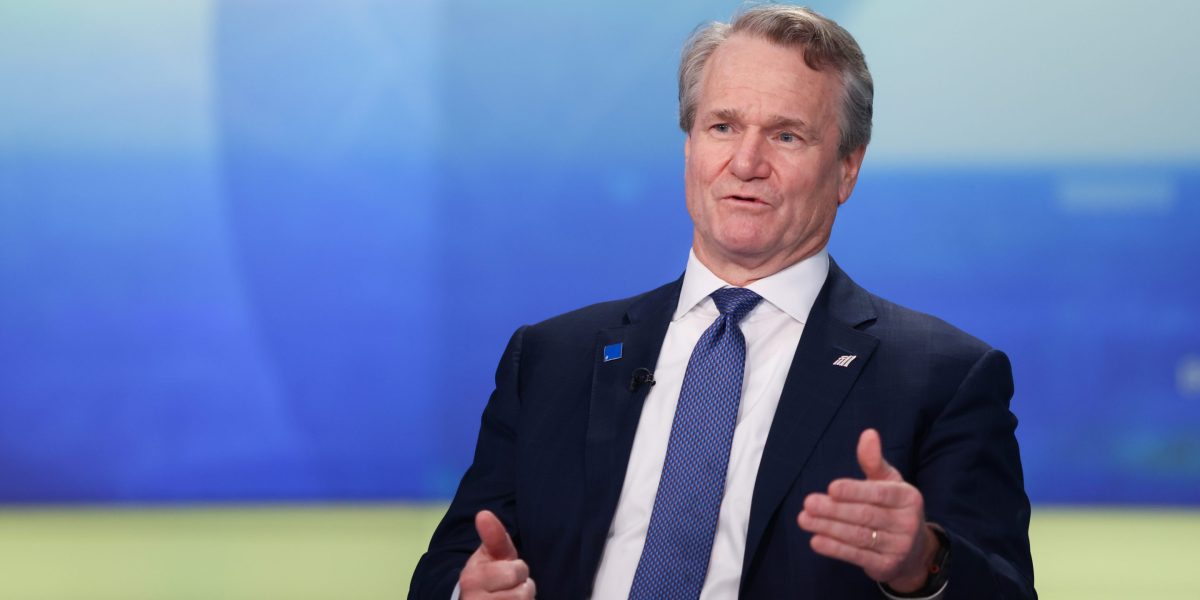
Bank of America Corp. Chief Executive Officer Brian Moynihan said that artificial intelligence is starting to have a bigger impact on the US economy.

“The AI investment’s been building during the year and is probably a bigger contributor next year and the years beyond,” Moynihan said Monday in a Bloomberg Television interview. “AI is kicking in more and more, and so it’s not all attributable to AI, but that’s having a marginal impact that’s pretty strong.”

Moynihan, who has led the bank for nearly 15 years, said the firm is predicting a strong economy for the US next year, with expected growth of 2.4%, up from about 2% in 2025. While the labor market has started to get softer, it appears that it’s more of a normalization for jobs, Moynihan said.

AI companies including OpenAI have been pulling in billions of dollars of funds in recent months as investors are eager to bet on the industry. But executives such as Amazon.com Inc. founder Jeff Bezos have warned that AI spending is an “industrial bubble” that could lead to lost investment, but will ultimately help society.

Moynihan said his bank sees relatively limited risk to the economy — including the impact on consumers and job losses — if the AI industry became too overheated and had to pull back, given that the sector is composed of a narrow group of companies.

“As a lender we look at the leverage on these projects and make sure we’re comfortable with that and the duration of the contract by the person who’s going to commit to use the data center,” Moynihan said.

The bank itself is also using artificial intelligence, he said in the interview. The company launched Erica, its agent bot, in 2018. Now, Erica can answer 700 questions, up from 200, Moynihan said.

Read More: Nvidia Looks Past DeepSeek and Tariffs for AI’s Next Chapter

“We’ll be applying more and more of automated intelligence — or augmented intelligence, as we call it, with a person using AI, using that to be more effective — and that’ll affect all the businesses,” Moynihan said.


Source link

Continue Reading

Business

Waymo chaos during San Francisco power outage likely due to ‘operational management failure’ instead of software flaw, expert says

Published

on


Many of Waymo’s self-driving cars blocked streets of San Francisco during a mass power outage Saturday and forced the company to temporarily suspend service, raising questions about the cars’ ability to to adapt to real-world driving conditions.

Social media users posted videos of Waymos as they encountered traffic lights that were off. Some cars’ hazard lights blinked and they abruptly stopped in place, failing to cross the intersection. Others stopped in the middle of the intersection, forcing other cars to swerve around them.

The power outage affected 130,000 homes and businesses in San Francisco, nearly one-third of the customers served by Pacific Gas and Electric Co. It was caused by a fire at a power substation, officials said. On Monday, the utility company was still working to restore power to thousands of customers.

Waymo operates hundreds of robotaxis in San Francisco, but it wasn’t clear how many cars were on the road at the time of the outage. The company paused service Saturday evening and resumed it Sunday afternoon.

The road-blocking problems that prompted Waymo to suspend its service during the weekend power outages revived concerns that city officials raised about the robotaxis periodically coming to abrupt and inexplicable stops before California regulators approved them as a commercial service in August 2023.

Tyler Cervini, who lives in the Mission District, said he was calling an Uber to bring him to the airport since his train station was not operating due to the outage. At the traffic light outside his apartment, there were five Waymos crowding the intersection, he said.

He got into his Uber right outside where all the Waymos were, but his driver “had to swerve through them to pick me up,” Cervini said. “He seemed extremely frustrated by what was going on.”

Waymo said that its vehicles are designed to treat nonfunctioning traffic signals as four-way stops, but the scale of the outage created unusual conditions.

“While the failure of the utility infrastructure was significant, we are committed to ensuring our technology adjusts to traffic flow during such events,” a Waymo spokesperson said. “Throughout the outage, we closely coordinated with San Francisco city officials.”

The company said most active trips were completed before vehicles were safely returned to depots or pulled over.

Philip Koopman, professor emeritus at Carnegie Mellon University and expert on self-driving vehicle safety, said the scale of the traffic disruption was concerning. Autonomous vehicles are generally programmed to come to a stop if they are unsure or confused on what to do and ask for remote assistance, he said.

Koopman said it did not appear to be a software failure in the cars themselves, but an “operational management failure” where the company did not have the capability to deal with so many robotaxis needing assistance at once.

Waymo should have suspended service earlier — as soon as their vehicles started having issues, he said.

“If you have thousands of robotaxis that stop, you have a problem,” he said. “What if this had been an earthquake? You would have thousands of robotaxis blocking the road.”

Waymo, which started as a secret project within Google in 2009, has steadily expanded its operations in San Francisco while also introducing its robotaxis into other California cities such as Los Angeles and San Jose, in addition to other U.S. markets in Texas, Arizona, Florida and Georgia.

In the months leading up to the approval from the state’s Public Utilities Commission, San Francisco’s transportation and fire department leaders flagged dozens of reports about robotaxis coming to standstills, blocking traffic.

Besides inconveniencing other drivers trying to get to their destinations, the road-blocking robotaxis were viewed as a possible impediment in life-threatening emergencies when firefighters and police officers were responding to calls for help.

Waymo’s fleet of robotaxis is on pace to complete more than 14 million rides this year, more than tripling from last year, according to the company.

California is considering expanding approval for heavy-duty autonomous trucks and vehicles carrying up to 15 passengers to operate, a move opposed by unions representing truck drivers.

Shane Gusman, director of Teamsters California, called the Waymo disruption “a clear warning that turning our roads and lives over to autonomous vehicles is premature and dangerous.”

“We live in a state where blackouts, wildfires, floods and earthquakes affecting power and roadways are all too common,” Gusman said in a statement. “AVs stalled in streets and intersections threaten the safety of AV passengers, and others on the road, and inhibit emergency response when we need it most.”

This story was originally featured on Fortune.com


Source link

Continue Reading

Business

Call of Duty co-creator Vince Zampella dies at 55

Published

on


Vince Zampella, one of the creators behind such best-selling video games as “Call of Duty,” has died. He was 55.

Video game company Electronic Arts said Zampella died Sunday. The company did not disclose a cause of death.

In 2010, Zampella founded Respawn Entertainment, a subsidiary of EA, and he also was the former chief executive of video game developer Infinity Ward, the studio behind the successful “Call of Duty” franchise.

A spokesperson for Electronic Arts said in a statement on Monday that Zampella’s influence on the video game industry was “profound and far-reaching.”

“A friend, colleague, leader and visionary creator, his work helped shape modern interactive entertainment and inspired millions of players and developers around the world. His legacy will continue to shape how games are made and how players connect for generations to come,” a company spokesperson wrote.

One of Zampella’s crowning achievements was the creation of the Call of Duty franchise, which has sold more than half a billion games worldwide.

The first person shooter game debuted in 2003 as a World War II simulation and has sold over 500 million copies globally. Subsequent versions have delved into modern warfare and there is a live-action movie based on the game in production with Paramount Pictures.

In recent years, Zampella has been at the helm of the creation of the action adventure video games Star Wars Jedi: Fallen Order and Star Wars Jedi: Survivor.

Join us at the Fortune Workplace Innovation Summit May 19–20, 2026, in Atlanta. The next era of workplace innovation is here—and the old playbook is being rewritten. At this exclusive, high-energy event, the world’s most innovative leaders will convene to explore how AI, humanity, and strategy converge to redefine, again, the future of work. Register now.


Source link

Continue Reading

Business

U.S. unveils plans for new ship under Trump’s ‘Golden Fleet’ bid

Published

on


President Donald Trump announced the US Navy will build a new “Trump-class” warship as part of the White House push to modernize the service’s surface fleet and restore domestic shipbuilding.

A poster displayed at the event at Trump’s gilded Mar-a-Lago estate featured an artist’s rendering of a sleek-looking warship dubbed the USS Defiant, cutting through choppy waters with a laser beam shooting from its deck and smoke billowing from a target in the background. 

Next to the ship was a picture of Trump raising his fist in the air in a near copy of the defiant pose he struck minutes after surviving an assassination attempt in 2024. Another poster shows a rendering of the vessel sailing by the Statue of Liberty

“We’re desperately in need of ships,” Trump said. “Some of them have gotten old and tired and obsolete, and we’re going to go the exact opposite direction.”

The Navy is also pursuing a new frigate based off the Legend-class cutter as it looks to shore up a surface combatant fleet that is one-third the size the service needs, the service announced Dec. 19. The ship, dubbed the FF(X), will be built by Newport News, Virginia-based HII, whose Legend-class cutter will serve as the basis for the new vessel.

The new ships are part of Trump’s “Golden Fleet” bid to revive US shipbuilding and address shortfalls in smaller ships exposed by recent military operations around the world. Overhauling shipping has been one of the top defense-related priorities, with Secretary of State Pete Hegseth saying contractors need to speed up development of new weapons systems or lose government contracts. 

Trump had already linked himself to another new weapons system, the F-47 stealth, a nod to his place as the 47th president. He’s also put his name on the newly anointed Donald J. Trump and the John F. Kennedy Memorial Center for the Performing Arts and the Donald J. Trump Institute of Peace.

The state of US shipbuilding is vastly behind China’s production rate and the Trump administration is prioritizing investing in its shipbuilding industry to narrow the output gap. Trump created a new Office of Shipbuilding earlier this year with plans for tax incentives to attract companies to the US. 

The Oval Office announcement signifies “the Navy is trying to tap into the enthusiasm of the administration for shipbuilding and say, ‘OK, you want to build ships, — let’s come up with some new ships to build because you’re going to if you have money and energy, let’s apply that toward things that the Navy needs,’” Bryan Clark, a senior fellow at the Hudson Institute, said in an interview.

Read More: Navy Cuts Orders for Frigate Trump Once Touted as ‘Beautiful’

The cruiser would replace Arleigh Burke class destroyers, which have roughly four decades of service life left and are equipped with Aegis Combat Systems that provide missile defense capability.

The Trump administration’s first attempt to build a new frigate in the president’s previous term ended with a significantly delayed and over-budget program. The original plan was to build 20 of the vessels to start, using a foreign design from Trieste, Italy-based Fincantieri SpA, whose Wisconsin-based subsidiary had been contracted to build the frigates. In order to adapt the design to meet US military standards, the ship’s cost ballooned and the increased complexity led to production delays.


Source link

Continue Reading

Trending

Copyright © Miami Select.