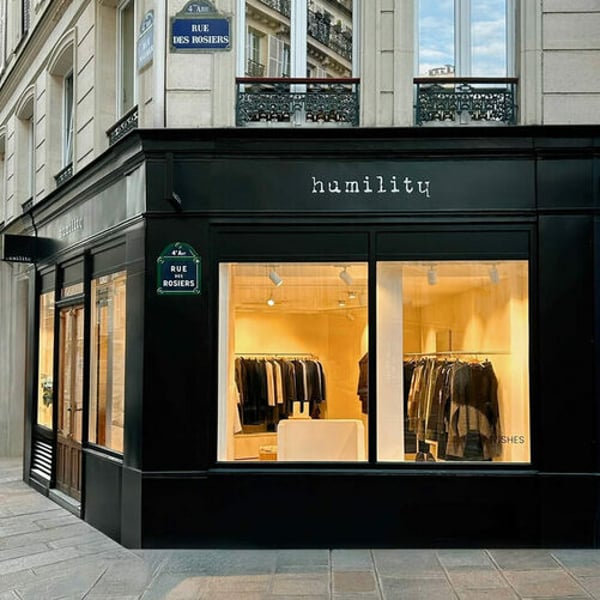
Ten years after its launch, Humility has opened its first Parisian boutique. A sister label to La Fée Maraboutée, the discreetly chic womenswear brand is growing at its own pace. It has just opened the doors of its first Parisian boutique in the Marais, at 11 rue Malher, on the corner of rue des Rosiers.
Humility’s new Marais boutique – Humility
The brand has taken over the space of multibrand retailer Camélia and now enjoys strong visibility in this highly competitive part of central Paris, attracting both French and international customers. It sits within a nearby retail mix that includes Free People, Cotélac, Balzac, Desigual and Cos.
Launched by La Fée Maraboutée founders Jean-Pierre Braillard and Virginie Mangano, Humility distils pared-back womenswear with understated elegance. Established in 2016 with a proposition radically different from the Roanne-based group’s flagship brand, the label swaps bohemian prints for a more architectural, almost monastic, aesthetic.
The current wardrobe champions ‘effortless’ elegance: oversize cuts, structured lines and a discreet colour palette (black, anthracite, chalk, khaki). Key pieces include the precisely cut Riu trousers, apron dresses with a workwear accent and, true to the group’s DNA, knitwear crafted in bouclé or textured wool blends. Pricing, slightly higher than at La Fée Maraboutée, ranges from 140 to 270 euros, with production predominantly in Europe, particularly Italy.
In terms of distribution, Humility remains selective, relying on a network of around 110 specialist multi-brand retailers, such as Solana in Paris and Lilyaké in Bordeaux. The brand is present through this channel in key European markets: the UK, Germany, Italy, Spain, and the Benelux region.
Interior of the Humility boutique – Humility
In recent years, the group has also been developing direct sales, both online and in-store. It is testing its mono-brand concept with a pilot location opened in 2023 in its home region, Lyon, at 24 Grande Rue de la Croix-Rousse, a laboratory that has helped refine the customer experience by adopting a concept-store approach and incorporating jewellery and home décor brands. Today, the brand is strengthening its visibility in department stores with around a dozen strategic corners, notably at Printemps Nation in Paris as well as at Galeries Lafayette in Reims and Tours.
The brand is also active internationally, having presented in Taiwan this summer, during the Mode in France event, its spring-summer 2026 collection inspired by the work of Japanese architect Tadao Ando. This collection will, of course, be showcased in its new Paris boutique.
The French group headed by Gaëlle Lelong does not disclose the brand’s financial performance. In 2024, despite a downturn in business, the parent company, La Fée, posted sales of over 37 million euros and remained profitable.
This article is an automatic translation. Click here to read the original article.
Luxury menswear brand Paul Stuart has been acquired by private investment group, Middle West Partners (MWP).
Paul Stuart
MWP partnered with apparel manufacturer, Peerless Clothing Inc. to acquire the New York City-based fashion brand from Mitsui & Co., which has been with the brand for more than 50 years.
Financial terms of the deal were not disclosed.
As part of the deal, John Hutchison, former chief executive officer of Bonobos, has been appointed the new CEO of Paul Stuart, according to a press release.
“The Paul Stuart name continues to resonate with a discerning client 87 years later, and we still see so much more potential for this luxury heritage brand,” said Kevin Kelleher, managing partner of MWP.
“Our goal is to protect its unmatched quality and amplify its unique attributes on a global scale.”
Earlier this year, MWP acquired high jewelry house, David Webb, as the private equity firm looks to expand its portfolio of brands.
“Paul Stuart has been one of my family’s favorite brands for more than 25 years. It has a look that’s distinctly its own—when you walk down the street, you know it’s Paul Stuart,” said co-founding partner at MWP, Michael Hamp.
“My father and now my brothers and I have worn Paul Stuart for as long as I can remember. It is both a privilege and honor to take on the responsibility of stewarding this brand.”
Gold surged past the $4,500-an-ounce mark for the first time on Wednesday, while silver and platinum also scaled record highs, as investors piled into precious metals on safe-haven demand and expectations that U.S. interest rates will fall further next year.
Reuters
Spot gold rose 0.1% to $4,492.51 per ounce by 0359 GMT, after touching a record high of $4,525.19 earlier in the session. U.S. gold futures for February delivery climbed 0.3% to a record high of $4,520.60. Silver gained 1.2% to $72.27 an ounce, after hitting an all-time peak of $72.70 earlier, while platinum jumped 3.3% to $2,351.05 after rising to a historic high of $2,377.50.
Palladium climbed almost 2% to $1,897.11, its highest level in three years.
“Precious metals have become more of a speculative narrative around the idea that, with de-globalization, you need an asset that can act as a neutral go-between, without sovereign risk particularly as tensions between the U.S. and China persist,” said Ilya Spivak, head of global macro at Tastylive.
Thin year-end liquidity exaggerated recent price moves but the broader theme was likely to endure, with gold targeting $5,000 over the next six to twelve months and silver potentially pushing toward $80 as markets respond to key psychological levels, Spivak added.
Gold has surged more than 70% this year, its biggest annual gain since 1979, driven by safe-haven demand, expectations of U.S. rate cuts, robust central-bank buying, de-dollarisation trends and ETF inflows, with traders pricing in two rate cuts next year.
Silver has jumped more than 150% over the same period, outpacing gold on strong investment demand, its inclusion on the U.S. critical minerals list and momentum buying.
Gold and silver have “been hitting the accelerator pedal this week” with fresh record highs, reflecting their appeal as stores of value amid expectations of lower U.S. rates and lingering global debt, said Tim Waterer, chief market analyst at KCM Trade.
Platinum and palladium, primarily used in automotive catalytic converters to reduce emissions, have surged this year on tight mine supply, tariff uncertainty, and a rotation from gold investment demand, with platinum up about 160% and palladium gaining more than 100% year to date.
“What we’re seeing in platinum and palladium is largely catch-up,” Spivak said adding that the thin nature of those markets leave them vulnerable to sharp swings, even as they broadly track gold, once liquidity returns.
Retail inflows into U.S. stocks are set to hit a record in 2025, as individual investors become a major force behind a rally that is likely to extend into the next year on hopes of interest rate cuts, analysts said.
Reuters
The amount of cash retail investors poured into U.S. stocks so far in 2025 is up 53% from $197 billion a year earlier and 14% higher than the $270 billion hit at the height of the retail trading frenzy in 2021, according to J.P.Morgan analysts.
Retail trading, meanwhile, accounted for 20–25% of total activity this year, touching a record high of about 35% in April, according to separate trading data from J.P.Morgan.
Individual investors snapped up high-quality stocks at discounts during selloffs, most notably after U.S. President Donald Trump‘s “Liberation Day” tariffs triggered a global meltdown in April, helping push the S&P 500 to fresh records. The benchmark index is up about 16% this year.
“Retail investors are here to stay, especially for 2026. They made money this year, they like to trade stocks, they have the applications to do so. We will continue to see them being a good presence,” said Steven DeSanctis, small- and mid-cap strategist at Jefferies.
Retail participation in the stock market has grown steadily over the years as the rise of low-cost, no-commission brokerages such as Robinhood and Interactive Brokers has made it easier and cheaper for average Americans to access the market.
The trend got wider notice in 2021 as many Americans who were homebound during the Covid-19 pandemic and were flush with cash used mobile trading platforms to bet on everything from GameStop to Big Tech.
AI plays such as Nvidia and Palantir Technologies were top favorites this year, according to retail brokerage data and executives, with the latter more than doubling in value as small-time traders bought the dip when institutional investors stepped back on valuation concerns, opens new tab.
Tesla shares, another top retail favorite, touched a record high on December 17, their first since the end of 2024.