Connect with us

Business

Solar power and battery storage are booming despite Trump policy whiplash as clean energy meets soaring data center demand

Published

on


There were some highs amid a lot of lows in a roller coaster year for clean energy as President Donald Trump worked to boost polluting fuelswhile blocking wind and solar, according to dozens of energy developers, experts and politicians.

Surveyed by The Associated Press, many described 2025 as turbulent and challenging for clean energy, though there was progress as projects connected to the electric grid. They said clean energy must continue to grow to meet skyrocketing demand for electricity to power data centers and to lower Americans’ utility bills.

Solar builder and operator Jorge Vargas said it has been “a very tough year for clean energy” as Trump often made headlines criticizing renewable energy and Republicans muscled a tax and spending cut bill through Congress in July that dramatically rolled back tax breaks for clean energy.

“There was a cooldown effect this year,” said Vargas, cofounder and CEO of Aspen Power. “Having said that, we are a resilient industry.”

Plug Power president Jose Luis Crespo said the developments — both policy recalibration and technological progress — will shape clean energy’s trajectory for years to come.

Energy policy whiplash in 2025

Much of clean energy’s fate in 2025 was driven by booster Joe Biden’s exit from the White House.

The year began with ample federal subsidies for clean energy technologies, a growing number of U.S.-based companies making parts and materials for projects and a lot of demand from states and corporations, said Tom Harper, partner at global consultant Baringa.

It ends with subsidies stripped back, a weakened supply chain, higher costs from tariffs and some customers questioning their commitment to clean energy, Harper said. He described the year as “paradigm shifting.”

Trump called wind and solar power “the scam of the century” and vowed not to approve new projects. The federal government canceled grantsfor hundreds of projects.

The Republicans’ tax bill reversed or steeply curtailed clean energy programs established through the Democrats’ flagship climate and health care bill in 2022. Wayne Winegarden, at the Pacific Research Institute think tank, said the time has come for alternative energy to demonstrate viability without subsidies. ( Fossil fuels also receive subsidies.)

Many energy executives said this was the most consequential policy shift. The bill reshaped the economics of clean energy projects, drove a rush to start construction before incentives expire and forced developers to reassess their strategies for acquiring parts and materials, Lennart Hinrichs said. He leads the expansion of TWAICE in the Americas, providing analytics software for battery energy storage systems.

Companies can’t make billion-dollar investments with so much policy uncertainty, said American Clean Power Association CEO Jason Grumet.

Consequently, greenhouse gas emissions will fall at a much lower rate than previously projected in the U.S., said Brian Murray, director of the Nicholas Institute for Energy, Environment and Sustainability at Duke University.

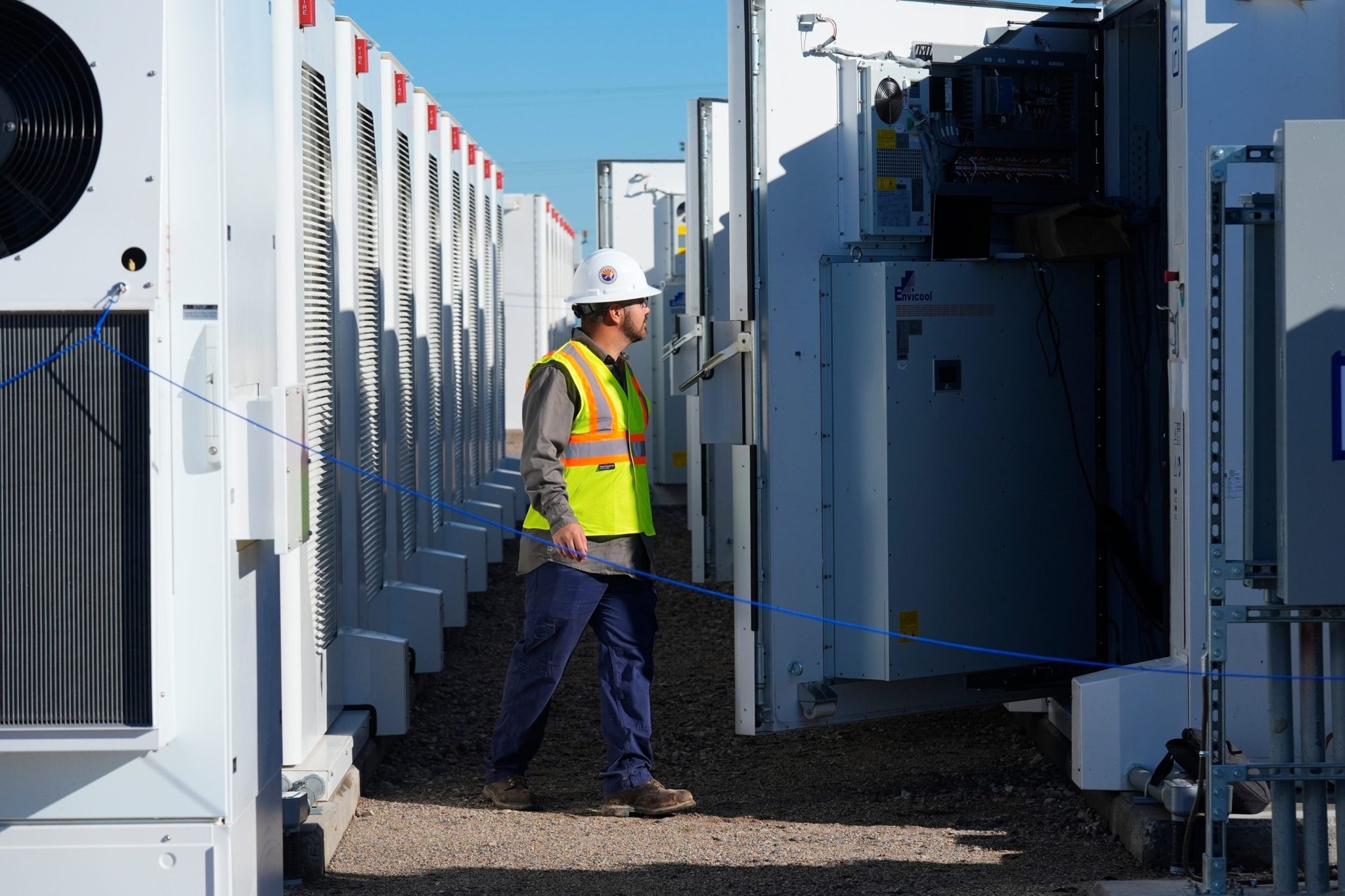
Still, solar and battery storage are booming

Solar and storage accounted for 85% of the new power added to the grid in the first nine months of the Trump administration, according to Wood Mackenzie research.

That’s because the economics remain strong, demand is high and the technologies can be deployed quickly, said Mike Hall, CEO of Anza Renewables.

Solar energy company Sol Systems said it had a record year as it brought its largest utility-scale project online and grew its business. The energy storage systems company CMBlu Energy said storage clearly stands out as a winner this year too, moving from optional to essential.

“Trump’s effort to manipulate government regulation to harm clean energy just isn’t enough to offset the natural advantages that clean energy has,” Democratic U.S. Sen. Sheldon Whitehouse said. “The direction is still all good.”

The Solar Energy Industries Association said that no matter the policies in Washington, solar and storage will grow as the backbone of the nation’s energy future.

Nuclear and geothermal had a good year, too

Democrats and Republicans have supported investing to keep nuclear reactors online, restart previously closed reactors and deploy new, advanced reactor designs. Nuclear power is a carbon-free source of electricity, though not typically labeled as green energy like other renewables.

“Who had ‘restart Three Mile Island’ on their 2025 Bingo card?” questioned Baringa partner David Shepheard. The Pennsylvania plant was the site of the nation’s worst commercial nuclear power accident, in 1979. The Energy Department is loaning $1 billion to help finance a restart.

Everyone loves nuclear, said Darrin Kayser, executive vice president at Edelman. It helps that the technology for small, modular reactors is starting to come to fruition, Kayser added.

Benton Arnett, a senior director at the Nuclear Energy Institute, said that as the need for clean, reliable power intensifies, “we will look back on the actions being taken now as laying the foundation.”

The Trump administration also supports geothermal energy, and the tax bill largely preserved geothermal tax credits. The Geothermal Rising association said technologies continue to mature and produce, making 2025 a breakthrough year.

Offshore wind had a terrible year

Momentum for offshore wind in the United States came to a grinding halt just as the industry was starting to gain traction, said Joey Lange, a senior managing director at Trio, a global sustainability and energy advisory company.

The Trump administration stopped construction on major offshore wind farms, revoked wind energy permits and paused permittingcanceled plans to use large areas of federal waters for new offshore wind development and stopped federal funding for offshore wind projects.

That has decimated the projects, developers and tech innovators, and no one in wind is raising or spending capital, said Eric Fischgrund, founder and CEO at FischTank PR. Still, Fischgrund said he remains optimistic because the world is transitioning to cleaner energy.

More clean energy needed in 2026

An energy strategy with a diverse mix of sources is the only way forward as demand grows from data centers and other sources, and as people demand affordable, reliable electricity, said former Democratic Sen. Mary Landrieu. Landrieu, now with Natural Allies for a Clean Energy Future, said promoting or punishing specific energy technologies on ideological grounds is unsustainable.

Experts expect solar and battery storage to continue growing in 2026 to add a lot of power to the grid quickly and cheaply. The market will continue to ensure that most new electricity is renewable, said Amanda Levin, policy analysis director at the Natural Resources Defense Council.

Hillary Bright, executive director of Turn Forward, thinks offshore wind will still play an important role too. It is both ready and needed to help address the demand for electricity in the new year, which will become increasingly clear “to all audiences,” she said. Turn Forward advocates for offshore wind.

That skyrocketing demand “is shaking up the political calculus that drove the administration’s early policy decisions around renewables,” she said.

BlueWave CEO Sean Finnerty thinks that states, feeling the pressure to deliver affordable, reliable electricity, will increasingly drive clean energy momentum in 2026 by streamlining permitting and the process of connecting to the grid, and by reducing costs for things like permits and fees.

Ed Gunn, Lunar Energy’s vice president for revenue, said the industry has weathered tough years before.

“The fundamentals are unchanged,” Gunn said, “there is massive value in clean energy.”

This story was originally featured on Fortune.com


Source link

Continue Reading

Business

Tariff refunds are unlikely because that would be ‘very complicated,’ Hassett says

Published

on


National Economic Council Director Kevin Hassett offered more of a practical reason than a legal argument on the future of President Donald Trump’s global tariffs.

Lower courts have ruled that the so-called reciprocal tariffs invoked under the International Emergency Economic Powers Act are illegal, though the Supreme Court will have a final say.

In an interview on CBS News’ Face the Nation on Sunday, Hassett predicted that the justices will rule in the White House’s favor.

“And I also think that if they didn’t find with us, that it’s going to be pretty unlikely that they’re going to call for widespread refunds, because it would be an administrative problem to get those refunds out to there,” he added, explaining that whoever made the actual tariff payment would be in line to get a refund.

That’s as Trump has vowed that foreign countries would pay the tariffs, though importers in the U.S. have been footing the bill with many companies passing along at least a portion of the costs to consumers.

Hassett said the eventual payer of a tariff “depends on elasticities of supply and demand,” while noting Chinese companies have slashed their prices to offset tariff costs.

“But the people who pay the tariff, if there is a refund, the people who actually paid for the good, the importer, in most cases, they’re the ones who would be the first line of defense for refunding the tariff,” he said. “But I really, really don’t think that’s going to happen, it’d be very complicated. And then that person would be responsible for allocating the tariff refund to the appropriate folks.”

Hassett added, “Yes, it is a mess, and that’s why I think the Supreme Court wouldn’t do it.”

Trade experts have pointed out that the federal government already issues millions of refunds every year for income taxes, suggesting tariff refunds wouldn’t be so daunting.

Through late September, about $90 billion of the $174 billion in tariff revenue generated up to then came from the IEEPA duties.

Meanwhile, companies are already positioning themselves to get their money back in the event the Supreme Court strikes down the tariffs.

Late last month, Costco filed a lawsuit in the U.S. Court of International Trade, joining dozens of other companies suing over the IEEPA duties.

The warehouse club chain said it needed to go to court due to the uncertainty that refunds will be guaranteed if the Supreme Court rules the tariffs are illegal.

Wall Street expects that to happen as justices largely seemed skeptical of the Trump administration when they heard arguments for the case.

But other tariffs invoked under separate laws would be unaffected by a Supreme Court decision, and fresh tariffs could be imposed to replace the IEEPA levies.

In a recent interview with the Wall Street Journal, Trump warned that if the Supreme Court strikes down his global tariffs, his alternatives are not as “nimble, not as quick.”

 “I can do other things, but it’s not as fast. It’s not as good for national security,” he added. 


Source link

Continue Reading

Business

Waymos froze, blocked traffic during San Francisco power outage

Published

on


Waymo’s driverless ride services were a high-profile victim of a power outage that affected large swaths of San Francisco, with cars freezing mid-ride across the city and disrupting traffic.

After traffic lights went dark at major intersections Saturday, social media videos showed multiple cars stopped in the middle of the street with their hazard lights flashing.

The power failures, which at one point affected 130,000 customers, closed stores and disrupted transit during the busy holiday shopping period — including many Waymo cars, Alphabet Inc.’s self-driving taxi service. 

Michele Riva, 30, was going home Saturday evening in a Waymo car when the outage happened. His car had kept moving when they were in a less transited area of the city, even with passengers crossing on the street, he said. He was only a minute away from his destination when the car stopped in front of a “very dense intersection” and non-working traffic lights, he said, without giving him any notice.

“I stayed in the Waymo for a couple of minutes, just to see,” said Riva, who is an engineer working in artificial intelligence. “The problem was that, at the beginning, there were a lot of people crossing the streets because there were no traffic lights. So I believe the Waymo just didn’t know what to do.”

PG&E Corp., which blamed the outage on a fire in a substation, began restoring most of the service Saturday evening. By Sunday morning, PG&E said it has restored service for 110,000 customers, but 21,000 remain without electricity. 

Riva tried contacting customer support for about three minutes while he was stuck in the immobile car, but gave up after the wait time became too long as the service was overwhelmed with other passengers’ calls. He decided to get out of the Waymo and walk the couple of blocks left to his home.

On Sunday, the Waymo app showed a notification to some customers saying the service for the Bay Area is paused, affecting at least seven cities.

“Our teams are working diligently and in close coordination with city officials, and we are hopeful to bring our services back online soon,” a Waymo spokesperson said in a statement Sunday.

Riva tried ordering another Waymo ride on Sunday before he saw the message.

“At the end of the day, I know it was an unpleasant situation for the other drivers, but I believe it really was all about safety — I believe it’s better safe than sorry,” Riva said. “I hope they will account for that in the future, because it’s truly a good service.”

Tesla Inc.’s CEO Elon Musk posted on X that his companies’ robotaxis — a direct competitor of Waymo — were “unaffected” by the power outage.


Source link

Continue Reading

Business

Nicki Minaj calls Trump and Vance ‘role models’ for young men at Turning Point USA event

Published

on


The rap star was interviewed at Turning Point USA’s AmericaFest convention by Erika Kirk, the widow of Charlie Kirk, about her newly found support for Trump — someone she had condemned in the past — and about her actions denouncing violence against Christians in Nigeria.

The female rapper’s recent alignment with the Make America Great Again movement has caught some interest because of her past criticism of Trump even when the artist’s own political ideology had been difficult to pin down. But her appearance Sunday at the flagship event for the powerful conservative youth organization may shore up her status as a MAGA acolyte.

Minaj mocked California Gov. Gavin Newsom, referring to him as New-scum, a nickname Trump gave him. Newsom, a Democrat, has 2028 prospects. Minaj expressed admiration for the Republican president and Vance, who received an endorsement from Erika Kirk despite the fact he has not said whether he will run for president. Kirk took over as leader of Turning Point.

“This administration is full of people with heart and soul, and they make me proud of them. Our vice president, he makes me … well, I love both of them,” Minaj said. “Both of them have a very uncanny ability to be someone that you relate to.”

Minaj’s appearance included an awkward moment when, in an attempt to praise Vance’s political skills, she described him as an “assassin.”

She paused, seemingly regretting her word choice, and after Kirk appeared to wipe a tear from one of her eyes, the artist put her hand over her mouth while the crowd murmured.

“If the internet wants to clip it, who cares? I love this woman,” said Erika Kirk, who became a widow when Charlie Kirk was assassinated in September.

Last month, the rapper shared a message posted by Trump on his Truth Social network about potential actions to sanction Nigeria saying the government is failing to rein in the persecution of Christians in the West African country. Experts and residents say the violence that has long plagued Nigeria isn’t so simply explained.

“Reading this made me feel a deep sense of gratitude. We live in a country where we can freely worship God,” Minaj shared on X. She was then invited to speak at a panel at the U.S. mission to the United Nations along with U.S. Ambassador Mike Waltz and faith leaders.

Minaj said she was tired of being “pushed around,” and she said that speaking your mind with different ideas is controversial because “people are no longer using their minds.” Kirk thanked Minaj for being “courageous,” despite the backlash she is receiving from the entertainment industry for expressing support for Trump.

“I didn’t notice,” Minaj said. “We don’t even think about them.” Kirk then said “we don’t have time to. We’re too busy building, right?”

“We’re the cool kids,” Minaj said.

The Trinidadian-born rapper is best known for her hits “Super Freaky Girl,” “Anaconda” and “Starships.” She has been nominated for 12 Grammy Awards over the course of her career.

In 2018, Minaj was one of several celebrities condemning Trump’s zero-tolerance immigration policy that split more than 5,000 children from their families at the Mexico border. Back then, she shared her own story of arriving to the country at 5 years old, describing herself as an “illegal immigrant.”

“This is so scary to me. Please stop this. Can you try to imagine the terror & panic these kids feel right now?” she posted then on Instagram.

On Sunday on stage with Erika Kirk, Minaj said, “it’s OK to change your mind.”


Source link

Continue Reading

Trending

Copyright © Miami Select.