Connect with us

Business

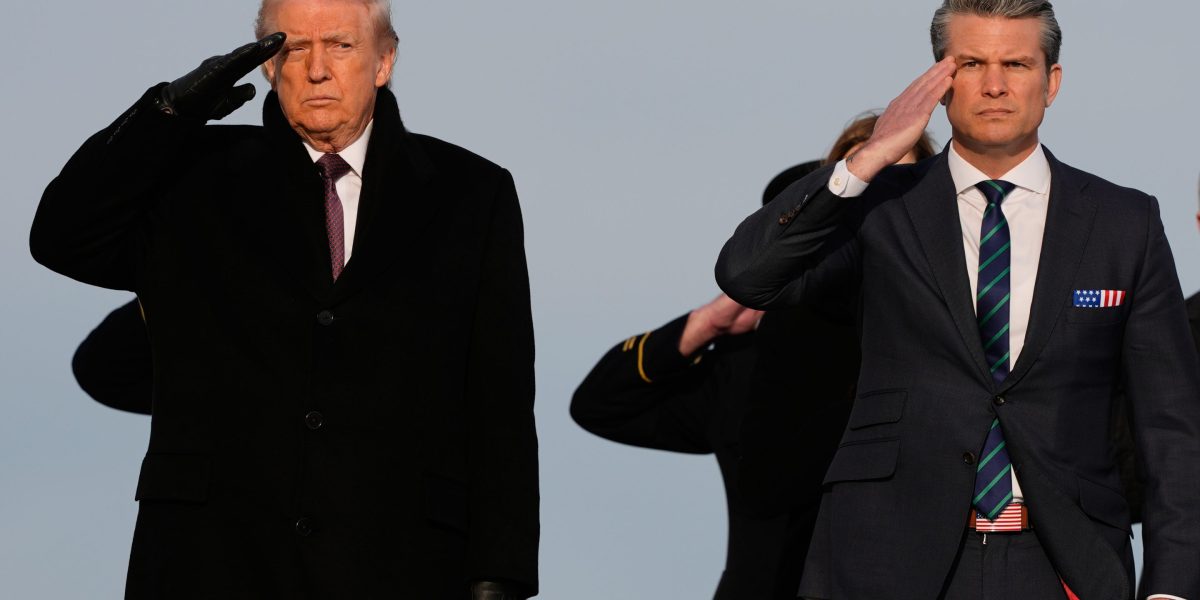
U.S. forces attack Islamic State targets in Syria in retaliation for ambush that killed Americans

Published

on


The Trump administration launched military strikes Friday in Syria to “eliminate” Islamic State group fighters and weapons sites in retaliation for an ambush attack that killed two U.S. troops and an American civilian interpreter almost a week ago.

A U.S. official described it as “a large-scale” strike that hit 70 targets in areas across central Syria that had IS infrastructure and weapons. Another U.S. official, who also spoke on condition of anonymity to discuss sensitive operations, said more strikes should be expected.

“This is not the beginning of a war — it is a declaration of vengeance. The United States of America, under President Trump’s leadership, will never hesitate and never relent to defend our people,” Defense Secretary Pete Hegseth said on social media.

The new military operation in Syria comes even as the Trump administration has said it’s looking to focus closer to home in the Western Hemisphere, building up an armada in the Caribbean Sea as it targets alleged drug-smuggling boats and vowing to keep seizing sanctioned oil tankers as part of a pressure campaign on Venezuela’s leader. The U.S. has shifted significant resources away from the Middle East to further those goals: Its most advanced aircraft carrier arrived in South American waters last month from the Mediterranean Sea.

Trump vowed retaliation

President Donald Trump pledged “very serious retaliation” after the shooting in the Syrian desert, for which he blamed IS. Those killed were among hundreds of U.S. troops deployed in eastern Syria as part of a coalition fighting the militant group.

During a speech in North Carolina on Friday evening, the president hailed the operation as a “massive strike” that took out the “ISIS thugs in Syria who were trying to regroup.”

Earlier, in his social media post, he reiterated his backing for Syrian President Ahmad al-Sharaa, who Trump said was “fully in support” of the U.S. effort.

Trump also offered an all-caps threat, warning IS against attacking American personnel again.

“All terrorists who are evil enough to attack Americans are hereby warned — YOU WILL BE HIT HARDER THAN YOU HAVE EVER BEEN HIT BEFORE IF YOU, IN ANY WAY, ATTACK OR THREATEN THE U.S.A.,” the president added.

The attack was conducted using F-15 Eagle jets, A-10 Thunderbolt ground attack aircraft and AH-64 Apache helicopters, the U.S. officials said. F-16 fighter jets from Jordan and HIMARS rocket artillery also were used, one official added.

U.S. Central Command, which oversees the region, said in a social media post that American jets, helicopters and artillery employed more than 100 precision munitions on Syrian targets.

How Syria has responded

The attack was a major test for the warming ties between the United States and Syria since the ouster of autocratic leader Bashar Assad a year ago. Trump has stressed that Syria was fighting alongside U.S. troops and said al-Sharaa was “extremely angry and disturbed by this attack,” which came as the U.S. military is expanding its cooperationwith Syrian security forces.

Syria’s foreign ministry in a statement on X following the launch of U.S. strikes said that last week’s attack “underscores the urgent necessity of strengthening international cooperation to combat terrorism in all its forms” and that Syria is committed “to fighting ISIS and ensuring that it has no safe havens on Syrian territory and will continue to intensify military operations against it wherever it poses a threat.”

Syrian state television reported that the U.S. strikes hit targets in rural areas of Deir ez-Zor and Raqqa provinces and in the Jabal al-Amour area near the historic city of Palmyra. It said they targeted “weapons storage sites and headquarters used by ISIS as launching points for its operations in the region.”

IS has not said it carried out the attack on the U.S. service members, but the group has claimed responsibility for two attacks on Syrian security forces since, one of which killed four Syrian soldiers in Idlib province. The group in its statements described al-Sharaa’s government and army as “apostates.” While al-Sharaa once led a group affiliated with al-Qaida, he has had a long-running enmity with IS.

The Americans who were killed

Trump this week met privately with the families of the slain Americans at Dover Air Force Base in Delaware before he joined top military officials and other dignitaries on the tarmac for the dignified transfer, a solemn and largely silent ritual honoring U.S. service members killed in action.

The guardsmen killed in Syria last Saturday were Sgt. Edgar Brian Torres-Tovar, 25, of Des Moines, and Sgt. William Nathaniel Howard, 29, of Marshalltown. Ayad Mansoor Sakat, of Macomb, Michigan, a U.S. civilian working as an interpreter, also was killed.

The shooting near Palmyra also wounded three other U.S. troops as well as members of Syria’s security forces, and the gunman was killed. The assailant had joined Syria’s internal security forces as a base security guard two months ago and recently was reassigned because of suspicions that he might be affiliated with IS, Interior Ministry spokesperson Nour al-Din al-Baba has said.

The man stormed a meeting between U.S. and Syrian security officials who were having lunch together and opened fire after clashing with Syrian guards.


Source link

Continue Reading

Business

Trump cut income taxes on tips and overtime, but many states—even some led by Republicans—haven’t done the same yet

Published

on


To tax tips or not? That is a question that will confront lawmakers in states across the U.S. as they convene for work next year.

President Donald Trump’s administration is urging states to follow its lead by enacting a slew of new tax breaks for individuals and businesses, including deductions for tips and overtime wages, automobile loans and business equipment.

In some states, the new federal tax breaks will automatically apply to state income taxes unless legislatures opt out. But in many other states, where tax laws are written differently, the new tax breaks won’t appear on state tax forms unless legislatures opt in.

In states that don’t conform to the federal tax changes, workers who receive tips or overtime — for example — will pay no federal tax on those earnings but could still owe state taxes on them.

States that embrace all of Trump’s tax cuts could provide hundreds of millions of dollars of annual savings to certain residents and businesses. But that could financially strain states, which are being hit with higher costs because of new Medicaid and SNAP food aid requirements that also are included in the big bill Trump signed.

Most states begin their annual legislative sessions in January. To retroactively change tax breaks for 2025, lawmakers would need to act quickly so tax forms could updated before people begin filing them. States also could apply the changes to their 2026 taxes, a decision requiring less haste.

So far, only a few states have taken votes on whether to adopt the tax breaks.

“States in general are approaching this skeptically,” said Carl Davis, research director at the nonprofit Institute on Taxation and Economic Policy.

Trump’s treasury presses states to `immediately conform’

A bill Trump signed on July 4 contains about $4.5 trillion of federal tax cuts over 10 years.

It creates temporary tax deductions for tips, overtime and loan interest on new vehicles assembled in the U.S. It boosts a tax deduction for older adults. And it temporarily raises cap on state and local tax deductions from $10,000 to $40,000, among other things. The law also provides numerous tax breaks to businesses, including the ability to immediately write off 100% of the cost of equipment and research.

Forty-one states levy individual income taxes on wages and salaries. Forty-four states charge corporate income taxes.

Treasury Secretary Scott Bessent this month called on those states “to immediately conform” to the federal tax cuts and accused some Democratic-led states that haven’t done so of engaging in “political obstructionism.” Though Bessent didn’t mention it, many Republican-led states also have not decided whether to implement the tax deductions.

“By denying their residents access to these important tax cuts, these governors and legislators are forcing hardworking Americans to shoulder higher state tax burdens, robbing them of the relief they deserve and exacerbating the financial squeeze on low- and middle-income households,” Bessent said.

But some tax analysts contend there’s more for states to consider. The tax break on tips, for example, could apply to nearly 70 occupation fields under a proposed rule from the Internal Revenue Service. But that would still exclude numerous low-wage workers, said Jared Walczak, vice president of state projects at the nonprofit Tax Foundation.

“Lawmakers need to consider whether these are worth the cost,” Walczak said.

Only a few states offer tax breaks for tips and overtime

Because of the way state tax laws are written, the federal tax breaks for tips and overtime wages would have carried over to just seven states — Colorado, Idaho, Iowa, Montana, North Dakota, Oregon and South Carolina. But Colorado opted out of the state tax break for overtime shortly before the federal law was enacted.

Michigan this fall became first — and, so far, only — state to opt into the tax breaks for tips and overtime wages, effective in 2026. The overtime tax exemption is projected to cost the state nearly $113 million and the tips tax break about $45 million during its current budget year, according to the state treasury department.

Michigan lawmakers offset that by decoupling from five federal corporate tax changes the state’s treasury estimated would have reduced Michigan tax revenues by $540 million this budget year.

Republican state Rep. Ann Bollin, chair of the Michigan House Appropriations Committee, said the state could not afford to embrace all the tax cuts while still investing in better roads, public safety and education.

“The best path forward is to have more money in people’s pockets and have less regulation — and this kind of moved in that direction,” she said.

Arizona could be among the next states to act. Democratic Gov. Katie Hobbs has called upon lawmakers to adopt the tax breaks for tips, overtime, seniors and vehicle loans, and follow the federal government by also increasing the state’s standard deduction for individual income taxpayers. Republican state House leaders said they stand ready to pass the tax cuts when their session begins Jan. 12.

Several states have rejected corporate tax breaks

In addition to Michigan, lawmakers in Delaware, Illinois, Pennsylvania and Rhode Island have passed measures to block some or all of the corporate tax cuts from taking effect in their states.

A new Illinois law decoupling from a portion of the corporate tax changes could save the state nearly $250 million, said Democratic state Sen. Elgie Sims, chair of the Senate Appropriations Committee. He said that could help ensure continued funding for schools, health care and vital services.

Illinois Gov. JB Pritzker, an outspoken Democratic opponent of Trump, also cited budget concerns for rejecting the corporate tax cut provision. He said states already stand to lose money because of other provisions in Trump’s big bill, such as a requirement to cover more of the costs of running the Supplemental Nutrition Assistance Program.

“The decoupling is an effort to try to hold back the onslaught from the federal government to make sure that we can support programs like the one we’re announcing today,” Pritzker told reporters at a December event publicizing a grant to address homelessness in central Illinois.

This story was originally featured on Fortune.com


Source link

Continue Reading

Business

A photo with Trump in it appears to have been removed from the partial Epstein files the Justice Department released

Published

on


A photo featuring President Donald Trump that was included in one of the Justice Department files on the late sex trafficker Jeffrey Epstein appears to have been removed online.

Late Friday, the department published a trove of documents to meet a deadline mandated by an overwhelmingly bipartisan vote in Congress, though not all the Epstein files were released, and many that were made public have been heavily redacted.

There was little mention of Trump in the text that was available, and White House officials highlighted photos of former President Bill Clinton.

But an image of a desk with several pictures on it included one showing Trump’s face. It was originally listed as EFTA00000468, but it no longer appears on the list of “data set 1” files and is not accessible online anymore.

“This photo, file 468, from the Epstein files that includes Donald Trump has apparently now been removed from the DOJ release,” Democrats on the House Oversight Committee pointed out in a post on X on Saturday. “@AGPamBondi is this true? What else is being covered up? We need transparency for the American public.”

The Justice Department didn’t immediately respond to a request for comment. It said on X that it hasn’t redacted any names of politicians, pointing to comments from Deputy Attorney General Todd Blanche.

“The only redactions being applied to the documents are those required by law — full stop,” he said. “Consistent with the statute and applicable laws, we are not redacting the names of individuals or politicians unless they are a victim.”

The administration’s failure to release all the files and the massive blackouts of many documents have already stirred outrage among congressional leaders of the effort to make them public.

Rep. Ro Khanna, D-Calif., said Friday that the document dump doesn’t comply with the spirit or the letter of the law, and singled out one file from a New York grand jury where all 119 pages were blacked out.

Later, he said he and Rep. Thomas Massie, R-Ky., have already started working on drafting articles of impeachment and inherent contempt against Attorney General Pam Bondi, though they haven’t decided yet whether to move forward.

“Impeachment is a political decision and is there the support in the House of Representatives? I mean Massie and I aren’t going to just do something for the show of it,” Khanna told CNN.

This story was originally featured on Fortune.com


Source link

Continue Reading

Business

OpenAI vs. Apple? Sam Altman is setting his sights on an even higher-stakes AI battle

Published

on


All eyes are on the Big Tech LLM race and, at least in the eyes of investors, it seems like Google (owned by Alphabet, No. 7) could run away with the win.

Google’s Gemini has been steadily stealing buzz and AI traffic share over the last few months from OpenAI. And if there was any moat to be had in LLMs, it would seem like it would belong to the company with the biggest treasure chest of personal data on users. That almost indisputably would be Google, thanks to Android, YouTube, Search history, Maps, and Gmail. On top of that, the company has one of the top AI minds, Demis Hassabis, and Google cofounder Sergey Brin leading its troops toward dominance.

Perhaps that’s why Sam Altman is setting his sights on winning what could be an even higher-stakes AI battle: creating the future mass AI consumer device. Altman feels that in the long term, his greatest foe will be Apple (No. 4), not Google, Meta (No. 22), or Amazon (No. 2). He recruited iPhone designer Jony Ive to OpenAI this May, and Ive has said the company’s secret device could be ready in the next two years.

What will that device be like? If you ask Altman, he describes limitations with the mobile phone. First of all, it can be turned off. It also can’t scan the room around you and give you real-time context and know exactly when to deliver relevant information to you. He sounds more bullish about audio than visual as the primary means of communication. And he sees no reason why a device and an operating system should be sold separately, like Google and Android—a future device should come with the trademark LLM baked in, like iOS in an iPhone.

Thanks largely to that iPhone, Apple is generating tens of billions of dollars a year in cash flow that it can plow into new devices and armies of engineers to design them—two areas where OpenAI lags far behind. Then again, Apple seems ripe to be disrupted: As Meta founder Mark Zuckerberg said on Joe Rogan’s podcast earlier this year, “They haven’t invented anything great in a while. It’s like Steve Jobs invented the iPhone, and now they’re just kind of sitting on it 20 years later.”

But for now, OpenAI and its team are all about perfecting ChatGPT. For more on how Altman is planning to position OpenAI as a long-term hardware play, and how he’s combating fast-rising competition like Anthropic and Google in the short term, check out Fortune’s reporting on what’s happening inside OpenAI as it battles its way through an eight-week code red.

Also, we’re taking a break for the holidays, so Fortune 500 Digest will be back in inboxes Jan. 10. In the meantime, you can read the latest online.


Source link

Continue Reading

Trending

Copyright © Miami Select.