Connect with us

Politics

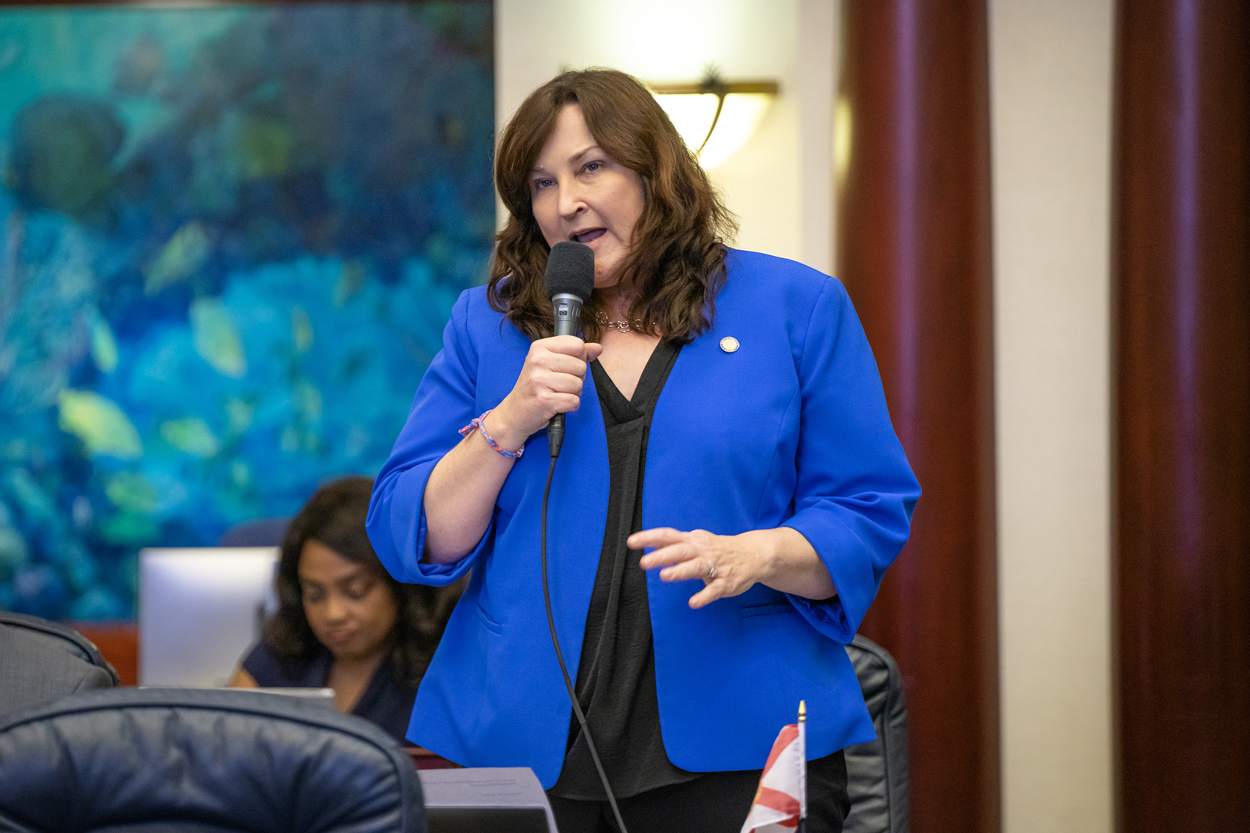
Christine Hunschofsky proposes limits on AI companion chatbots to protect kids from self-harm
Published

on


Rep. Christine Hunschofsky is pushing for regulations on emotionally responsive “companion chatbots,” arguing that rapid advances in artificial intelligence demand clearer rules to protect minors and vulnerable users.

Hunschofsky, a Parkland Democrat, recently filed legislation (HB 659) to impose disclosure, safety and reporting requirements for AI systems designed to provide humanlike companionship.

The bill’s focus is on self-harm prevention. If passed, the measure would prohibit operators from allowing companion chatbots to interact with users unless their platforms maintain evidence-based, publicly posted protocols to detect and respond to suicidal ideation.

If a user expresses such thoughts, the system would have to direct users to the 988 Suicide and Crisis Lifeline. Chatbots would also be barred from discussing suicide or self-harm.

“Increasingly, we are seeing heartbreaking cases where young people form deep emotional bonds with AI companions that end up pushing them further toward self-harm,” Hunschofsky said in a statement.

“These companion chatbots blur the lines to the point that people can’t tell the difference between a human and AI.”

There have been several cases in the past couple of years where interactions with chatbots tragically exacerbated the suicidal ideation of impressionable youths.

There was 14-year-old Sewell Setzer of Orlando, whose mother says he developed an intense attachment to a chatbot and the program’s responses worsened his mental state leading up to his death. Similar cases have arisen in California and Colorado.

HB 659, which pends a Senate companion, would mandate prominent disclosures clarifying that companion chatbots are AI-generated, not human, along with warnings that they may be unsuitable for some minors.

Platforms would also be required to offer both anonymous and standard age verification options.

For users known to be minors, HB 659 would require even more explicit disclosures that the user is interacting with artificial intelligence, default reminders at least every three hours encouraging breaks from continued interaction and measures preventing the chatbot from generating sexually explicit visual material or encouraging sexually explicit conduct.

Beginning July 1, 2027, operators would have to submit annual reports to the Department of Legal Affairs detailing how often their platforms issued 988 referrals and describing their suicide-prevention and content-restriction systems. The reports would be prohibited from including personal or identifying user information.

Violations would be treated as unfair or deceptive acts under Florida’s consumer-protection laws and enforced by the Attorney General. Companies would be given 30 days to cure alleged violations before enforcement action.

Hunschofsky’s measure comes amid discord between Florida and President Donald Trump’s administration on how to best proceed with AI regulation. DeSantis has pushed back against claims that a recent executive order Trump signed limits Florida’s ability to regulate AI.

Executive orders cannot preempt states, the Governor said, adding that Florida’s approach to the issue remains consistent with federal guidelines, which he said allow for child-safety and consumer protections.

Hunschofsky said her measure is about setting boundaries before harm becomes widespread.

“While AI continues to advance at a rapid pace, we have to ensure that safeguards are in place for our youth,” she said. “This bill is about protecting our children by making sure there are clear warnings, strong safeguards, and real accountability for the companies that put these companion chatbots on the market.”


Source link

Continue Reading

Politics

Alex Rogoff rejoins Jared Moskowitz’s staff as Outreach Director

Published

on


A former staffer for U.S. Rep. Jared Moskowitz will return to Capitol Hill after a short stint lobbying for a pro-Israel group.

Alex Rogoff has returned to the Parkland Democrat’s congressional staff as Outreach Director, as first noted by Legistorm. He previously worked for Moskowitz, first as a legislative assistant in 2023 shortly after the Congressman’s election. Rogoff rose to be Moskowitz’s Middle East Policy Advisor.

Before working for Moskowitz, Rogoff served with U.S. Rep. Ted Deutch, a Boca Raton Democrat who stepped down in 2022 to take over as CEO of the American Jewish Committee. Rogoff worked for Deutch, who directly preceded Moskowitz in Congress, from October 2021 to September 2022.

From August 2024 until this month, Rogoff worked for the Democratic Majority for Israel. That organization is dedicated to electing a pro-Israel Democratic majority in Congress.

Rogoff is a native of Ohio and graduated from Northwestern University with a master’s degree in international and global studies. He earned a bachelor’s degree from Lynn University before that.

Of course, Moskowitz and Deutch before him were among the strongest allies of Israel within Congress, supporting issues like funding the Golden Dome and standing by the nation over the Oct. 7 Hamas terrorist attacks in 2023.

On the two-year anniversary of the attacks, Moskowitz signed onto multiple bills recognizing the event.

“The world watched in horror as innocent lives were taken and families were torn apart by Hamas’s unspeakable attack on Israel. We can never forget what happened that day,” Moskowitz said at the time.

“I’m proud to stand with my colleagues in support of these bipartisan bills that will help us remember October 7, honor victims of this attack, and educate our next generation about the scourge of antisemitism. October 7, 2023, was the single deadliest day for the Jewish community since the Holocaust, and we have to make clear that it can never happen again.”

Deutch’s organization today serves as a staunch defender of Israel.


Source link

Continue Reading

Politics

Gov. DeSantis elevates 2 Judges, appoints 2 others in Palm Beach, Sarasota counties

Published

on


One new Judge, Michael Barnett, has been the beneficiary of multiple appointments by the Governor.

Gov. Ron DeSantis continues to fill vacancies created by legislation that passed this year to expand circuit and county courts.

In Palm Beach County, he elevated Judge Danielle Sherriff of Boynton Beach to serve on the 15th Judicial Circuit bench. A Florida State University alum, she has been a Judge on the Palm Beach County Court since 2023 and previously worked as an Assistant State Attorney.

DeSantis also tapped Palm Beach State College Trustee Michael Barnett, whom he previously named to the Palm Beach County Commission, to don Palm Beach County Court robes. Barnett, a Greenacres resident, holds a Juris Doctor from the University of Miami.

In Sarasota County, the Governor promoted County Court Judge Kennedy Legler of Sarasota to serve on the 12th Judicial Circuit Court. Legler has served in his current role since 2023 and previously was an Assistant State Attorney. He earned his Juris Doctor from Stetson University.

Assistant State Attorney Megan Leaf of Sarasota also gained an appointment to the County Court bench. A Stetson U graduate too, she worked as a prosecutor since 2017 and previously was a supervising attorney for the Department of Children and Families.

Sherriff, Barnett and Legler are filling vacancies established under SB 2508, a measure the Governor signed this year increasing the number of circuit and county court Judges statewide.

Leaf succeeds Judge David Denkin, who retired in August after more than two decades on the bench, during which he played a pivotal role in establishing Sarasota’s DUI court.


Source link

Continue Reading

Politics

New College is an economic engine worth the investment

Published

on


Once upon a time, more than thirty years ago, we were newcomers to the Sarasota/Manatee area. Our midwestern roots set us apart from the local, native Floridians who shared stories of riding horses from “out East” to Lido Beach, commuting to work and school by boat, picnicking under the long-lost pines at Siesta Beach, breaking up the workday with lunch at the Granary pop-up in Kress Plaza, O’Leary’s, the HobNob, or Main Bar, and so many more treasured stories from simpler times.

Back then, it was a quiet, sleepy town with a vibrant history, abundant natural beauty, a welcoming spirit, and a lifestyle that felt like home. We set about grafting our life onto the story of a place with roots established long before we arrived.

We assimilated into the community, establishing friendships and growing businesses in insurance, real estate, hospitality, and community partnerships.

During the past few decades, the area has grown and changed almost beyond recognition. Just as the locals accepted us all those years ago, it is our turn to adapt to the growth and extend the same welcoming spirit while buildings rise around us, shade patterns shift, traffic increases, and iconic landmarks undergo improvements and renovations.

Still, there are stalwart sentinels in our area that steadfastly mark time with historic significance, such as the Ringling Museum, the Asolo Theater, and the New College campus. With such rapid growth, as new threads are woven into old, strengthening the fabric of our community becomes paramount.

It is a pivotal moment in the timeline of our area. Decisions made now will determine the future of Sarasota and Manatee counties. One opportunity in which we see the potential to positively impact the area and help create a thriving hub of innovation, art, culture, intellectual curiosity, and creativity is to invest in New College.

As Gov. Ron DeSantis ushered in new leadership at New College and natural consequences of the disquiet of change reverberated, a period of adaptation ensued as the community expressed a wide array of opinions. The spirited conversation captured the collective attention.

However, something profound was quietly happening at the same time.

In the short time since the changes occurred, New College has raised more than $10 million from the community, dramatically increased enrollment, and sparked a wave of excitement not seen here in decades. It is now ranked the #1 liberal arts college in the country (Washington Monthly).

New College President Richard Corcoran is optimistic and enthusiastic about what lies ahead as he continues to lead with his signature intellect, kindness and grace. This is evidence that on the other side of change, no matter how difficult, there is often the opportunity for something really positive to occur.   Having New College thrive defines real economic development.

Shouldn’t the success of a bedrock institution in our community be a common goal? A strong college is not just about classrooms; instead, it’s about drawing talent to the area, attracting businesses, and fostering an ecosystem where innovation flourishes.

Communities like Austin, Nashville, and Pittsburgh didn’t become magnets for talent by accident. They made bold bets on education, and the returns compounded for generations. Our community has that same opportunity right now.

We also have something unique: a cultural identity that makes this region unlike any other in Florida. We are the state’s cultural garden, home to the Ringling legacy, a robust performing arts community, a hub for both elite and recreational sports, and institutions that bring world-class talent and opportunity to our stages, galleries, fields, arenas, and waterways.

Of course, the true foundation of our community is both the beauty of our natural areas and the warmth, hospitality, and generosity of the people who live here. However, even all of that does not secure our future. We need to invest in the next generation of leaders who will keep our region vibrant and vital for decades while honoring its history, people, and natural resources.

Make no mistake: every region in Florida and beyond is competing for the same talent, the same

companies, and the same dollars. Cities that hesitate in this fast-growing marketplace will lose. Cities that invest will win.

We want to help Sarasota and Manatee counties rise to their potential by making a personal commitment of $1 million toward New College of Florida.

Colleges like New College don’t just educate students; they anchor regional and state economies. The companies that come here will be those that see a strong, growing talent pipeline. That’s what makes this investment not just an educational commitment, but an economic investment.

With New College’s current trajectory, now is the time to accelerate, not retreat. Enrollment has surged, and programs like marine science, data science, and free speech and civil discourse institutes are positioning New College as Florida’s living laboratory for innovation.

This is exactly the kind of momentum that can transform a region.

Imagine what happens if we take this momentum and scale it. If New College grows its investment to $20 million, if we merge resources across campuses, and if we position this region as a single unified university hub, the ripple effects will transform Sarasota-Bradenton for the next 50 years.

This is about more than just one college. For too long, Southwest Florida has been seen primarily as a retirement destination. New College gives us the chance to redefine this region as a place of innovation, talent, and growth. The kind of place where the next generation chooses to stay and build their lives, all while elevating the cultural, intellectual, and social opportunities for our retired and seasonal populations who have so much to offer our community with their wisdom, experience, and talents.

Investing in New College is a way to honor the roots of our community with dignity and respect while forging ahead with energetic optimism toward excellence.

We may now be the ones lapsing into nostalgia, sharing memories of afternoons at GWiz, big life moments celebrated at The Colony, takeout from the Wildflower in Siesta Village, free parking, or life before roundabouts, to name a few, but time has only fortified our shared commitment to this area.

We aren’t donors from afar. We’re neighbors, business owners, and stakeholders in this community’s success. That’s why we’re investing and why we’re making a rare public announcement about it — so that others — business leaders, philanthropists, civic partners — will invest as well.

For us, the choice is clear. This special place, with its beauty, culture, and possibilities, deserves a future that matches its promise. The time to build Sarasota-Manatee’s future is right here, right now.

___

Steven Herrig is CEO of SUNZ Insurance.


Source link

Continue Reading

Trending

Copyright © Miami Select.