Connect with us

Business

Inside OpenAI’s ‘code red’ | Fortune

Published

on


The latest: Amazon reportedly is in talks to invest $10 billion or more in the ChatGPT maker, which already counts giants like Microsoft among its investors. Perhaps the most recent (and loudest) news cycle, however, had nothing directly to do with funding at all—social media lit up with reports that CEO Sam Altman had issued a “code red” to the OpenAI team, saying it was time to double down on improving ChatGPT (the LLM that started it all) or risk falling behind.

Fortune’s tech team recently dove into what’s going on behind the scenes, in a feature published this week and helmed by Jeremy Kahn, Alexei Oreskovic, and Lee Clifford. They wrote: 

The internal call to arms lays bare the very precarious position this market leader is now in, particularly as it confronts industry titans like Google (as well as Microsoft and Meta), with tens of billions of dollars in cash on their balance sheets and massive ecosystems of products to boost their distribution.  

For Altman, a longtime tech entrepreneur, the historic matchups of Silicon Valley’s past, pitting innovators and incumbents in winner-takes-all battles, are surely contributing to the sense of urgency: The annihilation of browser pioneer Netscape by Microsoft or the eclipse of BlackBerry’s handheld communications gadgets by Apple’s iPhone comes to mind. But there’s also the example set by Facebook founder Mark Zuckerberg, whose famous “lockdowns” over a decade ago helped repel the threat of Google’s nascent—and ultimately doomed—social networking product. 

The decisions made by OpenAI and its competitors at this critical juncture in a fast-moving market will decide which company cements its hold on what some have called the most transformative technology since electricity, and which will end up as odd footnotes in the final writing of the history of AI. 

Many Term Sheet readers know I love a good history lesson. (Did you know that venture capital has its roots in the financial structure of whaling ventures?) And lots of people like to say that AI marks an Industrial Revolution-esque change. If I’m honest, for all my skepticism, I do believe that. 

So, that means history is being written right now. One “code red” here or there is incremental, but could make all the long-term difference. Read the whole story here

Term Sheet Next… My colleague Lily Mae Lazarus just published this Term Sheet Next profile of Ari Malik, cofounder of Salient AI. He talks candidly about the company’s $25 million ARR—and how they’ve yet to lose a customer to churn. Read it here.

See you Monday,

Allie Garfinkle
X:
@agarfinks
Email: alexandra.garfinkle@fortune.com
Submit a deal for the Term Sheet newsletter here.

Allie Garfinkle curated the deals section of today’s newsletter. Subscribe here.

Venture Deals

Lovable, a Stockholm-based vibe coding platform, raised $330 million in Series B funding. CapitalG and Menlo Ventures led the round, and were joined by Salesforce Ventures, HubSpot Ventures, Accel, Evantic, Creandum, and others.

Edison Scientific, a San Francisco-based AI platform for scientific R&D, raised $70 million in seed funding. Triatomic Capital, Spark Capital, and an undisclosed major US institutional biotech investor led the round. They were joined by Pillar VC, Susa Ventures, Striker Venture Partners, Hawktail VC, Olive VC, and others.

Endra AI, a Stockholm-based mechanical, electrical, and plumbing engineering platform, raised $20 million in seed funding. Notion Capital led the round, and was joined by Norrsken VC.

Ember LifeSciences, a Westlake Village, Calif.-based cold chain technology company, raised $16.5 million in Series A funding. Sea Court Capital led the round, and was joined by Cardinal Health, Carrier Ventures, and others.

ZeroPhase, a Munich, Germany-based startup building a communication layer for unmanned defense systems, raised €5.8 million in seed funding. BlueYard Capital led the round.

Thread, a New York-based AI service desk platform for managed service providers, raised $18 million in growth equity funding. Susquehanna Growth Equity led the round, and they were joined by Headline.

Private Equity

Arctos Partners acquired a minority stake in Monumental Sports & Entertainment, a Washington, D.C.-based sports and venue management company. Financial terms were not disclosed.


Source link

Continue Reading

Business

‘This year is just not a jewelry Christmas’: Meet a 64-year-old small businesswoman who’s seen her Main Street decline for the last decade

Published

on


She had worked 22 days straight in her job as a technician at an engine plant to save up, and now Daijah Bryant could finally do what she was putting off: Christmas shopping.

Bryant pushed her cart out of a Walmart in Rocky Mount, North Carolina, and loaded her sedan’s backseat with bags of gifts. While they would soon bring joy to her friends and family, it was difficult for the 26-year-old to feel good about the purchases.

“Having to pay bills, if you happen to pay rent and try to do Christmas all at the same time, it is very, very hard,” she said with exasperation.

Ahead of President Donald Trump’s Friday evening visit to Rocky Mount, some residents say they are feeling an economic squeeze that seems hard to escape. The uneasy feeling spans political affiliation in the town, which is split between two largely rural and somewhat impoverished counties, although some were more hopeful than others that there are signs of reprieve on the horizon.

This will be Trump’s second event this month aimed at championing his economic policies ahead of a consequential midterm election next year, both held in presidential battleground states. Similar to Trump’s earlier stop in Pennsylvania, Rocky Mount sits in a U.S. House district that has been historically competitive. But earlier this year, the Republican-controlled legislature redrew the boundaries for the eastern North Carolina district to favor their party as part of Trump’s push to have GOP-led states gerrymander their congressional districts to help his party retain its House majority for the last half of his term.

Rocky Mount may be in a politically advantageous location, but the hardships its residents report mirror the tightening financial strains many Americans say they are feeling, with high prices for groceries, housing and utilities among their top concerns. Polls show persistently high prices have put Americans in a grumpy mood about the state of the economy, which a large majority say is performing poorly.

Trump has insisted the economy is trending upward and the country will see some relief in the new year and beyond. In some cases, he has dismissed affordability concerns and encouraged Americans to decrease their consumption.

‘Without the businesses, it’s dead’

Crimson smokestacks tower over parts of downtown Rocky Mount, reminding the town’s roughly 54,000 residents of its roots as a once-booming tobacco market. Through the heart of downtown, graffiti-covered trains still lug along on the railroad tracks that made Rocky Mount a bustling locomotive hotspot in the last century.

Those days seem long gone for some residents who have watched the town change over decades. Rocky Mount has adapted by tapping into other industries such as manufacturing and biopharmaceuticals, but it’s also had to endure its fair share of challenges. Most recently, financial troubles in the city’s government have meant higher utility prices for residents.

The city has been investing to try to revitalize its downtown, but progress has been slow. Long stretches of empty storefronts that once contained restaurants, furniture shops and drug stores line the streets. Most stores were closed Thursday morning, and not much foot traffic roamed the area.

That’s left Lucy Slep, who co-owns The Miner’s Emporium jewelry store with her husband, waiting for Trump’s promised “Golden Age of America.”

The jewelry store has been in downtown Rocky Mount for nearly four decades, just about as long as the 64-year-old said she has lived in the area. But the deterioration of downtown Rocky Mount has spanned at least a decade, and Slep said she’s still hoping it will come back to life.

“Every downtown in every little town is beautiful,” she said. “But without the businesses, it’s dead.”

Slep’s store hasn’t escaped the challenges other Rocky Mount small businesses have endured. Instead of buying, more people have recently been selling their jewelry to the shop, Slep said.

Customers have been scarce. About a week out from Christmas, the store — with handmade molded walls and ceilings resembling cave walls — sat empty aside from the rows of glass cases containing jewelry. It’s been hard, Slep said, but she and her husband are trying to make it through.

“This year is just not a jewelry Christmas, for whatever reason,” she said.

Better times on the horizon — depending on whom you ask

Slep is already looking ahead to next year for better times. She is confident that Trump’s economic policies — including upcoming tax cuts — will make a marked difference in people’s cost of living. In her eyes, the financial strains people are feeling are residual effects from the Biden administration that eventually will fade.

Optimism about what’s to come under Trump’s economy might also depend on whether residents feel their economic conditions have changed drastically in the past year. Shiva Mrain, an engineer in Rocky Mount, said his family’s situation has not “become worse nor better.” He’s been encouraged by seeing lower gas prices.

Bryant, the engine technician, feels a bit more disillusioned.

She didn’t vote in the last election because she didn’t think either party could enact changes that would improve her life. Nearly a year into the Trump administration, Bryant is still waiting to see whether the president will deliver.

“I can’t really say … that change is coming,” she said. “I don’t think anything is going to change.”


Source link

Continue Reading

Business

Why did Trump get 18 minutes of prime-time television for a totally partisan, largely inaccurate monologue?

Published

on


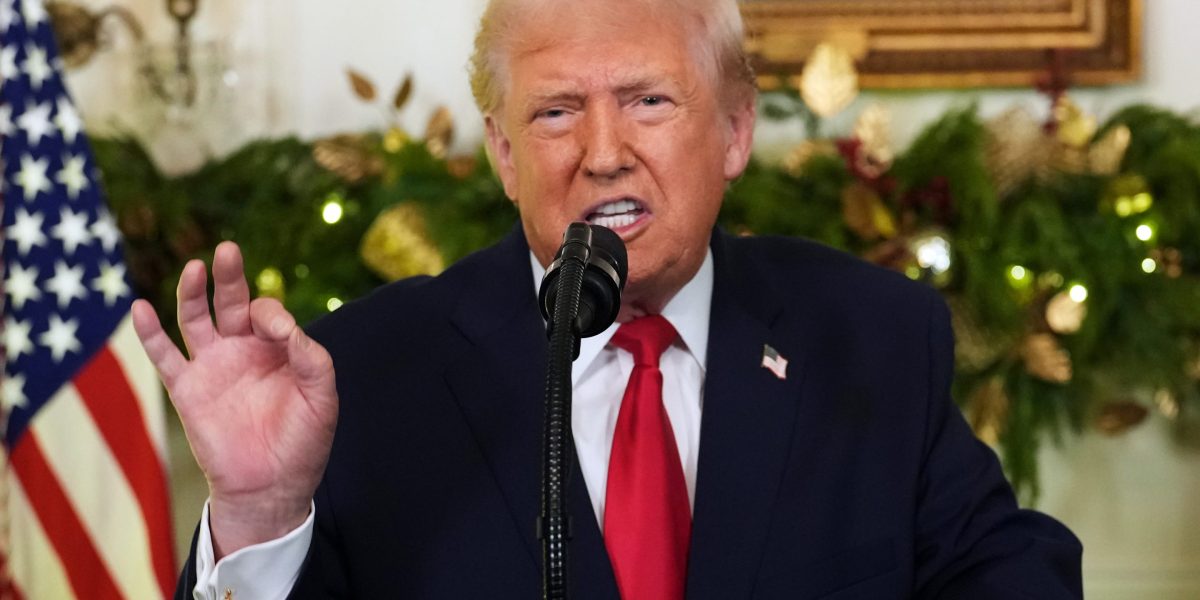
When Donald Trump delivered the first White House address of his second presidency Wednesday night, all major U.S. networks beamed his image and voice onto their airwaves, cable feeds and online platforms.

Americans ended up watching the Republican president stand in the Diplomatic Reception Room and deliver 18 minutes of aggressive, politically motivated arguments that misstated facts, blamed the nation’s ills on his predecessor, exaggerated the results of his nearly 11 months in office and amplified his characteristically gargantuan, immeasurable promises about what’s to come.

This was no commander in chief announcing a military action or discussing a critical national issue. It was a politician’s defiant insistence that he’s doing a better job than polls suggest most Americans believe. And the spectacle raises the question of whether network executives should grant airtime to the leader of the free world for a clearly political speech simply because he asks.

“It’s not that the Oval Office and the White House haven’t been used for political speeches before,” said former NBC executive Mark Lukasiewicz, who is dean of Hofstra University’s communications school after more than a decade leading NBC’s special broadcasts, including presidential addresses.

“But, as with a great deal of what Donald Trump does as president, this was outside the norm,” Lukasiewicz said, adding that news executives are reluctant to flout the historical standard that “when the president feels he needs to speak to the nation, you need to let him speak.”

The uneasy dynamics were further intensified because Trump spoke the same day that the Federal Communications Commission chairman, Brendan Carr, told members of Congress that his agency, which has regulatory authority over media companies, is not in fact an independent agency as has been understood through generations of Republican and Democratic administrations. That’s on top of Trump’s penchant for browbeating individual journalists who cover him and suing news organizations to the tune of multimillion-dollar settlements, notably from CBS and ABC.

Lukasiewicz, who left NBC soon after Trump’s 2016 election, said “it is hard to imagine that those factors aren’t on the minds of news executives and network executives making these decisions.”

Networks typically give presidents the benefit of the doubt

The White House did not immediately reply to questions Thursday about the process that led to Wednesday’s address. The networks also did not respond to Associated Press inquiries. Spokespeople at MS NOW and CNN, cable networks whose prime-time programming already is oriented to political coverage, declined comment.

Presidential addresses often begin with the White House press secretary or communications director contacting networks’ Washington bureau chiefs, asking for a specific amount of time and offering a general description of the topic. Lukasiewicz recalled that when President Barack Obama told the nation that 9/11 mastermind Osama bin Laden had been killed on his orders, his aides had told networks the president wanted to discuss a major national security matter.

Such conversations are relayed up to network executives, who must weigh whether to preempt or delay programming, decisions that can affect advertising revenue. Networks typically grant the time, reasoning that they’re relatively rare and historically have involved substantial matters.

Trump, who relishes talking directly to voters via social media and regularly talks to reporters on Air Force One and elsewhere, has made fewer requests for network time than many of his predecessors; he had not asked at all since returning to the White House in January.

Still, it’s not a guaranteed yes, with Obama and President Joe Biden being denied requests in recent decades.

The president disclosed his plans Tuesday on Truth Social, his social media platform. That announcement came hours after his declaration, also on Truth Social, that the U.S. would accelerate its actions against Venezuela and boats the Trump administration insists are running drugs that reach U.S. soil.

Taken together, those posts triggered chatter in Washington and beyond about official wartime actions. Some newsrooms predictably linked his planned speech to his Venezuela commentary. Presidents, after all, regularly make major military announcements in addresses from the White House: John F. Kennedy on the Cuban Missile Crisis, Lyndon Johnson on Vietnam, Jimmy Carter on the Iran hostages, Ronald Reagan on the Cold War and U.S. maneuvers in Latin America.

Presidents also have made plenty of U.S.-centered speeches, many fairly described as a politician pitching his preferred domestic policies with an unchecked megaphone.

Network leaders notably rejected Obama in 2014 when he wanted to talk about immigration policy while Congress was at an impasse over the matter. Lukasiewicz recalled being part of the executive team that rejected Obama’s request to speak during his first term on the Affordable Care Act becoming law.

In 2022, Biden spoke at length on his concerns about American democracy — but several networks did not carry his remarks from Philadelphia. By itself, the topic could be framed as a national concern above partisanship. Biden’s effort, though, was complicated by the fact that he was talking about Trump and Trump’s supporters who ransacked the U.S. Capitol on Jan. 6, 2021, at a time when they were being investigated and prosecuted.

Trump’s purpose still wasn’t obvious hours ahead of his speech

It’s not clear when — or if — the White House shared the substance of Trump’s remarks with network leaders. People familiar with how the process has worked in previous administrations said it would be defensible, since it was Trump’s first address this term, for networks to grant his request even without clarity about the topic.

By Wednesday afternoon and early evening, White House aides and some executive branch agencies had telegraphed to some journalists that the speech would be more oriented to the state of the nation nearly a year into Trump’s presidency — a framing that would still put the speech within historical norms. Trump, however, went beyond those traditional boundaries.

The United States was “laughed at” before he resumed the presidency in January, Trump insisted. He blamed Biden and Democrats for “the worst (inflation) in the history of our country,” but said “everything … is falling rapidly.” Biden-era inflation was not the worst in history, inflation rates began falling before he left office and, though they are now at or much closer to historically routine levels, that still means prices are rising.

The White House also offered charts that only Fox opted to show.

Trump accused immigrants in Minnesota of stealing “billions and billions” of dollars and used the language of war to call Biden-era immigration levels an “invasion.” He claimed he’d secured $18 trillion in foreign business investments to the U.S. when his own White House puts the number closer to half that. He said he scored a landslide in 2024 — despite his Electoral College vote share ranking in the bottom third through 230 years of victorious presidents.

Asked whether the display could give TV executives pause in the future, Lukasiewicz pointed back to business realities.

“I don’t know,” he said. “Those overlaying factors of the incredible pressure that this president can bring, and has shown himself completely willing to bring on these organizations and their corporate parents when he’s unhappy — that’s still part of part of the equation.”


Source link

Continue Reading

Business

From search to discovery: how AI Is redrawing the competitive map for every brand

Published

on


In the past, search used to look something like this in Google: “black running shoes, women’s size 8, under $100” – and ten blue links and a few shopping ads likely appeared. A helpful first step, but requiring further research and analysis.

Now, you can ask an even more pointed question – perhaps adding in a preference for arch support, a shopping mile radius – to a large language model (LLM) and get a clear, context-rich answer: “Here are three nearby options that fit your criteria. The top-rated one is available for pickup in 40 minutes.”

It’s an improved interaction, but not at the cost of a more complex user experience. This new way of search is redefining consumer behavior and expectations, and how marketers must approach brand visibility. In fact, it represents a reconfiguration of digital marketing and a new economy of visibility.

As these interactions become more complex and context-rich, the way we measure success must evolve too.

Visibility Is the New KPI

In traditional SEO, success means ranking on page one of Google. In the AI era, success means being part of the answer — cited, mentioned, or described accurately when an AI system responds.

This is not a mere marketing nuance: it’s a structural shift in how digital presence is valued. Companies that understand this will treat AI visibility as a new form of brand capital, something to monitor and manage as carefully as reputation or market share.

Advertising economics are already following this pattern: U.S. advertisers are projected to spend over $25 billion annually on AI-powered search placements by 2029, which is nearly 14% of total search budgets.

But, understanding how visibility is measured is just the first step. To capture it effectively, brands must recognize that product discovery itself is being reconstructed, with two distinct search experiences shaping how users find and interact with information.

Two User Experiences, Two Optimization Models

We now have two search experiences — traditional search and AI-driven search — each serving different user needs.

Frankly, this is the simplest framework to offer, when in fact, it is even more complex and nuanced once you take into account AI agents that act autonomously on behalf of the customer.

Traditional search is navigational, guiding users through lists of pages. Effectively, it points them in the right direction.

Meanwhile, AI-driven search is conversational, contextual, and consultative. It’s able to perform multi-step research, interpret context, and merge data from multiple sources into one synthesized response. For marketers, that means building for two visibility models: in SEO, we optimize for keywords; in AI discovery, we optimize for prompts.

The shift in user behavior is measurable and gaining ground. According to Semrush AI Visibility Index, between August and October 2025:

To stay visible, brands must start by identifying which questions matter most to their business – prioritizing prompts that are both high-volume and high-impact. Irrelevant traffic is wasted effort; rare relevance won’t scale. The sweet spot has always been where volume meets relevance, and AI discovery only raises the stakes—rewarding context, authority, and precision the same way great SEO always has.

As AI-driven and traditional search continue to evolve, the line between them is beginning to blur. Brands that optimize for both experiences today will be best positioned to thrive as these models converge into a single, unified discovery interface.

Preparing for the AI + Traditional Search Convergence

Eventually, you’ll see conversational answers alongside maps, reviews, and transactional links — a mix of synthesis and structure. When that happens, businesses will track two main metrics:

  • Traffic, the traditional measure of visits
  • AI Visibility, a new measure of how often and how accurately a brand appears in AI-generated responses

But visibility alone won’t be enough. The next wave of competition will happen at the content layer.

Brands will need to build for both bots and humans — crafting content that reads naturally, ranks intelligently, and feeds the context these models rely on. It’s a new kind of content development, where clarity for users and machine readability carry equal weight.

When that becomes common, websites will need to work as seamlessly for bots as they do for people. Features like SMS-based authentication or manual verification could block machine-driven transactions entirely. Businesses will need to rethink checkout and navigation to accommodate non-human operators.

While optimizing for visibility and content readiness is essential, the larger shift is economic: the convergence of AI and search is redefining how value is created, measured, and captured across the digital landscape.

AI Discovery and the New Economics of Search

The economics of search are changing.

This convergence of SEO and AI visibility is not a short-term marketing trend. It’s a deeper transformation — the creation of a discovery layer that connects information accuracy, credibility, and commercial outcomes in a continuous loop.

Within five years, we’ll unlikely distinguish between “search engines” and “AI assistants.” Instead, we’ll talk about several intelligent systems from companies such as Google and OpenAI that decide what people see, trust, and buy.

While the system itself is changing, the opportunity remains open. AI Search doesn’t belong only to the biggest players — it’s a reset. Smaller brands can rise faster by being precise, credible, and contextually relevant, while larger enterprises must relearn agility and authority at scale.

In traditional SEO, the strongest often dominated; in AI discovery, the most relevant wins.

Businesses that measure and manage their visibility within this new system will define the next era of digital competition.

The opinions expressed in Fortune.com commentary pieces are solely the views of their authors and do not necessarily reflect the opinions and beliefs of Fortune.


Source link

Continue Reading

Trending

Copyright © Miami Select.