Connect with us

Business

Alexandr Wang says the next Bill Gates will be a 13-year-old who is ‘vibe coding’ right now

Published

on


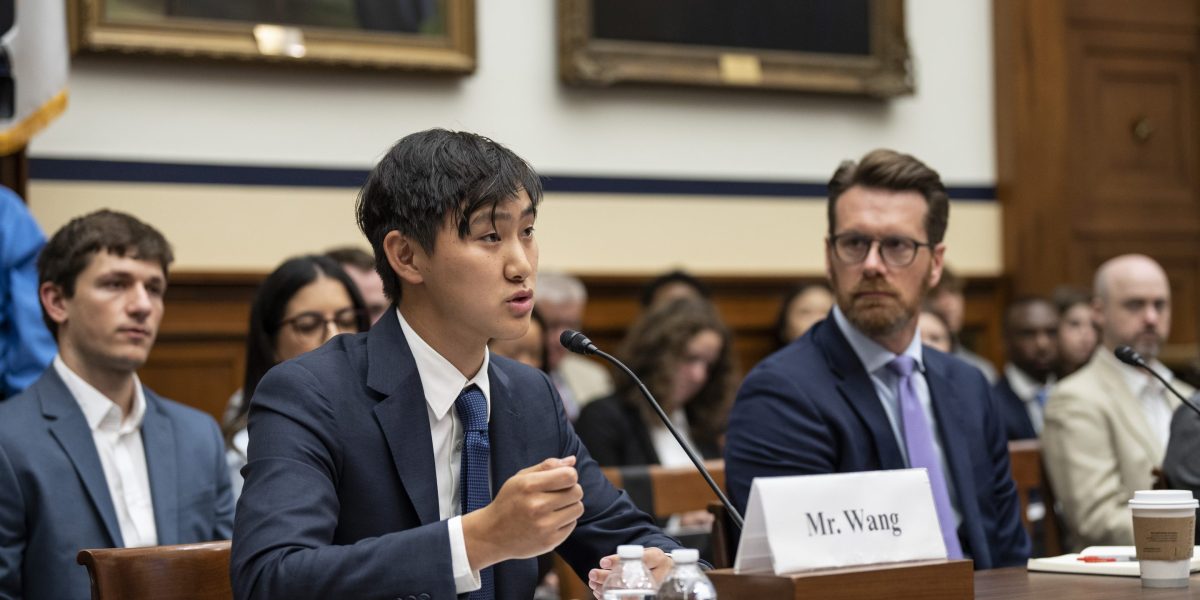
Alexandr Wang—who became the world’s youngest self-made billionaire at 24—is now, at 28, running one of the most ambitious AI efforts in Silicon Valley. In his first 60 days at Meta, he built a 100-person lab he described to TBPN hosts John Coogan and Jordi Hays as “smaller and more talent dense than any of the other labs.” 

His goal: nothing less than superintelligence.

Wang, with his aerial view of the industry, has advice for kids, especially those in Gen Alpha now entering middle school: Forget gaming, sports, or traditional after-school hobbies. 

“If you are like 13 years old, you should spend all of your time vibe coding,” he said in his recent TBPN interview. “That’s how you should live your life.”

Why is this a generational moment for Gen Z?

For Wang, the reasoning is simple. Every engineer, himself included, is now writing code he believes will be obsolete within five years.

“Literally all the code I’ve written in my life will be replaced by what will be produced by an AI model,” he said.

That realization has left him, in his words, “radicalized by AI coding.” What matters most now isn’t syntax, or learning a particular language, but time spent experimenting with and steering AI tools.

“It’s actually an incredible moment of discontinuity,” Wang said. “If you just happen to spend 10,000 hours playing with the tools and figuring out how to use them better than other people, that’s a huge advantage.”

Teenagers have a clear advantage over adults: time and freedom to immerse themselves in new technology. And while in the past, entrepreneurial teenagers leveraged this time to be “sneaker flippers” or run Minecraft servers, Wang says the focus should now be on the code.

He compares the moment to the dawn of the PC revolution. The Bill Gateses and Mark Zuckerbergs of the world had an “immense advantage” simply because they grew up tinkering with the earliest machines. 

“That moment is happening right now,” Wang said. “And the people who spend the most time with it will have the edge in the future economy.”

Is superintelligence coming?

Wang isn’t coy about Meta’s ambitions. He calls the company’s infrastructure, scale, and product distribution unmatched. 

“We have the business model to support building literally hundreds of billions of dollars of compute,” he said.

His team, just over 100 people, is deliberately designed to be “smaller and more talent dense” than rivals. “The other labs are like 10 times bigger,” Wang said, but their lab had “cracked” coders. 

The lab is split into three pillars: research, product, and infrastructure. Research builds the models Wang says will “ultimately be superintelligent.” Product ensures they get distributed across billions of users through Meta’s platforms. And infrastructure focuses on what he calls “literally the largest data centers in the world.”

Wang is particularly excited about hardware. Like many Meta executives now, he points to the company’s new smart glasses, which had a hilariously foppish demo, as the “natural delivery mechanism for superintelligence.”

Placed right next to the human senses, they will merge digital perception with cognition.

“It will literally feel like cognitive enhancement,” Wang said. “You will gain 100 IQ points by having your superintelligence right next to you.”

Why vibe coding matters

Vibe coding is the shorthand for this shift: using natural language prompts to generate and iterate on code. Rather than writing complex syntax, users describe their intent, and AI produces functioning prototypes.

The concept is spreading across Silicon Valley’s C-suites. Klarna CEO Sebastian Siemiatkowski has said he can now test ideas in 20 minutes, instead of burning weeks of engineering cycles. Google CEO Sundar Pichai revealed that AI already generates more than 30% of new code at the company, calling it the biggest leap in software creation in 25 years.

Wang takes that further. For him, vibe coding isn’t just a productivity hack, but a future cultural mandate. What matters isn’t the code itself — it’s the hours of intuition-building that come from pushing AI tools to their limits, which is why he urges Gen Alpha to start early.

“The role of an engineer is just very different now than it was before,” he said. 

A version of this story was published on Fortune.com on September 19, 2025.

More on Meta:

Join us at the Fortune Workplace Innovation Summit May 19–20, 2026, in Atlanta. The next era of workplace innovation is here—and the old playbook is being rewritten. At this exclusive, high-energy event, the world’s most innovative leaders will convene to explore how AI, humanity, and strategy converge to redefine, again, the future of work. Register now.


Source link

Continue Reading

Business

TikTok agrees U.S. joint venture deal with Oracle, Silver Lake and MGX

Published

on


TikTok has signed agreements with three major investors — Oracle, Silver Lake and MGX — to form a new TikTok U.S. joint venture, ensuring the popular social video platform can continue operating in the United States.

The deal is expected to close on Jan. 22, according to an internal memo seen by The Associated Press. In the communication, CEO Shou Zi Chew confirmed to employees that ByteDance and TikTok signed the binding agreements with the consortium.

“I want to take this opportunity to thank you for your continued dedication and tireless work. Your efforts keep us operating at the highest level and will ensure that TikTok continues to grow and thrive in the U.S. and around the world,” Chew wrote in the memo to employees. “With these agreements in place, our focus must stay where it’s always been—firmly on delivering for our users, creators, businesses and the global TikTok community.”

Half of the new TikTok U.S. joint venture will be owned by a group of investors — among them Oracle, Silver Lake and the Emirati investment firm MGX, who will each hold a 15% share. 19.9% of the new app will be held by ByteDance itself, and another 30.1% will be held by affiliates of existing ByteDance investors, according to the memo. The memo did not say who the other investors are and both TikTok and the White House declined to comment.

The U.S. venture will have a new, seven-member majority-American board of directors, the memo said. It will also be subject to terms that “protect Americans’ data and U.S. national security.”

U.S. user data will be stored locally in a system run by Oracle. The memo said U.S. users will continue “enjoying the same experience as today” and advertisers will continue to serve global audiences with no impact from the deal.

TikTok’s algorithm — the secret sauce that powers its addictive video feed — will be retrained on U.S. user data to “ensure the content feed is free from outside manipulation,” the memo said. The U.S. venture will also oversee content moderation and policies within the country.

American officials have previously warned that ByteDance’s algorithm is vulnerable to manipulation by Chinese authorities, who can use it to shape content on the platform in a way that’s difficult to detect.

The algorithm has been a central issue in the security debate over TikTok. China previously maintained the algorithm must remain under Chinese control by law. But the U.S. regulation passed with bipartisan support said any divestment of TikTok must mean the platform cuts ties — specifically the algorithm — with ByteDance.

The deal marks the end of years of uncertainty about the fate of the popular video-sharing platform in the United States. After wide bipartisan majorities in Congress passed — and President Joe Biden signed — a law that would ban TikTok in the U.S. if it did not find a new owner in the place of China’s ByteDance, the platform was set to go dark on the law’s January 2025 deadline. For a several hours, it did. But on his first day in office, President Donald Trump signed an executive order to keep it running while his administration tries to reach an agreement for the sale of the company.

Three more executive orders followed, as Trump, without a clear legal basis, continued to extend the deadline for a TikTok deal. The second was in April, when White House officials believed they were nearing a deal to spin off TikTok into a new company with U.S. ownership that fell apart after China backed out following Trump’s tariff announcement. The third came in June, then another in September, which Trump said would allow TikTok to continue operating in the United States in a way that meets national security concerns.

TikTok has more than 170 million users in the U.S. About 43% of U.S. adults under the age of 30 say they regularly get news from TikTok, higher than any other social media app including YouTube, Facebook and Instagram, according to a Pew Research Center report published this fall.

Shares of Oracle jumped $9.07, or 5%, to $189.10 in after-hours trading.

This story was originally featured on Fortune.com


Source link

Continue Reading

Business

Stocks: Bank of America warns fund managers just triggered a contrarian ‘sell’ signal

Published

on


Bank of America’s “Bull & Bear Indicator” rose from 7.9 to 8.5 in the last few days, triggering its contrarian “sell” signal for risk assets, according to a note from analyst Michael Hartnett and his colleagues seen by Fortune this morning. The indicator is derived from BofA’s regular fund manager survey, which asks 200-plus investment managers about their appetite for risk. The logic of the Bull & Bear Indicator is that when everyone in the market is bullish, it’s time to leave.

S&P 500 futures were up 0.25% this morning. The last session closed up 0.79%. The index remains a little less than 2% beneath its all-time high. Markets in Asia largely closed up this morning. Europe and the UK were flat in early trading. Whether stocks are overvalued—especially tech stocks—has been a running theme in the equity markets all year long. 

BofA’s sell signal has been activated 16 times since 2002, Hartnett says. On average, the MSCI All Country World Index (an index that represents stocks globally) declined by 2.4% afterwards, the bank says, with a maximum average drawdown of 8.5% by three months later.

The indicator has a record of being right 63% of the time—so it isn’t flawless. But BofA also notes that investors are in an unusually “risk-on” mood in equities right now: Last week saw a record inflow of $145 billion into equity exchange-traded funds, and the second-highest ever weekly inflow of money into U.S. stocks ($77.9 billion), Hartnett wrote. The indicator thus implies that a smart investor might want to become fearful given that others are too greedy.

Investor sentiment roughly correlates with sentiment in the Purchasing Managers Index, a survey of supply chain managers responsible for corporate buying. Right now, investors have broken ranks with the PMI, with the former being much more positive about future than the latter. They appear to be expecting the PMI to follow their lead, Hartnett argues.

“Investors [appear to be] bull positioned for ‘run-it-hot’ PMI & [earnings per share] acceleration on rate cuts, tariff cuts, tax cuts,” he told clients.

Conversely, assuming the market does not pull back—or a revesal is temporary—he predicts EPS growth of 9% for stocks in 2026 despite increased U.S. unemployment, and the threat of “bond vigilantes slowing [the] AI capex boom.”

Here’s a snapshot of the markets ahead of the opening bell in New York this morning:

  • S&P 500 futures are up 0.33% this morning. The last session closed up 0.79%. 
  • STOXX Europe 600 was flat in early trading. The U.K.’s FTSE 100 was flat in early trading. 
  • Japan’s Nikkei 225 was up 1.03%. 
  • China’s CSI 300 was up 0.34%. 
  • The South Korea KOSPI was up 0.65%. 
  • India’s NIFTY 50 was up 0.59%. 
  • Bitcoin was at $88K.
Join us at the Fortune Workplace Innovation Summit May 19–20, 2026, in Atlanta. The next era of workplace innovation is here—and the old playbook is being rewritten. At this exclusive, high-energy event, the world’s most innovative leaders will convene to explore how AI, humanity, and strategy converge to redefine, again, the future of work. Register now.


Source link

Continue Reading

Business

Inside OpenAI’s ‘code red’ | Fortune

Published

on


The latest: Amazon reportedly is in talks to invest $10 billion or more in the ChatGPT maker, which already counts giants like Microsoft among its investors. Perhaps the most recent (and loudest) news cycle, however, had nothing directly to do with funding at all—social media lit up with reports that CEO Sam Altman had issued a “code red” to the OpenAI team, saying it was time to double down on improving ChatGPT (the LLM that started it all) or risk falling behind.

Fortune’s tech team recently dove into what’s going on behind the scenes, in a feature published this week and helmed by Jeremy Kahn, Alexei Oreskovic, and Lee Clifford. They wrote: 

The internal call to arms lays bare the very precarious position this market leader is now in, particularly as it confronts industry titans like Google (as well as Microsoft and Meta), with tens of billions of dollars in cash on their balance sheets and massive ecosystems of products to boost their distribution.  

For Altman, a longtime tech entrepreneur, the historic matchups of Silicon Valley’s past, pitting innovators and incumbents in winner-takes-all battles, are surely contributing to the sense of urgency: The annihilation of browser pioneer Netscape by Microsoft or the eclipse of BlackBerry’s handheld communications gadgets by Apple’s iPhone comes to mind. But there’s also the example set by Facebook founder Mark Zuckerberg, whose famous “lockdowns” over a decade ago helped repel the threat of Google’s nascent—and ultimately doomed—social networking product. 

The decisions made by OpenAI and its competitors at this critical juncture in a fast-moving market will decide which company cements its hold on what some have called the most transformative technology since electricity, and which will end up as odd footnotes in the final writing of the history of AI. 

Many Term Sheet readers know I love a good history lesson. (Did you know that venture capital has its roots in the financial structure of whaling ventures?) And lots of people like to say that AI marks an Industrial Revolution-esque change. If I’m honest, for all my skepticism, I do believe that. 

So, that means history is being written right now. One “code red” here or there is incremental, but could make all the long-term difference. Read the whole story here

Term Sheet Next… My colleague Lily Mae Lazarus just published this Term Sheet Next profile of Ari Malik, cofounder of Salient AI. He talks candidly about the company’s $25 million ARR—and how they’ve yet to lose a customer to churn. Read it here.

See you Monday,

Allie Garfinkle
X:
@agarfinks
Email: alexandra.garfinkle@fortune.com
Submit a deal for the Term Sheet newsletter here.

Allie Garfinkle curated the deals section of today’s newsletter. Subscribe here.

Venture Deals

Lovable, a Stockholm-based vibe coding platform, raised $330 million in Series B funding. CapitalG and Menlo Ventures led the round, and were joined by Salesforce Ventures, HubSpot Ventures, Accel, Evantic, Creandum, and others.

Edison Scientific, a San Francisco-based AI platform for scientific R&D, raised $70 million in seed funding. Triatomic Capital, Spark Capital, and an undisclosed major US institutional biotech investor led the round. They were joined by Pillar VC, Susa Ventures, Striker Venture Partners, Hawktail VC, Olive VC, and others.

Endra AI, a Stockholm-based mechanical, electrical, and plumbing engineering platform, raised $20 million in seed funding. Notion Capital led the round, and was joined by Norrsken VC.

Ember LifeSciences, a Westlake Village, Calif.-based cold chain technology company, raised $16.5 million in Series A funding. Sea Court Capital led the round, and was joined by Cardinal Health, Carrier Ventures, and others.

ZeroPhase, a Munich, Germany-based startup building a communication layer for unmanned defense systems, raised €5.8 million in seed funding. BlueYard Capital led the round.

Thread, a New York-based AI service desk platform for managed service providers, raised $18 million in growth equity funding. Susquehanna Growth Equity led the round, and they were joined by Headline.

Private Equity

Arctos Partners acquired a minority stake in Monumental Sports & Entertainment, a Washington, D.C.-based sports and venue management company. Financial terms were not disclosed.


Source link

Continue Reading

Trending

Copyright © Miami Select.