Connect with us

Business

Republican leaders powerless to stop a January vote on healthcare after moderates defect on ACA subsidies

Published

on


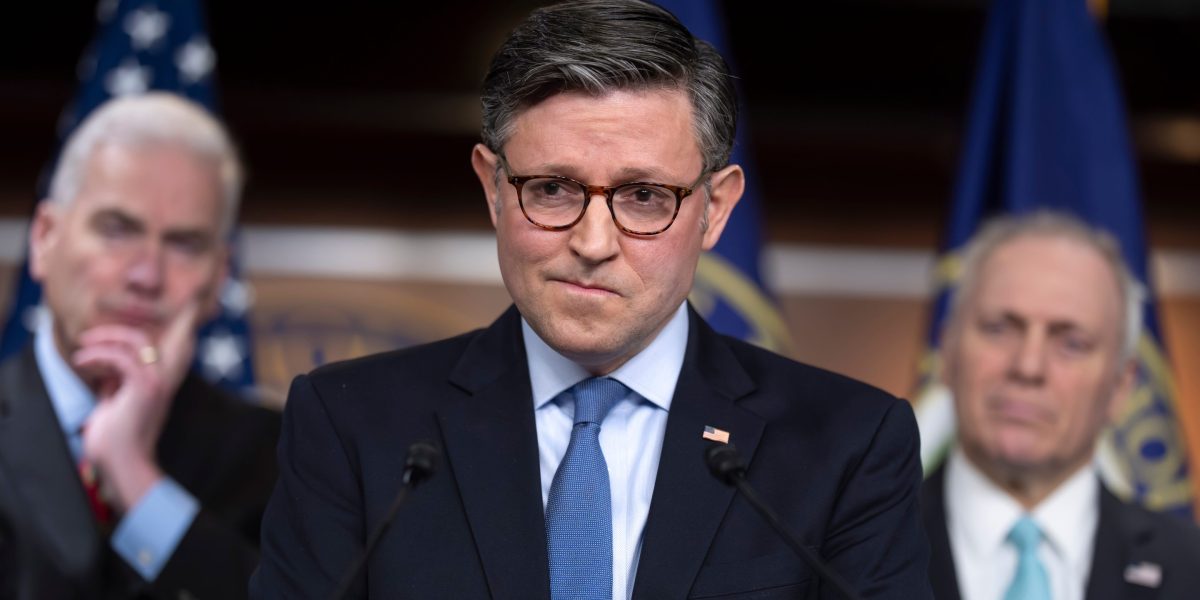
Speaker Mike Johnson had a ready-made refrain when asked why Republicans weren’t moving to extend federal health care subsidies: their party wanted to help 100% of Americans with their costs, not just the 7% of Americans enrolled in Affordable Care Act plans.

But not 100% of his conference agreed.

rare revolt from the moderate wing of the party has upended Johnson’s plans. Four Republicans this week signed onto a Democratic discharge petition that guarantees that the House will vote on extending the ACA subsidies sometime in January, with Republican leaders now powerless to stop it.

For Democrats, it was vindication of a months-long strategy, starting with the government shutdown in the fall, that pushed the expiration of the ACA support to the forefront of politics. Republicans from competitive districts most at risk of losing their seats in next year’s midterms felt the political pressure as they heard from constituents about their skyrocketing premiums.

“Nothing has changed with House Republican leadership, but something has changed within their own ranks,” said Rep. Pete Aguilar, chair of the House Democratic Caucus.

Flanked by his caucus Thursday on the Capitol steps, House Democratic Leader Hakeem Jeffries demanded that Johnson allow a vote on the three-year extension of ACA subsidies before lawmakers leave for the holidays: “Not tomorrow. Not next week. Not next year. Today.”

Johnson refused, saying it will “be on the floor that first week of January when we return.”

Lawmakers prepare to leave in limbo

The impasse left lawmakers with a cliffhanger as they headed home for the holiday break. Republican leaders now face growing pressure to appease centrist members who are threatening to side with Democrats to approve an extension of Affordable Care Act subsidies for three years.

Senate Majority Leader John Thune has to confront the issue as well. Any ACA bill clearing the House would simply push the fight to the Senate, which has already rejected a three-year extension.

A bipartisan group of senators has been meeting and discussing possible compromise bills that would extend the subsidies but put new limitations on them. But they would not consider anything until January.

Thune told reporters Thursday that a three-year extension of “a failed program that’s rife with fraud, waste and abuse is not happening.”

Yet Republican leaders in both chambers have not offered a plan that fully addresses members’ concerns about the sharp insurance cost increases many Americans are expected to face in 2026 and potentially beyond.

The White House has been engaged in discussions about the healthcare proposals but has largely allowed House Republicans to sort out their internal divisions and coalesce around a plan on their own, according to a senior administration official involved in the talks who was granted anonymity to discuss private discussions.

House Republicans on Wednesday passed a 100-plus-page health care package centered on long-standing GOP priorities, including expanding coverage options for small businesses and the self-employed. The bill would also rein in pharmacy benefit managers — middlemen that manage drug costs and process insurance claims.

Johnson touted the measure as “a bigger and better and more important thing for 100% of Americans, not just 7% of Americans.” But some Republicans who face tough reelection bids remain fixated on the looming spike in ACA costs.

The holidays provide Johnson with a brief window to try to persuade moderates to abandon the effort. The discharge petition froze once it reached the 218-signature threshold, meaning that while only four Republicans have publicly signed on, more may be willing to support the Democratic bill.

Rep. Ryan Mackenzie, one of the four Republicans who signed the Democratic petition, said it has “generated more conversations” and that “hopefully over the next three weeks, we will actually see some changes in some bipartisan efforts that actually can generate a meaningful vote that gets 218 in the House and 60 in the Senate.”

“I think allowing a vote is critically important,” Mackenzie said. “I think everybody should be able to put up their votes on the board, and they should be able to let everybody in the American public see how they voted on these individual issues.”

Leader Jeffries’ waiting game pays off

For months, Jeffries refused to support a one-year extension of ACA subsidies that a bipartisan group of lawmakers had been pursuing, dismissing it as a “non-starter” and “a laughable proposition.”

Instead, he held firm on a three-year extension with no income caps or cost offsets. That strategy paid off, as GOP moderates were forced to move in his direction when Johnson refused to allow any vote on an ACA extension.

Jeffries has faced criticism this year from progressive members of his caucus and grassroots groups who have urged him to push back more forcefully against Trump and Republicans. But on Thursday, much of the party rallied behind him on the Capitol steps, with several lawmakers praising his approach.

“As Leader Jeffries has said all along, this is the only real plan on the table,” said Aguilar.

Still, while Democrats have secured a vote, insurance costs for millions are set to rise next year, and passage of a three-year ACA subsidies extension remains a long shot even if it does pass the House. Senate Republicans have already rejected the three-year extension, but some GOP senators who are open to a deal on the subsidies said a House vote could provide momentum.

“We could have a vehicle — if we could get Republicans and Democrats behind it — then we could send it back,” said GOP Sen. Thom Tillis, adding that it “means that there’s still a chance.”

For Democrats, the fight has also allowed them to unify around a message they believe could prove potent on the campaign trail.

“The Republican health care crisis is unacceptable, unconscionable, and un-American,” Jeffries said.

A Republican House divided

The decision by four Republicans to break with party leadership and join Democrats is only the latest sign of discontent in the narrowly divided House.

Johnson has argued that the criticism directed at his leadership — and lawmakers repeatedly bypassing leadership to force votes — is inevitable given the slim GOP majority. He said he lacks the advantages of a large majority, where “the speaker had a long stick that he would administer punishment.”

“I don’t have that, because we have a small margin,” he said. Of the ACA extensions, Johnson said leadership had “talked about it at length” with GOP moderates, describing the conversations as “some intense fellowship.”

“Everybody’s in good spirits now and everybody understands what’s happening,” he added.

Some GOP members, however, don’t appear to share that assessment. There was lingering discontent as lawmakers headed home for the holidays.

“I don’t know how we did not vote on a good bipartisan extension,” said GOP Rep. Don Bacon, adding that Democrats will use the health care issue “like a sledgehammer” on the campaign trail.

House Majority Leader Steve Scalise, R-La., insisted that Republicans are finishing the year “as united as we’ve ever been.”

“We set out on a course to do big things, not little things, and that means we’re going to have some differences along the way.”

___

Associated Press reporter Mary Clare Jalonick and Kevin Freking contributed to this report.


Source link

Continue Reading

Business

Southeast Asian economies prove resilient in the face of Trump’s tariffs as supply chains expand

Published

on


Within a year of taking office, U.S. president Donald Trump turned global trade on its head. His sweeping tariffs took effect on Aug. 1, and have since upended countless trade relationships countries built through years of diplomacy. Yet despite the U.S.’ tariffs, global trade has been more resilient than expected, say Macquarie’s analysts in their 2026 global economic and market outlook (which was released in December). They’ve even benefitted an unlikely group: Southeast Asian economies. 

This is because many Chinese exporters turned to transshipping to reduce tariff payments—a process that led them to route goods through ASEAN countries before shipping them to the U.S.

Consequently, in 2025, the U.S. saw a reduction in Chinese goods, which were slapped with steep 40% tariffs, and an increase in ASEAN imports, which had lower tariffs averaging 10%.

President Trump, meanwhile, sought to diversify U.S. supply chains by inking trade deals with four ASEAN countries—Thailand, Malaysia, Cambodia and Vietnam—and pledging America’s commitment to the region.

“Our message to the nations of Southeast Asia is that the US is with you 100% and we intend to be a strong partner and friend for many generations to come,” Trump told leaders at the ASEAN summit in Kuala Lumpur on Oct. 26, noting that two-way trade between U.S. and Southeast Asia had reached a record of $453 billion in 2024.

China too, has sought to deepen ties with their Southern neighbours, signing an upgraded Free Trade Agreement (ACFTA 3.0) with ASEAN at the same summit—and cementing its position as Southeast Asia’s largest trading partner.

This has translated into steady growth for the ASEAN region.

“ASEAN’s growth in 2025 (+4.8%) turned out to be resilient and largely unchanged from 2024,” Maybank’s analysts say in their ASEAN Macro 2026 Year Ahead report, adding that “the fog of uncertainty from tariffs has dissipated”.

Maybank also noted that ASEAN countries’ negotiations with the White House resulted in tariff rates that were much lower than the ones Trump initially threatened, which were as high as 46% for Vietnam and 36% for Thailand. Meanwhile exemptions for tariff categories like electronics, pharmaceuticals, energy and minerals further reduced the bite of the tariffs.

An ongoing shift to dealmaking

But with the U.S. midterm elections looming in Nov. 2026, Trump will likely shift his focus to dealmaking and reducing economic uncertainty, Macquarie’s analysts say. 

This shift has already begun in recent months, they add, with the U.S. inking a bilateral framework agreement with the EU in July, and a deal to lower tariff rates for China in late October. Several partners have also signed similar tariff-slashing deals, including the UK and Japan.

“Looking ahead, we suspect the dealmaking approach to persist in 2026,” Macquarie’s analysts say, adding that notable potential deals include those with Mexico and Canada, which constitute 27% and 32% of U.S. exports.

Despite this, experts say that relations between the US and China will likely remain tense. “Relatively high tariffs on China could result in a further diversification of supply chains across Asia, with Chinese manufacturers shifting additional production to economies in the region,” Macquarie’s report reads.


Source link

Continue Reading

Business

Walmart’s women truckers surge thanks to $115,000 starting pay and other perks bringing in nontraditional candidates

Published

on


While the rest of the trucking industry faces a driver shortage, Walmart has managed to boost its driver numbers with six-figure starting pay and other perks that are catching the eye of even non-traditional applicants.

The mega retailer, which has claimed the top spot on the Fortune 500 for the past 13 years, has increased its number of in-house truck drivers by 33% over the past three years in part thanks to better wages and benefits.

In 2022, it boosted drivers’ starting pay to around $115,000 from an average salary of $87,000 previously. At the high end, drivers can make $135,000 per year, according to a Walmart spokesperson. The 2024 median pay for heavy and tractor-trailer truck drivers was $57,440 per year, according to the Bureau of Labor Statistics

Apart from a pay increase, Walmart also uses technology that allows for more reliable schedules compared to other companies. While some in the trucking industry are away for weeks at a time, Walmart gives its drivers consecutive days off of work and assigns them regional delivery territories to allow them to be home every week, a Walmart spokesperson told Fortune.

These perks, along with the better-than-average pay, have increasingly helped the company expand its pool of drivers and include more women. Just 9.5% of truck drivers in the U.S. are women as of 2024, according to the Women in Trucking Index—that’s compared to an estimated 18% of drivers at Walmart, according to a study by workforce intelligence company Revelio Labs that was viewed by Fortune. Bloomberg first reported on the study.

Through a 12-week training program that helps store associates transition to the trucking industry, Walmart has also increased its number of women drivers, a spokesperson said. Around 1,000 people have gone through the program, Bloomberg reported, representing about half of the company’s new drivers.

Possibly due to its efforts, Walmart has a five percentage point oversupply of truck drivers compared to its demand, according to the study by Revelio Labs. 

Walmart’s efforts to bring in more drivers, including those with less experience, is pivotal as the broader trucking industry faces a driver shortage that is expected to bring a shortfall of 160,000 drivers by 2028, according to the American Trucking Association. The broader category of U.S. retail, currently faces a shortfall of drivers, with demand for drivers exceeding supply by seven percentage points, according to Revelio Labs.

Older truck drivers are retiring and younger people aren’t keen to jump into trucking partly due to the long hours and time away from home. A 1,000-person survey from heavy-duty truck parts company FinditParts found that a quarter of Americans would not become truck drivers no matter what pay they were offered. 

For Walmart, any disadvantage in its supply chain, including a driver shortfall, could put it at a disadvantage with Amazon, with which it has been increasingly competing with in recent years, especially with its Walmart+ membership.

Without enough drivers, supply chains are delayed and prices go up. Finding and retaining drivers is thus of the utmost importance for companies like Walmart, Paul Bingham, a director of transportation consulting at S&P Global Market Intelligence, told Bloomberg.

“Trucking companies will need more drivers,” he said. “and they’ll have to attract them from the non-traditional population cohorts.”


Source link

Continue Reading

Business

Trump was wrong about tariffs funding the ‘Warrior Dividend’ of $1,776—troops were already set to get the money

Published

on


The “Warrior Dividend” that President Donald Trump announced during his televised address to the nation Wednesday is not a Christmas bonus made possible by tariff revenues, as the president suggested.

Instead, the $1,776 payments to troops are coming from a congressionally-approved housing supplement — money they were already set to receive — that was a part of tax cut extensions and expansions bill signed into law in July. Trump’s administration identified the source of the “dividend” payments Thursday.

In his remarks, Trump alluded to his “One Big Beautiful Bill Act” playing a role, but suggested that tariffs were largely responsible for the payments already on the way to 1.45 million members of the military.

“We made a lot more money than anybody thought because of tariffs and the bill helped us along. Nobody deserves it more than our military,” he said in announcing what he described as a “dividend.”

Trump has teased the idea of using his sweeping tariffs on imports to give Americans dividends ever since he imposed them in April. But these new payments are being disbursed by the Pentagon from a $2.9 billion military housing supplement that was part of Trump’s “One Big Beautiful Bill Act” to augment existing housing allowances, according to a senior administration official who requested anonymity to describe the payments.

The amount of the payments is a nod to next year’s 250th anniversary of the signing of the Declaration of Independence in 1776. In total, the measure is expected to cost $2.6 billion.

Trump’s announcement comes as he’s faced pressure to show he’s working to address rising costs for Americans, with prices remaining stubbornly high as the president has imposed double-digit tariffs on imports from almost every country. Trump has promised to lower prices, but he has struggled to do so. Inflation hit a four-decade high in June 2022 during Joe Biden’s presidency and then began to fall. But inflation has stayed elevated under Trump in part because of his tariffs.

Separately, members of the U.S. Coast Guard will be getting a similar one-time payment, the Department of Homeland Security announced Thursday. The “Devotion to Duty” payments, authorized by Secretary Kristi Noem a day earlier, will be $2,000 because, unlike the “Warrior Dividend,” they are subject to taxes. The amount Coast Guard members take home will be closer to $1,776.

The payments, according to the Coast Guard, will be classified as “special duty pay.” They will be paid for with money in a measure Trump signed in November, after a 43-day shutdown, that funds the government through January.

It’s not the first time Trump has brandished ‘dividends’

Sending money to voters is a timeworn tool for politicians and one that Trump has repeatedly tried to use, including this year.

Trump has for months suggested every American could receive a $2,000 dividend from the import taxes — an effort that seemed designed to try to shore up support for tariffs, which the president has said protect American industries and will lure manufacturing back from overseas.

But that particular pledge appeared to exceed the revenues being generated by his tariffs, according to a November analysis by the right-leaning Tax Foundation. The analysis estimated that the $2,000 payments being promised to taxpayers could add up to between $279.8 billion and $606.8 billion, depending on how they were structured.

The analysis estimated that Trump’s import taxes would produce $158.4 billion in total revenue during 2025 and another $207.5 billion in 2026. That’s not enough money to provide the payments as well as reduce the budget deficit, which Trump has also claimed his tariffs are doing.

Earlier this year, as his Department of Government Efficiency was slashing the U.S. government and its workforce, Trump had briefly proposed sending a DOGE “dividend” back to U.S. citizens.

Neither the tariff dividend or DOGE dividend has come to fruition, and members of Trump’s own party as well as officials in his administration have expressed some skepticism about the idea. There is also the risk that the payments being promised by Trump could push up inflation, as they would likely spur greater consumer spending. Republican lawmakers argued in 2021 that the pandemic relief package from then-President Biden — which included direct payments — helped trigger the run-up in inflation.

___

Associated Press writers Rebecca Santana, Konstantin Toropin and Lisa Mascaro contributed to this report.


Source link

Continue Reading

Trending

Copyright © Miami Select.