Connect with us

Business

‘They took all of our oil not that long ago. And we want it back’: Trump demands Venezuela return seized assets

Published

on


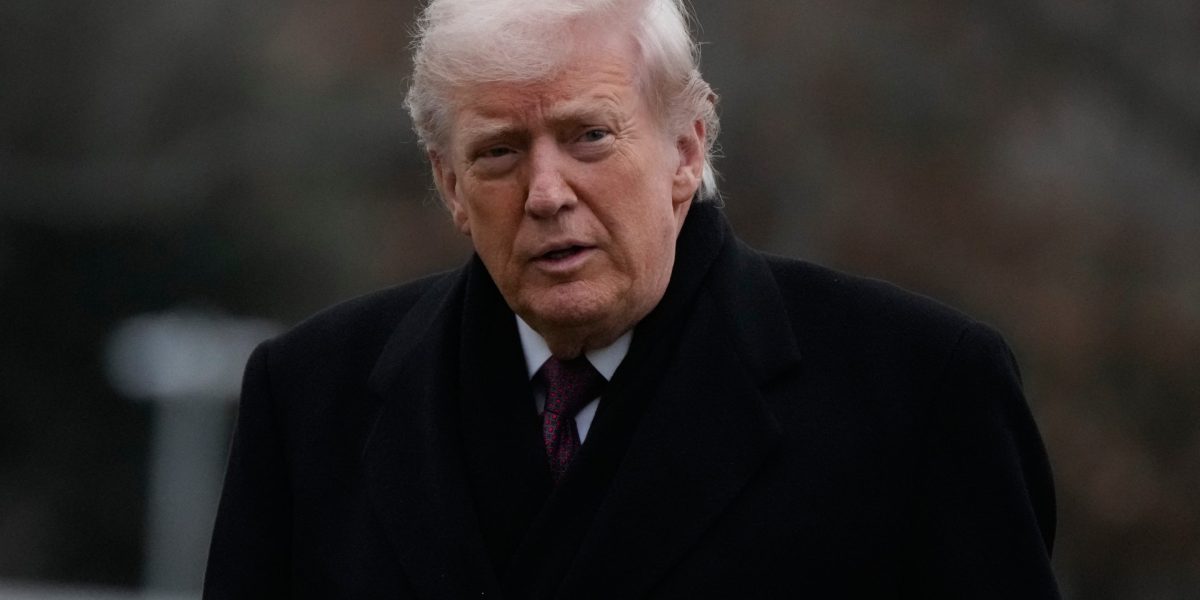
President Donald Trump demanded Wednesday that Venezuela return assets that it seized from U.S. oil companies years ago, justifying anew his announcement of a “blockade” against oil tankers traveling to or from the South American country that face American sanctions.

Trump cited the lost U.S. investments in Venezuela when asked about his newest tactic in a pressure campaign against leader Nicolás Maduro, suggesting his administration’s moves are at least somewhat motivated by disputes over oil investments, along with accusations of drug trafficking. Some sanctioned tankers already are diverting away from Venezuela.

“We’re not going to be letting anybody going through who shouldn’t be going through,” Trump told reporters. “You remember they took all of our energy rights. They took all of our oil not that long ago. And we want it back. They took it — they illegally took it.”

U.S. oil companies dominated Venezuela’s petroleum industry until the country’s leaders moved to nationalize the sector, first in the 1970s and again in the 21st century under Maduro and his predecessor, Hugo Chávez. Compensation offered by Venezuela was deemed insufficient, and in 2014 an international arbitration panel ordered the country’s socialist government to pay $1.6 billion to ExxonMobil.

While Venezuela’s oil has long dominated relations with the U.S., the Trump administration has focused on Maduro’s links to drug traffickers, accusing his government of facilitating the shipment of dangerous drugs into the U.S. In his social media post Tuesday night, Trump said Venezuela was using using oil to fund drug trafficking and other crimes.

U.S. forces last week seized an oil tanker off Venezuela’s coast amid a massive military buildup that includes the Navy’s most advanced aircraft carrier.

The military also has carried out a series of strikes on suspected drug boats in the Caribbean Sea and eastern Pacific Ocean that have killed a total of at least 99 people, including four in a strike Wednesday. Those attacks have prompted questions from lawmakers and legal experts about their legal justification. Trump also has said he is considering strikes on land.

Trump’s talk of ‘stolen assets’

Stephen Miller, Trump’s deputy chief of staff, likened Venezuela’s move to nationalize its oil industry to a heist.

“American sweat, ingenuity and toil created the oil industry in Venezuela,” Miller wrote on social media Wednesday. “Its tyrannical expropriation was the largest recorded theft of American wealth and property. These pillaged assets were then used to fund terrorism and flood our streets with killers, mercenaries and drugs.”

Venezuela first moved to nationalize its oil industry in the 1970s, a process that expanded under Chávez, who nationalized hundreds of private businesses and foreign-owned assets, including oil projects run by ExxonMobil and ConocoPhillips. That led to the arbitration panel’s 2014 order.

“There is a case that can be made that Venezuela owes this money to Exxon. I don’t think it’s ever been paid,” economist Philip Verleger said.

Trump blamed his predecessors for not taking a harder line against Venezuela over the asset seizures.

“They took it away because we had a president that maybe wasn’t watching,” Trump said Wednesday. “But they’re not going to do that again. We want it back. They took our oil rights — we had a lot of oil there. As you know they threw our companies out, and we want it back.”

Chevron has a waiver from the U.S. government for oil production in Venezuela, and the Texas-based oil giant says its operations have not been disrupted.

Venezuela’s debt to Chevron “has decreased substantially” since the company’s license to resume exporting Venezuelan oil to the U.S. was first granted in 2022, said Francisco Monaldi, a Venezuelan oil expert at Rice University in Houston. He said the amount is not public.

A new designation for Maduro’s government?

There was no change Wednesday to the list of foreign terrorist organizations after Trump said in his post that the “Venezuelan Regime” has been designated as one.

Officials at several national security agencies were told not to take Trump’s remarks about the designation literally and they should be treated as a figure of speech, according to a U.S. official involved in the discussions.

That official, who spoke on condition of anonymity to describe internal interagency communications, also stressed that the “blockade” Trump announced applies only to previously sanctioned vessels against which certain actions are already authorized, such as the seizure last week.

The State Department, which oversees the list, didn’t respond to requests for clarification.

Trump’s Justice Department in 2020 indicted Maduro on narcoterrorism charges and U.S. authorities have alleged that Venezuela’s leaders have profited from drug trafficking. Last month, the Trump administration designated a group linked to Maduro — the Cartel de los Soles — as a terrorist organization.

Venezuela decries American ‘piracy’

Maduro called United Nations Secretary-General Antonio Guterres on Wednesday for a conversation “regarding the current tensions in the region,” U.N. deputy spokesman Farhan Haq said.

“During the call, the secretary-general reaffirmed the United Nations’ position on the need for member states to respect international law, particularly the United Nations Charter, exert restraint and de-escalate tensions to preserve regional stability,” Haq said.

Venezuelan Foreign Minister Yván Gil demanded in a letter to the U.N. Security Council, which was obtained by The Associated Press, that the U.S. immediately release the “kidnapped crew” and return the oil illegally confiscated on the high seas.

In a second letter Wednesday, Venezuela’s U.N. Ambassador Samuel Moncada called for an emergency meeting of the U.N.’s most powerful body to discuss “the ongoing U.S. aggression.”

Citing Trump’s social media post, Moncada said, “this means that the U.S. government is claiming the world’s largest oil reserves as its own, in what would be one of the greatest acts of plunder in human history.”

In addition to urging the Security Council to condemn the taking of the tanker, Gil urged the U.N.’s most powerful body for a written statement stating that it hasn’t authorized actions against Venezuela “or against the international commercialization of its oil.”

While the strikes on alleged drug boats have raised questions about the use of military force, Trump’s seizure of the tanker and other actions against sanctioned entities are consistent with past American policy, said retired U.S. Vice Admiral Robert Murrett, now a professor at Syracuse University.

He also noted that from a military standpoint, seizing sanctioned oil tankers and imposing a blockade are far less risky than direct military confrontation.

“U.S. policy supports peaceful, democratic transition in Venezuela,” Murrett said. “If Maduro agrees tomorrow to step down and have a free and open election, I think we’d be delighted, Democrats and Republicans alike.”

___

Associated Press writers Matthew Lee in Washington, Regina Garcia Cano in Caracas, Venezuela, Cathy Bussewitz in New York and Edith M. Lederer at the United Nations contributed to this report.


Source link

Continue Reading

Business

Trump was wrong about tariffs funding the ‘Warrior Dividend’ of $1,776—troops were already set to get the money

Published

on


The “Warrior Dividend” that President Donald Trump announced during his televised address to the nation Wednesday is not a Christmas bonus made possible by tariff revenues, as the president suggested.

Instead, the $1,776 payments to troops are coming from a congressionally-approved housing supplement — money they were already set to receive — that was a part of tax cut extensions and expansions bill signed into law in July. Trump’s administration identified the source of the “dividend” payments Thursday.

In his remarks, Trump alluded to his “One Big Beautiful Bill Act” playing a role, but suggested that tariffs were largely responsible for the payments already on the way to 1.45 million members of the military.

“We made a lot more money than anybody thought because of tariffs and the bill helped us along. Nobody deserves it more than our military,” he said in announcing what he described as a “dividend.”

Trump has teased the idea of using his sweeping tariffs on imports to give Americans dividends ever since he imposed them in April. But these new payments are being disbursed by the Pentagon from a $2.9 billion military housing supplement that was part of Trump’s “One Big Beautiful Bill Act” to augment existing housing allowances, according to a senior administration official who requested anonymity to describe the payments.

The amount of the payments is a nod to next year’s 250th anniversary of the signing of the Declaration of Independence in 1776. In total, the measure is expected to cost $2.6 billion.

Trump’s announcement comes as he’s faced pressure to show he’s working to address rising costs for Americans, with prices remaining stubbornly high as the president has imposed double-digit tariffs on imports from almost every country. Trump has promised to lower prices, but he has struggled to do so. Inflation hit a four-decade high in June 2022 during Joe Biden’s presidency and then began to fall. But inflation has stayed elevated under Trump in part because of his tariffs.

Separately, members of the U.S. Coast Guard will be getting a similar one-time payment, the Department of Homeland Security announced Thursday. The “Devotion to Duty” payments, authorized by Secretary Kristi Noem a day earlier, will be $2,000 because, unlike the “Warrior Dividend,” they are subject to taxes. The amount Coast Guard members take home will be closer to $1,776.

The payments, according to the Coast Guard, will be classified as “special duty pay.” They will be paid for with money in a measure Trump signed in November, after a 43-day shutdown, that funds the government through January.

It’s not the first time Trump has brandished ‘dividends’

Sending money to voters is a timeworn tool for politicians and one that Trump has repeatedly tried to use, including this year.

Trump has for months suggested every American could receive a $2,000 dividend from the import taxes — an effort that seemed designed to try to shore up support for tariffs, which the president has said protect American industries and will lure manufacturing back from overseas.

But that particular pledge appeared to exceed the revenues being generated by his tariffs, according to a November analysis by the right-leaning Tax Foundation. The analysis estimated that the $2,000 payments being promised to taxpayers could add up to between $279.8 billion and $606.8 billion, depending on how they were structured.

The analysis estimated that Trump’s import taxes would produce $158.4 billion in total revenue during 2025 and another $207.5 billion in 2026. That’s not enough money to provide the payments as well as reduce the budget deficit, which Trump has also claimed his tariffs are doing.

Earlier this year, as his Department of Government Efficiency was slashing the U.S. government and its workforce, Trump had briefly proposed sending a DOGE “dividend” back to U.S. citizens.

Neither the tariff dividend or DOGE dividend has come to fruition, and members of Trump’s own party as well as officials in his administration have expressed some skepticism about the idea. There is also the risk that the payments being promised by Trump could push up inflation, as they would likely spur greater consumer spending. Republican lawmakers argued in 2021 that the pandemic relief package from then-President Biden — which included direct payments — helped trigger the run-up in inflation.

___

Associated Press writers Rebecca Santana, Konstantin Toropin and Lisa Mascaro contributed to this report.


Source link

Continue Reading

Business

House Democrats release more Epstein photos, including Bill Gates and a dinner full of wealthy philanthropists

Published

on


House Democrats released several dozen more photos Thursday from the estate of the convicted sex offender Jeffrey Epstein, showing his associations with the rich and famous, as the Department of Justice faces a deadline to release many of its case files on the late financier by the end of the week.

The photos released Thursday were among more than 95,000 that the House Oversight Committee has received after issuing a subpoena for the photos that Epstein had in his possession before he died in a New York jail cell in 2019. Congress has also passed, and President Donald Trump has signed, a law requiring the Justice Department to release its case files on Epstein, and his longtime girlfriend and confidante Ghislaine Maxwell, by Friday. Anticipation about what those files will show is running high after they have been the subject of conspiracy theories and speculation about his friendships with Trump, former President Bill Clinton, the former Prince Andrew, and others.

House Democrats have already released dozens of photos from Epstein’s estate showing Trump, Clinton and Andrew, who lost his royal title and privileges this year amid scrutiny of his relationship with the wealthy financier. The photos released Thursday showed Epstein cooking with Sultan Ahmed bin Sulayem, an Emirati businessman. The photos also include the billionaire Bill Gates and images of a 2011 dinner of notable people and wealthy philanthropists hosted by a nonprofit group. The committee made no accusations of wrongdoing by the men in the photos.

There were also images of passports, visas and identification cards from Russia, the Czech Republic, Ukraine, South Africa and Lithuania with personally identifying information redacted, as well as photos of Epstein with women or girls whose faces were blacked out. The committee has said it is redacting information from the photos that may lead to the identity of victims being revealed.

Rep. Robert Garcia, the top Democrat on the oversight panel, said in a statement that the “new images raise more questions about what exactly the Department of Justice has in its possession. We must end this White House cover-up, and the DOJ must release the Epstein files now.”

Join us at the Fortune Workplace Innovation Summit May 19–20, 2026, in Atlanta. The next era of workplace innovation is here—and the old playbook is being rewritten. At this exclusive, high-energy event, the world’s most innovative leaders will convene to explore how AI, humanity, and strategy converge to redefine, again, the future of work. Register now.


Source link

Continue Reading

Business

Down Arrow Button Icon

Published

on


A 911 call about a man resembling “the CEO shooter.” Body-camera footage of police arresting Luigi Mangione and pulling items from his backpack, including a gun that prosecutors say matches the one used to kill UnitedHealthcare CEO Brian Thompson, and a notebook they have described as a “manifesto.” Notes about a “survival kit” and “intel checkin,” and testimony about his statements behind bars.

A three-week pretrial hearing on Mangione’s fight to exclude evidence from his New York murder case revealed new details about his December 2024 arrest in Altoona, Pennsylvania, steps prosecutors say he took to elude authorities for five days, and what he may have revealed about himself after he was taken into custody.

The hearing ended Thursday. Mangione watched from the defense table as prosecutors called 17 witnesses, many of them police officers and other personnel involved in his arrest. Mangione’s lawyers called none. Judge Gregory Carro said he won’t rule until May 18, “but that could change.”

Mangione, 27, an Ivy League graduate from a wealthy Maryland family, has pleaded not guilty to state and federal murder charges. The pretrial hearing was in the state case, where he faces the possibility of life in prison, but his lawyers are trying to exclude evidence from both cases. Federal prosecutors are seeking the death penalty. He is due back in court for a hearing in that case on Jan. 9. Neither trial has been scheduled.

Here are some of the things we learned from Mangione’s pretrial hearing:

Body cameras give a close-up look at Mangione’s arrest

The public got an extensive, even exhaustive view of how police in Altoona, about 230 miles (370 kilometers) west of Manhattan, conducted Mangione’s arrest and searched his backpack after he was spotted eating breakfast at McDonald’s.

While there were quirky moments and asides — about holiday music, a hoagie and more — the point of the hearing was to help the judge assess whether Mangione voluntarily spoke to police and whether the officers were justified in searching his property before getting a warrant.

For the first time, body-worn camera video of Mangione‘s arrest was played in court and excerpts from one were made public. Previously, only still images had been released. Taken from multiple officers’ cameras, the footage put ears and eyes on the critical moments surrounding his arrest, along with an incongruously cheerful soundtrack: “Jingle Bell Rock” and other Christmas tunes on the restaurant’s sound system.

Officers on the witness stand were quizzed about what they said and did as Mangione went from noshing on a hash brown to being led away in handcuffs, as well as what they perceived, where they were standing and how they handled evidence after bringing him to a police station.

Mangione’s lawyers argue that none of the results of the search nor statements he made to police should be mentioned at his trial, which has yet to be scheduled. Prosecutors disagree. Carro didn’t hint at his conclusion. He invited both sides to submit written arguments and said he planned to study the body-camera video before issuing a written decision.

Differing views of Mangione’s statements and bag search

Mangione’s lawyers noted that one officer said “we’ll probably need a search warrant” for the backpack, but his colleagues had already rifled through it and later searched the bag again before getting a warrant.

Prosecutors emphasized an Altoona police policy, which they said is rooted in Pennsylvania law, that calls for searching the property of anyone who is being arrested. The two sides also amplified some contrasting signals, in officers’ words and actions, about their level of concern about whether the backpack contained something dangerous that could justify a warrantless search.

The officer searching the bag, Christy Wasser, testified that she was checking for a bomb. But Mangione’s lawyers pointed out that police didn’t clear the restaurant of customers — some were seen on body-camera footage walking to a bathroom a few feet away — and that she stopped her initial search almost immediately after finding a loaded gun magazine wrapped in a pair of underwear.

The find appeared to confirm officers’ suspicions that Mangione was the man wanted for Thompson’s killing.

“It’s him, dude. It’s him, 100%,” officer Stephen Fox was heard saying on body-worn camera video, punctuating the remark with expletives as Wasser held up the magazine.

Mangione gave police a fake name and a reason to arrest him

Mangione’s statements to police prior to his arrest matter mainly because, as shown on body-worn camera video, he initially gave officers a fake name — Mark Rosario — and a phony New Jersey driver’s license bearing that name. He eventually acknowledged the ruse and gave his real name after police ran the ID through a computer system and couldn’t get a match.

The fake name promptly gave Altoona police a reason to arrest him and hold him for New York City police. “If he had provided us with his actual name, he would not have committed a crime,” Fox testified. An NYPD lieutenant testified that the Rosario name matched one the suspected shooter used to purchase a bus ticket to New York and gave at a Manhattan hostel.

Mangione told police early on he didn’t want to talk, but officers engaged him for almost 20 minutes before a supervisor urged Fox to inform him of his right to remain silent. It happened after Mangione had admitted to lying about his name and said he “clearly shouldn’t have.”

An important factor in whether suspects have to be informed of their right to stay silent — known as a Miranda warning — is whether they are in police custody.

Prosecutors elicited testimony from officers suggesting Mangione could have believed he was free to leave when he gave the false name. But one of the first officers to encounter Mangione testified that he “was not free to leave until I identified who he was” — though Mangione wasn’t told that, and body camera video showed multiple officers standing between him and the restaurant door.

911 caller: Customers concerned ‘he looks like the CEO shooter’

For the first time, the public heard the 911 call that drew police to the Altoona McDonald’s, ultimately leading to Mangione’s arrest.

The restaurant’s manager told a dispatcher: “I have a customer here that some other customers were suspicious of that he looks like the CEO shooter from New York. They’re just really upset and they’re like coming to me and I was like, ‘Well, I can’t approach them, you know.’ ”

The woman, whose name was edited out of the recording played in court and omitted from the version released to the public, said she first tried calling a non-emergency number, but no one answered. Then she called 911.

“It’s not really an emergency,” she told the dispatcher at the start of the call.

The manager said Mangione was wearing a medical mask and a beanie pulled down on his forehead, leaving only his eyes and eyebrows visible. She said she searched online for a photo of the suspect for comparison.

A hoagie reward and getting ‘the ball rolling’ with the NYPD

At first, Altoona police officers were skeptical that Thompson’s killer might be in their city, a community of about 44,000 people about midway between Pittsburgh and Harrisburg.

Patrolman Joseph Detwiler, the first officer to arrive at McDonald’s, sarcastically responded “10-4” when a dispatcher asked him to check on the manager’s 911 call, a police supervisor testified.

The supervisor, Lt. Tom Hanelly Jr., testified that he texted Detwiler a reminder to take the call seriously and offered to buy the officer his favorite hoagie — a large turkey from local sandwich shop Luigetta’s — if he nabbed “the New York City shooter.”

Though, Hanelly acknowledged on the witness stand, “it seemed preposterous on its face.”

Hanelly said he read up on the shooting as he drove to McDonald’s and searched for a direct line “to get the ball rolling” with NYPD investigators. He ended up calling a New York City 911 call taker.

“We’re acting off a tip from a local business here, we might have the shooter,” Hanelly said in a recording played in court.

The call taker asked what shooter he was talking about. Hanelly then clarified, “the UHC shooter” and said he “matches the photos that your department put out.”

Hanelly said an NYPD detective called him back about 45 minutes later.

Mangione in court: Pumping his fist and scribbling notes

Mangione stayed active throughout the hearing, taking notes, reading documents, conferring with his lawyers and occasionally looking back toward his two-dozen or so supporters in the courtroom gallery.

He watched intently as prosecutors played a surveillance video of the killing and security and body-worn camera footage of his interactions with Altoona police. He pressed a finger to his lips and a thumb to his chin as he watched footage of two police officers approaching him at the McDonald’s.

He gripped a pen in his right hand, making a fist at times, as prosecutors played the 911 call.

Mangione arrived to court each morning from a federal jail in Brooklyn, where he has been held since shortly after his arrest. He was given permission to wear regular clothes — a gray or dark blue suit and various button-down shirts — instead of jail garb and had his hands uncuffed throughout the proceedings.

One day, he pumped his fist for photographers. Another day, he shooed away a photographer he felt had gotten too close to him.

A backpack full of ‘goodies,’ including to-do lists and travel plans

Along with the gun and notebook, police officers said Mangione’s backpack was stuffed with food, electronics and notes including to-do lists, a hand-drawn map and tactics for surviving on the lam — items Altoona Police Sgt. Eric Heuston described as “goodies” that might link him to the killing.

‘Keep momentum, FBI slower overnight,’ said one note. ‘Change hat, shoes, pluck eyebrows,’ said another.

One note said to check for “red eyes” from Pittsburgh to Columbus, Ohio or Cincinnati (“get off early,” it reads). The map showed lines linking those cities, and noted other possible destinations, including Detroit and St. Louis.

Other items found on Mangione or in his bag included a pocketknife, driver’s license, passport, credit cards, AirPods, protein bar, travel toothpaste and flash drives.

Mangione talked behind bars, prison officers say

Before he was moved to New York City, Mangione was held under close watch in a special housing unit at a Pennsylvania state prison, SCI Huntingdon, about 19 miles (31 kilometers) west of Altoona.

Correctional officer Matthew Henry testified that Mangione made an unprompted comment to him that he had a backpack with a 3D-printed pistol and foreign currency when he was arrested.

Correctional officer Tomas Rivers testified that Mangione asked him whether the news media was focused on him as a person or on the crime of Thompson’s killing. He said Mangione told him he wanted to make a public statement.

Rivers said Mangione was in the special housing unit in part because the facility’s superintendent had said he “did not want an Epstein-style situation,” referring to Jeffrey Epstein’s suicide at a Manhattan federal jail in 2019.


Source link

Continue Reading

Trending

Copyright © Miami Select.