Connect with us

Politics

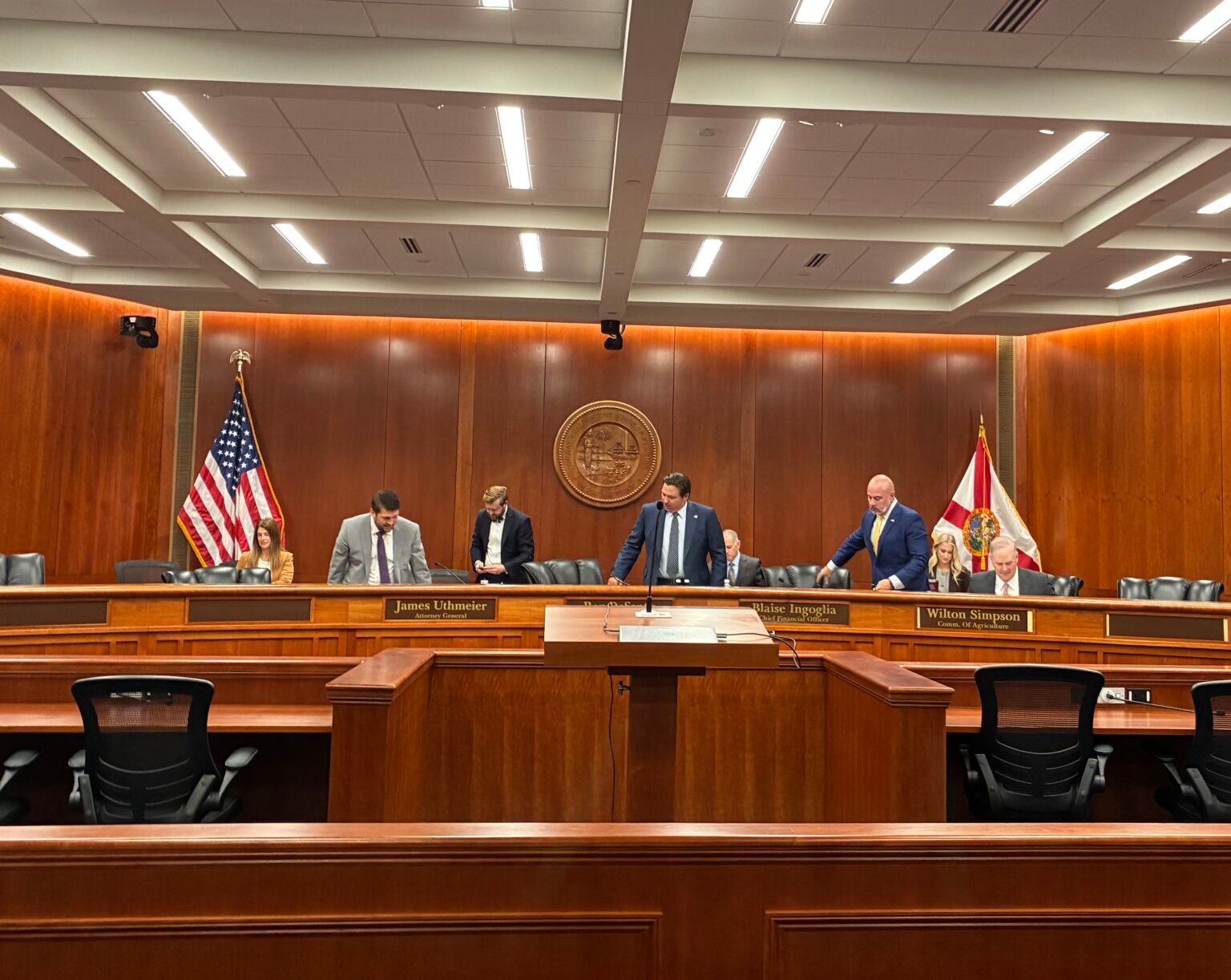
Cabinet approves cops’ immigration requests
Published

on


Gov. Ron DeSantis and the Florida Cabinet have approved more than $2 million in immigration enforcement money for local agencies seeking AI language translators, pepper spray, GPS trackers, handcuffs, bonuses, and more.

The $2.4 million greenlit to 10 law enforcement agencies means Florida has now approved roughly $21 million of the original $250 million diverted by the Legislature in February to support U.S. Immigration and Customs Enforcement (ICE).

DeSantis and the Cabinet members, who make up the newly created State Board of Immigration Enforcement, approved the money unanimously.

The Board is part of a broader Florida crackdown on undocumented immigration. In February, the GOP-dominated Legislature approved a sweeping measure demanding all counties partner with ICE, creating state-level penalties for entering Florida without proper documentation, and removing in-state tuition for undocumented college students.

The Florida law came right as President Donald Trump took office, ordering mass deportations and setting aside mass sums of money for states to set up migrant detention centers. Florida was the first state to do so with “Alligator Alcatraz,” a sprawling, controversial facility in the heart of the Everglades.

Where is the money going?

The largest lump of the $2.4 million will go to the Martin County Sheriff’s Office, which requested the most money ($738,451) for the widest-ranging variety of immigration-related activity.

After the Florida Highway Patrol, the South Florida county is responsible for the most encounters with suspected undocumented immigrants and the most noncitizens arrested on federal immigration charges, according to the Florida Department of Law Enforcement’s immigration dashboard.

Martin County’s breakdown includes $2,546 for 30 handcuffs and 30 leg irons; $13,153 for tactical goggles, ballistic helmets and bulletproof vests; $1,639 for 10 canisters of high-volume pepper spray; $271,103 for a rapid DNA testing machine; $136,736 for license plate readers; $185,029 for tasers; and $859 for Bluetooth rechargeable shooting ear protectors.

The next-highest grant is for Volusia County Corrections, totaling $505,789. The asks include $68,400 for detention beds, $22,400 to train 40 officers under the 287(g) program, $43,000 in bonuses for correctional officers, $183,760 for six detection screening systems to check migrants for “contraband,” $182,500 for a full-body security scanning system to check migrants for contraband, fevers and health problems, $1,400 for 72 uniforms, and $4,100 for 50 mattresses.

GPS trackers, AI translators, and biometric scans

The remaining requests came from the Hillsborough County Sheriff’s Office, the Madison Police Department, the Fruitland Park Police Department, the City of Port Richey Police Department, the town of Havana, the Putnam County Sheriff’s Office, the town of Welaka Police Department, and the Nassau County Sheriff’s Office.

The majority of the money is for license plate readers, overtime or bonuses for law enforcement or correctional officers. Fruitland Park received $22,300 for GPS trackers. According to the submitted request, the Department plans to deploy the trackers against “a suspect vehicle … allowing officers to safely monitor vehicles suspected of transporting unauthorized aliens.”

Havana received $93,687 for body-worn cameras, $90,088 for tasers, and $6,201 for nine universal AI language translators. These translators will “facilitate effective communication with non-English (speaking) individuals during stops and immigration focused activities.”

Putnam County received $17,378 for six laptops; $5,793 for handcuffs, leg cuffs, and chains; $69,384 for 21 Rapid ID devices, and $2,557 for one “Rapid ID two finger biometric device accompanied by a DNA barcode.”

These would be used to determine “accurate biometric identification of detainees.”

___

Reporting by Livia Caputo. Florida Phoenix is part of States Newsroom, a nonprofit news network supported by grants and a coalition of donors as a 501c(3) public charity. Florida Phoenix maintains editorial independence. Contact Editor Michael Moline for questions: [email protected].


Source link

Continue Reading

Politics

Senator Geraldine F. Thompson Way to be unveiled Friday in Orlando

Published

on


Officials are scheduled Friday to officially recognize Senator Geraldine F. Thompson Way — a renamed portion of South Street in downtown Orlando honoring the late Senator who died this year.

Sen. LaVon Bracy Davis and Orlando Mayor Buddy Dyer are expected to attend the 10:30 a.m. ceremony to unveil the new road sign.

Bracy Davis, who won a Special Election to finish the remainder of Thompson’s term, said on social media that the event is paying tribute to Thompson to “honor her decades of leadership, her dedication to preserving African American history, and her unwavering service to the people of Florida.”

Thompson died at age 76 in February from knee replacement surgery complications.

Thompson was the Director of the Wells’Built Museum of American-American History in Orlando’s Parramore district. Fittingly, Senator Geraldine F. Thompson Way will be renamed on West South Street between South Division Avenue and U.S. 441, which passes by the museum.

“Sen. Geraldine Thompson was a force — a trailblazer, a historian, a fierce advocate, and a devoted mother and grandmother who worked every day to uplift all Floridians, ensuring that no one was left behind,” U.S. Rep. Maxwell Frost said in a statement at the time of her death.

Other lawmakers, both Republicans and Democrats, put out statements of support and tributes after her death.

Thompson, a Democrat, had represented Orlando in the Legislature for two decades. At one point, the Orlando Sentinel described her as the “epicenter of Black history in Orlando.”

She took people on bus tours of the city’s Black history, wrote a book on Orlando’s African American community, hosted Juneteenth events and helped launch Orlando’s early celebrations to honor Martin Luther King Jr. 

Last month, officials gathered to open Harris Rosen Way, the honorary roadway on International Drive between State Road 528 and Sand Lake Road.

Rosen, the CEO of the largest independent hotel chain in Florida, died at age 85 in 2024.


Source link

Continue Reading

Politics

UF’s HiPerGator supercomputer ranked among best in the world

Published

on


‘The University of Florida is not just keeping pace with the future of AI, it is helping define it.’

The University of Florida is home the fastest university-owned supercomputers in the U.S.

That’s according to several technology observers that surveyed the UF HiPerGator supercomputer. The TOP500, the TOP500 High Performance Conjugate Gradient and the IO500, all tech assessment systems, made the analysis.

Officials with UF launched the next generation of the school’s HiPerGator computer system in October. The system features an extension of the school’s artificial intelligence initiative that began five years ago. The latest rankings reflect UF’s efforts in developing the system in a collaboration with NVIDIA to expand AI education and research.

“As a wise person once said: If you are a leader, you will know,” said Erik Deumens, Director of UF Information Technology Research Computing. “Not because someone declares you to be, but because people will come to you for guidance.”

The IO500 benchmark placed HiPerGator at the top of its list of the fastest university-owned supercomputers in the world, and ranked it 10th among fastest supercomputers overall.

The TOP500 placed HiPerGator as the 10th-fastest university-owned supercomputer in the world and 106th-fastest overall.

The TOP500 High-Performance Conjugate Gradient ranked the HiPerGator the fifth-fastest supercomputer in higher education and the 32nd-fastest supercomputer in the world among all sectors.

“The University of Florida is not just keeping pace with the future of AI, it is helping define it,” said NVIDIA co-founder and UF alumnus Chris Malachowsky. “Our collaboration empowers faculty, researchers and students with HiPerGator to drive breakthroughs and innovation.”

Out of UF’s $1.33 billion annual budget for research, about 60% is dedicated toward projects that are reliant on the HiPerGator.

The upgraded HiPerGator system’s program also comes as UF added 100 new AI faculty and 230 AI and data science courses to the curriculum. In the past year alone, the system has supported some 7,000 users from across the Southeast U.S.


Source link

Continue Reading

Politics

Architect David Glenn Jr. to challenge Kathleen Peters for Pinellas County Commission District 6

Published

on


Architect David Glenn Jr. has filed to challenge longtime incumbent Kathleen Peters for the Pinellas County Commission District 6 seat, setting up a contested race for a post that has often drawn no opposition.

Glenn’s entry ensures voters will have a contested race for the District 6 seat in the upcoming election cycle. Peters, who filed in April, has run unopposed during recent election cycles, but has already raised $63,650 for her re-election campaign nonetheless.

Glenn filed his candidacy paperwork with the Pinellas County Supervisor of Elections on Dec. 10. While his campaign website is still listed as “coming soon,” Glenn has launched a Facebook page and used the platform to publicly announce his run, sharing photos and outlining his priorities for county government.

Glenn describes himself as a registered Florida architect and interior designer who has lived in Pinellas County since 2000. He said his decision to run is driven by frustration with entrenched county leadership and a desire to bring new ideas to local government.

Glenn’s platform places a heavy emphasis on land use and development policy, arguing that Pinellas County’s limited remaining land requires a shift toward denser, more carefully planned growth. He calls for creation of high-density overlay districts in non-flood and non-evacuation areas to concentrate future development in key sectors, balanced with surrounding lower-density neighborhoods to preserve their character.

Under his proposal, homeowners could sell transferable development rights, or “air rights,” to higher-density projects. Glenn argues that increased density would expand the county’s tax base, support job creation and ease pressure on property tax rates.

Glenn is also calling for increased investment in county services. His platform highlights public transit funding for the Pinellas Suncoast Transit Authority, expanded support for county parks and recreation, and longer operating hours for county libraries.

He also advocates for streamlined county building and zoning departments to reduce development delays, and for increased support for county-operated animal services and rescue organizations.

Glenn also emphasizes a need for affordable housing. He proposes the creation of dedicated housing developments for teachers and first responders near their workplaces, as well as expanded housing options for veterans and seniors. 

He also supports adopting a countywide nuisance ordinance aimed at addressing problematic short-term rental properties, drug houses and chronic code violators. He said such an ordinance would give county staff and law enforcement additional tools to address properties that disturb their neighborhoods.

Glenn pledged to model part of his public service approach after former Gov. Bob Graham’s “Workdays” initiative, committing to spend time working alongside residents in different jobs and settings to better understand day-to-day challenges.


Source link

Continue Reading

Trending

Copyright © Miami Select.