Connect with us

Fashion

Faguo and Losanje aim high with a series of upcycled pieces
Published

on


Published


December 18, 2025

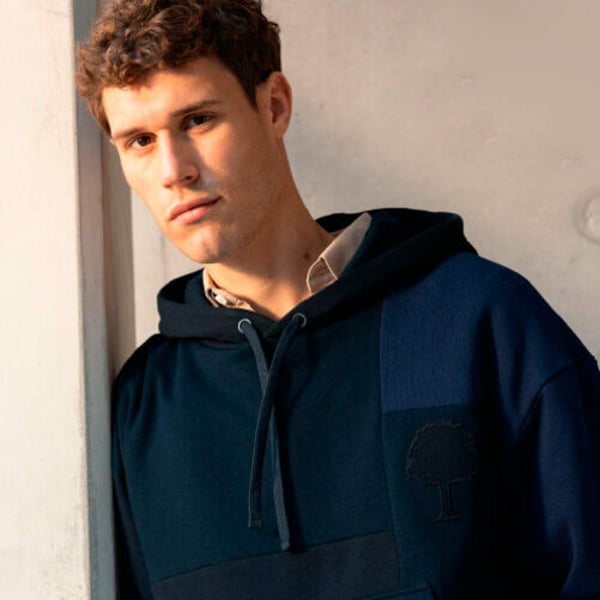
In February, the French low-impact clothing brand Faguo will launch several thousand T-shirts and a sweatshirt produced by Losanje, a specialist in the industrialisation of upcycling for clothing and accessories.

Faguo x Losanje

For this series, Faguo has opted to produce Lugny T-shirts, featuring the brand’s tree logo on the chest, along with the Dirac hooded sweatshirt. The former, available in blue and dark green, is priced at €60, while the latter, in blue, costs €105. The pieces were made from garments collected at sorting centres in France and across Europe, then cut and assembled by Faguo’s teams.

“We felt it was important to choose our iconic pieces for this collaboration, to help shift perceptions of upcycling,” Anaïs Barry, Losanje’s marketing and communications director, tells FashionNetwork.com. “Our aim is always to dress people with the smallest possible environmental impact. With upcycling, we reduce that impact by a further 90% compared with a standard Faguo garment. But we’re also counting on the pieces appealing in their own right as products.”

For Losanje, the stakes are high. The French company, whose aim is to prove that upcycling can be an industrial alternative to producing new clothes, has delivered what could be, in Europe and worldwide, the first 100% upcycled collection produced in several thousand unique pieces, according to Simon Peyronnaud, president and co-founder of Losanje.

“We’ve already released drops with brands such as Miu Miu and Marine Serre, collaborations that involved dozens or hundreds of pieces,” explains the executive. “This time, we’re looking at genuine repeatability. It’s been a highly instructive collaboration, and one we have high expectations for, to demonstrate that we can source existing materials here at home rather than from cotton fields.”

Faguo x Losanje

Losanje claims to have reused over 320 tonnes of textile products in five years via upcycling, through collaborations with the SNCF, La Poste, the Comité Paris 2024 and Roland-Garros, among others. To support its growth, the company recently inaugurated a new factory in Nevers, in the Nièvre department.

“We’re moving from a 700-square-metre industrial workshop to a real 2,500-square-metre factory, purpose-built to take us to the next level,” explains Simon Peyronnaud, whose company currently employs 25 people. He hints at several ongoing projects with brands and groups keen to invest in an upcycled offering.

This article is an automatic translation.
Click here to read the original article.

Copyright © 2025 FashionNetwork.com All rights reserved.


Source link

Continue Reading

Fashion

Nike edges past quarterly revenue expectations on resilient demand

Published

on


By

Reuters

Published


December 18, 2025

Nike on Thursday edged past market expectations for quarterly revenue, helped by resilient demand for its running shoes amid a big marketing push to fend off stiff competition from upstart brands in North America.

Reuters

The company reported second-quarter revenue of $12.43 billion, compared with analysts’ average estimate of $12.22 billion, according to data compiled by LSEG.

Nike is returning to wholesalers, ⁠after it had reduced exposure to the channel for some time, and refreshing its product lines to focus on ⁠categories such as running and basketball, as it tries to reclaim its sporting roots under CEO Hill’s extensive turnaround plan.

The company is also investing in introducing product lines such as ‍its ‌NikeSKIMS partnership with Kim Kardashian‘s brand as well as announcing a motorized ⁠footwear system to help casual ‌athletes and mobility-impaired people move faster.

However, tariffs on imports from ‌Vietnam, where the world’s largest footwear company manufactures around 50% of its shoes, have continued to pressure Nike’s margins.

Increasing its exposure at wholesalers has also hit margins, even though the company has been introducing fresher, ‍higher-priced products at its direct-to-consumer channels.

Executives noted in September that Nike’s recovery would not be linear, as in the current economic environment, consumers have turned ‌increasingly picky ⁠about ​spending big bucks on non-essential items with tariffs and ⁠inflation squeezing ​budgets.

The need to stay relevant through sleek marketing campaigns and innovation in its product lines has become more pressing for apparel makers, with companies ​such as yogawear maker Lululemon also losing ground to newer brands such as Vuori and Alo Yoga.

Nike’s gross margin ⁠for the quarter ended November 30 ⁠fell 300 basis points, compared with a 320 basis points fall in the preceding three-month period.

© Thomson Reuters 2025 All rights reserved.


Source link

Continue Reading

Fashion

Kering announces ‘phased’ acquisition of jewellery components manufacturer Raselli Franco Group

Published

on


Published


December 18, 2025

“This acquisition marks a strategic step for Kering and illustrates our ambition in the jewellery sector”: for his first acquisition at the helm of Kering, Luca de Meo, CEO of the French luxury group since September, has opted for an Italian player. On Thursday, the group announced the “phased” acquisition of Raselli Franco Group, an Italian company specialising in the manufacture of jewellery, with the aim of taking full ownership by 2032.

Kering to gradually increase its stake in the Raselli Franco Group – Raselli Franco

The first stage of this progressive acquisition will take place in 2026, in a transaction that values the company— a long-standing Kering partner based in Valenza, between Milan and Turin, with offices in Paris, the United States, Canada, China and Hong Kong— at around 575 million euros.

“The acquisition will be carried out in several stages, starting with an initial stake of 20% in the first quarter of 2026, for an amount of 115 million euros,” the group said in a statement, stressing that the agreement envisages full ownership by 2032.

“By securing essential production capacity for our jewellery business, this partnership will strengthen our value chain and accelerate the growth of our Houses,” said de Meo in the press release. Kering owns the Boucheron, Pomellato, DoDo and Qeelin jewellery brands.

Founded in 1969, Raselli Franco Group is internationally recognised for its expertise and capacity for innovation in jewellery prototyping and manufacturing, according to Kering.

The company spans the entire value chain, from sourcing raw materials and precious stones to research and development, design, component creation, assembly and quality control, the luxury group said.

In the first nine months of the year, Kering’s sales fell by 14% to 11 billion euros, but in the third quarter, the jewellery brands posted “very solid momentum, with double-digit revenue growth”, the group said when presenting its results. The segment recorded double-digit growth, with Boucheron cited as the growth driver, performing particularly well in the United States and Asia-Pacific. As for Pomellato and Qeelin, commentary was positive on the development of both brands.

With AFP

This article is an automatic translation.
Click here to read the original article.

Copyright © 2025 FashionNetwork.com All rights reserved.


Source link

Continue Reading

Fashion

OVS sees sales rise 6% in the first nine months, EBITDA up 9.4%

Published

on


Published


December 18, 2025

In the nine months from February 1 to October 31, 2025, OVS Spa reported net sales of 1,244.7 million euros, up 5.8% on the first nine months of 2024. Pro-forma growth, excluding Goldenpoint’s contribution, was 2.9%, four percentage points ahead of the market.

Stefano Beraldo, OVS Group CEO

By sales channel, direct store sales totalled 1,004 million euros (+7.6% versus 2024; pro-forma growth +4.0%). The franchising and B2B channel posted revenues of 241 million euros, down 0.9% year on year due to lower sales to off-price marketplaces, while business with franchise partners edged up slightly.

During the period, adjusted EBITDA reached 152.3 million euros, up 17.1 million on the same period of 2024, with a positive contribution from Goldenpoint. Breaking this down, OVS’s EBITDA rose by 11.6 million to 122.8 million euros; Upim‘s EBITDA was 30.5 million, compared with 29.3 million last year; and Stefanel‘s EBITDA increased by around 2 million euros.

The third quarter confirmed the group’s positive momentum, with net sales of 452 million euros (+9%; +4.1% excluding Goldenpoint). Adjusted EBITDA was 50.6 million euros, up 9.4%.

“The growth in the third quarter was particularly significant given the challenging basis for comparison with the same period last year, which recorded an exceptional +13%. (…) This performance reflects the effectiveness of the strategic choices made, particularly in the womenswear segment, with an assortment structured around collections with distinct and complementary identities. The Piombo, Les Copains, and B.Angel collections are therefore delivering significantly better sales per square metre than the rest of the range. The beauty segment also continued to deliver excellent results, with double-digit growth,” commented CEO Stefano Beraldo.

“In terms of performance by banner, the strongest growth was achieved by OVS, while Upim consolidated the exceptional +8% posted in the first nine months of 2024. Stefanel also performed very well, with like-for-like growth of around 10% in the quarter. Finally, our approach to managing Goldenpoint is beginning to deliver its first results: overall sales are up by around 10% on the comparable period, driven by the success of the product categories developed by our design studios,” he said. 

This article is an automatic translation.
Click here to read the original article.

Copyright © 2025 FashionNetwork.com All rights reserved.


Source link

Continue Reading

Trending

Copyright © Miami Select.