Connect with us

Business

Sheryl Sandberg says Silicon Valley’s hyper-masculine rhetoric is ‘terrible’—contributing to ‘one of the worst’ corporate climates she’s ever seen

Published

on


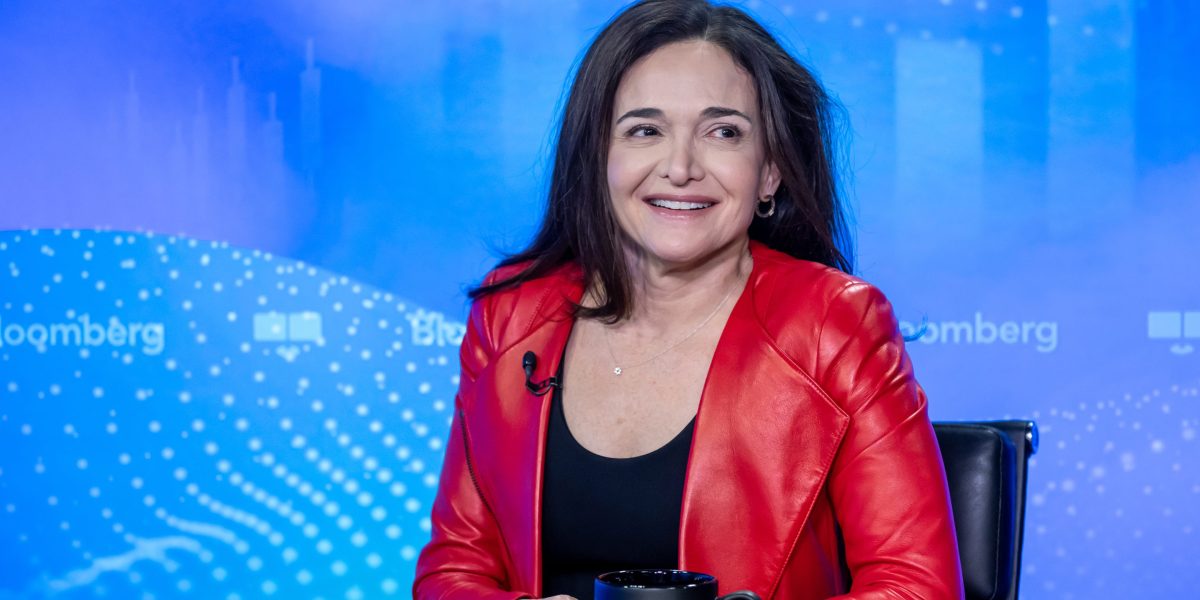
Sheryl Sandberg, formerly chief operating officer at Meta (formerly Facebook) and author of the motivational leadership book Lean In, has some thoughts on the hyper-masculine corporate culture sweeping Silicon Valley: It’s “one of the worst” she’s seen. 

Sandberg, who served for more than 14 years as Meta’s COO before stepping down in 2022, told CNBC corporate America has undergone a cultural shift, explaining “rhetoric matters, who says what matters.”

“Yes, the environment is terrible, really—I think one of the worst you and I have seen in our careers—but we’ve seen this backsliding before, and that is not an excuse for companies not to do the right thing by all of their employees,” Sandberg told CNBC correspondent Julia Boorstin.

Sandberg’s comments stand out because her former boss, Facebook founder and Meta CEO Mark Zuckerberg, has been one of the leaders of Silicon Valley’s creep toward hyper-masculinity. In a January interview with podcaster Joe Rogan, Zuckerberg said while he encouraged fostering welcoming environments, he saw corporate America as “culturally neutered” and said it could use more “aggression” and masculine energy.

Meanwhile, President Donald Trump and the White House have also been on a crusade against diversity, equity, and inclusion (DEI) initiatives both in the public and private sectors. On his first day back in the White House, the president signed an executive order to eliminate all DEI initiatives in the federal government. Beyondthe White House, the Trump administration has also ordered all federal agencies to “combat illegal private-sector DEI preferences.” Federal agencies have already started looking into practices at dozens of universities and some companies such as Northwestern Mutual Life Insurance, whose DEI policies are being investigated by the Equal Employment Opportunity Commission.

As the masculine and anti-DEI rhetoric has ramped up, women’s progress in the workplace has stalled, according to the latest Women in the Workplace study administered by LeanIn.org and management consulting firm McKinsey, which surveyed 9,500 employees at 124 companies. Half of the companies surveyed are no longer making women’s career advancement a priority. Another 21%, she said, see women’s career advancement as a low priority, or not a priority at all—and these are companies that are choosing to participate in the study, she added. 

All this adds up to a five-alarm fire for gender equity advocates, said Sandberg. 

Succeeding at work and uplifting a team means leaders need to be hardcore, she said, but the way to foster that hardcore mentality is through empathetic and kind leadership that brings out the best in workers.

“These things are not at odds and they’re also not particularly masculine or particularly feminine,” Sandberg said. “The best leaders, whether they’re male or female, have both.”


Source link

Continue Reading

Business

Yann LeCun is targeting a $3.5 billion valuation for his new startup that hasn’t even launched yet

Published

on


Yann LeCun, the legendary artificial intelligence researcher who helped build and shape Meta’s AI strategy, is already underway on his next big thing. Less than a month after announcing his departure from Mark Zuckerberg’s social media empire, the 65-year-old Turing Award winner has launched fundraising talks that would value his new venture at roughly $3.5 billion before it’s even launched.

The startup, Advanced Machine Intelligence (AMI) Labs, aims to create what LeCun calls “world models”: AI systems that understand physics, maintain persistent memory, and plan complex actions rather than simply predicting the next word. The company plans to establish its headquarters in Paris early next year, with LeCun serving as executive chairman. He’s even picked the CEO already: On Thursday, LeCun announced on LinkedIn that he’s selected Alexandre LeBrun, founder of French health-tech startup Nabla, to take on the chief executive role.

Why LeCun is abandoning Silicon Valley

The €500 million (~$586 million) funding target would be one of the largest prelaunch raises in AI history, reflecting investor confidence in LeCun’s vision of moving beyond today’s large language models.

“Silicon Valley is completely hypnotized by the current models of generative AI,” LeCun explained earlier this month at the AI-Pulse conference. “To pursue this kind of new research, you have to go outside the Valley—to Paris.”

LeCun’s exit from Meta after 12 years—five as founding director of Facebook AI Research and seven as chief AI scientist—had been rumored for weeks before he confirmed it on Nov. 18. His departure coincides with Meta’s strategic pivot toward more powerful LLM-based models under new chief AI officer Alexandr Wang, the twentysomething founder of Scale AI.

While Meta will not invest in AMI Labs, the companies plan to forge a partnership, allowing LeCun to continue his research while maintaining ties to his former employer.

The AI bubble grows bigger

The spectacular valuation for a pre-revenue startup has amplified concerns about an AI investment bubble. Industry leaders have warned that excitement around AI may be outpacing business fundamentals, and LeCun’s fundraising could test whether even the most respected names in the field can command premium valuations without proven commercial traction. The startup faces competition from well-funded European rivals like Black Forest Labs, valued at $4 billion, and Quantexa at $2.6 billion.

LeCun’s skepticism about AI’s current direction has been clear. Earlier this year, during an appearance on Alex Kantrowitz’s Big Technology podcast, he said: “We are not going to get to human-level AI just by scaling LLMs,” arguing they cannot achieve that milestone because they simply predict text rather than truly understand the world. His startup, AMI Labs, on the other hand, aims to develop systems that observe and interact with the physical environment like humans do, potentially revolutionizing robotics, transportation, and health care.

A return to European roots

The French computer scientist, who won the 2018 Turing Award alongside Geoffrey Hinton and Yoshua Bengio, has long advocated for European AI talent. He convinced Meta to open its FAIR lab in Paris in 2015 and now argues the city offers the right environment for his next-generation research.

LeCun’s social media post announcing his departure emphasized continuity: “I am creating a startup company to continue the Advanced Machine Intelligence research program (AMI) I have been pursuing over the last several years with colleagues at FAIR, at NYU, and beyond.” He described the goal as bringing about “the next big revolution in AI: systems that understand the physical world, have persistent memory, can reason, and can plan complex action sequences.”

The partnership with Nabla provides immediate applications for AMI’s technology. The health-tech company will gain first access to world model technologies, enabling it to develop FDA-certifiable AI systems for health care. LeBrun’s transition from Nabla CEO to AMI Labs CEO signals deep integration between the two companies, though he will remain chairman and chief AI scientist at Nabla.


Source link

Continue Reading

Business

Roblox CEO David Baszucki says the best career advice he’s ever received is to outright ignore the advice of others

Published

on


As some Gen Z graduates find themselves iced out of the job market, millions have slipped into so-called NEET status (not in employment, education, or training), unclear as to when their careers will finally be able to take off. For Roblox CEO David Baszucki, that sense of professional drift is familiar.

Although today he helms the $60 billion video game platform—and has a $5 billion net worth to go with it—when he graduated from Stanford University in 1985, he said his career prospects were anything but clear. 

Like today’s aspiring professionals, it was tempting for him to lean on the advice of mentors, professors, or friends to figure out how to jump-start his career. But Baszucki warns that mindset could leave you worse off. In fact, looking back, he says the best advice he ever received was to actually stop overvaluing what others think.

“A lot of my development has been trying to, over time, ignore advice I’ve been given,” Baszucki recalled to students at his alma mater. Instead, when you’re having a rough time, listen when people say, “Trust your gut.”

Baszucki went from lost window cleaner to billionaire tech leader

Even though Stanford has a reputation as a launchpad for billion-dollar companies—from Snapchat to Databricks—Baszucki hit a wall after graduation. His dream job didn’t materialize, and his résumé was thin: One of his only work experiences was window-cleaning with his brother one summer.

“I can remember in this terrible time right out of college trying to figure out what I was going to do,” Baszucki shared with an audience of Stanford business students.

“Rather than trusting my intuition, I can remember having a spreadsheet of nine potential careers and then all these metrics—‘it’s really good for this, but it’s not so good for this.’

“It was, like, a really weird way to try to figure out your career,” he added.

It was then that Baszucki first learned about the need to trust your own instincts.

After landing a postgrad salaried role, Baszucki spent the next two or three years in what he now calls the “absolute worst jobs in the world” where he faced “massive disappointment.” 

Eventually, he took a step back to listen to his gut—and the reset paid off. Baszucki went on to carve his own path and create Knowledge Revolution, an educational software company that sold for $20 million in 1998. After the sale, he expected to get poached for a CEO job. When he didn’t, he found himself once again adrift and needing to forge his own path.

“Time and time again, you have to participate in making your own reality,” he told Fortune earlier this year.

A few years later, he began building what would become Roblox, now a global gaming platform with over 150 million daily active users. 

Fortune reached out to Roblox for further comment.

The best career advice: Trust your own instincts

During a time when data and data-driven decision-making is all the rage in the workplace, leaning on intuition might sound misguided. However, many executives still lean on their instincts to guide even major business decisions.

“Be able to balance a lot of different people’s opinions, but at the end of the day, you have to have your own conviction deep down and make decisions for yourself,” LinkedIn CEO Ryan Roslansky said when asked to give career advice.

“You have to know what’s right, you have to care about what’s right, to be passionate about what’s right,” Roslansky added. “And if you’re going to put yourself out there and decide to dive into the crowd, it should be because you want to … not because someone else is telling you to do it.”

Skims cofounder and CEO Jens Grede also recently echoed the importance of trusting your gut—as long as you exercise it.

“You can feed [intuition] by being a curious person,” Grede said on his wife Emma’s Aspire podcast. “Your gut is really your collective memory, your collective experience and learnings … Every book you read, every article, every conversation, every wrong or right decision you’ve made, that becomes your gut.”


Source link

Continue Reading

Business

‘The rocket ship keeps going off’: Inside the Nvidia phenomenon with author Stephen Witt

Published

on


For employees at Nvidia, the chipmaker at the center of the artificial intelligence boom, the financial incentives to retire are staggering, yet few are heading for the exits. According to Stephen Witt, the freelance journalist and author whose book on the most valuable company in the world, The Thinking Machine, just became the FT and Schroders business book of the year, this retention of wealthy engineers comes down to a fear of missing out on history (along with all that money, of course).

“I think if the company was selling breakfast cereal, a lot of them would retire, but they’re making what they believe to be the single most important technology of all time,” Witt told Fortune in a recent interview, referring to Nvidia’s groundbreaking GPU chips that function as something like the oil wells of the AI boom.

“They’re engineers,” Witt said of Nvidia CEO Jensen Huang, his friends, his investors, and his employees, all of whom he talked to for his deeply reported book. He described their attitude as one of “I can’t leave now … I just can’t not be working with this technology. It’s like a once-in-a-lifetime opportunity.” Acknowledging that Nvidia’s soaring valuation to a $4-trillion-plus market capitalization doesn’t hurt, Witt explained how “the rocket ship keeps going off,” both from a technological and financial standpoint. The thing is, he explained, “they’re a very generous employer, especially with employee stock purchasing programs.”

Field of GPU dreams

Nvidia’s journey was not an overnight success, according to Witt. The author described the company’s early development of GPUs for AI as a Field of Dreams scenario where it built technology “without any users, without any customers.” Seen through the lens of capitalism, developing a new technology, at least for “very long-dated technologies, the market will not work” without some kind of buffer to allow time for the tech to mature, Witt concluded: “Jensen was a singular individual, and his stock price went down, or was stagnant, for 10 years while he was developing these platforms, for people to compute. He was not rewarded for a long, long, long time for doing this.”

Nvidia’s financial performance and stock price have taken off since 2015, to Witt’s point, and began gathering steam in the 2004–07 period, when academic AI researchers discovered the benefit of Nvidia’s GPUs. And there was a long period where the stock was not generating great returns, but Nvidia’s chips were always popular with gamers, and so the market worked to at least that extent.

Witt noted that he found similar dynamics in previous reporting, having written a book about MP3 file-sharing tech in 2015 (How Music Got Free). “That was also true of those guys,” he said, who likewise faced many years of development before it paid off. “If we were working in a corporation, I don’t think anyone would have had the patience. We needed almost a third base between academia and finance to sort of make this work.” Witt cited other examples, such as neural nets and the state-sponsored TSMC, one of Nvidia’s closest rivals in the advanced semiconductor space.

Witt said his reporting revealed that many Nvidia workers were initially on the losing side of this dynamic, having bought into employee stock ownership programs and seen the stock fall 50% or 60% from there. “The employees would get upset. They’d be like, ‘Oh, my God … I invested, I maxed out my cap to, you know, an employee stock purchasing program, and … now it’s underwhelming, and I don’t know if I’ll ever make it back.” At that point, Huang instituted a program to allow workers to buy the stock at a discount to the current market price, but also at a discount to any price in the past two years. “And then the stock turned into a rocket ship,” said Witt. Soon enough, he found, “every employee started maxing out these contributions to the employee stock purchase program, and then the stock continued to go up another, like, hundred times on these very low-cost basis transactions.”

The bubble question

Now that the market has caught up, questions of a financial bubble loom. Witt, who has worked for a hedge fund and said he approaches journalism with a shareholder’s mindset, admits the possibility of a crash if cash flows don’t eventually align with infrastructure spending: “So, so much is predicated on getting the timing of cash flows correct. And it may be the case that we throw all this money into building data centers and buying Nvidia chips, and that doesn’t pay off at the exact right time, and then everything crashes for a little while. That may be happening right now.”

Yet Witt also drew a sharp distinction between financial bubbles and technological utility, saying that the now well-trod comparisons of AI to the internet and railroad booms may have some merit. But echoing similar remarks from leaders such as JPMorgan CEO Jamie Dimon, Witt said of AI: “This stuff is real.” Witt predicted that breakthroughs from Nvidia, TSMC, and others will lead fo a “spreading wave of robots and autonomy,” recalling Huang’s own prediction that in 10 years, anything that moves will be autonomous. “We’re moving into the world of AI,” Witt added, saying that in 10 years, “we will interact with AI as frequently as we interact with the internet or electricity. And there’s a big scramble on to be the company that gets it in front of me. I think that explains all the investment.”

The political dynamic

The big scramble for funding also has a political effect, of course. “Jensen was forced to become a political creature, especially this year,” Witt said, suggesting that “he kind of pivoted into being almost like Trump’s Thomas Cromwell,” likening him to the famous advisor to King Henry VIII, although Huang is a close external advisor and not in Trump’s cabinet, with someone like Treasury Secretary Scott Bessent or Commerce Secretary Howard Lutnick a much closer analogue. (Witt said as an aside that he’s been reading Hilary Mantel’s modern classic Wolf Hall lately, and the subject was on his mind.) On Huang and Trump’s relationship, Witt added: “He became, like, a real advisor in the game … And he was really successful in that regard.”

Witt observed of the dynamic that “Trump likes to be close to Jensen because Jensen’s a winner. And Trump likes winners, and Jensen’s basically the biggest winner there is right now.” Huang also needs certain support from the federal government, Witt added, not just exemption from tariffs for Taiwan, but also in selling certain chips to China. “Maybe even most importantly, and maybe least discussed, he needs absolutely to secure an ongoing pipeline of H-1B visas for his best technical work,” Witt said, noting that one-third, if not more, of Nvidia’s employees are South Asians. “They’re extremely dedicated, they’re extremely bright, and it’s part of really what makes Nvidia work.”

Ultimately, Nvidia’s soaring valuation is underpinned by a new geopolitical narrative. Witt argues that the U.S. is engineering a merger between Silicon Valley and the Pentagon, fueled by fears of an “AI gap” with China. “Just as in the old days,” Witt said, “you would talk about the fear of a missile gap with the Soviet Union. Now, it’s an AI gap with China.” And on that count, Witt added, Trump likes winners, “and he’s got a winner in AI.”


Source link

Continue Reading

Trending

Copyright © Miami Select.