For most people, success means squeezing as much as possible into 80‑odd years: a big job with a flashy title and matching salary, a swanky apartment in the city or McMansion in the suburbs, bucket‑list trips squeezed into limited vacation days, kids if they want them—and maybe an early retirement if everything goes to plan.
The entrepreneur who famously spends millions each year trying to slow his own aging now has a new target in his sights: he wants to make humans immortal by 2039.
“The search for the fountain of youth is the oldest story ever told,” Johnson wrote on X and Facebook. “For the first time in the history of life on earth, in just the past 24 months, the window has opened for a conscious being to realistically strive for this goal. It is an absolutely insane moment.”
The 48-year-old said that the 14-year goal is based on “new, promising therapies that can turn back the clock decades,” while adding that thanks to AI, it’s actually a very “reasonable target.”
First, he argued, his team just need to fix some of the “buggy” issues, like therapies that are “mistakenly causing cancer.”
Humans are currently a ‘suicidal species’—Bryan Johnson is cloning his organs to change that in less than 15 years
The Braintree, Kernel, and most recently, Blueprint, founder admitted that his team “currently do not know” how project 2039 immortality will be achieved. But he revealed the efforts they’re going to to get there, including looking into jellyfish cells and the enzymes of lobsters, which are both linked to slow ageing. “We need to port the software to humans,” Johnson added.
That, coupled with the “AI-driven rate of innovation” and using his own body as a guinea pig, is where he thinks the real acceleration will happen.
This isn’t Johnson’s first attempt to slow down time. The tech founder has previously made headlines for “the world’s first multigenerational plasma exchange” with his then‑17‑year‑old son and 70‑year‑old father. He has also spent around $2 million a year on treatments that he believes have given him the skin of a 28 year old and the lung capacity of an 18 year old.
Now, after six years of prodding and testing, he maintains that, biologically, he has not aged a day.
“To speed things up now, I’m currently having thousands of Bryan Johnson organ clones built in a dish,” Johnson said. “This will allow me to test drugs and other molecules against my biology to accelerate learning and save my body from potential mishaps.”
“Yes, we’ll make mistakes. Hopefully they won’t be fatal,” he concluded, adding that he’ll be sharing the results of his research on his platform Blueprint for free.
For the average human—what he calls a “suicidal species” that “unnecessarily kill ourselves with what we eat and how we live our lives”—he’ll provide details on how to copy his million-dollar-routine with “a fraction of the cost and effort.”
Bryan Johnson eats his final meal of the day at 11 a.m. as part of his multimillion-dollar anti-ageing routine
High-profile execs are well accustomed to 5 a.m. alarms and plunge pools. But in his quest to live forever, Johnson takes his high-performance routine to a whole other level.
He previously told Fortunethat he wakes up at 4:30 each morning, and then every hour of his day is regimented by an algorithm built from rigorous bodily monitoring and the science from over 2,000 academic publications.
Johnson starts his day by working out—completing 35 different exercises—taking a list of supplements and washing it all down with a smoothie.
Then, with the help of a team of 30 specialists, he undergoes daily body fat scans, routine MRIs, and often, invasive blood and stool sample tests to see the biological age of his organs.
In between these tests, he takes 61 pills daily and eats three meals a day, within a strict five-hour time frame, usually consisting of a super veggie salad followed by a nutty pudding and lots of greens. The tech entrepreneur eats 70 pounds of vegetables every month.
Most people eat dinner a few hours before going to bed. But Johnson’s bed time is 8:30 p.m. and to ensure his food is fully digested before, he has his last meal of the day at 11 a.m.
The Justice Department released thousands of files Friday about convicted sex offender Jeffrey Epstein, but the incomplete document dump did not break significant ground about the long-running criminal investigations of the financier or his ties to wealthy and powerful individuals.
The files included photographs of famous people who spent time with Epstein in the years before he came under suspicion, including some candid snapshots of Bill Clinton, who flew on Epstein’s jet and invited him to the White House in the years before the financier was accused of wrongdoing. But there was almost no material related to another old Epstein friend, President Donald Trump, aside from a few well-known images, sparing the White House from having to confront fresh questions about a relationship the administration has tried in vain to minimize.
The records, consisting largely of pictures but also including call logs, grand jury testimony, interview transcripts and other documents, arrived amid extraordinary anticipation that they might offer the most detailed look yet at nearly two decades worth of government scrutiny of Epstein’s sexual abuse of young women and underage girls. Yet the release, replete with redactions, seemed unlikely to satisfy the clamor for information given how many records had yet to be released and because some of the materials had already been made public.
Democrats and some Republicans seized on the limited release to accuse the Justice Department of failing to meet a congressionally set deadline to produce the files, while White House officials on social media gleefully promoted a photo of Clinton in a hot tub with a woman with a blacked-out face. The Trump administration touted the release as proof of its commitment to transparency, ignoring that the Justice Department just months ago said no more files would be released. Congress then passed a law mandating it.
In a letter to Congress, Deputy Attorney General Todd Blanche wrote that the Justice Department was continuing to review files in its possession, was withholding some documents under exemptions meant to protect victims and expected additional disclosures by the end of the year.
Trump, who was friends with Epstein for years before the two had a falling-out, tried for months to keep the records sealed.
But bowing to political pressure from fellow Republicans, Trump last month signed a bill giving the Justice Department 30 days to release most of its files and communications related to Epstein, including information about the investigation into his death in a federal jail. The law set a deadline for Friday.
Limited details about Trump
Trump is hardly glimpsed in the files, with the small number of photos of him appearing to have been in the public domain for decades. Those include two in which Trump and Epstein are posing with now-first lady Melania Trump in February 2000 at an event at his Mar-a-Lago resort.
Trump’s connection to Epstein is well-documented, but he has sought to distance himself from his former friend. He has said he cut off ties with Epstein after the financier hired young female employees from Mar-a-Lago and has repeatedly denied knowledge of his crimes.
The FBI and Justice Department abruptly announced in July that they would not be releasing any additional records, a decision that was supported by Trump. But the president reversed course once it became clear that congressional action was inevitable. He insisted the Epstein matter had become a distraction to the Republican agenda and releasing the records was the best way to move on.
The White House, meanwhile, has moved to shift focus away from Trump’s ties to Epstein, with Attorney General Pam Bondi last month saying that she had ordered a federal prosecutor to investigate Epstein’s connections to Trump’s political foes, including Clinton.
Neither Trump nor Clinton has ever been accused of wrongdoing in connection with Epstein, and the mere inclusion of someone’s name in the files from the investigation does not imply otherwise.
Among other prominent Epstein contacts is the former Prince Andrew, who appears in a photograph released Friday wearing a tuxedo and lying on the laps of what appear to be several women who are seated, dressed in formalwear. Pop star Michael Jackson also appears in multiple photos, including one showing him standing next to a smiling Epstein.
New photos of Clinton
Unlike Trump, Clinton is featured prominently in the files, though the records included no explanation of how the photographs of the former president related to any investigation or the context surrounding them.
Some photos showed him on a private plane, including one with a woman, whose face is redacted, seated alongside him with her arm around him. Another shows him in a pool with Epstein’s longtime confidant, British socialite Ghislaine Maxwell, and a person whose face was also redacted. He is also seen in a hot tub with a woman whose face was redacted.
This undated, redacted photo released by the U.S. Department of Justice shows Ghislaine Maxwell and former President Bill Clinton swimming with an unknown person.
U.S. Department of Justice via AP
Senior Trump White House aides took to X to promote the Clinton photos.
White House press secretary Karoline Leavitt wrote “Oh my!” and added a shocked face emoji in response to a photo of Clinton in the hot tub.
“They can release as many grainy 20-plus-year-old photos as they want, but this isn’t about Bill Clinton,” Clinton spokesman Angel Ureña said in a statement.
“There are two types of people here,” he said. “The first group knew nothing and cut Epstein off before his crimes came to light. The second group continued relationships after that. We’re in the first. No amount of stalling by people in the second group will change that.”
The Epstein investigations
After nearly two decades of court action, a voluminous number of Epstein records had already been public before Friday, including flight logs, address books, email correspondence, police reports, grand jury records, courtroom testimony and deposition transcripts.
Besides public curiosity about whether any of Epstein’s associates knew about or participated in the abuse, Epstein’s accusers have also sought answers about why federal authorities shut down their initial investigation into the allegations in 2008.
“Just put out the files,” said Marina Lacerda, who says she survived sexual assault by Epstein. “And stop redacting names that don’t need to be redacted.”
One of the few revelations in the documents was a copy of the earliest known concern about Epstein’s behavior — a report taken by the FBI of a woman in 1996 who believed photos and negatives she had taken of her 12-year-old and 16-year-old sisters for a personal art project had been stolen by Epstein. The documents don’t show what, if anything, the agency did with that complaint.
Police in Palm Beach, Florida, began investigating Epstein in 2005 after the family of a 14-year-old girl reported being molested at his mansion. The FBI joined the investigation. Authorities gathered testimony from multiple underage girls who said they’d been hired to give Epstein sexual massages.
Ultimately, prosecutors gave Epstein a deal that allowed him to avoid federal prosecution. He pleaded guilty to state prostitution charges involving someone under age 18 and was sentenced to 18 months in jail.
Epstein’s accusers spent years in civil litigation trying to get that plea deal set aside. One of those women, Virginia Giuffre, accused Epstein of arranging for her to have sexual encounters, starting at age 17, with other men, including billionaires, famous academics, politicians and Andrew Mountbatten-Windsor, then known as Britain’s Prince Andrew.
Prosecutors never brought charges in connection with Giuffre’s claims, but her account fueled conspiracy theories about supposed government plots to protect the powerful. Giuffre died by suicide in April.
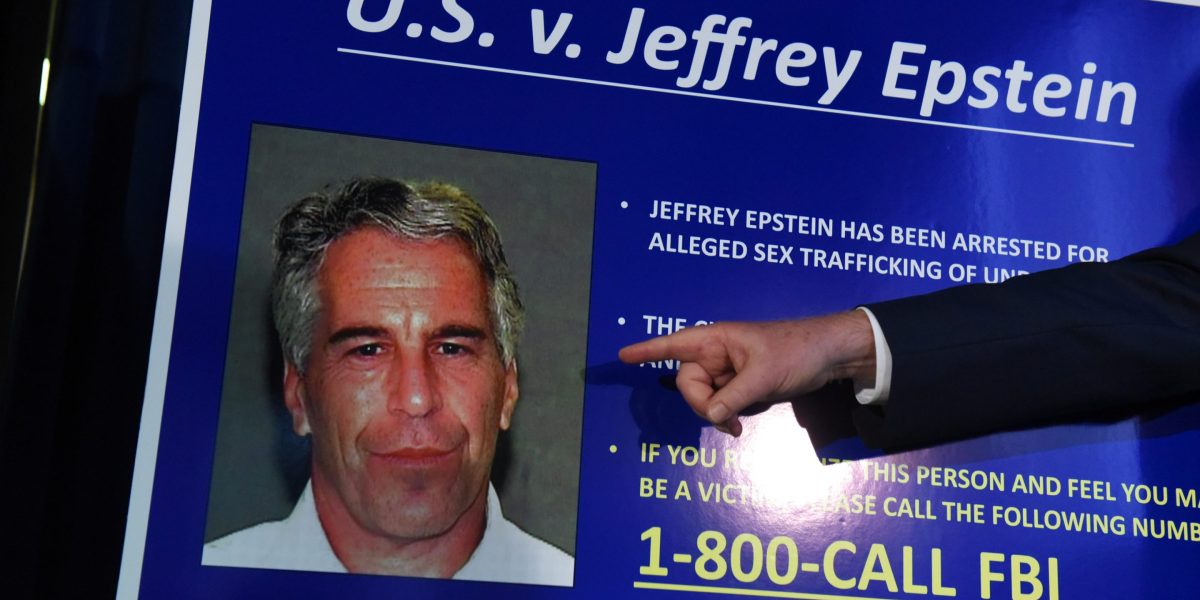
Federal prosecutors in New York brought new sex trafficking charges against Epstein in 2019, but he killed himself in jail after his arrest. Prosecutors then charged Maxwell, his longtime confidant, with recruiting underage girls for Epstein to abuse. She was convicted in 2021 and is serving a 20-year prison sentence.
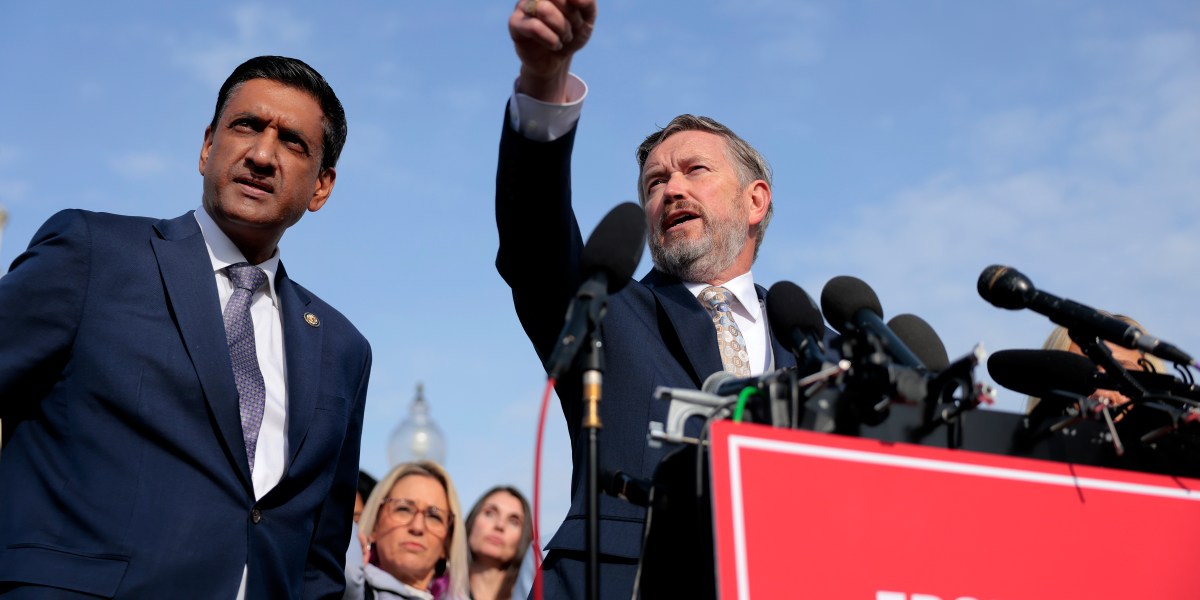
The Justice Department’s extensive redactions to the Jeffrey Epstein files on Friday don’t comply with the law that Congress passed last month mandating their disclosure, according to Rep. Ro Khanna.
The California Democrat and Rep. Thomas Massie, R-Ky., led the effort on the legislation, which required that the DOJ put out its entire trove of documents by today.
But he blasted the document dump and singled out one file from a New York grand jury where all 119 pages were blacked out.
“This despite a federal judge ordering them to release that document,” Khanna said in a video posted on X. “And our law requires them to explain redactions. There’s not a single explanation. That entire document was redacted. We have not seen the draft indictment that implicates other rich and powerful men who were on Epstein’s rape island who either watched the abuse of young girls or participated in the abuse of young girls in the sex trafficking.”
He said Attorney General Pam Bondi has been “obfuscating for months” and called the files on Friday “an incomplete release with too many redactions.”
The Justice Department didn’t immediately respond to a request for comment.
In a separate X post, Massie agreed with Khanna, saying the DOJ “grossly fails to comply with both the spirit and the letter of the law” that President Donald Trump signed last month.
Deputy Attorney General Todd Blanche told Congress that the Justice Department had identified 1,200 victims of Epstein or their relatives and redacted materials that could reveal their identities, according to the New York Times.
Earlier on Friday, Blanche told Fox News that “several hundred thousand” pages would be released on Friday. “And then, over the next couple of weeks, I expect several hundred thousand more,” he added.
“Thomas Massie and are exploring all options,” Khanna warned. “It can be the impeachment of people at Justice, inherent contempt, or referring for prosecution those who are obstructing justice. We will work with the survivors to demand the full release of these files.”
Join us at the Fortune Workplace Innovation Summit May 19–20, 2026, in Atlanta. The next era of workplace innovation is here—and the old playbook is being rewritten. At this exclusive, high-energy event, the world’s most innovative leaders will convene to explore how AI, humanity, and strategy converge to redefine, again, the future of work. Register now.
The highly anticipated Epstein files have so far landed with a thud as page after page of documents have been blacked out, with many nearly totally redacted.
While hundreds of thousands of documents have been released so far on the Justice Department’s site housing the information, there isn’t that much to see.
“Simply releasing a mountain of blacked out pages violates the spirit of transparency and the letter of the law,” Senate Minority Leader Chuck Schumer said in a statement. “For example, all 119 pages of one document were completely blacked out. We need answers as to why.”
That appeared to refer to a document titled “Grand Jury NY.”
The data dump came late Friday, the deadline that Congress established last month for disclosing the trove of files, though other documents had already been released earlier by the DOJ, Congress and the Epstein estate.
Numerous celebrities were also in that document, such as Rolling Stones singer Mick Jagger and the late pop idol Michael Jackson, who also appeared in photos with Epstein.
Former Senators John Kerry and George Mitchell were on the list as were Jes Staley, a former JPMorgan and Barclays executive, and Leon Black, a cofounder and former CEO of Apollo Global Management.
Appearing in the files doesn’t necessarily imply any wrongdoing as Epstein mingled in wider social circles and was ofter asked for charitable donations.
But Staley said he had sex with a member of Epstein’s staff, and Black was pushed out of Apollo over his Epstein ties, which Black maintains were for tax- and estate-planning services.
Numerous hotels, clubs and restaurants are listed too, plus locations simply described as “massage.” Banks included the now defunct Colonial Bank as well as Bear Stearns and Chemical Bank, which both eventually became part of JPMorgan.
Other entries fell under country categories like Brazil, France, Italy and Israel. Former Israeli prime ministers Ehud Olmert and Ehud Barak were on the list.






 Politics8 years ago