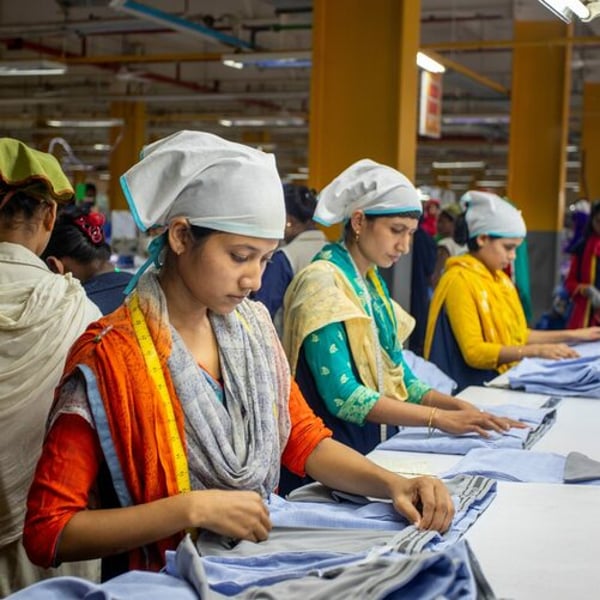
Clothes destined for Europe could soon require digital passports to prove their green credentials, opening a new era of transparency for the world’s $1.7-trillion fashion industry.
Digital product passports could transform the textile industry in Bangladesh – Shutterstock
Consumers will be able to scan QR codes or electronic tags to see the garments’ digital product passports (DPPs) and check if a fashion brand’s green claims are true. The passports will tell consumers what the clothes are made of, how much energy, water and chemicals were used to make them, and who took part in each stage of their production.
Textile suppliers from Bangladesh, the world’s second largest apparel exporter, may need to implement an initial version of the passport as early as 2027, according to analysis by the European Parliamentary Research Service.
“As consumers place a higher premium on sustainability and transparency, the digital product passport could be a key tool to provide granular records about the environmental footprint of each piece of cloth- starting from the cotton field to finished garment,” said Asif Ibrahim, vice chairman of the Dhaka-based apparel manufacturing company Newage Group of Industries. But Ibrahim said smaller manufacturers were far from ready to fulfil the stringent, new European Union (EU) needs, which aim to stop manufacturers overclaiming their green credentials.
From payroll information to material certifications, fashion makers already provide reams of data about labour and environmental standards to meet buyers’ requirements and audits. Yet a 2023 report by the British-based NGO Greenpeace said some brands and suppliers had misled consumers- for instance highlighting their recycling record, even if most of the ‘recycled’ fibre came from plastic bottles not textile scraps.
“Providing authentic and traceable data from across the supply chain is key to stop the problem of greenwashing,” said Rezwan Ahmed, CEO of Aus Bangla Jutex Ltd, a company producing bags, caps and aprons from recycled and organic cotton.
Bangladeshi suppliers have already started working with technology companies to get ready for the changes. Ahmed has partnered with Aware, a Dutch firm working with several fashion suppliers, using decentralised blockchain to record relevant data as fabric becomes a finished garment.
A manufacturer inputs key pieces of data- perhaps yarn count, water consumption or colour- and Aware’s blockchain-based platform then generates a QR code for consumers. “The manufacturers will have control over what they disclose to their brands and consumers- as we want to give the manufacturers ownership of data,” said Md. Muyeed Hasan, Bangladesh country manager at Aware.
Cotton ginners, washers and dye factories, as well as the makers of finished garments, will all upload any relevant data and certificates to their digital profiles, then must add details about each batch of production in real time. Claims about energy and water usage will be verified by third parties, he told the Thomson Reuters Foundation.
The passport may require Bangladesh’s smaller garment makers to upgrade their hardware and software capacity as well as how they manage their data, said Ibrahim from the Newage Group. Smaller manufacturers make up a large share of Bangladesh’s roughly 3,320 export-oriented apparel factories, according to Mapped in Bangladesh, a project developed by BRAC University in the Bangladeshi capital.
British-based DigiProdPass has partnered with Bangladesh’s garment manufacturers’ association BGMEA to help smaller producers meet the new passport requirements. Salauddin Sohag, managing director of DigiProdPass, said his company is rolling out pilot studies and plans to train smaller businesses to help them adapt.
“Suppliers will need support from global fashion brands and development organisations to upgrade their capacity- while the government should incentivise the early adopters,” said Ibrahim.
In the run-up to Christmas Boots is stepping up its gift-delivered-direct-to-the-door offer with delivery partners Uber Eats, Deliveroo and Just Eat, offering a within-30-minutes target.
Boots
The upgrade follows a surge of on-demand orders from “thousands of customers” on Christmas Eve last year. And it pointed to research that shows 56% leave some of their Christmas shopping to the very last day, so “the retailer is primed for another busy Christmas Eve”.
The health & beauty giant’s on-demand deliveries are now available from 500 stores across the UK, and in selected locations across the country, very-last-minute customers can order up until midnight on Christmas Eve “and will still receive their shopping in time for the big day”.
Boots said last-minute shoppers can choose from over 10,000 products with over 1,600 Christmas gifts available. Customers can also order up until Monday 22 December for Click & Collect in-store, and 23 December for next-day home delivery.
Paula Bobbett, chief Data and Digital officer at Boots, said: “We want to make it even easier for our customers who find themselves shopping right up to the last moment. Boots on-demand can help change that final dash into an easy delivery. We’re here to make shopping feel joyful, not stressful, helping shoppers find thoughtful gifts quickly and easily, even if they’ve missed online order cut-offs or store opening hours.”
The brand, founded in 2010 by Mathieu and Nicolas Gourdikian, who retain a minority stake, has faced a succession of crises that now threaten its very existence. The challenge is no longer simply to finance growth, but to ensure operational survival.
According to documents reviewed by FashionNetwork.com, JOTT’s commercial engine has stalled, leaving the brand with large volumes of stock to clear, eroding its brand image despite significant work on its stylistic proposition. For several seasons, substantial volumes of its down jackets have been offered at knock-down prices, and even sold off on markets.
After a sharp decline in activity at its logistics and distribution company JOTT Opérations in 2023, revenue collapsed again last year by more than 28% to 54.7 million euros. The company attributes this dramatic fall directly to the bankruptcy of its logistics provider at the beginning of 2024- an event that necessitated the urgent relocation of stock and a complex recovery of operations.
The cost of this logistical setback contributed to a deficit of 30 million euros at JOTT Opérations and an operating loss of more than 4 million euros for JOTT France, the company’s own distribution entity. The activities of entities in other markets are also suffering, implying that it remains to be proven that the brand concept can be exported profitably.
Faced with these accumulated losses, the operational companies’ equity turned negative, weakening the company’s structure just as significant instalments were falling due. In 2024, shareholder support helped address this situation, with 18 million euros injected in two tranches. However, this appears to have merely contained the damage, without preventing the massive depreciation of the group’s assets.
Thus, in 2025, the rescue plan faced an impossible equation: operating losses had made the enormous debt contracted at the time of the LBO unsustainable. Specifically, this debt- concentrated in a holding company called Jaguar Bidco- amounts to nearly 156 million euros. Negotiations with creditors, in particular Idinvest Partners and Eurazeo, were, understandably, extremely tight. The shareholder recapitalisation, approved last April, is clearly a vital step forward for the future of JOTT.
A tight agreement with creditors
This 99 million euro injection is not merely about plugging an accounting gap; it is an essential condition demanded by the company’s bondholders to give the business breathing space. In exchange for this major financial effort, creditors have agreed to pause certain financial obligations through a mechanism known as a waiver. However, this breathing space is not a blank cheque. In return for their patience, the creditors attached particularly strict covenants to the agreement. These contractual commitments oblige the company’s management to meet performance ratios quarter after quarter. For the brand, this means advancing under close scrutiny: any failure to meet the trajectory could break the waiver agreement and give creditors the right to demand immediate repayment of their claims, or even to take control of the equity.
If management keeps its commitments, this translates into crucial relief for cash flow: the suspension of interest payments on the debt until the end of 2027, turning immediate cash pressure into future debt. This should enable JOTT to concentrate its resources on the only thing that matters now: selling products.
This reprieve, coupled with agreements with banking partners, gives management, now led by Thierry Miremont, a two-year window to reinvent JOTT’s business model. According to the available information, the strategic plan includes an in-depth transformation of retail.
This transformation involves a painful but necessary rationalisation: the company has already begun closing shops deemed unprofitable, notably in Paris and Bordeaux and across various European markets. At the same time, JOTT is betting on technological modernisation to regain efficiency, accelerating the roll-out of performance initiatives such as an automatic replenishment tool, according to the company’s management. As the brand seeks to increase its share of full-price products, investment appears key: it must ensure that stock- already subject to significant write-downs- is managed as tightly as possible to reduce product obsolescence and maximise margins. One piece of good news? Despite the difficulties, the tax audits carried out in 2024 on Jaguar Topco, the ultimate parent company, and JOTT France concluded without any reassessments in 2025.
The challenge, however, is considerable. The company will have to return rapidly to profitability- probably requiring an annual improvement of several tens of millions of euros- in order to make up the deficit. It will also have to prove to its partners the group’s future viability. Without this operational performance, the brand will not be able to cope with the resumption of debt repayments in 2028.
Management did not wish to answer our questions about the company’s situation. Nevertheless, its teams are hard at work optimising store performance (with a network that has already shrunk to 140 points of sale), strengthening the desirability of the collections and attracting new retailers, notably by preparing to exhibit at the Pitti Uomo trade fair in Florence and Who’s Next in Paris. But despite this operational proactivity, the challenge remains major: to turn the brand around by making it more agile and efficient within a compressed timeframe and against an unfavourable backdrop in both the French and international markets.
This article is an automatic translation. Click here to read the original article.
Czech streetwear specialist Footshop told FashionNetwork.com about its ambitions for the French market. It has now set its sights on Rue de Rivoli in Paris’s 1st arrondissement for its French flagship, FashionNetwork.com has learned. The opening date for this sixth store has not yet been announced.
63 Rue de Rivoli (Paris 1st arrondissement) – Google Street View
With this address, Footshop secures a 237 square-metre, three-storey store, where the retailer will be flanked by menswear label Delaveine and Ray-Ban on one side, and by Bershka and Uniqlo on the other. Opposite, the building at 126 Rue de Rivoli, previously occupied by C&A, will in 2027 house a Radisson Collection hotel and 3,000 square metres of retail space.
Launched in Prague in 2012 by Peter Hajducek, Footshop will be well placed to attract shoppers from both Forum des Halles and the neighbouring Samaritaine. Aiming to become the European leader in streetwear, the company positions itself as a response to an increasingly discerning customer base.
The brand’s flagship in Prague – Footshop
This approach has prompted Nike, Adidas Originals, Puma, New Balance, Asics, and Birkenstock to collaborate with the retailer, which operates flagships in Prague, Budapest, Bucharest, Bratislava, and Warsaw, but relies primarily on online sales. The company recently said that its digital platforms, Footshop and Queens, are said to have generated 82 million visits and 585,000 downloads in one year.
After achieving sales of 61.6 million euros (75% generated internationally) in 2024, the company is expected to reach 82 million euros in 2025, representing annual growth of 40%.
This article is an automatic translation. Click here to read the original article.