Connect with us

Business

Down Arrow Button Icon

Published

on


Dealmakers are heading into the final weeks of 2025 on a $100 billion cliffhanger.

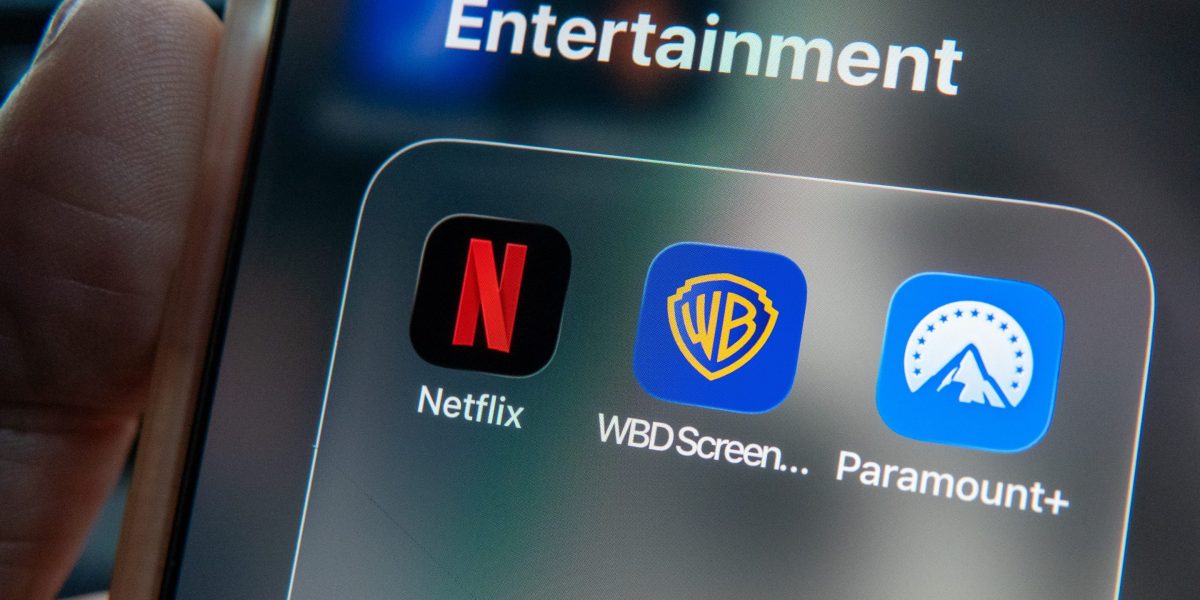
Paramount Skydance Corp.’s hostile bid to snatch Warner Bros. Discovery Inc. from under the nose of Netflix Inc. encapsulates the themes that have shaped a banner year for mergers and acquisitions: renewed desire for transformative tie-ups, massive checks from Wall Street, the flow of Middle East money and US President Donald Trump’s role as both disruptor and dealmaker.

Global transaction values have risen around 40% to about $4.5 trillion this year, data compiled by Bloomberg show, as companies chase ultra-ambitious combinations, emboldened by friendlier regulators. That’s the second-highest tally on record and includes the biggest haul of deals valued at $30 billion or more.

“There’s a sentiment in boardrooms and among CEOs that this is a potential multi-year window where it’s possible to dream big,” said Ben Wallace, co-head of Americas M&A at Goldman Sachs Group Inc. “We’re at the beginning of a rate-cutting cycle so there’s anticipation that there will be more liquidity.”

Beyond Netflix’s purchase of Warner Bros., this year’s blockbusters include Union Pacific Corp.’s acquisition of rival railroad operator Norfolk Southern Corp. for more than $80 billion including debt, the record leveraged buyout of video game maker Electronic Arts Inc., and Anglo American Plc’s takeover of Teck Resources Ltd. to reshape global mining. 

“When you look around and you see your peers doing these big deals and taking advantage of the tailwinds, you don’t want to be left out,” said Maggie Flores, partner at law firm Kirkland & Ellis LLP in New York. “The regulatory environment is in a position that is very conducive to dealmaking and people are taking advantage of it.”

The tally also shows a level of exuberance in certain pockets that some advisers and analysts worry is unsustainable. Global trade tensions are ongoing, and market observers are increasingly warning of a selloff in the white-hot equity markets that have underpinned the M&A resurgence.

Top executives at Goldman Sachs, JPMorgan Chase & Co. and Morgan Stanley have all flagged the risk of a correction in the months ahead, in part tied to concerns about an overheated artificial intelligence ecosystem, where huge amounts of investment have juiced technology stocks.

“These equity returns are really coming out of AI, and AI spend is not sustainable,” said Charlie Dupree, global chair of investment banking at JPMorgan. “If that pulls back, then you are going to see a broader market that isn’t really advancing.”

The AI buzz led to some the year’s standout transactions. Sam Altman’s OpenAI took in major investments from the likes of SoftBank Group Corp., Nvidia Corp. and Walt Disney Co., and a consortium led by BlackRock Inc.’s Global Infrastructure Partners agreed to pay $40 billion for Aligned Data Centers. In March, Google parent Alphabet Inc. framed its $32 billion acquisition of cybersecurity startup Wiz Inc. as a way to provide customers with new safeguards in the AI era.

“Everyone needs to be an AI banker now,” said Wally Cheng, head of global technology M&A at Morgan Stanley. “Just as software began eating the world 15years ago, AI is now eating software. You have to be conversant in AI and understand how it will affect every company.”

The technology sector more broadly has already notched a record year for deals, thanks to a series of big-ticket takeovers across public and private markets. The trend extended to the White House over the summer, when the US government took a roughly 10% stake in Intel Corp. in an unconventional move aimed at reinvigorating the company and boosting domestic chip manufacturing.

It was one of the clearest indications of Trump’s willingness to blur the lines between state and industry and insert himself into M&A situations during his second term, particularly in sectors deemed mission critical. His administration also acquired a stake in rare-earth producer MP Materials Corp. and Commerce Secretary Howard Lutnick has hinted at similar deals in the defense sector.

Trump has separately been positioning himself as kingmaker on high-profile transactions. The government secured a so-called golden share in United States Steel Corp. as a condition for approving its takeover by Japan’s Nippon Steel Corp., and the president recently signaled he’ll oppose any acquisition of Warner Bros. that doesn’t include new ownership of CNN.

“The Trump administration’s approach to merger regulation today is markedly different compared to the first time around,” said Brian Quinn, a professor at Boston College Law School. Quinn said he couldn’t think of a member of the Republican Party from 15 to 20 years ago who would now believe the US government “is involved in the business of picking winners.”

To be sure, bankers will be wondering if they could have achieved more in 2025 had it not been for the chaotic period earlier in the year, when deals were put on hold after Trump’s trade war hobbled markets. And in a sign that persistent economic challenges are still impacting some parts of M&A, the number of deals being announced globally remains flat.

Many small and mid-cap companies have lagged the broader stock market and are opting to pursue their own strategic plans instead of weighing inorganic options, according to Jake Henry, global co-leader of the M&A practice at consultancy McKinsey & Co.

“They’re thinking ‘I’m better off just operating my business and getting there.’ It has to be an explosive offer for them to come to the table,” he said.

Meanwhile, private equity firms, whose buying and selling is a key barometer for M&A, are still having a harder time offloading certain assets because of valuation gaps with buyers. This has had a knock-on effect on their ability to raise funds and spend on new acquisitions. But bankers are starting to see a recovery here too as interest rates come down and bring more potential acquirers to the table.

“What’s motivating sponsors more than anything is their need to return cash to investors,” said Saba Nazar, chair of global financial sponsors at Bank of America Corp. “We have been in bake-off frenzy for the last couple of months.”

Road to Record

Dealmakers began the year whispering of M&A records under Trump’s pro-business administration. While they will just miss out on the milestone in 2025, there is a strong sense on Wall Street that those early bumps only delayed the inevitable. 

Brian Link, co-head of North America M&A at Citigroup Inc., said that after ‘Liberation Day’ in April, he expected to spend more time figuring out the impact of tariffs on different business and how to adjust around that. 

“That has not been the case,” he said. “Unless fear creeps back into the market, there doesn’t seem to be anything in the near term that’s going to change the dynamic here.”


Source link

Continue Reading

Business

AI megadeals, IPO green shoots, and a middle-market squeeze: The new M&A reality for CFOs

Published

on


Good morning. M&A made a comeback this year, but growth is lagging in the middle market.

PwC’s U.S. Deals 2026 Outlook, released this morning, credits the AI boom and a revitalized private equity (PE) activity for the market achieving 10,333 deals worth $1.6 trillion through Nov. 30, 2025. Total deal value rose about 45% from last year and was the second-highest ever recorded, even amid major shifts in economic policy, such as tariffs.

Courtesy of PwC

Big bets on AI helped drive activity among tech companies—especially in megadeals. There were 74 megadeals (valued at $5 billion or more), the highest number since 2021, of which more than 20% were driven by AI.

Fortune has reported on several megadeals this year, including Alphabet agreeing to acquire cloud security and AI company Wiz for about $32 billion; Meta buying a 49% stake in Scale AI for roughly $14.8 billion; and CoreWeave acquiring Core Scientific for about $9 billion.

Another finding of PwC’s report is that PE activity rose, with financial-buyer deal volume increasing by 4% to 1,484 transactions, while M&A value increased 54% to $536 billion. Meanwhile, IPO activity rebounded in the second half of 2025 as investors eagerly embraced new offerings. Pent-up demand, easing rates, and steadier trade policy should bode well for 2026 IPOs, according to PwC.

However, when it comes to the middle market, M&A slumped to a decade low, with just 496 projected deals, hindered by macroeconomic factors. Stabilization in trade policy and interest rates could improve conditions, according to PwC. PE firms are increasingly looking to the middle market for opportunities, although valuation gaps remain a challenge for exits.

Looking ahead to 2026, a finance chief at an industrial manufacturing company told PwC that “2026 brings a rare mix of pressure and momentum.” Although cost and supply-chain challenges persist, “interest rates, AI buildout, and energy infrastructure development are creating real opportunities,” the CFO said.

Finance chiefs typically approach M&A by evaluating both risks and strategic opportunities. I recently talked with Zane Rowe, CFO of Workday, about the company’s definitive agreement to acquire Swedish AI startup Sana for around $1.1 billion. The deal, expected to close in the fourth quarter of Workday’s fiscal 2026, follows two other strategic acquisitions, Paradox and Flowise. The acquisitions reflect the company’s disciplined approach to M&A, Rowe said. “We keep a very high hurdle on talent, team, technology, and cultural fit, and it’s really a paradigm that has to fit perfectly; and that’s how we think about our M&A strategy,” he noted.

PwC projects that despite several potential challenges, the current M&A uptick rests on solid ground. If trade policy stabilizes, interest rates drop, and AI enthusiasm continues, the firm expects the market to build on the significant gains it made in 2025, especially if macroeconomic drivers and renewed confidence help push both middle-market corporates and PE firms back into the M&A arena. You can read the complete report here.

SherylEstrada
sheryl.estrada@fortune.com

Leaderboard

Christy Schwartz was promoted to CFO of Opendoor Technologies Inc. (Nasdaq: OPEN), a real estate technology company, effective Jan. 1, 2026. Schwartz, who has served as interim CFO, was selected after an extensive CFO search. On September 30, she became interim CFO, replacing Selim Freiha. Schwartz also previously served as Opendoor’s interim CFO from December 2022 to November 2024, and as chief accounting officer from March 2021 to May 2025. She also held the role of VP, corporate controller from August 2016 to March 2021.

Todd Saypoff was appointed CFO of Moore, a data-driven constituent experience management (CXM) company. Saypoff brings experience scaling financial operations across organizations ranging from startups to global enterprises. His background includes CFO roles at Lucid Holdings, Shazam, which was acquired by Apple, and NBCUniversal Owned Television Stations.

Big Deal

CFOs are the strategic partners to CEOs, and Teneo’s annual “Vision CEO and Investor Survey” provides some insight into what chief executives are expecting in 2026.

Seventy-three percent of CEOs and 82% of investors expect the global economy to improve in 2026. The U.S. remains the most attractive market in the world for investment. Meanwhile, AI spending will continue to rise in 2026, with 68% of CEOs increasing investment.

More than half (53%) of investors expect ROI from AI in six months or less, while only 16% of large-cap CEOs believe they can deliver on that timeline. Another finding is that regulatory streamlining is expected to boost business. More than 80% of both CEOs and investors cite recent policy changes related to technological advancement and regulatory streamlining as being helpful to their business.

The findings are based on insights from over 750 global CEOs and institutional investors, representing nearly $19 trillion in company and portfolio value.

Going deeper

“Meet the 25 most powerful rising executives reshaping corporate America” is a new article by Fortune‘s Ruth Umoh that highlights the Fortune Next to Lead list, now in its second year.  The list spotlights a group of 25 influential executives inside the Fortune 500. 

Overheard

“History shows that breakthrough technologies don’t just slot into existing systems, they make us rethink those systems entirely.”

Charles Lamanna, Microsoft corporate president, writes in a Fortune opinion piece titled, “I lead Microsoft’s enterprise AI agent strategy. Here’s what every company should know about how agents will rewrite work.”


Source link

Continue Reading

Business

Hollywood reels from shocking Reiner murders as police weigh charges for their son

Published

on


Los Angeles police are set to present a case to prosecutors Tuesday following Nick Reiner’s arrest in the killings of his parents, Rob Reiner and Michele Singer Reiner, which stunned their communities in Hollywood and Democratic politics, where both were widely beloved.

Prosecutors are set to decide whether and how to charge 32-year-old Nick Reiner, who is being held in jail without bail. He was arrested several hours after his parents were found dead in their home in the upscale Brentwood neighborhood of Los Angeles on Sunday, police said.

Rob Reiner was the Emmy-winning star of the sitcom “All in the Family” who went on to direct films including “When Harry Met Sally…” and ”The Princess Bride” He was an outspoken liberal activist for decades. Michele Singer Reiner was a photographer, movie producer and advocate for LGBTQ+ rights. They had been married for 36 years.

Representatives for the Reiner family did not respond to requests for comment, and it wasn’t clear if Nick Reiner had an attorney who could speak on his behalf. Police haven’t said anything about a motive for the killings.

Investigators believe Rob and Michelle Singer Reiner died from stab wounds, a law enforcement official told The Associated Press. The official, who was briefed on the investigation, could not publicly discuss the details and spoke to the AP on condition of anonymity.

The killings were especially shocking given the warm comic legacy of the family. Rob Reiner was the son of comedy legend Carl Reiner, who died in 2020 at age 98.

Kathy Bates, who won an Oscar as the star of Rob Reiner’s 1990 film “Misery,” was among those paying tribute to the couple.

“I loved Rob,” Bates said in a statement. “He was brilliant and kind, a man who made films of every genre to challenge himself as an artist. He also fought courageously for his political beliefs. He changed the course of my life. Michele was a gifted photographer.”

Bill Clinton called the couple “good, generous people who made everyone who knew them better.”

“Hillary and I are heartbroken by the tragic deaths of our friends Rob and Michele Reiner,” he said in a statement. “They inspired and uplifted millions through their work in film and television.”

Three months ago, Nick Reiner was photographed with his parents and siblings at the premiere of his father’s film “Spinal Tap 2: The End Continues.”

He had spoken publicly of his struggles with addiction, cycling in and out of treatment facilities with bouts of homelessness in between through his teen years. Rob and Nick Reiner explored — and seemed to improve — their relationship through the making of the 2016 film, “Being Charlie.”

Nick Reiner co-wrote and Rob Reiner directed the film about the struggles of an addicted son and a famous father. It was not autobiographical but included several elements of their lives.

“It forced us to understand ourselves better than we had,” Rob Reiner told the AP in 2016. “I told Nick while we were making it, I said, ‘You know it doesn’t matter, whatever happens to this thing, we won already.’”

Rob Reiner was long one of the most prolific directors in Hollywood, and his work included some of the most memorable and endlessly watchable movies of the 1980s and ’90s, including “This is Spinal Tap” and “A Few Good Men.”

He met Michele Singer Reiner on the set of “When Harry Met Sally…,” and their meeting would inspire the film’s shift to a happy ending, with stars Billy Crystal — one of Reiner’s closest friends for decades — and Meg Ryan ending up together on New Year’s Eve.

The Reiners were outspoken advocates for liberal causes and major Democratic donors.

President Donald Trump on Monday blamed Rob Reiner’s outspoken opposition to the president for the actor-director’s killing, delivering the unsubstantiated claim in a social media post that seemed intent on decrying his opponents even in the face of a tragedy.

___

Balsamo reported from Washington. Associated Press Entertainment Writer Andrew Dalton in Los Angeles contributed.


Source link

Continue Reading

Business

Valerie Health raises $30 million Series A to scale “AI front offices” for physicians

Published

on


The intersection of AI and healthcare has been getting massive attention from investors—and rightfully so, says Peter Shalek. 

“I think this is truly a once-in-a-lifetime moment,” said Shalek, cofounder and CEO of Valerie Health. “Software, at its best, takes complexity away from the end user that benefits their customers. It creates new experiences, and that hasn’t happened in the last 30 years… Over the next ten years, the experience of going to the doctor will change.” 

To meet the moment, Shalek—who co-founded digital mental health startup Joyable, which was sold to AbleTo—teamed up with Nitin Joshi, cofounder of Uber Health and Stripe engineering leader to start Valerie Health in 2023. Valerie, Shalek says, is “an AI front office” for independent doctors’ offices. 

“All the space that sits between the patient and provider, we’re taking that over and automating as much as possible,” Shalek said. “We automate referrals, we automate faxes, we automate scheduling. But over time, we’re building out a comprehensive platform that can really manage the entire workflow from front to back.”

Valerie Health—named with Shalek and Joshi’s children’s initials—has raised its $30 million Series A, led by Redpoint Ventures, Fortune has exclusively learned. General Catalyst, Primary Ventures, BoxGroup, and Karman Ventures participated in the round, along with 406 Ventures and Waybury Capital. Angels included executives from One Medical, Oscar, Main Street Health, and DoorDash. Valerie has now raised $39 million.  

“The future of healthcare is personalized and proactive,” said Meera Clark, partner at Redpoint Ventures. “Think about the ability to shift an appointment time or get that next appointment on the books—imagine a system has context to reach out to me and schedule based on my preferences, knows my healthcare needs, and knows my risk profile, what I might need to be screening for. You really need a foundation in place to be that proactive and personalized, and Valerie is laying that foundation.”

To Shalek, this isn’t just about a tech-enabled future, it’s the hope for better healthcare overall.

“We live in the U.S., with the best medical care in the world,” said Shalek. “We have incredible therapeutics, incredible diagnostics, incredible surgical capabilities—and yet, we have very mediocre average healthcare. The gap is about getting patients the right care that they need. It’s about democratizing healthcare, not just care for the healthiest and wealthiest people, which is too often what happens.”

See you tomorrow,

Allie Garfinkle
X:
@agarfinks
Email:alexandra.garfinkle@fortune.com
Submit a deal for the Term Sheet newsletter here.

Allie Garfinkle curated the deals section of today’s newsletter.Subscribe here.

Venture Deals

Link Cell Therapies, South San Francisco, Calif.-based oncology cell therapy company, launched from stealth with $60 million in Series A funding. Johnson & Johnson Innovation led the round, and was joined by Samsara BioCapital, Sheatree Capital, and Wing Venture Capital

AIR, an AI-powered credit intelligence startup, raised $6.1 million in seed funding. The round was co-led by Work-Bench Ventures and Lerer Hippeau.

Auxira Health, Columbia, Md.-based virtual cardiology company, raised $7.8 million in seed funding. Route 66 Ventures and Abundant Venture Partners led the round, and were joined by DigiTx Partners, American Heart Association Ventures, Ensemble Innovation Ventures, and City Light Capital.

– Soverli, a Zurich, Switzerland-based smartphone cybersecurity company, raised $2.6 million in pre-seed funding. Founderful led the round and was joined by the ETH Zurich Foundation and Venture Kick.

Private Equity

Godspeed Capital agreed to make a strategic investment in NextPoint Group, a Herndon, Va-based technology solutions provider for the intelligence and defense communities. Financial terms weren’t disclosed.

IPOs

Wealthfront, a Palo Alto, Calif.-based financial platform, is going public today with an offering of 34.6 million shares priced at $14 a share. 

Funds + Funds of Funds

Lightspeed Venture Partners, a Menlo Park, Calif.-based multi-stage venture capital firm, raised $9 billion in capital across six vehicles. 

Dragoneer Investment Group, a San Francisco-based investment firm, raised $4.3 billion for its seventh venture capital fund. 

Exits

Freshworks agreed to acquire FireHydrant, a New York-based AI-enabled incident management startup. Financial terms weren’t disclosed.

NVIDIA agreed to acquire SchedMD, a Lehi, Utah-based developer of open-source workload management system Slurm.

Fortune AIQ: The year in AI–and what’s ahead

Businesses took big steps forward on the AI journey in 2025, from hiring Chief AI Officers to experimenting with AI agents. The lessons learned—both good and bad–combined with the technology’s latest innovations will make 2026 another decisive year. Explore all of Fortune AIQ, and read the latest playbook below: 

The 3 trends that dominated companies’ AI rollouts in 2025.

2025 was the year of agentic AI. How did we do?

AI coding tools exploded in 2025. The first security exploits show what could go wrong.

The big AI New Year’s resolution for businesses in 2026: ROI.

Businesses face a confusing patchwork of AI policy and rules. Is clarity on the horizon?


Source link

Continue Reading

Trending

Copyright © Miami Select.