Connect with us

Business

Actor Joseph Gordon-Levitt wonders why AI companies don’t have to ‘follow any laws’

Published

on


In a sharp critique of the current artificial intelligence landscape, actor-turned-filmmaker-turned- (increasingly) AI activist Joseph Gordon-Levitt challenged the tech industry’s resistance to regulation, posing a provocative rhetorical question to illustrate the dangers of unchecked development: “Are you in favor of erotic content for eight-year-olds?”

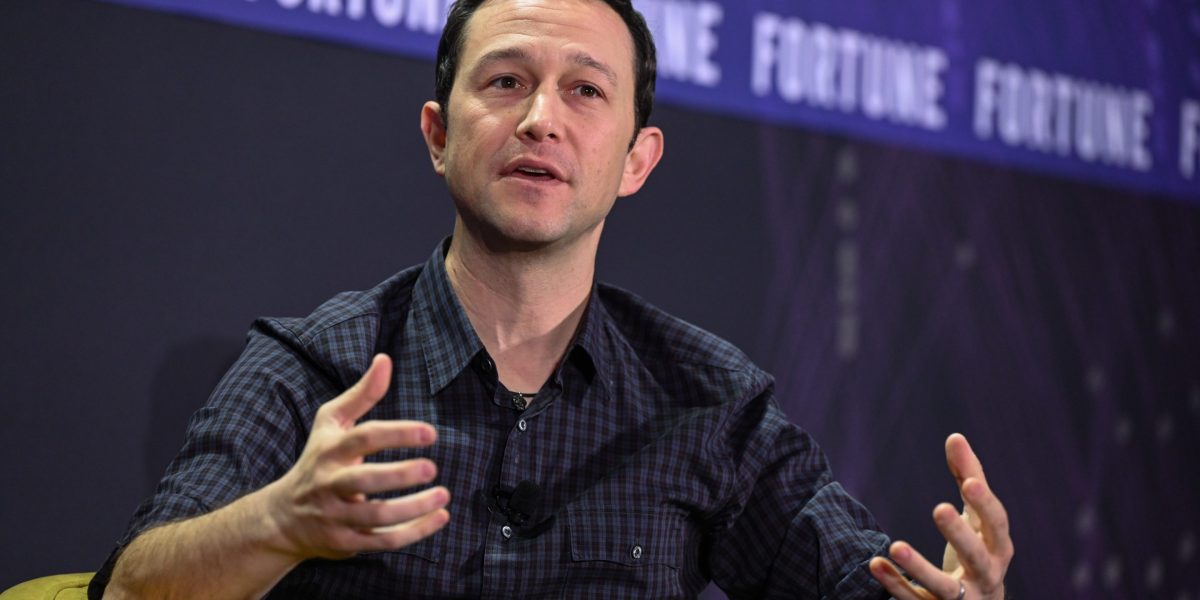
Speaking at the Fortune Brainstorm AI conference this week with editorial director Andrew Nusca, Gordon-Levitt used “The Artist and the Algorithm” session to pose another, deeper question: “Why should the companies building this technology not have to follow any laws? It doesn’t make any sense.”

In a broad-ranging conversation covering specific failures in self-regulation, including instances in which “AI companions” on major platforms reportedly verged into inappropriate territory for children, Gordon-Levitt argued relying on internal company policies rather than external law is insufficient, noting such features were approved by corporate ethicists.

Gordon-Levitt’s criticisms were aimed, in part, at Meta, following the actor’s appearance in a New York Times Opinion video series airing similar claims. Meta spokesperson Andy Stone pushed back hard on X.com at the time, noting Gordon-Levitt’s wife was formerly on the board of Meta rival OpenAI.

Gordon-Levitt argued without government “guardrails,” ethical dilemmas become competitive disadvantages. He explained that if a company attempts to “prioritize the public good” and take the “high road,” they risk being “beat by a competitor who’s taking the low road.” Consequently, he said he believes business incentives alone will inevitably drive companies toward “dark outcomes” unless there is an interplay between the private sector and public law.

‘Synthetic intimacy’ and children

Beyond the lack of regulation, Gordon-Levitt expressed deep concern regarding the psychological impact of AI on children. He compared the algorithms used in AI toys to “slot machines,” saying they use psychological techniques designed to be addictive.

Drawing on conversations with NYU psychologist Jonathan Haidt, Gordon-Levitt warned against “synthetic intimacy.” He argued that while human interaction helps develop neural pathways in young brains, AI chatbots provide a “fake” interaction designed to serve ads rather than foster development.

“To me it’s pretty obvious that you’re going down a very bad path if you’re subjecting them to this synthetic intimacy that these companies are selling,” he said.

Haidt, whose New York Times bestseller The Anxious Generation came recommended from Gordon-Levitt onstage, recently appeared at a Dartmouth-United Nations Development Program symposium on mental health among young people and used the metaphor of tree roots for neurons. Explaining tree-root growth is structured by environments, he brought up a picture of a tree growing around a Civil War–era tombstone. With Gen Z and technology, specifically the smartphone, he said: “Their brains have been growing around their phones very much in the way that this tree grew around this tombstone.” He also discussed the physical manifestations of this adaptation, with children “growing hunched around their phone,” as screen addiction is literally “warping eyeballs,” leading to a global rise in myopia shortsightedness.

The ‘arms race’ narrative

When addressing why regulations have been slow to materialize, Gordon-Levitt pointed to a powerful narrative employed by tech companies: the geopolitical race against China. He described this framing as “storytelling” and “handwaving” designed to bypass safety checks,. Companies often compare the development of AI to the Manhattan Project, arguing slowing down for safety means losing a war for dominance. In fact, The Trump administration’s “Genesis Mission” to encourage AI innovation was unveiled with similar fanfare just weeks ago, in late November.

However, this stance met with pushback from the audience. Stephen Messer of Collectiv[i] argued Gordon-Levitt’s arguments were falling apart quickly in a “room full of AI people.” Privacy previously decimated the U.S. facial recognition industry, he said as an example, allowing China to take a dominant lead within just six months. Gordon-Levitt acknowledged the complexity, admitting “anti-regulation arguments often cherrypick” bad laws to argue against all laws. He maintained that while the U.S. shouldn’t cede ground, “we have to find a good middle ground” rather than having no rules at all.

Gordon-Levitt also criticized the economic model of generative AI, accusing companies of building models on “stolen content and data” while claiming “fair use” to avoid paying creators. He warned a system in which “100% of the economic upside” goes to tech companies and “0%” goes to the humans who created the training data is unsustainable.

Despite his criticisms, Gordon-Levitt clarified he is not a tech pessimist. He said he would absolutely use AI tools if they were “set up ethically” and creators were compensated. However, he concluded without establishing the principle that a person’s digital work belongs to them, the industry is heading down a “pretty dystopian road.”


Source link

Continue Reading

Business

Jim Carrey nearly quit ‘Grinch’ — Then the founder of SEAL Team Six came to the rescue

Published

on


For his role in the movie How the Grinch Stole Christmas, which came out in 2000, Jim Carrey’s tortuous costume and makeup had him on the verge of walking away from a $20 million paycheck.

In an interview with Vulture, the actor said the first day of makeup took eight hours. He nearly quit and suffered from panic attacks after having to wear painful green contacts, makeup that made him breathe through his mouth the whole time, and a full body suit made of itchy yak hair. But before he walked away, producer Brian Grazer hired the founder of SEAL Team Six to help Carrey suck it up.

“Richard Marcinko was a gentleman that trained CIA officers and special-ops people how to endure torture. He gave me a litany of things that I could do when I began to spiral. Like punch myself in the leg as hard as I can. Have a friend that I trust and punch him in the arm. Eat everything in sight. Changing patterns in the room,” Carrey told Vulture in the interview, which was published on Friday.

“If there’s a TV on when you start to spiral, turn it off and turn the radio on. Smoke cigarettes as much as possible. There are pictures of me as the Grinch sitting in a director’s chair with a long cigarette holder. I had to have the holder, because the yak hair would catch on fire if it got too close,” he added.

Carrey said he later learned that Marcinko was the founding officer of SEAL Team Six, the famed special-operations unit. Marcinko passed away at age 81 in December 2021.

Director Ron Howard and Grazer, who were also part of the Vulture interview, recalled Carrey struggling onset because of his Grinch costume.

Howard said the pain he endured was less physical than mental as the makeup was “destroying” Carrey’s skin. It was determined by medical professionals that Carrey couldn’t work in the makeup five days in a row, so he would have a day off or only be off-camera feeding dialogue on Wednesdays, he added.

“Jim started having panic attacks. I would see him lying down on the floor in between setups with a brown paper bag. Literally on the floor. He was miserable,” Howard said.

Carrey even offered to return his entire $20 million paycheck, with interest, Grazer said. But, instead Grazer found Marcinko. 

“I said, ‘Listen, you can quit on Monday, but just spend time with this guy on the weekend,’” Grazer said.


Source link

Continue Reading

Business

A NIMBY revolt is turning voters in Republican strongholds against the AI data-center boom

Published

on


Silicon Valley and Washington sees data centers as the backbone of America’s AI future. Residents who live next to them see giant, humming boxes that throw diesel exhaust into the air, drive up energy costs, and steamroll the look and feel of their neighborhoods—“a plague,” as Virginian anti-data center activist Elena Schlossberg put it.

“If you live near a data center that’s being powered by these gas turbines, you simply cannot imagine living there,” she said. You can “hear the noise” in your home, added Schlossberg—who got into the fight a decade ago while trying, unsuccessfully, to stop Facebook from putting a data center next to her property. 

Virginia has long been the biggest data center hub of not just the country but the world, with northern Virginia alone hosting 13% of the globe’s data centers in 2023, according to a government report. And for just as long, residents have been locked into battles over what that footprint means for their communities.

Now, Schlossberg is leading a Virginia nonprofit group, Save Prince William County, to fight against the encroachment of even more data centers to power the AI boom. Data center power demand is expected to rise five-fold over the next decade, Deloitteprojects; reaching 176 gigawatts, the same amount as Australia and the United Kingdom’s entire power grids combined.

AI infrastructure builders, and the tech giants that plan to rely on the future data centers, argue that they’re essential to unlocking AI’s economic benefits. But in some of the states slated to house these projects, many of them politically purple-ish or even red—Virginia, Indiana, Ohio, Pennsylvania—voters are revolting, often successfully keeping them out of their neighborhoods. Indeed, in elections held last month, opposition to data centers helped tip elections in Democrats’ favor in Virginia and Republican-leaning Georgia.

“Folks realize they’re getting duped,” said Kerwin Olson, executive director of the Citizens Action Coalition, an environmental advocacy coalition based in Indiana. “It’s not just something they hear on Fox News or MSNBC anymore. It’s happening in their own backyard.”

Big Tech companies, Olson added, are showing up at local planning commissions and drainage boards asking for “huge giveaways”— tax abatements, zoning variances, special exceptions —”all to build a $3 billion box that creates maybe 30 jobs.”

“So they’re like, what’s in it for us?” Olson asked. 

Upcoming political battles

The first signs of what could be a broader political reckoning are appearing at the county level. In Prince William County—home to the fight over a proposed 2,000-acre “Digital Gateway” development near the Manassas battlefield—data centers have already forced recalls, resignations, and primary defeats of elected officials, Schlossberg said. The issue has become so radioactive that candidates in both parties now treat opposition to data-center expansion as a prerequisite for running, she added.

“It’s never been red versus blue,” Schlossberg said. “It’s people who live here versus people who want to industrialize where we live.”

That county could be a canary in the coalmine for what comes next, as Democrats and Republicans approach critical midterm congressional elections in 2026. Across key swing states, activists say the next wave of AI-driven projects will collide with a public that is far more organized and hostile than it was even two years ago. 

That tension is beginning to creep into politics. In Indiana, legislators publicly tout the state’s new data-center incentives while privately warning counties that the projects are not without tradeoffs. In Virginia, candidates now get asked—at libraries, at farmer’s markets, even at high school football games—whether they would support a temporary moratorium.

Olson said his group has been “buried” in calls from Hoosiers in every corner of the state—red, blue, rural, suburban—asking for help deciphering tax abatements and utility filings. “I’ve worked on energy issues for decades,” he said. “I have never seen anything like the scale of anger over this.”

When voters see those consequences firsthand, Olson said, they stop caring about geopolitical talking points. “You can tell people this is about beating China,” he said. But when their bill goes up, and their kids are sleeping in basements with headphones on because of the noise, they’re not thinking about China. 

At the heart of the backlash is a basic economic question that data-center backers haven’t convincingly answered: Why should the public subsidize infrastructure that serves some of the world’s richest companies?

Indiana’s first filing under its new “80/20” law—touted as a safeguard to make data centers pay most of the costs—still leaves ratepayers actually footing nearly 40% of the bill, Olson said. The organization he runs, Citizens Action Coalition, did an analysis that revealed that Hoosier households paid 17.5% more in utility bills in 2025 than the previous year. In Virginia, residents fear they will ultimately finance the transmission lines and new generation needed to serve hyperscale facilities.

“The public utility model was always a social contract,” Schlossberg said. “The data-center industry blew that up.”

In many ways, the backlash boils down to a trust problem. Residents don’t trust Big Tech, seeing the hyperscalers as being like “robber barons at the turn of the century” but with unprecedented demands for land, water, and power. Olson pointed to NDAs, closed-door negotiations, and local officials dining with tech consultants as signs that decisions are being made over communities’ heads and without local voters’ input. Layered onto that is a broader skepticism of AI itself: Many voters aren’t convinced they should remake their towns for what still feels like an unproven or overhyped technology.

“It’s like the Gilded Age, part two,” Olson said. “Only bigger.”


Source link

Continue Reading

Business

The job market is so bad, people in their 40s are resorting to going back to school instead of looking for work

Published

on


This year’s job market has been bleak, to say the least. Layoffs hit the highest level in 14 years, job openings are barely budging, and quits figures are plummeting. It’s no wonder people feel stuck and discouraged—especially as many candidates have been on the job hunt for a year.

But some mid-career professionals are working with the cards they’ve been dealt by going back to school. Many are turning to data analytics, cybersecurity, AI-focused courses, health care, MBA programs, or trade certifications for an “immediate impact on their careers,” Metaintro CEO Lacey Kaelani told Fortune.

Metaintro is a job-search engine with 2 million active users that runs on open-source data processing more than 600 million jobs in real time.

“We absolutely see this trend [of adults going back to school] accelerating,” Kaelani said. “In combination with layoffs over the recent years plus the rise of required AI skills, experience is no longer enough.”

Kelsey Szamet, an employment attorney with Kingsley Szamet Employment Lawyers, said she’s noticed people over the age of 40 to go back to grad school or earn certifications.

While it’s not necessarily a completely new phenomenon, it’s becoming more frequently now that the job market is the pits. 

Still, Szamet he sees “very consistent” reasons for people considering higher education at a later stage in life. Some believe they’ve “plateaued” in their career and education is the only option. Others have been affected by layoffs, and there are some “who have simply become burned out with work and want a meaningful profession,” she told Fortune

“Then, too, come life circumstances. Some people have fewer responsibilities, better financial security, or a sense they will never make a change if they put it off now,” she said, adding she’s seeing more people pivot out of “dying industries,” those whose salaries have stagnated, or those who have job-security fears.  

According to Hanover Research, the top master’s degrees on the rise include artificial intelligence, mechatronics, robotics, automation engineering, research methodology, quantitative methods, as well as construction engineering technology. 

The cost of going back to school

Sometimes going back to school can also just feel like delaying the inevitable: student loans and other living costs. 

While grad school can certainly offer the opportunity to level-up your career once you’ve completed a program, it comes with financial and personal sacrifices, like time. According to the National Center for Education Statistics, one year of grad school, on average, costs about $43,000 in tuition. That’s nearly 70% the average salary in the U.S.

“Going to school can be very beneficial, but it can be very costly too,” Szamet said. And, when people are older and going back to school, they should consider “the cost of education and how stressful it can be to juggle work and family responsibilities with education.” Overall, “one ought to assess if it will be a good investment,” she added. 

That’s why it’s important to do your homework. Some degree programs have a better return-on-investment than others. According to an ROI analysis by the Foundation for Research on Equal Opportunity, the median master’s degree increases lifetime earnings by $83,000, but some master’s degrees are worth more than $1 million. Computer science, engineering, and nursing are some of the highest-ROI master’s programs, with average ROIs of about $500,000, according to the Foundation for Research on Equal Opportunity analysis. 

Still, 40% of master’s degrees actually “have no net financial value at all,” according to the report.  

“In today’s job market, going back to school only works when it’s strategic and targeted [like a] specific technical certification in a high-demand field), but fails when it’s vague,” Kaelani emphasized. “It’s no longer ‘more education equals a better job.’”

This story was originally featured on Fortune.com


Source link

Continue Reading

Trending

Copyright © Miami Select.