Connect with us

Business

Congressman leading GOP’s mid-term House campaign says Trump is intimately involved in recruitment

Published

on


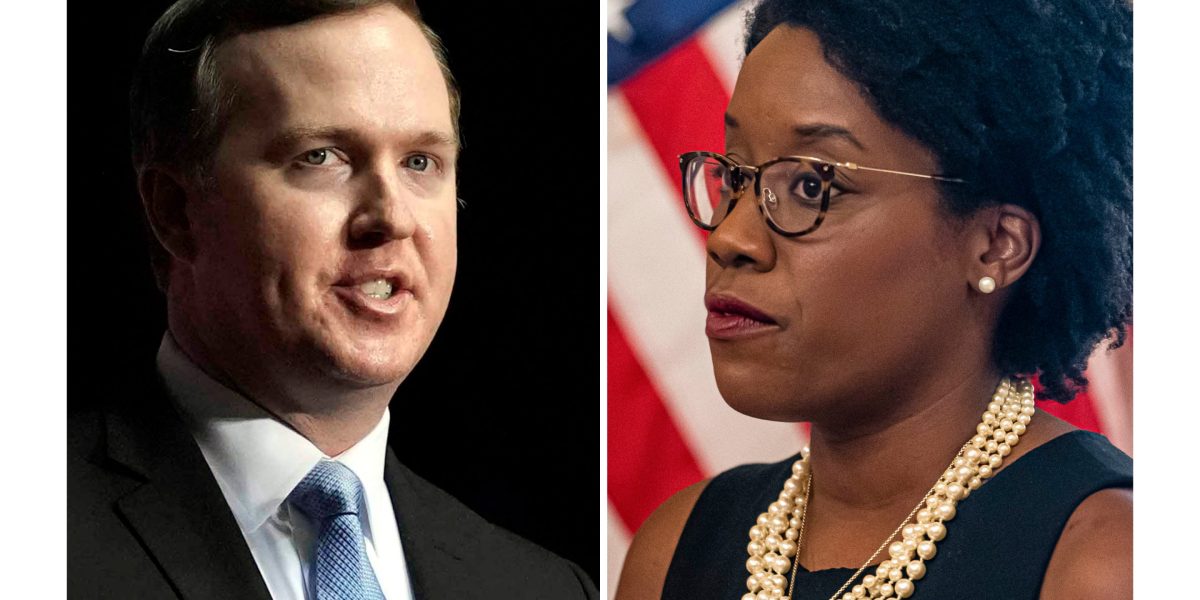
Even though Republican Brian Jack is only a first-term congressman, he has become a regular in the Oval Office these days. As the top recruiter for his party’s House campaign team, the Georgia native is often reviewing polling and biographies of potential candidates with President Donald Trump.

Lauren Underwood, an Illinois congresswoman who does similar work for Democrats, has no such West Wing invitation. She is at the other end of Pennsylvania Avenue working the phones to identify and counsel candidates she hopes can erase Republicans’ slim House majority in November’s midterm elections.

Although they have little in common, both lawmakers were forged by the lessons of 2018, when Democrats flipped dozens of Republican-held seats to turn the rest of Trump’s first term into a political crucible. Underwood won her race that year, and Jack became responsible for dealing with the fallout when he became White House political director a few months later.

Underwood wants a repeat in 2026, and Jack is trying to stand in her way.

For Republicans, that means going all-in on Trump and his “Make American Great Again” agenda, gambling that durable enthusiasm from his base will overcome broader dissatisfaction with his leadership.

“You’re seeing a lot of people very inspired by President Trump,” Jack said about his party’s House candidates. “They’re excited to serve in this body alongside him and the White House. That’s been a tool and a motivating factor for so many people who want to run.”

Underwood said she is looking for candidates with community involvement and public service beyond Washington politics. A registered nurse, she was a health care advocate before she ran in 2018, joining a cadre of Democratic newcomers that included military veterans, educators, activists and business owners.

“It’s about having ordinary Americans step up” in a way that “draws a sharp contrast with the actions of these MAGA extremists,” she said.

Trump’s involvement is more direct than in 2018

It’s routine for a president’s party to lose ground in Congress during the first midterms after winning the White House. Trump, however, is in the rare position to test that historical trend with a second, nonconsecutive presidency.

Neither party has released its list of favored candidates in targeted seats. But Jack said Oval Office discussions with Trump focus on who can align with the White House in a way that can win.

Jack highlighted former Maine Gov. Paul LePage as an example. LePage is running in a GOP-leaning district where Democrats face the challenge of replacing Rep. Jared Golden, another member of the party’s 2018 class who recently announced he would not seek reelection.

Trump’s involvement contrasts with 2017, when he was not as tied to House leadership, including then-Speaker Paul Ryan, R-Wis., on details of the midterm campaign as he is now. Jack, who got his start with Trump by managing delegate outreach before the 2016 convention, was White House deputy political director during that span. He was promoted to political director after the 2018 losses.

Jack continued advising the president, especially on his endorsements, between Trump’s 2021 departure for the White House and Jack’s own congressional campaign in 2024. He described Trump as intimately involved in recruitment decisions and open to advice on his endorsements since those 2018 defeats.

Trump loyalty will not always be easy to measure, especially in first-time candidates.

But Jack said Republicans have quality options. He pointed to Albuquerque, New Mexico, where Republicans could have a competitive primary that includes Jose Orozco, a former Drug Enforcement Administration contractor, and Greg Cunningham, a former Marine and police officer.

“They both have very inspirational stories,” Jack said.

Orozco has asked voters to “give President Trump an ally in Congress.” Cunningham did not focus on Trump in his campaign launch.

Democrats describe a district-by-district approach

Underwood said Democrats are replicating a district-by-district approach of 2018. Recruiting in the Trump era, she said, is more often about talking with prospective candidates who raised their hands to run than about coaxing them into politics.

The notable numbers of women and combat veterans in her first-term class, Underwood said, was not a top-down strategy but the result of candidates who saw Trump and Republicans as threats to functional government and democracy.

Underwood, who at age 32 became the youngest Black woman ever to serve in Congress after her 2018 election, recalled that Republicans’ efforts to repeal the Affordable Care Act spurred her to run because of her training as a nurse. She shares those experiences with recruits, sharpening how they can connect their ideas and background to the job of a congressperson.

Underwood said she also regularly fields questions about serving in an era of political violence and about the day-to-day balance of being a candidate or congressperson, especially from recruits who have children.

National security is again a draw for Democrat. Former Marine JoAnna Mendoza is running in a largely rural southern Arizona seat and former Rep. Elaine Luria, another Underwood classmate and former naval officer, is running again in Virginia after losing her seat in 2022. Luria was among the lead House investigators of the Jan. 6, 2021, Capitol riot.

Underwood said there are clear parallels to 2018, when successful congressional candidates included Mikie Sherrill, a former Navy helicopter pilot who is now New Jersey governor-elect; Jason Crow, a former Army Ranger who is one of her recruiting co-chairs; and Virginia Gov.-elect Abigail Spanberger, a former CIA case officer.

Democrats also noted the need to find candidates who reflect a district’s cultural sensibilities, meaning a candidate who can withstand Republican accusations that national Democrats are out of touch with many voters.

For instance, in a South Texas district, the top potential Democratic challenger is Tejano music star Bobby Pulido. The five-time Latin Grammy nominee has criticized progressive Rep. Alexandria Ocasio-Cortez of New York for using the term “Latinx” rather than “Latino” or “Latina.”

Trump’s gerrymandering fight causes uncertainty

Mid-decade gerrymandering, mostly in Republican-led states at Trump’s behest, leaves the state of the 435 House districts in flux. Even with the changes, Democrats identify more than three dozen Republican-held seats they believe will be competitive. Republicans counter with about two dozen Democratic-held seats they think can flip.

In the Southwest, Democrats are targeting all three Republican seats in Arizona. The GOP is aiming at three Democratic seats in Nevada. From the Midwest across to the Philadelphia suburbs, Democrats want to flip two Iowa seats, two in Wisconsin three in Michigan, three in Ohio and four in Pennsylvania. Republicans are targeting four Democratic seats in New York.

Nearly all Democratic targets were within a 15-percentage point margin in 2024, many of them much closer than that. Democratic candidates in 2025 special elections typically managed double-digit gains compared with Trump’s margins in 2024, including a recent special House election in Tennessee, when Democrats came within 9 points in a district Trump won by 22 points.

“It’s the same kind of shifts that we saw in 2017 before the 2018 wins,” said Meredith Kelly, a top official at the Democratic Congressional Campaign Committee during Trump’s first presidency. “So, it becomes a mix of that national environment and finding the right candidates who fit a district and can take advantage.”


Source link

Continue Reading

Business

Ford takes $19.5 billion hit, scraps some EV ambitions in pivot to more hybrid and gas models

Published

on


The Dearborn, Michigan-based automaker will make a series of changes to its line of vehicles and production facilities to focus on producing affordable vehicles that better align with customer desires, it announced Monday.

The company will also scrap production of certain larger EVs—including the F-150 Lightning, which it will retool as an electric vehicle with a gas-powered generator—as well as redouble development of smaller, lower-cost cars, including a midsize pickup truck in 2027.

“This is a customer-driven shift to create a stronger, more resilient and more profitable Ford,” Ford president and CEO Jim Farley said in a press release. “The operating reality has changed, and we are redeploying capital into higher-return growth opportunities: Ford Pro, our market-leading trucks and vans, hybrids and high-margin opportunities like our new battery energy storage business.”

As EV demand trends downward, particularly following the end of the federal tax credit in September, Ford had struggled to sustain demand for its Model E line. Farley warned in September the end of the tax credit would throttle EV demand, cutting sales to 5% of total auto volume from roughly 10% to 12% at the time. Earlier this month, the automaker reported it sold 164,925 vehicles in November, a 0.9% year-over-year decline, with EV sales tumbling 61% to 4,247. With $3.6 billion in losses in the first three quarters of this year alone, Ford’s Model E division has lost more than $13 billion in less than three years.

In addition to regulatory challenges, Ford attributed the need to produce smaller, more affordable EVs as well as gas and hybrid vehicles, to battery prices remaining stubbornly high and an affordability crisis shaking consumer brand loyalty. The company said on Monday it would launch five new “affordable” vehicles by the end of the decade, four of which would be assembled domestically. The automaker intends to have 50% of its global vehicle volumes be hybrids, extended-range EVs, and full EVs, by 2030, up from 17% this year.

As a result of the changes to its production focus, Ford will also repurpose some of its facilities, including revamping its Tennessee Electric Vehicle Center into the Tennessee Truck Plant, which will no longer produce EVs, but rather manufacture the new Built Ford Tough truck models beginning in 2029. Its Ohio plant will similarly assemble new gas and hybrid cars in 2029.

Ford said it will employ thousands of workers in the next few years to staff its American plants. After concluding production for the 2025 F-150 Lightning model, Ford will redeploy one-third of that workforce to production on a gas and hybrid model of the F-150.

Ford will book $19.5 billion in charges, most of which will occur in 2026, as a result of the pivot, including an $8.5 billion asset write-down for its Model E division. The automaker raised its EBIT guidance for 2025 to about $7 billion, up from $6 billion, and it reaffirmed its adjusted free cash flow range of between $2 billion and $3 billion.

Ford has struggled to get returns from its ever-growing investment in its EV models, even as it continues to toy with strategy changes. Monday’s announcement follows Ford’s decision in August to invest $2 billion in retooling a Kentucky factory in order to manufacture EVs, as well as rejig its production process to a “universal EV platform” to lower the cost of its models.

Ford said it expects its Model E to be profitable by 2029; in early 2023, it predicted profitability by 2026.

At the time of the Kentucky factory announcement, analysts were hesitant to laud the company, warning that if Ford did not make a compelling product, its billions of dollars poured into factory changes and fresh vehicle production would be for nought, particularly as EV demand stays hot and cold.

“If the vehicles don’t appeal due to being EVs, then billions will be wasted,” Morningstar equity strategist David Whiston told Fortunein August. “That’s why you need a great product, great range, and lower battery cost and vehicle manufacturing techniques.”

He added, “The challenge is, do you have a great product or not? [It’s] hard to get excited about a vehicle you can’t see yet.”


Source link

Continue Reading

Business

Trump vows to fight ‘fraud’ in SNAP benefits for 42 million Americans

Published

on


President Donald Trump ’s administration is talking tough about SNAP, saying the government’s biggest food aid program is riddled with fraud that must be stopped.

His appointees are looking at Supplemental Nutrition Assistance Program from an enforcement perspective, seeing fraud as a major and expensive problem, perpetrated by organized criminal organizations, individual recipients and retailers willing to break the laws for profit.

“We know there are instances of fraud committed by our friends and neighbors, but also transnational crime rings,” Jennifer Tiller, a senior advisor to U.S. Agriculture Secretary Brooke Rollins, said in an interview.

Some experts agree that SNAP fraud is a major problem. But there is little publicly available data showing the extent of it, and others who study the program are skeptical about the scale.

“It you’re spending $100 billion on anything, you’re going to have some leakage,” said Christopher Bosso, a professor of public policy and politics at Northeastern University who published a book on SNAP.

The administration leans into fraud allegations

Of the $100 billion spent on SNAP a year, about $94 billion goes to benefits and the rest to administrative costs.

About 42 million people — or 1 in 8 Americans — receive SNAP benefits averaging about $190 per person per month. The number of recipients is in the same ballpark as the number of people in poverty — 36 million by the traditional measure and 43 million under a more nuanced one also used by the federal government.

Under federal law, most households must report their income and basic information every four to six months and be fully recertified for SNAP at least every 12 months.

The Trump administration has demanded that states turn over data on individual SNAP recipients including Social Security numbers, dates of birth and immigration status as part of its effort to root out fraud.

States with Republican governors, plus North Carolina, have complied. Most led by Democrats are pushing back in court, arguing that providing the data would violate recipients’ privacy.

The USDA says that from the records that have been shared, it found 186,000 deceased people — about 1% of participants in those states — receiving benefits and about 500,000 people — about 2.7% — receiving benefits in more than one jurisdiction.

The USDA has not made public detailed reports on the data and has not broken down the estimates by type of alleged fraud. The department also hasn’t answered questions about what portion of any improperly awarded benefits was actually spent and how much sat unclaimed on EBT cards after recipients moved or died.

The department estimated in a letter to the states that have refused to turn over data that the nationwide total combining fraud and undetected errors could be $9 billion a year or more. Democratic-led states responded in a letter last week that states already have systems to catch wrongdoing and that USDA isn’t explaining how it’s crunching the numbers.

Program participants can be perpetrators or victims of fraud

There are a lot of forms of wrongdoing.

SNAP benefits are put on EBT cards that recipients swipe in stores like debit cards. Organized crime groups put skimmers on EBT readers to get information used to make copies of the benefit cards and steal the allotments of recipients — or to use stolen identity information to apply for benefits for fictitious people. A Romanian man who was in the U.S. illegally pleaded guilty last year to skimming cards in California. Authorities say he took more than 36,000 numbers over three years.

A USDA employee pleaded guilty this year to accepting bribes in exchange for providing registration numbers for EBT card readers placed illegally in several New York delis. Authorities said more than $30 million passed through those terminals.

And three people were charged this year in Franklin County, Ohio, accused of using stolen benefits to order big quantities of energy drinks and candy — apparently to resell it.

Mark Haskins, who worked on USDA investigations from 2013 until leaving the department in August as branch chief of a special investigations unit, said there have been cases of retailers running similar operations. Several states are barring using SNAP for some junk food products with policies that kick in as soon as Jan. 1.

Haskins also says some legitimate recipients buy non-grocery items with SNAP benefits by persuading a store employee to ring up the wrong item — generally one that costs more than what’s being bought — or to sell benefit cards. He said he thinks those forms of fraud are more costly than the ones run by organized criminal groups.

Haskins and Haywood Talcove, CEO of LexisNexis Risk Solutions Government, which helps create fraud prevention strategies, both believe fraud costs significantly more than the USDA’s $9 billion estimate.

“The system is corrupt. It doesn’t need a fix here and there, it needs a complete overhaul,” said Haskins, who would like to see fewer retailers in the network and participants having to reapply, even if that makes it harder for qualified people to access benefits.

Advocates and researchers see a different system

The USDA last published a report on SNAP fraud in 2021. It covered what happened in from 2015 through 2017 and found that about 1.6% of benefits were stolen from recipients’ accounts.

The government replaced benefits that were stolen between Oct. 1, 2022 and Dec. 20, 2024. The value of replaced benefits over that time was $323 million — or about 24 cents for every $100 in SNAP benefits, though that’s believed to be an undercount.

It’s reports like those that lead advocates and academics who research SNAP to see fraud, while troublesome, as less than the massive problem the USDA makes it out to be.

Dartmouth College economist Patricia Anderson, who studies food insecurity, said in an email that the maximum benefits for a family of four are about $1,000 a month. “It really takes organized crime that is either stealing from the EBT cards or creating a lot of fake recipients out of whole cloth before the gain for the fraudster really starts to be worth it,” she said.

Jamal Brown, a 41-year-old food stamp participant who lives in Camden, New Jersey, said he’s witnessed people selling benefits to bodegas to get cash. And he’s had his benefits stolen by a skimmer.

He also said he had to deal with benefits being cut off after being told he missed an interview to recertify his need when a county welfare worker didn’t call him as planned.

“It’s always something that goes wrong,” Brown said, “unfortunately.”


Source link

Continue Reading

Business

Small businesses say Trump tariffs are hurting consumers—here’s what is getting more expensive

Published

on


NEW YORK (AP) — The Ah Louis Store in San Luis Obispo, California, turns into a winter wonderland every holiday season.

Green garlands, giant nutcrackers, baubles and bows go up in early November on the historic downtown building that houses the gift shop. Inside, customers can choose from over 500 different types of ornaments and a variety of holiday gift baskets.

“We really just make it a magical spot,” co-owner Emily Butler said. “Whether you come in or not, we want to make sure that we’re spreading that holiday joy.”

But Butler says she and her twin sister-business partner had to work harder this year to turn browsers into buyers and to make a profit. Many of the decorations and stocking stuffers they sell are made overseas and either did not arrive or got more expensive when President Donald Trump imposed unusually high taxes on imported goods, she said.

In response, the sisters focused their selection on more profitable items like nutcrackers and gift baskets. They’ve also noticed customers cutting back, selecting a $100 gift basket over the $150 version, or buying one ornament instead of several, Butler said..

“We’re definitely seeing more cautious spending this year,” she said.

Along with the unpredictable tariffs, stubborn inflation and weak hiring have shaken consumer confidence in the U.S. economy. The vast majority of U.S. adults say they’ve noticed higher than usual prices for groceries, electricity and holiday gifts in recent months, according to a December poll from The Associated Press-NORC Center for Public Affairs Research.

A Gallup index that summarizes Americans’ assessments of current economic conditions fell to a 17-month low in November. Consumers also indicated less enthusiasm for spending money on holiday gifts; their estimated gift budgets decreased $229 between October and November, the largest drop Gallup has recorded at that point of the holiday shopping season. The survey was conducted in November, partially during the government shutdown, which might have tempered spending plans.

However, the worst-case impact on consumer prices that many economists foresaw from the Trump administration’s tariff policies hasn’t materialized. Some products have been affected more than others. Here’s a look at what has happened with supplies and prices in popular gifting categories.

Games and toys

Game and toys were particularly susceptible to tariff-related price increases since the majority of the ones sold in the U.S. are made in China, according to industry trade group The Toy Association. The tariff rate the Trump administration imposed on Chinese goods became a rollercoaster that started at an additional 10%, peaked at 145% and ended up at 47%.

The uncertainty made it hard for toy shops to decide what to order for the holidays. Dean Smith, who co-owns independent toy stores JaZams in Princeton, New Jersey, and Lahaska, Pennsylvania, said the manufacturers in China that he buys toys from did not pass on their tariff costs all at once but he has seen their prices inch higher with every reorder.

Smith estimated that wholesale prices for 80% of his inventory went up anywhere from 5% to 20%. Some shoppers who don’t buy toys regularly might be surprised by price increases he adopted in turn, Smith said. A doll that sold for $20 to $25 last year now costs $30 to $35 at JaZams, he said.

“For folks with marginal incomes, this is going to be a very difficult holiday,” Smith said.

Electronics

Consumer electronics are mostly made in China and other Asian countries. In 2023, China accounted for 78% of U.S. smartphone imports, and 79% of laptop and tablet imports, according to the Consumer Technology Association trade group.

Best Buy said in May that it was raising prices due to tariffs. But CEO Corie Barry said late last month that the consumer electronics chain made sure to stock computers, phones and other products at different price levels, a decision she credited with helping Best Buy attract more lower-income shoppers.

“The consumer is not a monolith,” Barry told reporters.

Game consoles are always a popular holiday item, and console makers made news earlier this year when they announced price increases. Sony raised the price of the PlayStation 5 by $50 to $550 in August, following Microsoft and Nintendo raising prices for their game consoles.

Jewelry

Jewelry shoppers will likely see higher prices, but that has more to do with the soaring price of gold than tariffs so far, according to David Bonaparte, president & CEO of trade group Jewelers of America.

The varying tax rates Trump set for countries that import American goods with a total value less than their exports to the U.S. affected jewelry in various ways. Watches from Switzerland, for example, were subject to a 39% tariff from July 31 until the country struck a deal with the Trump administration last month to lower the import tax rate on its products to 15%.

India, which refines many of the diamonds sold in the U.S., rushed in shipments of the gemstones before a 50% tariff on the country’s products took effect on Aug. 27. Higher prices for jewelry made with diamonds shipped from India will likely start to be felt in 2026, Bonaparte said.

“It’s really a matter of what happens after Jan. 1,” he said. “If these tariffs are still in place, then prices will probably increase.”

Holiday decor

Holiday decorations are yet another category that mostly comes from overseas, particularly China.

Jeremy Rice co-owns House, a home-décor shop in Lexington, Kentucky, that specializes in artificial flowers, wreaths and table decorations. He said the tariffs slowed down production of much of his fall stock and seasonal merchandise like ribbon. Some larger and more expensive items he didn’t order at all because they would have been too expensive to retail.

Rice raised prices on the products he did get. The popular red berry stems that House long has carried increased from $8.95 last year to $10.95 due to higher import costs, he said.

“We sell thousands of these berry stems, and every time we sold one, I flinched from knowing what it should have been, knowing that our supplier paid more for them, which made us pay more for them, which made our customer pay more for them,” Rice said.

Shopping strategically

For those looking to avoid tariff-related price increases, John Harmon, managing director of technology research at technology consulting company Coresight Resarch, recommends checking out secondhand stores and discount retailers like T.J. Maxx, Marshall’s and HomeGoods. The off-price chains buy much of their inventory from leftover stock that would have entered the U.S. before new tariffs kicked in.

Joe Adamski, senior director at procurement services company ProcureAbility, said books, food and beverages are some of the domestically produced goods that make good gifts.


Source link

Continue Reading

Trending

Copyright © Miami Select.