Connect with us

Business

2 U.S. service members and one American civilian killed in Islamic State ambush in Syria

Published

on


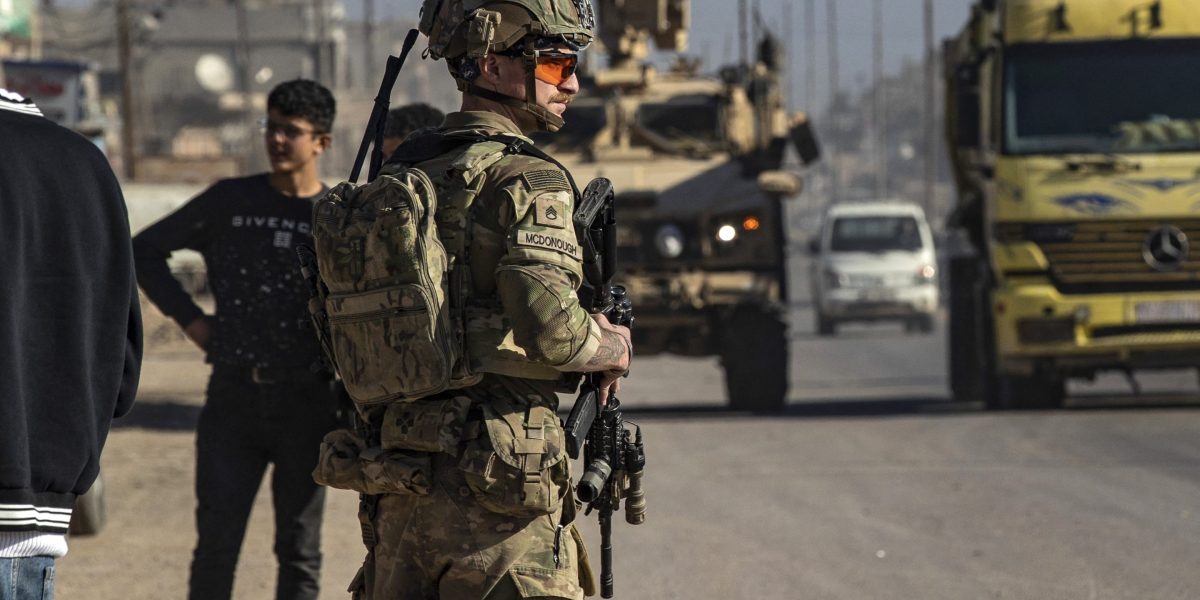
Two U.S. service members and one American civilian were killed and three other people wounded in an ambush on Saturday by a lone member of the Islamic State group in central Syria, the the U.S. military’s Central Command said.

The attack on U.S. troops in Syria is the first to inflict casualties since the fall of President Bashar Assad a year ago.

Central Command said in a post on X that as a matter of respect for the families and in accordance with Department of Defense policy, the identities of the service members will be withheld until 24 hours after their next of kin have been notified.

U.S. Defense Secretary Pete Hegseth posted on X: “Let it be known, if you target Americans — anywhere in the world — you will spend the rest of your brief, anxious life knowing the United States will hunt you, find you, and ruthlessly kill you.”

The shooting took place near historic Palmyra, according to the state-run SANA news agency, which earlier said two members of Syria’s security force and several U.S. service members had been wounded. The casualties were taken by helicopter to the al-Tanf garrison near the border with Iraq and Jordan.

SANA said the attacker was killed, without providing further details.

The Britain-based Syrian Observatory for Human Rights said the attacker was a member of the Syrian security force.

The U.S. has hundreds of troops deployed in eastern Syria as part of a coalition fighting the Islamic State group.

Last month, Syria joined the international coalition fighting against the IS as Damascus improves its relations with Western countries following the ouster of Assad when insurgents captured his seat of power in Damascus.

The U.S. had no diplomatic relations with Syria under Assad, but ties have warmed since the fall of the five-decade Assad family rule. The interim president, Ahmad al-Sharaa, made a historic visit to Washington last month where he held talks with President Donald Trump.

IS was defeated on the battlefield in Syria in 2019 but the group’s sleeper cells still carry out deadly attacks in the country. The United Nations says the group still has between 5,000 and 7,000 fighters in Syria and Iraq.

U.S. troops, which have maintained a presence in different parts of Syria — including Al-Tanf garrison in the central province of Homs — to train other forces as part of a broad campaign against IS, have been targeted in the past. One of the deadliest attacks occurred in 2019 in the northern town of Manbij when a blast killed two U.S. service members and two American civilians as well as others from Syria while conducting a patrol.


Source link

Continue Reading

Business

Microsoft’s AI boss calls Elon Musk a ‘bulldozer’ with ‘superhuman capabilities’

Published

on


Microsoft AI CEO Mustafa Suleyman said he’s in regular contact with his peers in artificial intelligence, including OpenAI’s Sam Altman, Anthropic’s Dario Amodei, and Google DeepMind’s Demis Hassabis.

In fact, Suleyman and Hassabis once worked together as cofounders of DeepMind, though Suleyman went on to cofound Inflection AI then joined Microsoft last year.

In a wide-ranging interview with Bloomberg on Friday, he was asked to share his thoughts on some of his fellow AI leaders, including Altman, whose startup recently completed a for-profit restructuring and revamped its partnership with Microsoft.

He described Altman as “courageous,” noting that OpenAI is aggressively building out a fleet of AI data centers to handle the massive amount of computing power needed to run ChatGPT.

“He may well turn out to be one of the great entrepreneurs of our generation,” Suleyman added. “He’s certainly achieved a lot. He’s building data centers at a faster rate than anyone in the industry, and if he can pull it off, it will be pretty dramatic.”

And despite concerns that OpenAI’s investment commitments far outstrip its current level of revenue, he said he has every confidence the company can pull it off.

As for Hassabis, Suleyman called him a great scientist. “I think he’s a great thinker and he’s a good polymath. He’s made massive contributions in the field, multiple times. He’s truly exceptional.”

Suleyman also revealed that even though the one-time collaborators are now competitors, they remain good friends and stay in touch regularly. He even texted Hassabis recently to congratulate him on Nano Banana, Gemini 3 and AlphaFold.

Then he was asked about Elon Musk, who is an OpenAI cofounder but has since fallen out with Altman and is pursuing AI through his startup xAI. Suleyman called him a “bulldozer.”

“He’s kind of got superhuman capabilities to bend reality to his will and has, you know, pretty incredible track record,” he added. “And somehow he sort of mostly manages to pull off what appears to be impossible.”

Not only did Musk disrupt the auto and space sectors with Tesla and SpaceX, respectively, he’s charging into medical technology with Neuralink and transportation with the Boring Co.

He also dove into politics, becoming the top Republican donor last year, and briefly joining the Trump administration. He feuded with the president this summer, but they have shown some signs of warming up lately.

While Musk has a “different kind of set of values,” Suleyman said, “I kind of like that he speaks his mind. He’s very unfiltered.”


Source link

Continue Reading

Business

Danish intelligence report warns of US economic leverage and military threat under Trump

Published

on


The United States is using its economic power to “assert its will” and threaten military force against friend and foe alike, a Danish intelligence agency said in a new report.

The Danish Defense Intelligence Service, in its latest annual assessment, said Washington’s greater assertiveness under the Trump administration also comes as China and Russia seek to diminish Western, especially American, influence.

Perhaps most sensitive to Denmark — a NATO and European Union member country, and a U.S. ally — is growing competition between those great powers in the Arctic. U.S. President Donald Trump has expressed a desire to see Greenland, a semiautonomous and mineral-rich territory of Denmark, become part of the United States, a move opposed by Russia and much of Europe.

“The strategic importance of the Arctic is rising as the conflict between Russia and the West intensifies, and the growing security and strategic focus on the Arctic by the United States will further accelerate these developments,” said the report, published Wednesday.

The assessment also follows the release last week of a new Trump administration national security strategy that depicts European allies as weak and aims to reassert America’s dominance in the Western Hemisphere.

Russian President Vladimir Putin has said Russia is worried about NATO’s activities in the Arctic and will respond by strengthening its military capability in the polar region.

The findings and analyses in the report echo a string of recent concerns, notably in Western Europe, about an increasingly go-it-alone approach by the United States, which under Trump’s second term has favored bilateral deals and partnerships at the expense of multilateral alliances like NATO.

“For many countries outside the West, it has become a viable option to forge strategic agreements with China rather than the United States,” read the report, which was written in Danish. “China and Russia, together with other like-minded states, are seeking to reduce Western – and particularly US – global influence.”

“At the same time, uncertainty has grown over how the United States will prioritize its resources in the future,” it added. “This gives regional powers greater room for maneuver, enabling them to choose between the United States and China or to strike a balance between the two.”

The Trump administration has raised concerns about respect for international law with its series of deadly strikes on alleged drug-smuggling boats in the Caribbean Sea and eastern Pacific Ocean — part of a stepped-up pressure campaign against President Nicolás Maduro of Venezuela.

Trump has also refused to rule out military force in Greenland, where the United States already has a military base.

“The United States is leveraging economic power, including threats of high tariffs, to assert its will, and the possibility of employing military force – even against allies – is no longer ruled out,” the report said.


Source link

Continue Reading

Business

EU indefinitely freezes Russian assets to prevent Hungary and Slovakia from vetoing support Ukraine

Published

on


The European Union on Friday indefinitely froze Russia’s assets in Europe to ensure that Hungary and Slovakia, both with Moscow-friendly governments, can’t prevent the billions of euros from being used to support Ukraine.

Using a special procedure meant for economic emergencies, the EU blocked the assets until Russia gives up its war on Ukraine and compensates its neighbor for the heavy damage that it has inflicted for almost four years.

EU Council President António Costa said European leaders had committed in October “to keep Russian assets immobilized until Russia ends its war of aggression against Ukraine and compensates for the damage caused. Today we delivered on that commitment.”

It’s a key step that will allow EU leaders to work out at a summit next week how to use the tens of billions of euros in Russian Central Bank assets to underwrite a huge loan to help Ukraine meet its financial and military needs over the next two years.

“Next step: securing Ukraine’s financial needs for 2026–27,” added Costa, who will chair the Dec. 18 summit.

The move also prevents the assets, estimated to total around 210 billion euros ($247 billion), from being used in any negotiations to end the war without European approval.

28-point plan drafted by U.S. and Russian envoys stipulated that the EU would release the frozen assets for use by Ukraine, Russia and the United States. That plan, which surfaced last month, was rejected by Ukraine and its backers in Europe.

French Foreign Minister Jean-Noël Barrot wrote on X that the EU decision means that “no one will decide in place of the Europeans the use of these funds.”

Hungary and Slovakia object

The vast majority of the funds — around 193 billion euros ($225 billion) at the end of September — are held in Euroclear, a Belgian financial clearing house.

The money was frozen under sanctions that the EU imposed on Russia over the war it launched on Feb. 24, 2022, but these sanctions must be renewed every six months with the approval of all 27 member countries.

Hungary and Slovakia oppose providing more support to Ukraine, but Friday’s decision prevents them from blocking the sanctions rollover and make it easier to use the assets.

Hungarian Prime Minister Viktor Orbán – Russian President Vladimir Putin’s closest ally in Europe – said on social media that it means that “the rule of law in the European Union comes to an end, and Europe’s leaders are placing themselves above the rules.”

“The European Commission is systematically raping European law. It is doing this in order to continue the war in Ukraine, a war that clearly isn’t winnable,” he wrote. He said that Hungary “will do everything in its power to restore a lawful order.”

In a letter to Costa, Slovak Prime Minister Robert Fico said that he would refuse to back any move that “would include covering Ukraine’s military expenses for the coming years.”

He warned “that the use of frozen Russian assets could directly jeopardize U.S. peace efforts, which directly count on the use of these resources for the reconstruction of Ukraine.”

But the commission argues that the war has imposed heavy costs by hiking energy prices and stunting economic growth in the EU, which has already provided nearly 200 billion euros ($235 billion) in support to Ukraine.

Belgium, where Euroclear is based, is opposed to the “reparations loan” plan. It says that the plan “entails consequential economic, financial and legal risks,” and has called on other EU countries to share the risk.

Russia takes court action

Russia’s Central Bank, meanwhile, said on Friday that it has filed a lawsuit in Moscow against Euroclear for damages it says were caused when Moscow was barred from managing the assets. Euroclear declined to comment.

The Belgian clearing house has around 17 billion euros ($20 billion) in Russia and it’s unclear what would happen to that money if the legal challenge or others like it succeed.

In a separate statement, the Central Bank also described wider EU plans to use Russian assets to aid Ukraine as “illegal, contrary to international law,” arguing that they violated “the principles of sovereign immunity of assets.”

But EU Economy Commissioner Valdis Dombrovskis brushed off the suit, saying that the decision is “legally robust,” and that he expects Russia “to continue to launch speculative legal proceedings to prevent the EU from upholding international law.”

Chris Weafer, CEO of Macro-Advisory Ltd. Consultancy, said that the timing of the court action is “clearly linked” to the EU’s intention to use the frozen assets.

“The Russian Central Bank is making clear that it will respond with legal actions against all countries involved in the decision to take the Russian money,” he said.

Friday’s EU decision came hours after Germany summoned the Russian ambassador in Berlin following allegations of sabotage, disinformation campaigns, cyberattacks and interference in its elections.

___

Associated Press journalists Karel Janicek in Prague, Sylvie Corbet in Paris, Katie Marie Davies in Manchester, England and Stefanie Dazio in Berlin contributed to this report.


Source link

Continue Reading

Trending

Copyright © Miami Select.