Connect with us

Business

Botched baton passes show why AI needs trust, Blackbaud exec says

Published

on


The U.S. Olympic men’s and women’s sprinting teams have won more gold medals than any other country in history, but the men’s 4×100-meter relay team has suffered four blistering defeats in the past two decades. Why? An absolute whiff at the critical point when a runner has to instinctively reach back and trust their squadmate enough to perfectly place the baton in their hand.  

Sudip Datta, chief product officer at AI-powered software firm Blackbaud, said that image captures exactly what’s taking place in AI today. Companies are advancing swiftly to build the fastest and most powerful systems they can, but there’s a severe lack of trust between the technology and the people using it, causing any new innovation or efficiencies to completely fumble at the handoff. 

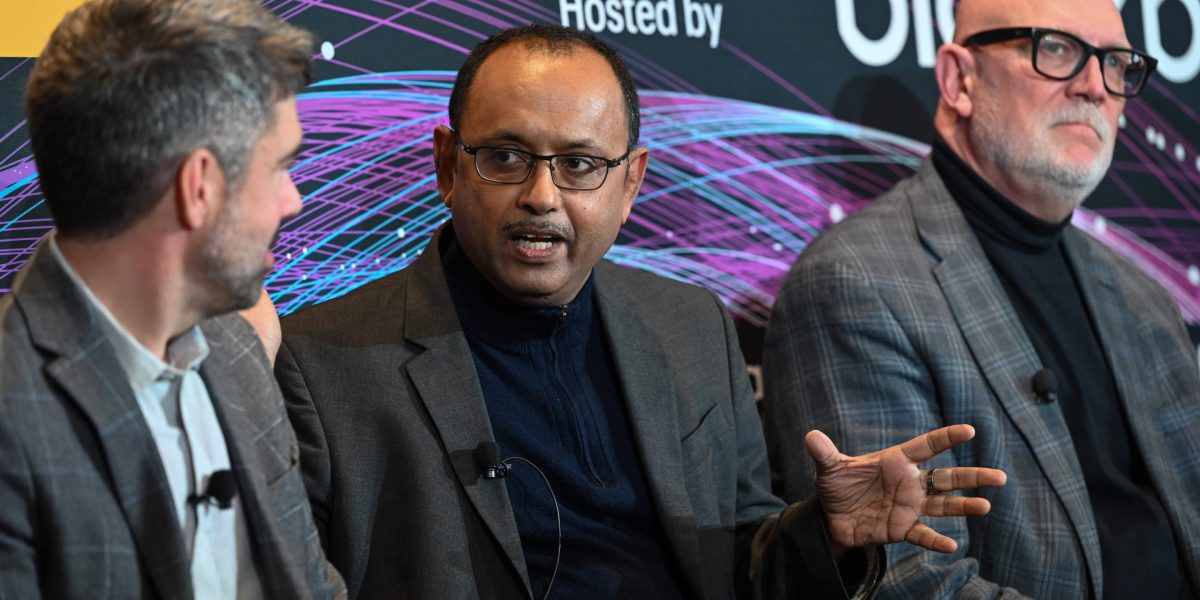
“How many times did the U.S. have the fastest athletes, but ended up losing the 4×100 relay?” Datta asked an expert roundtable audience at Fortune’s Brainstorm AI event in San Francisco this week. “Because the trust was not there, where the runner would blindly take it from someone who is passing the baton.”

Datta said the reflexive reach backward on faith alone is what will separate the winners from the losers in AI adoption. And a major challenge looming in building trust is that a lot of companies today treat trust-building as a compliance burden that slows everything down. The opposite is true, he told the Brainstorm AI audience. 

“Trust is actually a revenue driver,” said Datta. “It’s an enabler because it propels further innovation, because the more customers trust us, we can accelerate on that innovation journey.”

Scott Howe, president and CEO of data collaboration network LiveRamp, outlined five conditions that need to be met in order to build trust. Regulation has done a reasonable job in setting up the first two but “we still have a long way to go” on the remaining three, he said. The five conditions include: Transparency into how your data is going to be used; control over your data; an exchange of value for personal data; data portability; and finally, interoperability. Regulations including the EU’s General Data Protection Regulation (GDPR) have secured some minimal progress but Howe said most people don’t “get nearly fair value for the data we contribute.”

“Instead, really big companies, some of whom are speaking on stage today, have scraped the value and made a ton of money,” said Howe. “And then the last two, as an industry and as businesses, we are nowhere on.”

Owning the data

In Howe’s vision of the future, he sees data being viewed as a property right and people being entitled to fair compensation for its use. 

“The LLMs don’t own my data,” said Howe, referring to large language models. “I should own my data and so I should be able to take it from Amazon to Google, and from Google to Walmart if I want, and it should travel with me,”

However, major tech companies are actively resisting portability and interoperability, which has created data silos that entomb customers in their current ecosystems, said Howe. 

Beyond personal data and potential consumer rights issues, the trust challenge takes on a different shape inside various companies, and each has to decide what their own AI systems can safely access and which tasks can be completed autonomously. 

Spencer Beemiller, innovation officer at software company ServiceNow, said the firm’s customers are trying to determine which AI systems can operate without human oversight, a question that remains largely unanswered. He said ServiceNow helps organizations track their AI agents the same way they’ve historically monitored infrastructure by tracking what the systems are doing, what they have access to, and their lifecycle. 

“We’re trying to get a little bit of a grasp on helping our customers determine what points actually matter to create that autonomous decision making,” Beemiller said. 

Issues like hallucinations, where an AI system will confidently provide made-up or inaccurate information in response to a question, require significant risk mitigation processes, he said. ServiceNow approaches it by using what Beemiller called “orchestration layers,” in which queries are directed to specialized models. Small language models handle enterprise-specific tasks that require more precision, while larger models manage natural conversational items, he said. 

“So it’s a little bit of a ‘Yes, and’ conversation of certain agent components will talk to specific models that are only trained on internal data,” he said. “Others called up from the orchestration layer will abstract to a larger model to be able to answer the problem.”

Still, many fundamental issues remain unresolved, including questions about cybersecurity, critical infrastructure, and the potentially catastrophic consequences that could stem from AI errors. And even more so than in other areas of tech, there’s an inherent tension between moving fast and getting it right.

“If we can win the trust, speed follows,” Datta said. “It’s not about only running fast, but also having trust along the way.”

Read more from Brainstorm AI:

Cursor developed an internal AI help desk that handles 80% of its employees’ support tickets, says the $29 billion startup’s CEO

AI is already taking over managers’ busywork—and it’s forcing companies to reset expectations

OpenAI COO Brad Lightcap says ‘code red’ will force the company to focus, as the ChatGPT maker ramps up enterprise push


Source link

Continue Reading

Business

Stock market rotation out of AI is just getting started, analysts say

Published

on


Investors rushed out of the AI trade this past week and piled into materials, industrials, financials and healthcare, representing a sector rotation that could have staying power, according to Wall Street analysts.

Oracle stock led the latest AI selloff after the hyperscaler’s earnings report and spending guidance renewed fears about excessive capital expenditures.

Jeremy Siegel, Wharton professor emeritus and WisdomTree chief economist, told CNBC on Friday that it’s hard to be certain about the current stock market rotation because there have been “so many head fakes in the past.”

“But as I said, this one has more legs in the sense that there are more things that are happening that throw doubt on how fast or how profitable all the AI buildout is going to be,” he added.

In Oracle’s case, recent delays in data center construction may actually end up being a silver lining if it slows expenditures, but there are still more questions than answers about the profitability of AI, Siegel said.

He noted his research has shown that when companies grow spending faster than their income, they ultimately overexpand, hitting profits and stock returns.

“I’m not saying that that’s necessarily going to happen to AI or certainly all the AI, but that narrative has to come in mind,” Siegel warned.

Also on Friday, Bank of America Securities investment strategist Michael Hartnett said markets are frontrunning a “run-it-hot” scenario expected for next year by rotating into a Main Street trade made up of mid- and small-cap stocks, while getting out of a Wall Street trade consisting of mega-cap names.

Eric Teal, chief investment officer for Comerica Wealth Management, had a similar view in a note on Thursday, saying that the market was dominated by momentum and AI stocks during the first eight months of the year.

But since then, concerns about valuations, margin sustainability, and high debt shifted sentiment around the technology sector.

Financial and healthcare stocks have been more appealing, while small caps and even “micro-cap stocks” will benefit from falling short-term rates, he added.

“More importantly, we foresee this rotation in the early stages with relative valuations remaining attractive,” Teal predicted. 


Source link

Continue Reading

Business

Even in Silicon Valley, skepticism looms over robots, while ‘China has certainly a lot more momentum on humanoids’

Published

on


Robots have long been seen as a bad bet for Silicon Valley investors — too complicated, capital-intensive and “boring, honestly,” says venture capitalist Modar Alaoui.

But the commercial boom in artificial intelligence has lit a spark under long-simmering visions to build humanoid robots that can move their mechanical bodies like humans and do things that people do.

Alaoui, founder of the Humanoids Summit, gathered more than 2,000 people this week, including top robotics engineers from Disney, Google and dozens of startups, to showcase their technology and debate what it will take to accelerate a nascent industry.

Alaoui says many researchers now believe humanoids or some other kind of physical embodiment of AI are “going to become the norm.”

“The question is really just how long it will take,” he said.

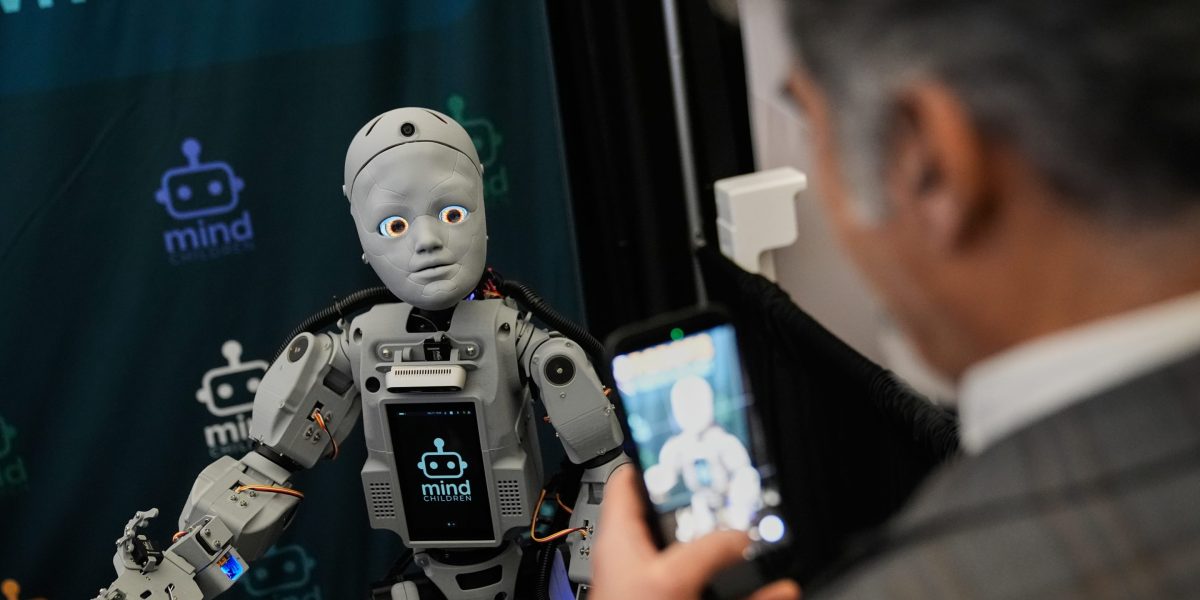
Disney’s contribution to the field, a walking robotic version of “Frozen” character Olaf, will be roaming on its own through Disneyland theme parks in Hong Kong and Paris early next year. Entertaining and highly complex robots that resemble a human — or a snowman — are already here, but the timeline for “general purpose” robots that are a productive member of a workplace or household is farther away.

Even at a conference designed to build enthusiasm for the technology, held at a Computer History Museum that’s a temple to Silicon Valley’s previous breakthroughs, skepticism remained high that truly humanlike robots will take root anytime soon.

“The humanoid space has a very, very big hill to climb,” said Cosima du Pasquier, founder and CEO of Haptica Robotics, which works to give robots a sense of touch. “There’s a lot of research that still needs to be solved.”

The Stanford University postdoctoral researcher came to the conference in Mountain View, California, just a week after incorporating her startup.

“The first customers are really the people here,” she said.

Researchers at the consultancy McKinsey & Company have counted about 50 companies around the world that have raised at least $100 million to develop humanoids, led by about 20 in China and 15 in North America.

China is leading in part due to government incentives for component production and robot adoption and a mandate last year “to have a humanoid ecosystem established by 2025,” said McKinsey partner Ani Kelkar. Displays by Chinese firms dominated the expo section of this week’s summit, held Thursday and Friday. The conference’s most prevalent humanoids were those made by China’s Unitree, in part because researchers in the U.S. buy the relatively cheap model to test their own software.

In the U.S., the advent of generative AI chatbots like OpenAI’s ChatGPT and Google’s Gemini has jolted the decades-old robotics industry in different ways. Investor excitement has poured money into ambitious startups aiming to build hardware that will bring a physical presence to the latest AI.

But it’s not just crossover hype — the same technical advances that made AI chatbots so good at language have played a role in teaching robots how to get better at performing tasks. Paired with computer vision, robots powered by “visual-language” models are trained to learn about their surroundings.

One of the most prominent skeptics is robotics pioneer Rodney Brooks, a co-founder of Roomba vacuum maker iRobot who wrote in September that “today’s humanoid robots will not learn how to be dexterous despite the hundreds of millions, or perhaps many billions of dollars, being donated by VCs and major tech companies to pay for their training.” Brooks didn’t attend but his essay was frequently mentioned.

Also missing was anyone speaking for Tesla CEO Elon Musk’s development of a humanoid called Optimus, a project that the billionaire is designing to be “extremely capable” and sold in high volumes. Musk said three years ago that people can probably buy an Optimus “within three to five years.”

The conference’s organizer, Alaoui, founder and general partner of ALM Ventures, previously worked on driver attention systems for the automotive industry and sees parallels between humanoids and the early years of self-driving cars.

Near the entrance to the summit venue, just blocks from Google’s headquarters, is a museum exhibit showing Google’s bubble-shaped 2014 prototype of a self-driving car. Eleven years later, robotaxis operated by Google affiliate Waymo are constantly plying the streets nearby.

Some robots with human elements are already being tested in workplaces. Oregon-based Agility Robotics announced shortly before the conference that it is bringing its tote-carrying warehouse robot Digit to a Texas distribution facility run by Mercado Libre, the Latin American e-commerce giant. Much like the Olaf robot, it has inverted legs that are more birdlike than human.

Industrial robots performing single tasks are already commonplace in car assembly and other manufacturing. They work with a level of speed and precision that’s difficult for today’s humanoids — or humans themselves — to match.

The head of a robotics trade group founded in 1974 is now lobbying the U.S. government to develop a stronger national strategy to advance the development of homegrown robots, be they humanoids or otherwise.

“We have a lot of strong technology, we have the AI expertise here in the U.S.,” said Jeff Burnstein, president of the Association for Advancing Automation, after touring the expo. “So I think it remains to be seen who is the ultimate leader in this. But right now, China has certainly a lot more momentum on humanoids.”


Source link

Continue Reading

Business

ACA subsidies are about to expire, and Congress still has no consensus solution

Published

on


The Senate failed to get anywhere on the health care issue this week. Now it’s the House’s turn to show what it can do.

Speaker Mike Johnson unveiled a Republican alternative late Friday, a last-minute sprint as his party refuses to extend the enhanced tax subsidies for those who buy policies through the Affordable Care Act, also called Obamacare, which are expiring at the end of the year. Those subsidies help lower the cost of coverage.

Johnson, R-La., huddled behind closed doors in the morning — as he did days earlier this week — working to assemble the package for consideration as the House focuses the final days of its 2025 work on health care.

“House Republicans are tackling the real drivers of health care costs to provide affordable care,” Johnson said in a statement announcing the package. He said it would be voted on next week.

Later Friday, though, House Democratic Leader Hakeem Jeffries said: “House Republicans have introduced toxic legislation that is completely unserious, hurts hardworking America taxpayers and is not designed to secure bipartisan support. If the bill reaches the House floor, I will strongly oppose it.”

Time is running out for Congress to act. Democrats engineered the longest federal government shutdown ever this fall in a failed effort to force Republicans to the negotiating table on health care. But after promising votes, the Senate failed this week to advance both a Republican health care plan and the Democratic-offered bill to extend the tax credits for three years.

Now, with just days to go, Congress is about to wrap up its work with no consensus solution in sight.

What Republicans are proposing

The House Republicans offered a 100-plus-page package that focuses on long-sought GOP proposals to enhance access to employer-sponsored health insurance plans and clamp down on so-called pharmacy benefit managers.

Republicans propose expanding access to what’s referred to as association health plans, which would allow more small businesses and self-employed individuals to band together and purchase health coverage.

Proponents say such plans increase the leverage businesses have to negotiate a lower rate. But critics say the plans provide skimpier coverage than what is required under the Affordable Care Act.

The Republicans’ proposal would also require more data from pharmacy benefit managers, or PBMs, as a way to help control drug costs. Critics say PBMs have padded their bottom line and made it more difficult for independent pharmacists to survive.

Additionally, the GOP plan includes mention of cost-sharing reductions for some lower-income people who rely on Obamacare, but those do not take effect until January 2027.

The emerging package from the House Republicans does not include an extension of an enhanced tax credit for millions of Americans who get insurance coverage through the Affordable Care Act. Put in place during the COVID-19 crisis, that enhanced subsidy expires Dec. 31, leaving most families in the program facing more than double their current out-of-pocket premiums, and in some cases, much more.

What Trump wants

President Donald Trump has said he believes Republicans are going to figure out a better plan than Obamacare — something he has promised for years — but offered few details beyond his idea for providing Americans with stipends to help buy insurance.

“I want to see the billions of dollars go to people, not to the insurance companies,” Trump said late Friday during an event at the White House. “And I want to see the people go out and buy themselves great healthcare.”

The president did not comment directly on the House’s new plan. He has repeatedly touted his idea of sending money directly to Americans to help offset the costs of health care policies, rather than extending the tax credits for those buying policies through Obamacare. It’s unclear how much money Trump envisions. The Senate GOP proposal that failed to advance would have provided payments to new health savings accounts of $1,000 a year for adult enrollees, or $1,500 for those ages 50 to 64.

It appeared there were no such health savings accounts in the new House GOP plan.

Political pressure is building for many

Going Johnson’s route has left vulnerable House Republicans representing key battleground districts in a tough spot.

Frustrated with the delays, a group of more centrist GOP lawmakers is aligning with Democrats to push their own proposals for continuing the tax credits, for now, so that Americans don’t face rising health care costs.

They are pursuing several paths for passing a temporary ACA subsidy extension, co-sponsoring a handful of bills. They are also signing onto so-called discharge petitions that could force a floor vote if a majority of the House signs on.

Such petitions are designed to get around the majority’s control and are rarely successful, but this year has proven to be an exception. Lawmakers, for example, were able to use a discharge petition to force a vote on the release of the Jeffrey Epstein files held by the Department of Justice.

One petition, filed by Rep. Brian Fitzpatrick, R-Pa., had signatures from 12 Republicans and 12 Democrats as of Friday afternoon. It would force a vote on a bill that includes a two-year subsidy extension and contains provisions designed to combat fraud in the ACA marketplace. There are also restrictions for PBMs, among other things.

Another petition from Rep. Josh Gottheimer, D-N.J., has 39 signatures and is broadly bipartisan. It’s a simpler proposal that would force a vote on a one-year ACA enhanced subsidy extension and would include new income caps limiting who qualifies for the enhanced credit.

Both discharge petitions have enough Republicans’ support that they would likely succeed if Jeffries encouraged his caucus to jump on board. So far, he’s not tipping his hand.

“We’re actively reviewing those two discharge petitions and we’ll have more to say about it early next week,” Jeffries said.

Meanwhile, Jeffries is pushing Democrats’ own discharge petition, which has 214 signatures and would provide for a clean three-year subsidy extension. No Republicans have signed onto that one.

And as Republicans made clear in the Senate this week, a three-year extension without changes to the program has no chance of passing their chamber.



Source link

Continue Reading

Trending

Copyright © Miami Select.