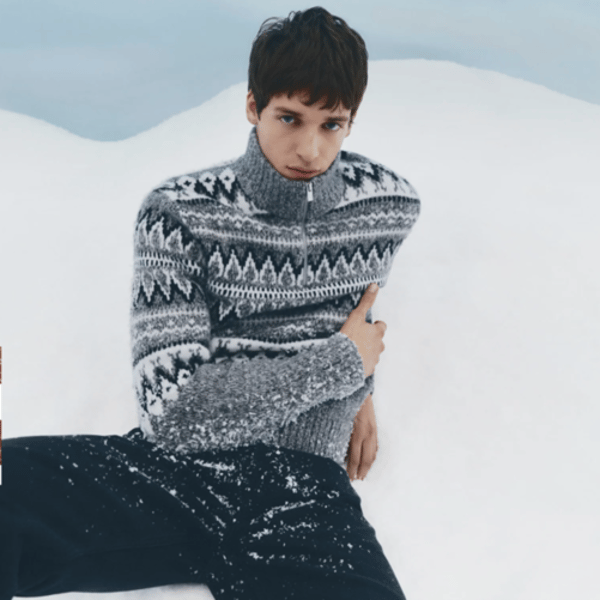
There’s never a bad time to be the main choice as a fashion destination, but M&S has taken top-of-the-tree status this Christmas when it comes to AI gift inspiration. And in the Beauty category, Charlotte Tilbury has been mentioned more than any other cosmetics brand while Decathlon took top spot in the Sports category.
M&S
That’s all down to the ‘AI Christmas Nice List’ compiled by digital marketing and PR agency Tank, revealing which UK retailers AI favours for Christmas gifting by analysing hundreds of ChatGPT responses across 10 retail sectors, awarding a mention score based on how early products are recommended.
And of the top fashion searches, M&S achieved the highest mention score (21) in the category. And that was out of nearly 150 websites.
Following M&S, shoppers are more likely to see fashion picks from Next, Barbour and John Lewis, with mention scores of 20, 17 and 15, respectively.
Next, it has to be noted, also received three more total mentions than M&S, but “these were later in AI’s response and scored lower overall”, the report said.
High ratings for British heritage brand Barbour and John Lewis were helped by their annual Christmas ads bringing in press coverage and social media attention to drive holiday demand, with this year’s ad including Barbour’s retuned link-up with Shaun The Sheep.
Other big name fashion recommendations include Matalan at number five (14 mentions), followed by Sainsbury’s TU Clothing (11 mentions), Longchamp (10), accessories brand Fairfax & Favor and White Stuff (both 8 mentions).
John Lewis also showed up the most overall in ChatGPT, with 31 mentions across eight out of 10 sectors analysed including Home and Food & Drink categories.
Martin Harris, head of digital at Tank, commented on the research: “ChatGPT is used everyday for personal and commercial queries such as Christmas gift ideas, so if fashion brands aren’t appearing for the relevant results, they could be missing out on sales. AI search is important for retailers and while there is hesitancy around it, it is essential brands are discoverable where shoppers are searching for information.
“While some small retailers could struggle with being found in AI during peak seasons like Christmas, it presents an opportunity to improve visibility in their niche. Consumers can also use AI to find niche brands and products. That’s why it’s even more important retailers know what their customers want and have a strategy to appear in the relevant results.”
Pulse-racing experiences have been big this year at many UK retail destinations, but maybe a more sedate set of attractions are needed during the hectic Christmas trading period.
John Lewis Partnership
So John Lewis Partnership has introduced three new hospitality destinations to its stores in response to the continued demand from customers to combine shopping with wider experiences. The department store retailer has opted for relaxation and refuelling. A wise choice given that JLP noted hospitality-related sales are up almost 10% over the past year.
New additions include a 250 sq ft Champagne Bar that has opened in the atrium of Peter Jones, Sloane Square; and a European first with Warabi-Mochi Kamakura (a premium Japanese brand specialising in matcha and warabi mochi, a traditional Japanese confection), officially open at John Lewis Oxford Street
Building on its success in other stores, John Lewis Southampton has also opened a new Ori Caffe, the 11th across the John Lewis portfolio.
Katie Papakonstantinou, director of Services & Hospitality for John Lewis said: “We’re continually looking for ways to enhance the John Lewis experience, and [these additions are] a direct response to our customers’ growing desire to combine shopping with unique and enjoyable experiences.”
“Our growth in hospitality sales over the past year is a clear sign that this strategy is resonating, and these exciting new concepts are central to our commitment to making our stores a true destination – for the festive season and beyond.”
She added: “This investment in hospitality is a key component of the broader John Lewis store transformation plan which has just seen the John Lewis Bluewater complete a nearly £10 million refurbishment, as well as investments into Beauty Halls across the Liverpool, Solihull, Welwyn, and Cambridge stores.”
Boucheron is poised to open its first flagship boutique in China, in Shanghai’s Xintiandi district, following its iconic addresses at 26 Place Vendôme in Paris and in Ginza, Tokyo. This third flagship worldwide marks a major step in the maison’s international expansion and forms part of the growth strategy in Asia led by Hélène Poulit-Duquesne, Boucheron’s CEO since 2015.
Boucheron boutique in Shanghai – DR
Founded in 1858 by Frédéric Boucheron, the maison grew through four generations of his direct descendants and has established itself as a leading name in jewellery, high jewellery, and watchmaking. The first jewellery house to open a boutique on Place Vendôme, Boucheron is now part of the Kering luxury group and operates over 90 boutiques worldwide.
The new Shanghai address occupies a historic 19th-century shikumen building in the heart of the Xintiandi district. The 278 square-metre interior is organised around distinct worlds: a winter garden inspired by 19th-century European greenhouses, a Chinese forest installed in the central display cases by artist Xiaojing Yan, and a bridal suite inspired by Yu Garden, a famous Shanghai landmark.
A staircase connects the interior spaces to the VIP lounges, blending the symbolic colours of the maison and of China, and showcasing works by Jonathan Bréchignac. The VIP lounges retain the original shikumen architecture with exposed beams and brickwork, and present works by Peng Yong alongside de Gournay wallpaper motifs inspired by historic Chinese landscapes.
The boutique also features a space dedicated to Asian expertise and archival pieces, offering clients an insight into the history of Boucheron’s ties with China. The flow within the boutique is designed according to Feng Shui principles to optimise the client journey and experience, integrating wood panelling, marble, and French-style furnishings, in keeping with the maison’s DNA.
This opening forms part of Boucheron’s strategy to strengthen its presence in China, where the maison already has 17 boutiques on the mainland, and to marry French heritage with local cultural elements to offer Asian clients a comprehensive retail and heritage experience.
This article is an automatic translation. Click here to read the original article.
According to the CGT Champagne inter-union, employees in LVMH‘s Champagne division in France are mobilising against the scrapping of a profit-sharing bonus “which has existed since 1967.”
Shutterstock
“The mobilisation is due to the withdrawal this year of profit-sharing at Moët & Chandon. It has been in place since 1967, and this is a first. Employees have also been informed of the cancellation of the value-sharing bonus, on the grounds that the group generated slightly lower profits,” said José Blanco, general secretary of the CGT Champagne inter-union, to AFP on Friday.
Following strikes on December 5 and 8, a rally was held on Thursday outside Moët & Chandon’s head office.
“This strike took place on Thursday in Épernay, outside Moët & Chandon’s head office, with all the group’s Champagne houses: Veuve Clicquot, Krug, Moët & Chandon… and support from other Champagne houses. Around 600 people were present,” said Blanco.
“Originally, it wasn’t supposed to be a demonstration, but an information meeting organised within Moët & Chandon. In the end, the employees gathered on Avenue de Champagne and blocked it,” explained Mr Blanco.
Further actions are being considered, but no date has yet been set. Contacted by AFP, LVMH did not comment.
LVMH’s Wines & Spirits division, which includes Champagnes (Moët & Chandon, Krug, Ruinart…) as well as wines (Château Cheval Blanc, Château d’Yquem, Château d’Esclans…), and Hennessy cognac and Glenmorangie whisky, saw a sharp decline in 2024, with revenue down 11% year-on-year to €5.9 billion.
Over the first nine months of 2025, the division’s revenue fell a further 7%, notably due to customs duties. However, the group estimated that sales returned to growth (at constant exchange rates) in the third quarter, “with an improvement in Champagne, good growth in rosé wines and still weak demand in cognac.”
According to HSBC analysts, Champagne and wine sales accounted for 4% of LVMH’s €84.7 billion revenue in 2024, and cognac and spirits sales for 3%. The bank forecasts an 11% drop in Champagne and wine sales in the fourth quarter of 2025.
The division, which announced in the spring plans to reduce its workforce, has been headed since February by the group’s former chief financial officer, Jean-Jacques Guiony, assisted by Alexandre Arnault, son of billionaire and LVMH CEO Bernard Arnault.
This article is an automatic translation. Click here to read the original article.