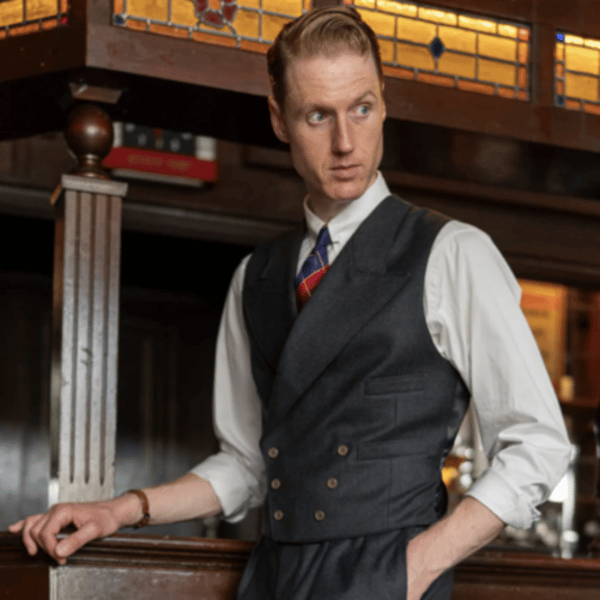
Cathcart London is set to bring British heritage menswear to the world stage next month, making its Pitti Uomo debut in Florence.
Cathcart London
Its appearance will be a “significant step in international expansion” for the 11-year-old family business, as the brand unveils its AW26 collection to international press and buyers across 13-16 January.
Director James Cathcart said: “Exhibiting at Pitti Uomo for the first time is a pivotal step for the brand and the market equally. Our goal has always been to excite, offering rare designs with honesty and integrity. Pitti is the ideal stage to present our classic British style to a new global audience.”
The AW26 collection will showcase eight distinct styles of tailored suit jackets all crafted from pure wool including flannel, worsted multi-stripe, and herringbone, headlined by the popular King Cole Double Breasted Jacket.
These are complemented by six styles of matching pure wool trousers, arriving in wide, classic and narrow heritage cuts. The collection is completed by double breasted and single breasted waistcoats, offered in four versatile colourways.
It also features six distinct knitwear styles, including the return of Fair Isle Jumper, Jazz Jumper and other original vintage inspired knits hand produced in England.
The workwear collection sees the return of the Deck Jacket and Battle Trousers, both made from 100% cotton corduroy, “offering a balance of sophisticated tailoring and versatile daily utility for the modern man”.
The outerwear range completes the collection, featuring three classic British heritage coat styles. These include a new Herringbone Ulster Coat crafted from luxury herringbone wool woven in Yorkshire, alongside returning favourites, the Polo Coat and the Mackinaw.
Italian luxury ready-to-wear and knitwear label Fabiana Filippi, founded in 1985, has made a major change to its shareholding structure. The family of Giacomo Filippi Coccetta, Fabiana Filippi’s co-founder and president, has sold its entire stake in the label to Ventisettetredici S.r.l., a company owned by the family of Giacomo’s brother Mario, the label’s CEO and co-founder.
Mario Filippi Coccetta – Fabiana Filippi
“The operation is part of the company’s evolution process. The company’s strategic and operational activities will continue to develop in line with the current business plan,” said Fabiana Filippi in a press release, adding that “the decision is the result of a shared evaluation and a desire to ensure greater stability to the ownership structure in the medium to long term.”
In the press release, Mario Filippi Coccetta thanked Giacomo’s family for their contribution to the company’s growth and for helping strengthen its competitive position. Fabiana Filippi is determined to continue to invest in its DNA and to consolidate its distinctive identity, with an emphasis on product quality and manufacturing excellence, the company added.
Fabiana Filippi, founded in Giano dell’Umbria, near Perugia, is distributed via some 700 stores in over 60 countries, and operates monobrand stores in fashion capitals like Milan, London and Paris. In 1990, Fabiana Filippi started to manufacture its branded knitwear. Ready-to-wear was added in 2000, and later accessories. According to financial press sources, Fabiana Filippi S.p.A.’s revenue in 2024, the latest available figure, was approximately €53.6 million, down 26.75% from the approximately €73.2 million recorded in 2023. In 2024, the company recorded a loss of approximately €5 million.
The label is named after Fabiana, the daughter of Giacomo and Donatella Filippi Coccetta (the latter was until now in charge of product development). In September, Fabiana, 40, left the family business to enter the beauty sector, founding luxury skincare brand F2O.
All aboard for Italian luxury! From September 8 to 18, 2027, a Ponant Explorations cruise celebrating Italian luxury will bring together travellers, artisans, and several Italian houses from Livorno to Venice. The voyage will take place aboard Le Boréal, calling at Florence, the island of Elba, Taormina, Sorrento, and the Venetian lagoon.
The cruise will take in all of Italy (except Sicily), from Livorno to Venice. – Ponant Explorations
Built around artisanal craftsmanship, the cruise will be based on a collaboration between Ponant Explorations (part of Artémis, owned by the Pinault family) and five Kering group houses: Gucci, Bottega Veneta, Brioni, Pomellato, and Ginori 1735. Participants will discover their heritage treasures through workshop visits, demonstrations and conversations with professionals, with prices starting at €11,930 per person.
Stopovers in Florence and Venice
In Florence, Kering’s flagship label Gucci will open its archives, as well as Palazzo Gucci, to travellers. There, they will discover pieces tracing the house’s history and its relationship with travel. On board, an exhibition will extend this immersion in the brand’s world, presenting various objects and documents.
Five Italian luxury houses are taking part in the cruise – Gucci
Along Venice’s canals, Bottega Veneta will offer guests the chance to observe the crafting of leather goods and its Intrecciato weave. Visitors will follow an itinerary linking several locations tied to the house’s history, and take part in a discussion in a Venetian palazzo, where the essential steps in designing an accessory will be explained.
Garment construction and gemstone selection
Brioni will showcase the work of the master tailor by demonstrating the construction of a garment, from fabric selection through to assembling the pieces. The aim of this session is to reveal the rationale behind each movement and the various decisions involved in creating a garment.
Pomellato will give participants a lesson on stone selection – Pomellato
Pomellato will focus on gemstone selection. The jeweller will guide participants through the evaluation criteria and the interplay between colours, volumes and settings. Travellers will be able to follow how a piece is defined before it is made.
Discover Italy as few know it
Ginori 1735 will open the doors of its Florentine manufactory, where visitors can watch porcelain being crafted, from shaping to decoration. A demonstration will show the painting techniques used by the house’s artisans, followed by an introductory workshop. A pop-up café devoted to the house’s universe will round out the experience.
Brioni will demonstrate the work of a master tailor – Brioni
Stopovers in northern and southern Italy will offer visits to cities, historic sites, and wine estates. Travellers can explore the island of Elba, Otranto, or Taormina, discover museums, or stroll through historic centres. The aim is to link these places to the themes of the voyage: craftsmanship, place, traditions, and creativity.
As with any cruise, food matters: the cuisine on board will be inspired by the regions on the itinerary and will accompany the stages of the journey without any pursuit of spectacle. Optional pre- or post-cruise programmes will also offer discoveries around Florence, Chianti or Verona, to suit individual interests.
And the Pinault family’s aim is clearly to generate a potential new dynamic among its various assets.
This article is an automatic translation. Click here to read the original article.
Beware the march of the robots! The majority of routine retail tasks are set to be replaced by artificial intelligence (AI) by 2035, according to new data.
Artificial intelligence will have a huge impact on the retail sector – Photo: Pixabay
Nearly 60% of retail tasks across core functions could be augmented or automated by AI, according to a new report from law firm Eversheds Sutherland and research agency Retail Economics, seen by CityAM.
The report noted that UK retailers are set to spend a third of their budgets on AI-aligned tech next year to help allay concerns over rising costs, with 69% expecting to increase investment within two years.
While “the speed of this shift sets the UK among the most advanced global markets”, the report also warns that progress is “increasingly vulnerable to longstanding operational barriers”.
Andrew Todd, partner at Eversheds Sutherland, said: “AI will primarily handle routine and data-driven tasks, leaving more able to focus on strategy, creativity, judgement and customer engagement”.
Todd predicts that new specialist positions will emerge in the sector, while traditional roles “evolve” in the AI-influenced environment.
The report claims a host of analysts and pundits have predicted a rapid shift in working patterns. McKinsey, for example, has outlined “a partnership between people, agents, and robots”.
And the march towards A1 is already in high gear, as it highlights McKinsey’s claim that the number of adverts for jobs vulnerable to AI’s impact is down 38% compared to three years ago.
Richard Lim, CEO at Retail Economics, added that the next decade will “see a profound shift in how work is carried out across [retail].”
“Disruption will happen in waves as retailers test, learn and iterative generative and agentic AI technologies,” he added.