Italian ready-to-wear producer Swinger International (Swinger) is in trouble. The company, based in Bussolengo, near Verona, has been producing jeans and ready-to-wear for major fashion labels since the early 1970s, and is now about to lay off almost half of its workforce.
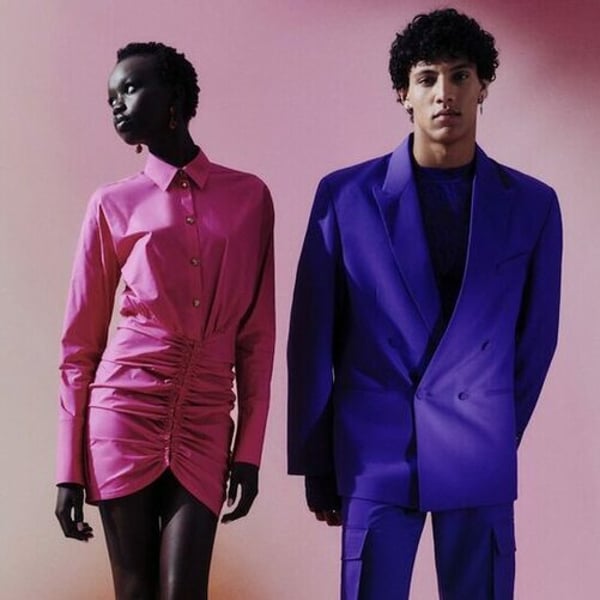
Spring/Summer 2025 Versace Jeans Couture looks, produced by Swinger International
It will be a very bitter Christmas for Swinger’s employees. Only two weeks after entering an eight-month temporary redundancy procedure relating to its entire workforce, on November 25 the company applied for collective redundancy for 70 of its 148 employees, as reported by local newspaper L’Arena.
The business outlook for Swinger worsened dramatically in the last few months, after the company lost Versace as a client. The Italian luxury label, whose acquisition Prada formally completed last week, single-handedly generated about 80% of Swinger’s revenue, according to union sources. The same sources said that Prada is expected to relocate the manufacturing of Versace products outside Europe.
Contacted by FashionNetwork.com, Swinger declined to comment or make a statement. It said however that the company owners’ reactions to this serious state of affairs will be made known in the coming days.
It is a real shame that Swinger is in such dire straits. From its inception in the 1970s as a small artisanal producer of jeans and later ready-to-wear, Swinger scaled up its business over the decades, securing the licenses of global labels like Roberto Cavalli, Vivienne Westwood, Missoni and Fendi, notably producing ready-to-wear targeted to younger consumers. From the nearly €100 million revenue recorded in 2020, Swinger grew to over €175 million in 2023. In 2011, Swinger had acquired womenswear brand Genny, still part of its portfolio, naming Sara Cavazza Facchini as creative director.
The first union consultation to handle the collective redundancy procedure took place at the offices of Confindustria Verona on Tuesday. Italian labour regulations state that the company owners and employee representatives have 45 days to reach an agreement, plus an additional 30 days during which the Veneto regional authority can be involved in a mediator role. L’Arena newspaper has reported that negotiations have so far been unsuccessful.
On Tuesday December 9, the Filctem-CGIL union refused to sign off on a deal. According to L’Arena, the union’s representatives said that “their requests, including among other provisions a safeguarding clause relating to when the redundancies would start, have not been taken on board.” Moreover, the union said that “the conditions set by the company are absolutely unacceptable, starting with a wholly inadequate resignation bonus.” Filctem-CGIL also said that it will assist individual employees if mandated by them.
Swinger’s current difficulties are said to have started in May, when the company applied for a redundancy procedure for 171 employees, owing to a shortfall in production orders, but things came to a head in late summer, even after 23 workers resigned.
Private equity firm TPG Inc. is considering options for APM Monaco, including a possible stake sale or an initial public offering of the jeweler, according to people familiar with the matter.
APM Monaco
TPG is working with an adviser and may start a dual-track process early next year, the people said, asking not to be identified discussing private information. The US investment firm is aiming to fetch a valuation of at least $2 billion for the company in a deal, one of the people said.
Deliberations are preliminary and TPG might decide to keep the asset for longer, the people added.
A representative for TPG declined to comment.
A TPG-led consortium acquired a 30% stake in APM Monaco in 2019, and in 2021 documents were submitted for a Hong Kong IPO that never materialized. The following year, the group started sounding out potential interest in its stake, Bloomberg News reported, though TPG said at the time it didn’t plan to sell.
European private equity firm Trail and China Synergy, an investment firm backed by TPG and China international Capital Corp., were also part of the investor group that bought the stake in APM Monaco six years ago.
TPG had $286 billion in assets under management as of the end of September. The US buyout firm invested in APM Monaco through its Asia-focused private equity platform.
APM operates about 500 jewelry stores globally, according to its website.
Caleres on Tuesday reported a 6.6% uptick in sales to $790.1 million for the third quarter, on the back double-digit growth in the American footwear firm’s brand portfolio.
Caleres
The St. Louis-based company said brand portfolio segment sales surged 18.8%, thanks to the recently acquired Stuart Weitzman brand. Without the acquisition, which was announced in February, sales increased just 4.6% on last year.
Elsewhere, Famous Footwear sales decreased 2.2%, with comparable sales down 1.2% for the three months ending November 1.
During the quarter, net earnings fell to $2.4 million, or earnings per diluted share of $0.07, compared to net earnings of $41.4 million or earnings per diluted share of $1.19 in the prior-year period.
“Caleres delivered third quarter sales results that were ahead of our internal expectations, highlighted by organic sales growth in our brand portfolio segment, strong lead brands performance, sequential improvement in trends at Famous Footwear, and accelerated e-commerce momentum in both segments of our business,” said Jay Schmidt, president and chief executive officer at Caleres.
“With the recent addition of Stuart Weitzman, our brand portfolio now drives nearly half our sales and more than half our operating earnings. As we expected, we experienced pressure on our earnings from tariffs and near-term acquisition dilution, however, the fundamentals of our business are improving.”
Caleres acquired footwear brand Stuart Weitzman from luxury heavyweight Tapestry in February for just $105 million. The cash deal was completed this summer.
Groupe Dynamite on Tuesday posted strong third-quarter results, reporting double-digit sales growth and increasing its full-year guidance.
Groupe Dynamite lifts 2025 outlook after Q3 revenue surge. – Dynamite
Revenue for the quarter rose 40.3% to $363.0 million from $258.8 million a year earlier, driven by a 31.6% increase in comparable store sales and contributions from new locations. Online revenue grew 43.3% to $63.2 million.
The Canadian fashion retailer behind the Dynamite and Garage brands posted net earnings of $41.1 million, up 101.7% from a year earlier, with diluted earnings per share rising to $0.71 from $0.38.
Operating income surged 90.3% to $120.1 million, while adjusted EBITDA rose 67.5% to $146.1 million.
“Our teams once again demonstrated the strength of our values-led culture. What we delivered this quarter across product, stores, and digital reflects the intention, discipline, and agility that continue to set us apart. We’re well into our journey to elevate and premiumize both brands, and the customer response remains strong,” said Stacie Beaver, president and chief operating officer.
“Operationally, our real estate strategy continues to be a core pillar, with 17 gross openings year-to-date positioning us for sustained, high-quality traffic. On digital, we’re encouraged by the 40 basis points increase in e-commerce penetration in Q3 2025, as we enhance our platforms to support richer storytelling and more seamless experiences. With a solid foundation, real momentum, and teams who move fast and stay aligned, we enter Q4 confident in our ability to raise performance, strengthen brand experiences, and deepen our community connections.”
Looking ahead, the company increased its fiscal 2025 outlook and now expects comparable store sales growth of 25.5% to 27.5%, up from 17% to 19%.
The company said its outlook remains subject to risks, including tariffs, real estate delays, weather disruptions, changes in consumer demand and IT or supply chain issues.