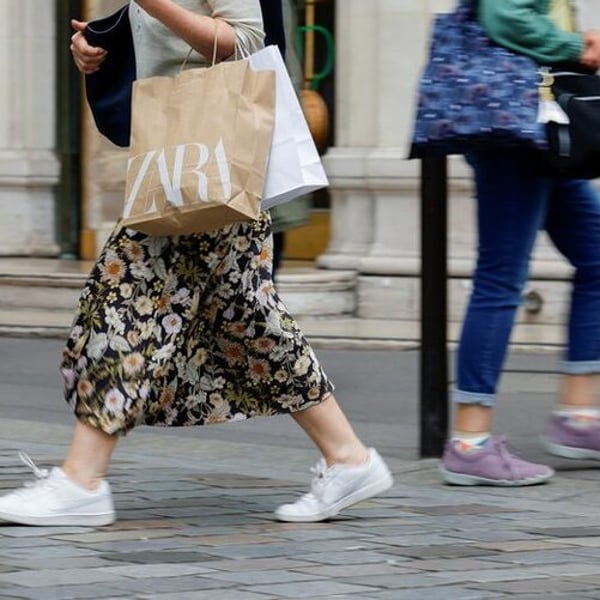
Two key monthly spending reports came out on Tuesday morning and showed that, as other reports have suggested, that November retail sales and general spending were pretty unimpressive.
Reuters
It’s worth noting that different reports use different criteria to reach their figures so there will be variations.
Barclays said card spending saw its greatest fall since 2021 last month, as consumer confidence remained subdued.
Non-essential spend fell for the first time since July 2024, although Black Friday still managed to give retailers their busiest day of 2025.
So let’s look at the numbers. Consumer card spending (which takes in all types of spending, such as dining out and entertainment, as well as retail) was down 1.1% year on year. It was considerably lower than the latest CPIH inflation rate of 3.8%. The biggest drop was seen in essential spending, which was down 2.9% but non-essential spending fell only 0.3%.
Specific card spending at retail dipped 1.1% and transaction growth was negative to the tune of 2.3%, but on Black Friday transaction volumes rose 62.5% compared to the average day this year.
Of the sectors that came out on top, pharmacy, health & beauty spending grew 6.1% in November, continuing its strong streak as far as spend growth was concerned, although transaction growth was negative at 2.4%.
Clothing store spend was up 1.3% with transaction growth of 3.6%. Department stores had a tough time with spend down 8.2% and transaction growth down 6.4%.
Meanwhile, the BRC-KPMG Retail Sales Monitor, said UK total retail sales increased by 1.4% year on year in November, against a decline of 3.3% in November 2024. This was below the 12-month average growth of 2.5%.
Non-food sales increased by 0.1% year on year, against a decline of 7.9% in November 2024. In-store non-food sales decreased by 0.3%, after a fall of 6.2% in November 2024 and online non-food sales increased by 0.5% year on year, against a drop of 10.3% a year ago.
Both fashion and footwear dipped slightly during the month, according to the BRC. This goes against the Barclays view that clothing sales rose slightly. But in both cases, the fact is that fashion stores went the extra mile to drive sales and didn’t seem to be that successful.
Helen Dickinson, chief executive of the British Retail Consortium, said: “Pre-Budget jitters among shoppers meant the month of Black Friday did not deliver as strongly as retailers had hoped or the economy needed. Sales growth was the weakest in six months, despite the elevated inflation. Not unexpectedly, online dominated, with the proportion of non-food bought online reaching its highest level since 2022. Many consumers took advantage of promotions, with homeware and upholstery selling well ahead of festive hosting. Fashion lagged, especially with the mild first half of November dampening demand for winterwear.”
Spanish fashion brand Adolfo Domínguez continues to expand into new markets. Having recently entered countries such as Argentina and Lebanon, Adolfo Domínguez now makes its debut in Georgia with the opening of a new outlet store in the capital.
Interior of the brand’s new outlet boutique in Tbilisi – Adolfo Domínguez
Located on Gamarjveba Street in Tbilisi, the store has been designed in line with the brand’s classic concept, featuring a sophisticated, minimalist aesthetic. It offers a wide selection from Adolfo Domínguez’s womenswear collections and accessories at reduced prices.
With this opening, the Galician brand strengthens its presence across Eastern Europe and Western Asia, following the launch of two points of sale in Beirut last September. The brand has also expanded this year into international markets such as Argentina and Andorra, opening two standalone stores as part of its global expansion strategy.
At the close of its most recent financial year, the company operated a global retail network of 371 points of sale across 51 countries, and was also present in 31 markets through its e-commerce platform.
Founded in the 1970s by designer Adolfo Domínguez and chaired since 2020 by businesswoman Adriana Domínguez, the company reported revenues of €24.1 million in the first quarter of the current financial year, driven particularly by strong international sales.
This article is an automatic translation. Click here to read the original article.
On Tuesday, a board member for French-Italian eyewear/optics giant EssilorLuxottica said that Meta holds a stake of at least 3% in the group, owner among others of the Ray-Ban brand, with which Meta is collaborating.
The Ray-Ban and Meta logos featured at the EssilorLuxottica stand at the VivaTech trade show in Paris – (Reuters – Benoit Tessier)
The fact that Meta has a stake in EssilorLuxottica had been reported by several sources in the past, but it hadn’t until now been confirmed by either group. Meta and EssilorLuxottica are collaborating closely on the Ray-Ban Meta connected glasses.
José Gonzalo, executive director of French public investment bank Bpifrance and a member of the EssilorLuxottica board, said that the Meta stake could grow. “[Meta] holds at least 3% [of EssilorLuxottica],” said Gonzalo, adding that the figure could possibly rise up to 5%, though it is more likely it will be closer to the bottom end of the 3-5% range. “Nothing is stopping [Meta] from growing [its stake],” said Gonzalo.
Contacted by Reuters, Meta declined to comment for the time being, while EssilorLuxottica was not available for comments.
Gonzalo also said that Meta isn’t currently seeking to sit on EssilorLuxottica’s board. “They aren’t on the board, and haven’t asked to be represented on it,” he stated.
(Reporting by Mathieu Rosemain, with Elisa Anzolin and Tassilo Hummel; French version by Coralie Lamarque, edited by Kate Entringer)
Italian luxury ready-to-wear and knitwear label Fabiana Filippi, founded in 1985, has made a major change to its shareholding structure. The family of Giacomo Filippi Coccetta, Fabiana Filippi’s co-founder and president, has sold its entire stake in the label to Ventisettetredici S.r.l., a company owned by the family of Giacomo’s brother Mario, the label’s CEO and co-founder.
Mario Filippi Coccetta – Fabiana Filippi
“The operation is part of the company’s evolution process. The company’s strategic and operational activities will continue to develop in line with the current business plan,” said Fabiana Filippi in a press release, adding that “the decision is the result of a shared evaluation and a desire to ensure greater stability to the ownership structure in the medium to long term.”
In the press release, Mario Filippi Coccetta thanked Giacomo’s family for their contribution to the company’s growth and for helping strengthen its competitive position. Fabiana Filippi is determined to continue to invest in its DNA and to consolidate its distinctive identity, with an emphasis on product quality and manufacturing excellence, the company added.
Fabiana Filippi, founded in Giano dell’Umbria, near Perugia, is distributed via some 700 stores in over 60 countries, and operates monobrand stores in fashion capitals like Milan, London and Paris. In 1990, Fabiana Filippi started to manufacture its branded knitwear. Ready-to-wear was added in 2000, and later accessories. According to financial press sources, Fabiana Filippi S.p.A.’s revenue in 2024, the latest available figure, was approximately €53.6 million, down 26.75% from the approximately €73.2 million recorded in 2023. In 2024, the company recorded a loss of approximately €5 million.
The label is named after Fabiana, the daughter of Giacomo and Donatella Filippi Coccetta (the latter was until now in charge of product development). In September, Fabiana, 40, left the family business to enter the beauty sector, founding luxury skincare brand F2O.