Connect with us

Fashion

Tornatore immortalises Brunello Cucinelli on film
Published

on


Published


December 9, 2025

A wealth of emotion and enchantment marked the world premiere of the documentary film “Brunello, il Visionario Garbato”, directed by Oscar winner Giuseppe Tornatore with a score by fellow Oscar winner Nicola Piovani, presented in Rome on December 4 in the magical setting of Cinecittà.

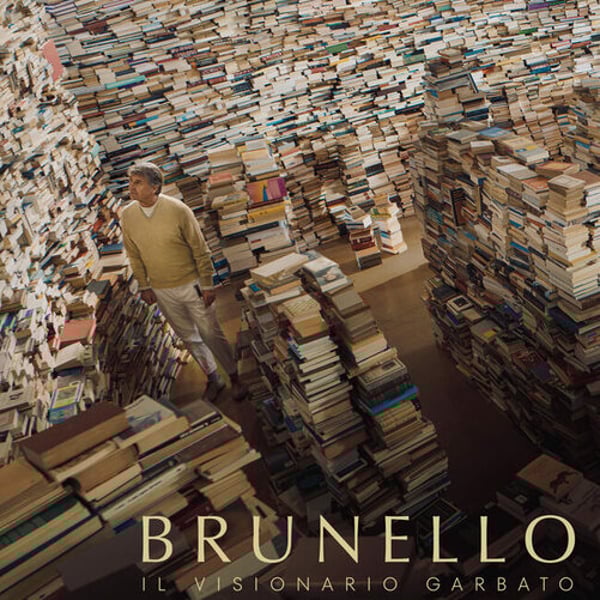
The poster for the film about Brunello Cucinelli directed by Giuseppe Tornatore

Blending documentary and fiction, the film retraces the places and key moments in the Umbrian entrepreneur’s life journey, from his childhood in the countryside to the village of Solomeo, transformed into the emblem of a distinctive humanistic capitalism. Testimonies, archival footage and personal recollections reveal a man who, from humble beginnings, built a company and an internationally renowned name while always holding fast to the values he cherishes—above all, fairness, dignity and social justice.

“When I was a child we lived in an isolated cottage. Next to us were my uncles, cousins and grandparents, a total of 13 people, all sharecroppers. We had no running water, electricity, heating or even a bathroom, and the farm work was hard. We worked hard and in the evenings, although worn out with fatigue, there was no shortage of smiles and conversation when we gathered for dinner. We children made up games out of nothing and had great fun in our simplicity. I loved being immersed in nature, among the animals, and in the evening I never tired, then as now, of spending hours admiring the stars,” recalled a moved Cucinelli.

Francesco Cannevalle plays child Brunello

“My father taught me from an early age the importance of precision and beauty. When I helped him plough the fields, driving the oxen, he would say, ‘The furrows must be straight, Brunello.’ ‘Why, Dad?’ I would ask. ‘Because straight furrows are beautiful.’ Life in those days, though poor, was happy, healthy, orderly, characterised by strong brotherhood and harmony with the rhythms of nature. And there was faith, of course—indispensable.”

The film, which opens in Italian cinemas between December 9 and 11, goes on to recount the move to Ferro di Cavallo in the 1960s, where Brunello’s father found a job with a steady paycheque as a factory worker, hoping to offer a better life to his family. The arrival in the city is a culture shock: with so many more comforts, Brunello misses the silence; the television seems almost to quash family conversation; and schoolmates mock him because he is a “farm boy”. Then, one evening, overhearing a conversation between his parents, he discovers that his father is unhappy because he is “humiliated in the factory where he is treated like a beast, like a slave”—a pivotal moment for the protagonist. Brunello says to himself, “I do not know what I will do in life, but I would like to try to work and live for human dignity.”

A promise the entrepreneur has certainly kept. A thirst for truth and justice, a desire to do well and to do good, translated into concrete actions in his work, and also drove him to conceive a film about his life.

Nicola Piovani, Brunello Cucinelli, Giuseppe Tornatore

“I’ve seen so many docu-films made after the protagonist’s death and, in my opinion, the protagonist himself must be turning in his grave. I wanted people to have a record of my actions, to hear the facts told in my own voice, while I am alive, for the sake of truth, not for glory. Considering that the film of my life is ‘Nuovo Cinema Paradiso’, who else could I have contacted but Giuseppe Tornatore? So I called him and managed to convince him. And then we thought of Nicola Piovani, for what has become a wonderful, perfectly judged score. They are two masters and also two poets—for me, poets are humanity’s first great figures—and they managed to enter my soul,” Cucinelli explained. “It took us three years to complete the project: filming was spread over two years and one more was devoted to editing. We sought to invest in the great ideals we believe in: family, spirituality, religion, combining them with wisdom, equality and concord, which are for me the great pillars of a decent person.”

Tornatore, who knew little of Cucinelli’s life before embarking on this cinematic adventure with him, said he was gradually drawn in by his stories. The key spark for the Sicilian director was Brunello’s relationship with card games, his great passion since childhood, nurtured in his teenage years and early adulthood, particularly at the bar with friends. A pastime, mind you, not an end in itself nor mere gambling, but one that attained the dignity of a mental exercise, based on logic and strategy, which would later serve him well in business.

“I came up with this idea of telling it all as if it were a card game; it was the spark that led me to say that we could try to shoot,” Tornatore explained.

And he jokes about his protagonist who, although he wanted a film made in his lifetime, actually “was exemplary, because he behaved as if he were dead! He never, in fact, meddled; he did not ask me to remove or add even a single frame. I thank Brunello for allowing me to enter his story and tell it in my own way.”

Brunello Cucinelli
Brunello Cucinelli

Tornatore begins with Brunello’s childhood, portrayed by Francesco Cannevale and Francesco Ferrone, then moves into his youth with Saul Nanni—the only professional actor on a set composed mostly of ordinary people—alongside Brunello himself, who interacts with his own life as though a spectator. There are also contributions from the family in the form of interviews: his wife Federica, his first love and muse; his daughters, Camilla and Carolina; and friends—from those who are not famous to Hollywood superstars such as Patrick Dempsey and Oprah Winfrey—who recount anecdotes and share reflections about him. The film revisits his early entrepreneurial successes, the creation of the company, its growing achievements, and all his work for the benefit of employees and, more generally, the community.

Brunello Cucinelli and family at the premiere of the film in Rome.

Cucinelli is filmed in the places dearest and most emblematic to him: the old rural family home, the countryside around Perugia and Solomeo, his “place of the soul”, the village that pulses at the heart of his life and work. It was there that the woman who would become his wife lived, and among those alleyways and half-ruined walls that the young Brunello conceived the winning venture centred on cashmere and dreamed of restoring the village, the church and the castle—the latter so that it could one day become the headquarters of his company. A dream that became reality thanks to unstoppable determination and undisputed creative genius, but also thanks to Providence. Brunello never forgets his faith, the prayers of the community and his spiritual mentor, Don Alberto, who have always accompanied and supported him.

Tornatore has managed, with his trademark mastery, to fuse moments of powerful pathos with ironic, sardonic and even irreverent elements (some scenes at Bar Gigino or at the Munich trade fair are hilarious), lending the character greater dimensionality and warmth.

Cinecittà
Cinecittà

Nothing was, of course, left to chance. Nor the spectacular Ancient Rome set at Cinecittà chosen by Cucinelli, after the film’s screening inside the Nuovo Teatro 22 (Europe’s largest studio, ed.), to host his guests, including FashionNetwork, at an unforgettable gala dinner.

A long walkway among the ‘ancient ruins’, illuminated by candles and quotations from philosophers dear to Brunello (“Beauty is the splendour of Truth,” Plato; “The language of truth is simple,” Socrates; “Live according to nature,” Marcus Aurelius) led us inside the Basilica Aemilia, where the walls had been decorated with some 130,000 volumes, a nod to the film poster and to the Umbrian entrepreneur’s love of knowledge, philosophy and literature, particularly Greek and Latin.

Brunello Cucinelli certainly did not need a film to become an enduring star in the human and entrepreneurial firmament of our time, but this Tornatore masterpiece will surely also consecrate him to eternal cinematic memory.

This article is an automatic translation.
Click here to read the original article.

Copyright © 2025 FashionNetwork.com All rights reserved.


Source link

Continue Reading

Fashion

CEO Mario Filippi Coccetta grows stake in luxury knitwear label Fabiana Filippi to 100%

Published

on


Translated by

Nicola Mira

Published


December 10, 2025

Italian luxury ready-to-wear and knitwear label Fabiana Filippi, founded in 1985, has made a major change to its shareholding structure. The family of Giacomo Filippi Coccetta, Fabiana Filippi’s co-founder and president, has sold its entire stake in the label to Ventisettetredici S.r.l., a company owned by the family of Giacomo’s brother Mario, the label’s CEO and co-founder.

Mario Filippi Coccetta – Fabiana Filippi

“The operation is part of the company’s evolution process. The company’s strategic and operational activities will continue to develop in line with the current business plan,” said Fabiana Filippi in a press release, adding that “the decision is the result of a shared evaluation and a desire to ensure greater stability to the ownership structure in the medium to long term.”

In the press release, Mario Filippi Coccetta thanked Giacomo’s family for their contribution to the company’s growth and for helping strengthen its competitive position. Fabiana Filippi is determined to continue to invest in its DNA and to consolidate its distinctive identity, with an emphasis on product quality and manufacturing excellence, the company added.

Fabiana Filippi, founded in Giano dell’Umbria, near Perugia, is distributed via some 700 stores in over 60 countries, and operates monobrand stores in fashion capitals like Milan, London and Paris. In 1990, Fabiana Filippi started to manufacture its branded knitwear. Ready-to-wear was added in 2000, and later accessories. According to financial press sources, Fabiana Filippi S.p.A.’s revenue in 2024, the latest available figure, was approximately €53.6 million, down 26.75% from the approximately €73.2 million recorded in 2023. In 2024, the company recorded a loss of approximately €5 million.
 
The label is named after Fabiana, the daughter of Giacomo and Donatella Filippi Coccetta (the latter was until now in charge of product development). In September, Fabiana, 40, left the family business to enter the beauty sector, founding luxury skincare brand F2O.

Copyright © 2025 FashionNetwork.com All rights reserved.


Source link

Continue Reading

Fashion

Pinault family’s holding company brings Kering and Ponant together to create cruises that explore Italian luxury

Published

on


Published


December 10, 2025

All aboard for Italian luxury! From September 8 to 18, 2027, a Ponant Explorations cruise celebrating Italian luxury will bring together travellers, artisans, and several Italian houses from Livorno to Venice. The voyage will take place aboard Le Boréal, calling at Florence, the island of Elba, Taormina, Sorrento, and the Venetian lagoon.

The cruise will take in all of Italy (except Sicily), from Livorno to Venice. – Ponant Explorations

Built around artisanal craftsmanship, the cruise will be based on a collaboration between Ponant Explorations (part of Artémis, owned by the Pinault family) and five Kering group houses: Gucci, Bottega Veneta, Brioni, Pomellato, and Ginori 1735. Participants will discover their heritage treasures through workshop visits, demonstrations and conversations with professionals, with prices starting at €11,930 per person.

Stopovers in Florence and Venice

In Florence, Kering’s flagship label Gucci will open its archives, as well as Palazzo Gucci, to travellers. There, they will discover pieces tracing the house’s history and its relationship with travel. On board, an exhibition will extend this immersion in the brand’s world, presenting various objects and documents.

Five Italian luxury houses are taking part in the cruise
Five Italian luxury houses are taking part in the cruise – Gucci

Along Venice’s canals, Bottega Veneta will offer guests the chance to observe the crafting of leather goods and its Intrecciato weave. Visitors will follow an itinerary linking several locations tied to the house’s history, and take part in a discussion in a Venetian palazzo, where the essential steps in designing an accessory will be explained.

Garment construction and gemstone selection

Brioni will showcase the work of the master tailor by demonstrating the construction of a garment, from fabric selection through to assembling the pieces. The aim of this session is to reveal the rationale behind each movement and the various decisions involved in creating a garment.

Pomellato will give participants a lesson on stone selection
Pomellato will give participants a lesson on stone selection – Pomellato

Pomellato will focus on gemstone selection. The jeweller will guide participants through the evaluation criteria and the interplay between colours, volumes and settings. Travellers will be able to follow how a piece is defined before it is made.

Discover Italy as few know it

Ginori 1735 will open the doors of its Florentine manufactory, where visitors can watch porcelain being crafted, from shaping to decoration. A demonstration will show the painting techniques used by the house’s artisans, followed by an introductory workshop. A pop-up café devoted to the house’s universe will round out the experience.

Brioni will demonstrate the work of a master tailor
Brioni will demonstrate the work of a master tailor – Brioni

Stopovers in northern and southern Italy will offer visits to cities, historic sites, and wine estates. Travellers can explore the island of Elba, Otranto, or Taormina, discover museums, or stroll through historic centres. The aim is to link these places to the themes of the voyage: craftsmanship, place, traditions, and creativity.

As with any cruise, food matters: the cuisine on board will be inspired by the regions on the itinerary and will accompany the stages of the journey without any pursuit of spectacle. Optional pre- or post-cruise programmes will also offer discoveries around Florence, Chianti or Verona, to suit individual interests.

And the Pinault family’s aim is clearly to generate a potential new dynamic among its various assets.

This article is an automatic translation.
Click here to read the original article.

Copyright © 2025 FashionNetwork.com All rights reserved.


Source link

Continue Reading

Fashion

AI to dominate routine retail jobs in decade ahead – report

Published

on


Published


December 10, 2025

Beware the march of the robots! The majority of routine retail tasks are set to be replaced by artificial intelligence (AI) by 2035, according to new data.

Artificial intelligence will have a huge impact on the retail sector – Photo: Pixabay

Nearly 60% of retail tasks across core functions could be augmented or automated by AI, according to a new report from law firm Eversheds Sutherland and research agency Retail Economics, seen by CityAM.

The report noted that UK retailers are set to spend a third of their budgets on AI-aligned tech next year to help allay concerns over rising costs, with 69% expecting to increase investment within two years.

While “the speed of this shift sets the UK among the most advanced global markets”, the report also warns that progress is “increasingly vulnerable to longstanding operational barriers”.

Andrew Todd, partner at Eversheds Sutherland, said: “AI will primarily handle routine and data-driven tasks, leaving more able to focus on strategy, creativity, judgement and customer engagement”.

Todd predicts that new specialist positions will emerge in the sector, while traditional roles “evolve” in the AI-influenced environment.

The report claims a host of analysts and pundits have predicted a rapid shift in working patterns. McKinsey, for example, has outlined “a partnership between people, agents, and robots”.

And the march towards A1 is already in high gear, as it highlights McKinsey’s claim that the number of adverts for jobs vulnerable to AI’s impact is down 38% compared to three years ago.

Richard Lim, CEO at Retail Economics, added that the next decade will “see a profound shift in how work is carried out across [retail].”

“Disruption will happen in waves as retailers test, learn and iterative generative and agentic AI technologies,” he added.

Copyright © 2025 FashionNetwork.com All rights reserved.


Source link

Continue Reading

Trending

Copyright © Miami Select.