Connect with us

Business

Netflix CEO shrugs off Paramount bid, says he’s ‘super confident’ about WBD deal

Published

on


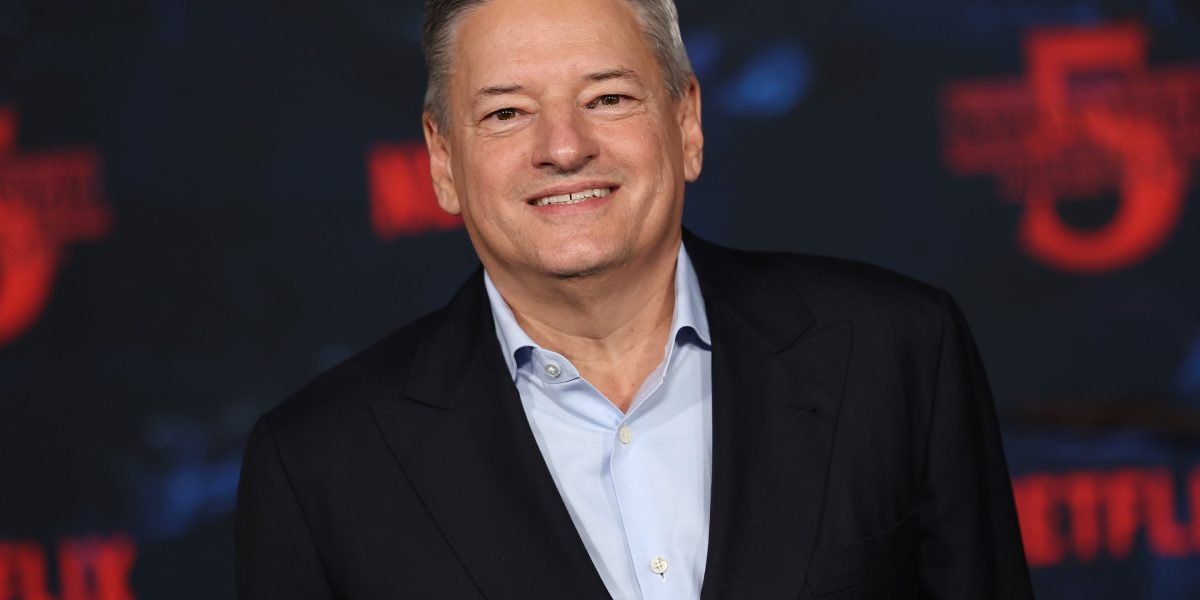
After announcing an almost-$83 billion deal to buy most of Warner Bros. Discovery on Friday, Netflix’s top brass projected calm on Monday as Paramount Skydance lobbed a hostile bid to purchase all of WBD,  and investors seemed to recoil at the sheer size of Netflix’s own offer.

“Today’s move was entirely expected,” Co-CEO Ted Sarandos told investors at a UBS conference, brushing off Paramount’s bid just hours earlier. “We have a deal done, and we are incredibly happy with the deal. We think it’s great for our shareholders. It’s great for consumers. We think it’s a great way to create and protect jobs in the entertainment industry.” From Netflix’s perspective, Sarandos added, “We have a deal done, and we’re incredibly happy with the deal.”

Sarandos’s co-CEO, Greg Peters, then walked the audience through Netflix’s three-phase plan to wring value from Warner Bros. and HBO. If the deal goes through, he said, Netflix would turbocharge licensing opportunities, “double down” on the HBO brand, and unlock upsides from Warner Bros’ vast library of IP, which many analysts consider a “crown jewel” in the industry. 

The executives’ comments came after investors sent Netflix stock tumbling down 6% in the two trading sessions since its Warner deal was announced, with some analysts blasting the $82.7 billion deal as “exorbitant” and “very risky.” Netflix stock is down more than 20% over the last six months.

Peters acknowledged that Netflix is known as a builder, not a buyer—generally developing its own intellectual property, rather than purchasing other companies’: “We haven’t done this before,” he said. But the company that started out lending DVDs by mail has pivoted several times to become the more than $400-billion behemoth now challenging Hollywood’s order.

And it’s worth noting that Netflix began streaming other companies’ content before it began producing its own programming. Its licensing operations are still vaunted in the industry, with the famous example of the legal drama Suits becoming a smash hit several years after it stopped airing on cable TV. As Peter put it: “Essentially, we are constantly in the business of evaluating various different licensing opportunities for titles and then trying to figure out, how do we maximize the value of that asset on our platform?” The Warner deal will just make official what Netflix already does, day in and day out.”

Netflix’s deal announcement on Friday rattled many in Hollywood, including creators and their unions, and movie theater owners, whose trade organization called it an “unprecedented threat” to their business

Sarandos, the executive behind the model that made “Netflix and chill” a byword for the millennial dating practice of and binging shows and movies at home, has largely refused to release movies in theaters, except to qualify for awards. At an event earlier this year, Sarandos dismissed going to the movies as “an outmoded idea for most people” and said Netflix was “saving Hollywood” with its stream-at-home model.

But on Monday he extended an olive branch to theater owners, saying of theatrical releases “We didn’t buy this company to destroy that value.” “What we are going to do with this is we’re deeply committed to releasing those movies exactly the way they’ve released those movies today,” he said at the UBS conference. “When this deal closes, we are in that business, and we’re going to do it.” 

Sarandos also discussed his conversations with President Donald Trump—which Bloomberg reported over the weekend began in November. 

President Trump “cares deeply about American industry, and he loves the entertainment industry,” Sarandos said. Jobs were the president’s main concern, according to Sarandos, who reeled off statistics showing that Netflix original productions employed 140,000 people between 2020 and 2024, contributing $125 billion to the U.S. economy. “We are producing in all 50 states,” he said. “We’ve used 500 independent production companies to make content for us, about roughly 1,000 original projects.” 

Sarandos and Peters pointed out that Paramount’s offer might entail more job cuts, because Paramount and Warner have more overlap in their operations than Netflix and Warner. “In the offer that Paramount was talking about today, they also were talking about $6 billion of synergies,” said Sarandos. “Where do you think synergies come from? Cutting jobs. Yeah, so we’re not cutting jobs, we’re making jobs.”

Sarandos also discussed HBO, the premium cable channel turned streamer—Netflix’s former rival and inspiration. Sarandos has famously said of Netflix that “the goal is to become HBO faster than HBO can become us,” comments he later modified to add he wants “CBS and BBC” too. Now that his company is set to become HBO’s parent, he said it can realize its true destiny as the leading light of prestige TV. 

“They’ve been doing gymnastics to make themselves into a general entertainment brand,” Sarandos said of HBO in the HBO Max era overseen by WBD CEO David Zaslav. “Under this transaction, they don’t have to do that anymore.” 

Both Netflix co-CEOs also hammered a message clearly aimed at regulators who might take anti-trust action to halt the deal: The combined company would hardly dominate TV. The Netflix deal spins off CNN, TNT, Discovery, HGTV, the Food Network and the company’s other cable channels, while the Paramount offer keeps the cable assets attached. Using Nielsen viewership data that appeared to include linear TV as well as streaming, Peters said Netflix commands just 8% of U.S. TV hours; adding HBO would raise that to 9%.

“We’d still be behind YouTube,” he noted. “And we’d still be behind a combined Paramount–WBD at 14%.”

BofA Research’s Media & Entertainment team used a different metric—total TV streaming—from Nielsen data to calculate that Warner and Netflix combined would be about 21% of the market, whereas Paramount and Netflix would be 8%. Both would still come in behind YouTube at 28%, however. 

Trump weighed in on Sunday about his relationship with Sarandos and the pending antitrust question. Saying the Netflix co-CEO is a “fantastic person,” Trump added that the Warner-Netflix market share “could be a problem.” At any rate, Trump added, uncharacteristically for a sitting president, he would be involved in what happens next.

Sarandos finished the UBS panel by reiterating to everyone listening and watching, many of whom have been long-term holders of Netflix stock, that he was “excited” about the deal. (The question of whether Netflix would sweeten its bid for WBD wasn’t raised.)

“We think this deal with Warner Brothers is good for shareholders,” he said. “We think it’s good for consumers. We think it’s good for creators. We think it’s great for the entertainment industry as a whole.”

[Editor’s note: one of the authors worked at Netflix from June 2024 through July 2025.]


Source link

Continue Reading

Business

Instacart may be jacking up grocery prices using AI, study shows—a practice called ‘smart rounding’

Published

on


Instacart tried to replace “Yesterday’s price is not today’s price” with “Today’s price might not be the same price for everyone.” The online grocery giant is experimenting with algorithmic pricing that can cost shoppers an extra $1,200 per year, a study released yesterday found.

The methodology: In September, Consumer Reports and the progressive think tank Groundwork Collaborative used ~200 volunteers to check prices on 20 items in four cities. The volunteers simultaneously chose the same product from the same store and found price differences in ~75% of items. Costco, Kroger, Safeway, and Target were among the retailers included.

The price is not right for everyone

  • Instacart uses pricing tools from Eversight, an AI company it purchased in 2022, that can create as much as a 23% increase in prices for customers and 2%–5% jump in profit for stores, according to CR.
  • Experts told CR that Instacart was testing customers’ price sensitivity. This was confirmed when an email between Instacart and Costco that called the practice “smart rounding” was accidentally sent to CR by Costco.

Shop of horrors: This type of dynamic pricing, which has proliferated in the age of AI, can contribute to steeper costs, according to an academic paper released this year. And Instacart is all in on AI: The company and OpenAI just announced a partnership that will allow customers to cook up recipes in ChatGPT and pay for groceries without leaving the chat interface.—DL

This report was originally published by Morning Brew.

Join us at the Fortune Workplace Innovation Summit May 19–20, 2026, in Atlanta. The next era of workplace innovation is here—and the old playbook is being rewritten. At this exclusive, high-energy event, the world’s most innovative leaders will convene to explore how AI, humanity, and strategy converge to redefine, again, the future of work. Register now.


Source link

Continue Reading

Business

Top economist warns more rate cuts after today would signal the economy is in danger

Published

on


Claudia Sahm thinks investors should rethink what they’re salivating for.

The Federal Reserve is likely to deliver its third interest rate cut of the year on Wednesday, a move widely understood to be insurance against the bottom completely falling out of the labor market. But to Sahm—a former Fed economist, recession-indicator architect, and one of the central bank’s most closely watched outside interpreters—the more consequential question isn’t what the Fed does on Wednesday. It’s what additional cuts would mean.

“If the Powell Fed ends up doing a lot more cuts,” she told Fortune ahead of the decision, “then we probably don’t have a good economy. Be careful what you wish for.”

That framing cuts against the dominant mood on Wall Street, where rate cuts have recently been reflexively welcomed and futures markets are already pricing in a second round of easing in 2026. But Sahm thinks investors should only want more cuts if they’re prepared to cheer for a recession.

Powell’s last stretch, and the hardest one

Sahm expects the Fed’s cut today—almost universally anticipated in futures markets—to be paired with language that raises the bar for any move in January. With the core inflation rate still sticky at 2.8%, higher than the Fed’s preferred rate of 2%, and unemployment rising, the Fed is straddling both halves of its mandate. 

“It is a tough one,” Sahm said. “Whatever they do could upset the other side.”

That tension is especially sharp because Fed Chair Jerome Powell is nearing the end of his term. He has three meetings left—January, March, and April—before the administration installs a successor, but President Donald Trump will announce his pick for the new chair (widely believed to be White House advisor Kevin Hassett) around Christmas. Once he does that, Powell effectively becomes a “lame duck” Fed Chair, although Sahm notes that “frankly, he has been one for some time” since Trump, who has grown to loudly despise his nominee, was elected. 

“Feels like in a way the last Powell Fed meeting,” Bloomberg’s Conor Sen wrote on X

What matters now for Sahm is that the data—not the politics—are driving policy. She warns that could change next year with a more political Fed. 

The labor-market signal the Fed is watching

What Sahm is focused on is not the headline rate cut but the underlying fragility in the job market that the Fed is trying to insure against.

Unemployment has risen three months in a row through September. Hiring has slowed to levels that historically place upward pressure on unemployment, “because you always have people coming into the labor market,” she said. 

Layoffs, however, haven’t surged yet. That’s precisely why Sahm thinks relying on initial jobless claims to assess labor-market risk is dangerous. 

“Initial claims don’t give you a sense of what’s coming,” she said. They’re what economists like to call a lagging indicator, meaning they tend to spike after a recession is underway, not before it. Recent weekly readings, distorted by holidays and special factors, are even less informative.

The real risk, in her view, is that the Fed waits too long.

“If the Fed waits until they see signs of deterioration,” she said, “they’ve waited too long.”

Sahm expects Powell to keep the path open for more easing but to emphasize that each additional cut requires stronger justification.

“If Powell talks about the funds rate getting close to neutral,” Sahm said, “that tells you it’s a pretty high bar to keep cutting. Every cut takes pressure off the economy, and inflation is still elevated.” 

That messaging—tightening the bar while remaining data-dependent—is what Wall Street might interpret as a “hawkish cut.”

But Sahm stresses the Fed cannot box itself in. The December employment report arrives just a week after today’s press conference. Declaring victory—or declaring the cutting cycle finished—would expose Powell to being immediately flat-footed.

“If all goes well,” she said, “this could be the last cut of the Powell Fed.”


Source link

Continue Reading

Business

Sheryl Sandberg’s Lean In finds ‘ambition gap’ in survey first: Fewer women want promotions

Published

on


The prophet of leaning in has found that, at least in 2025, women are leaning out. 

According to nonprofit Lean In and McKinsey & Company’s latest Women in the Workplace report, for the first time since the report began a decade ago, significantly fewer women than men are interested in getting a promotion at work. Compared to 80% of men in entry-level career stages, 86% in mid-career, and 92% of senior executives, only 69% of entry-level women, 82% in their mid-career, and 84% of female senior executives reported a desire to advance in their careers. The data was taken from 124 companies with 3 million workers, as well as interviews with 62 human resources executives. 

In 2023, 81% of both men and women surveyed said they were interested in getting promoted, including 93% of women under 30, highlighting an “ambition gap” that has emerged in the last year. 

Lean In attributed the gap to a disparity in support and resources available to women in the workplace, including less advocacy from managers, making them less likely to be recommended for a promotion. According to the report, when women receive the same career support as men, the ambition gap in seeking a promotion disappears.

The gap is part of a growing pattern of women being left behind in the workplace, says former Meta Platforms Inc. executive and nonprofit Lean In founder Sheryl Sandberg. While the number of men in the workplace this year has risen by nearly 400,000, the number of working women has fallen by about 500,000, data from the U.S. Bureau of Labor Statistics shows. 

“This is my fourth decade in the workplace, and we are in a particularly troubling moment in terms of the rhetoric on women,” she told CNN on Tuesday. “You see it everywhere in all the sectors. But what I’ve seen is, you know, we make progress, we backslide. We make progress, we backslide. And I think this is a major moment of backsliding.”

Troubling workplace trends

Stricter return-to-office mandates and the rising cost of childcare have forced many women to either cut hours or quit their jobs altogether, what some researchers are calling “The Great Exit.” Labor force participation from women aged 25 to 44 with children under 5 fell by about 3% from January to June of this year alone.

The women who are still able to work from home, sometimes out of necessity because of childcare responsibilities, risk becoming invisible at their job. Many get less feedback and mentorship than their in-office counterparts. They are also less likely to be promoted than their male counterparts and see fewer raises and lower wages.

The changes in workplace patterns also come amid concerted efforts to curb diversity, equity, and inclusion efforts in the workplace, with women saying this rollback has impacted their career plans, including prioritizing job security over career growth opportunities. President Donald Trump got rid of EO 11246, an executive order mandating federal contractors provide equal employment to marginalized groups like women and people of color, on his second day in office.

Lean In’s data suggests remaining workplace DEI efforts are also falling short. Despite 88% of companies saying they prioritize inclusive cultures, only 54% say they’ve committed to programs designed for women’s career enhancement and 48% committing to efforts to advance women of color at work. One-fifth of companies surveyed reported no specific support efforts for moving women up in their careers.

“We’ve built systems that aren’t working, and women are bearing the brunt of it,” billionaire philanthropist Melinda French Gates told Fortune in October. “It’s very concerning to see so many women leaving the workforce—but if you’ve been listening all along to what women say about their careers, it’s not surprising.”

French Gates said she attributes continued challenges for women in the workplace to tradeoffs they have to make, including balancing work with childcare. Women also continue to face workplace harassment and navigate enduring stereotypes about their own leadership capabilities, French Gates added.

To Sandberg, the issue goes beyond something ideological. She argued neglecting women in the workplace is a dangerous economic choice, saying that if the U.S. were to increase women’s workforce participation on par with other wealthy countries, it would add an additional 4.2% GDP growth. Organisation for Economic Co-operation and Development data indicates the wealth of a country is correlated with the participation of women in its workforce.

“This is a critical issue, not of special treatment,” Sandberg said, “but of making sure we get the best out of our workforce and we are competitive economically.”


Source link

Continue Reading

Trending

Copyright © Miami Select.