Connect with us

Business

The U.S. has over 900 billionaires and their wealth soared by 18% to $6.9 trillion this year: UBS

Published

on


The United States remains the clear leader in global wealth creation, with its billionaire population expanding and their combined fortunes soaring over the past year, according to UBS Global Wealth Management’s Billionaire Ambitions Report for 2025. It reveals that U.S. billionaires’ wealth increased by almost a fifth (18% year on year) to a staggering $6.9 trillion in 2025.

This massive surge helped lift the global billionaire population to 2,919 individuals, holding a total record wealth of $15.8 trillion. The U.S. now hosts 924 billionaires, representing nearly a third (31.7%) of the global billionaire population. The growth in the Americas region, which was led by the U.S., saw overall billionaire wealth climb 15.5% to $7.5 trillion.

The dramatic increase in U.S. wealth was largely driven by an exceptional year for innovation and rising financial asset prices, the Swiss bank concluded. The United States welcomed 109 fresh entrants to the billionaire ranks, vastly outnumbering the 18 who dropped below the threshold or passed away. The growth was heavily buoyed by self-made success, as 87 new U.S. residents became self-made billionaires, contributing $171.9 billion to the Americas’ total new wealth.

The technology sector played a crucial role in this growth, UBS added, with tech billionaires globally seeing their assets increase by 23.8% to $3 trillion. This surge in tech wealth is closely linked to the appreciating values of companies driving the artificial intelligence revolution, such as Nvidia, Oracle, and Meta.

Six U.S. tech billionaires alone saw their wealth increase by a combined $171 billion compared with the previous year. This wave of entrepreneurship means that 2025 recorded the second-highest number of self-made individuals becoming billionaires in the history of the report, behind the remarkable year for markets that was 2021, demonstrating widespread business creation across diverse sectors.

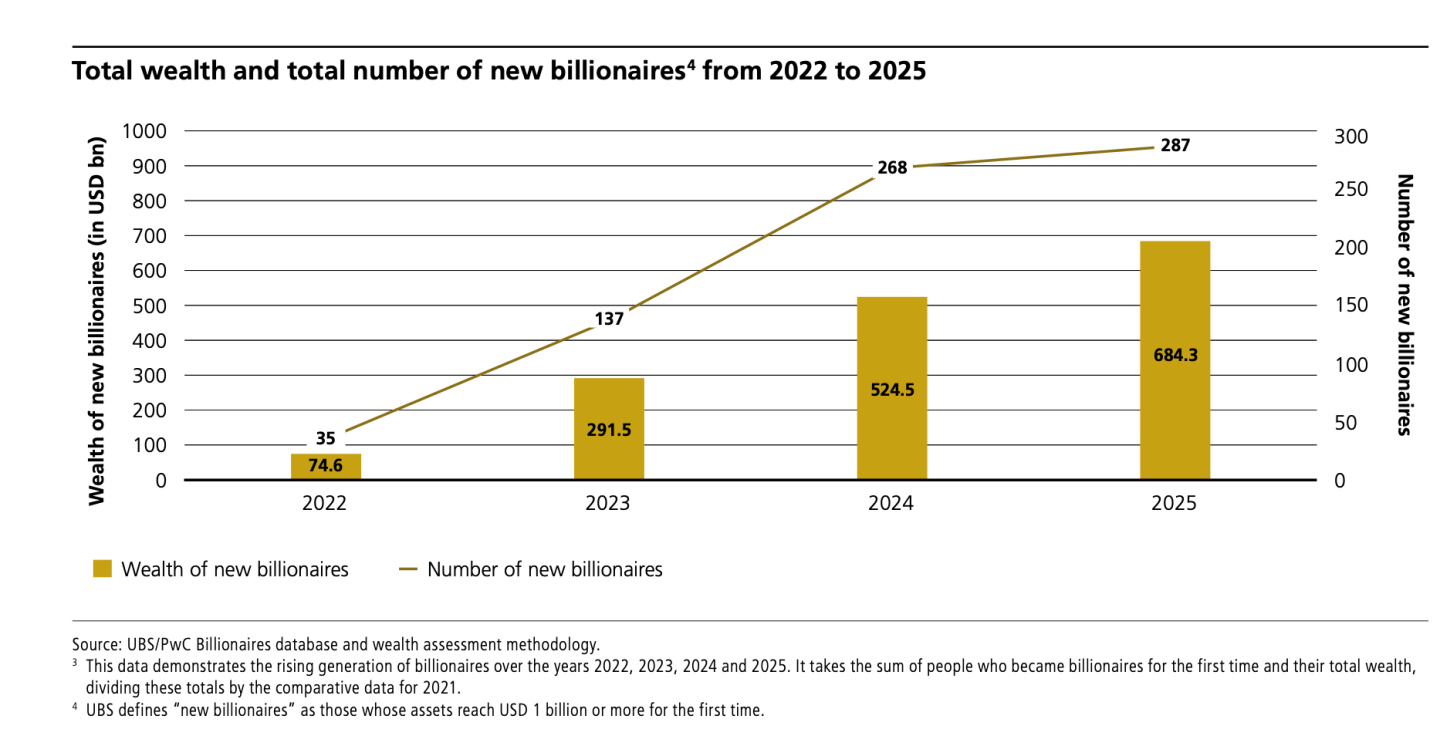
That year, 360 self-made billionaires accounted for $782 billion, an “exceptional rise [that] resulted from asset price appreciation in a period of ample financial liquidity following the COVID-19 pandemic.” The result in 2025 was more down to “widespread business creation,” UBS added. The report found the number of new billionaires minted annually increased roughly eightfold from 35 in 2022 to 287 in 2025, while their assets have grown by roughly ninefold, from $74.6 billion to $684.3 billion.
The coming transfer of wealth

While U.S. entrepreneurs are busy creating new wealth, the long-anticipated “great wealth transfer” is accelerating. Globally, at least $5.9 trillion is expected to be inherited by billionaire children over the next 15 years. Of that amount, at least $2.8 trillion will pass to U.S. heirs over this period. This calculation is likely conservative as it does not factor in future appreciation of asset values.

The report highlights that families are becoming increasingly international as the wealth transfer intensifies, yet the inheritance itself is set to be concentrated in a small number of markets, with the U.S. leading the way.

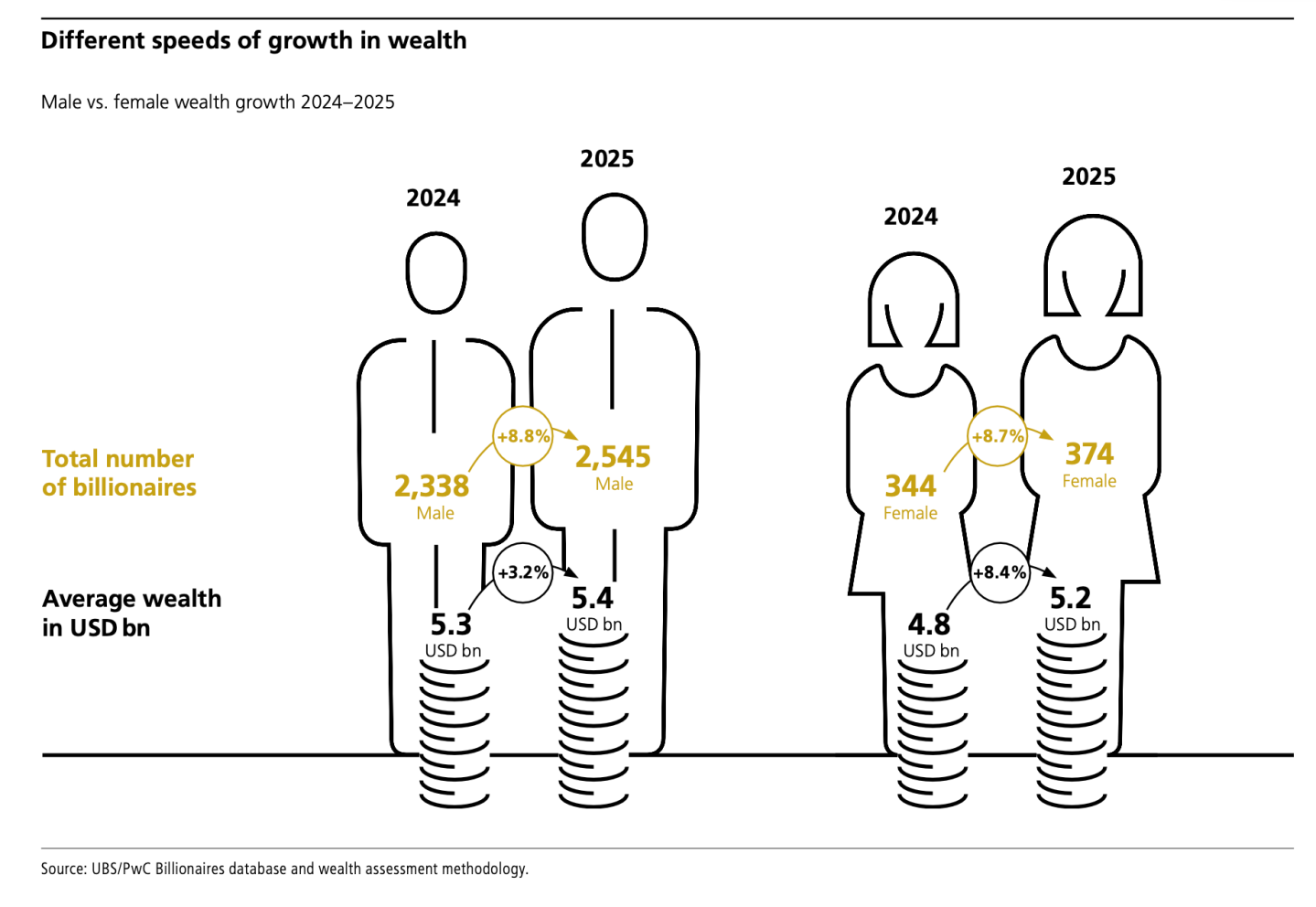
Female billionaires made notable progress in 2025, according to the report. While there are only 374 female billionaires globally, compared with 2,545 male, their average wealth grew by 8.4% to $5.2 billion in 2025, more than twice the 3.2% average growth rate for men. This is part of a trend, with the average wealth of female billionaires rising at a faster rate for each of the four years since 2022. In part, this is driven by inheritance, with more women becoming billionaires through inheritance than any other way in 2025. Of the 43 women who became billionaires in the year, UBS found that 27 inherited while 16 were self-made.
Despite the vast sums set for inheritance, surveyed billionaires expressed a strong desire for their children to achieve success independently. More than eight in 10 (82%) of those surveyed hope their children will develop the necessary skills and values to succeed without relying solely on the inherited fortune. Over half (55%) also want their heirs to use their wealth to make a positive impact on the world.

Furthermore, billionaires are highly mobile, with 36% of those surveyed having relocated at least once, and a further 9% considering a move. The top three reasons for relocation are linked to better quality of life (36%), geopolitical concerns (36%), and organizing tax affairs more efficiently (35%). This high level of mobility could potentially alter the geographic picture of where wealth is ultimately transferred.

The report was generated in part through an online survey of 87 billionaire clients as well as in-depth interviews which took place over several weeks in September and October.


Source link

Continue Reading

Business

AICPA president pushes back after Education Department reclassifies accounting degrees

Published

on


Are master’s and doctorates in accounting “professional” degrees? Not anymore, according to the Department of Education.

The department’s Reimagining and Improving Student Education (RISE) committee recently released draft regulations that specified which graduate degrees count as “professional” for purposes of federal student loans—and accounting wasn’t on the list. Neither were many graduate degrees commonly considered “professional,” such as nursing, engineering, education, and architecture, Inside Higher Ed reported.

The education department’s decision isn’t merely semantic: If it’s finalized, it will affect how much federal aid students are able to receive. Students in the 11 degree fields designated “professional” will be able to borrow up to $50,000 a year and no more than $200,000 in total. For students in other programs, federal loans will be capped at $20,500 per year and a total of $100,000.

Professions fire back: Numerous professional organizations, including the National Academy of Medicine, the American Nurses Association, the American Association of Colleges of Nursing, the Council on Social Work Education, and the American Institute of Architects, have spoken out against the department’s decision.

Now, accounting organizations have followed suit. The AICPA and state societies of accounting, the National Association of State Boards of Accountancy (NASBA), and the American Accounting Association (AAA), a professional organization representing accounting educators, have all released formal statements in opposition to the decision. Both the AICPA and AAA statements requested that the education department reconsider classifying accounting degrees as professional, and NASBA wrote in its statement that it “will engage policymakers to ensure accounting is restored to the professional degree category.”

Concern for accounting’s reputation: Leaders at the accounting organizations have expressed concerns that the decision could weaken public perception of accounting as a learned profession. In a statement, the Department of Education clarified that the term “professional” is an “internal definition” used for student loan purposes. But Daniel Dustin, president and CEO of NASBA, told CFO Brew that he worries people, and especially young people who might be considering accounting as a career, might miss that context.

“Does that have a negative impact on middle school, high school students who are looking for careers?” he asked. “Does it have the same impact on college students who may not have declared a major yet?” He stressed, as NASBA did in its statement, the longevity of accounting’s professional status. “Certified public accountancy has been a licensed profession in the United States since 1896, the third profession after doctors and lawyers,” he observed.

In a video posted to LinkedIn, AICPA president and CEO Mark Koziel reaffirmed accounting’s status. “Accounting is absolutely a profession, full stop,” he said. “It’s built on trust, integrity, and rigorous standards” and requires a “lifelong commitment to an ethical practice and continuing education,” he said, concluding “These are the hallmarks of a true profession.”

The ruling will go into effect in July 2026, following a comment period. The department stated that it “has not prejudged the rulemaking process and may make changes in response to public comments.” But if accounting continues to be left off its list of professional degrees, leaders of accounting organizations worry that fewer students will choose to pursue graduate degrees in accounting.

Grad degrees could be harder to fund: “We don’t want to provide disincentives for people to move toward further education,” Mark Beasley, president of the AAA and an accounting professor at North Carolina State University, told CFO Brew, noting that the department’s decision could “make it more difficult financially” for students to earn advanced degrees. According to US News and World Report, tuition for a master’s in accounting typically ranges from $25,000 to $70,000. Tuition varies based on whether a student opts for a public or private school, or for an online or in-person program, but at some schools, it’s higher than the federal loan cap the Department of Education proposed. The amount “would not cover NC State” tuition, Beasley said.

If the loan cap remains where it is, students who want to pursue graduate degrees would have to find other ways to fund them. Doctoral students might receive assistantships that come with teaching stipends, Beasley said, and there’s a possibility accounting firms might help students fund their education. Private loans are an option, but they come with drawbacks: Interest rates could be higher than on federal loans, Dustin said, and students might not be able to defer them or consolidate them as readily.

And the private student loan industry may not be able to handle an influx of new borrowers. Only 8% of student loans are private, according to Inside Higher Ed. The industry has dwindled since the Great Recession, per the New York Times.

Accounting education could suffer: The proposal could even be harmful to accounting education on a broader scale. If it lowers demand for graduate education, programs might get smaller, Beasley said. And master’s degree completions in accounting have already dropped 38% between 2017–18 and 2023–24, AICPA data shows. It’s possible that fewer students will pursue master’s degrees in the future, given that candidates no longer need to complete 150 credit hours of schoolwork, or 30 more hours than are necessary for a bachelor’s degree, to sit for the CPA exam.

Having fewer doctoral students in accounting could also lead to fewer accounting faculty further down the road. Both Dustin and Beasley pointed out that many accounting educators are growing older. “We might see a shortage in five to 10 years as retirements increase,” Beasley said.

Ultimately, Beasley said, the department’s ruling “work[s] against the public interest.” It could discourage people from pursuing “the kinds of training and education and knowledge development to really be good at making professional judgments that are critical for the capital market system to be reliable here in the US.”

This report was originally published by CFO Brew.


Source link

Continue Reading

Business

Robinhood launches staking for Ethereum and Solana in ongoing crypto expansion

Published

on


Robinhood is doubling down on crypto offerings. The trading app will launch staking for Ethereum and Solana in New York starting on Tuesday, according to the company, allowing customers to earn yield on cryptocurrency. 

The company will let customers stake in New York and plans to expand across the country. “We’re proud of the momentum we’ve seen with staking and especially excited that staking is now available to customers in New York, which has one of the most rigorous regulatory frameworks in the country,” wrote Johann Kerbrat, senior vice president and general manager of Robinhood Crypto, in a note to Fortune

Staking has been part of the crypto universe for nearly a decade, rewarding users who lock up a stash of tokens in order to help operate a blockchain network. But uncertainty over its legal status has meant it has been mostly experienced crypto users who have engaged in it using their own wallets.

In 2023, the exchange Kraken agreed to pay $30 million to settle allegations that it broke the Securities and Exchange Commission’s rules by offering staking. Robinhood’s launching of crypto stakes reflects a looser regulatory environment under President Donald Trump’s administration. 

“These crypto enhancements are strategic chess moves positioning Robinhood for the anticipated transformation of financial infrastructure through blockchain technology and tokenization—particularly with the regulatory clarity we expect under the current administration,” said Caydee Blankenship, senior equity research analyst at CFRA Research. 

Robinhood also announced a push into global crypto markets. In Europe, it will add perpetual futures contracts on several coins, and it will also enter the Indonesian market, as it agreed to buy a brokerage and crypto platform in the country. 

Robinhood is not new to crypto, as users on the platform have been able to trade Bitcoin and Ethereum since 2018. However, the company has beefed up its crypto arm this year. In June, Robinhood completed a $200 million acquisition of Bitstamp, the world’s longest-running crypto exchange. Crypto transactions accounted for more than 21% of the company’s revenue, as of last month’s earnings report. 

Robinhood’s expansion of their digital assets could help them challenge other crypto exchanges, according to Romeo Alvarez, research analyst at William O’Neil. “Robinhood is stepping up its efforts to compete on a global basis with larger trading platforms like Coinbase, Binance, OKX, and Kraken,” he said.  

The last few days have seen other big banks vie for staking. On Friday, BlackRock filed for a stake Ethereum ETF, the iShares Ethereum Staking Trust (ETHB). The Wall Street giant already has an Ethereum ETF (ETHA), but that one does not have staking components. 


Source link

Continue Reading

Business

Amazon robotaxi service Zoox to charge for rides in 2026, with ‘laser-focus’ on transporting people, not deliveries, says cofounder

Published

on


Amazon’s self-driving robotaxi subsidiary, Zoox, expects to start charging passengers for rides in Las Vegas in early 2026, with paid rides in the San Francisco Bay Area coming later next year, a company executive said Monday.

The move, which would represent a key milestone for Zoox as it seeks to catch up with Alphabet’s Waymo, depends on obtaining federal regulatory and state approvals, Zoox Co-founder and chief technology officer Jesse Levinson told the audience at Fortune’s Brainstorm AI event in San Francisco on Monday.

And while robotaxi rival Waymo recently partnered with DoorDash to test food deliveries with driverless cars, Levinson said that Zoox is “laser focused” on moving people around cities, an addressable market he sees as being “just profoundly huge.” That directive has come “all the way from the very top” at Amazon, he added, despite the retailer’s significant interest in driverless package delivery.

“It’s harder to move people around than packages in terms of what you have to do with your vehicle,” Levinson said. On the other hand, automating package delivery is rife with its own challenge because the boxes have to get in and out of the vehicle, which isn’t as straightforward as people who can move themselves, he added.

Zoox crossed the 1 million mile technical threshold for autonomous rides just last week, Levinson said. The company’s distinct, carriage-seated vehicles, which have no steering wheels or manual controls, currently provide rides to passengers free of charge in portions of Las Vegas and Zoox is slowly opening up the waitlist to use the service in San Francisco.

Despite the progress and the plans to start charging fares, Zoox won’t generate revenues that are meaningful to Amazon, its $2.4 trillion parent company, for at least several more years, Levinson said. 

“This is pretty expensive,” said Levinson. “Over the next few years, it will start to be a really interesting business because the revenue you can generate from the robotaxi is quite a bit more than the expense to run robotaxi.”

That’s the point at which the business will become more “financially interesting,” he added.

Building cars without human drivers in mind

While creating a driverless robotaxi service comes with various challenge, Levinson believes it will ultimately be a key method for moving people around dense urban areas.

“Our view is that people aren’t doing this, not because it’s not a good idea, but because it’s just really hard,” said Levinson. “It takes a lot of time, it’s very cross functional, and it’s expensive. But I do think over time this is going to be a much more popular way of human transportation”

One of the gaps between a driverless robotaxi service like Zoox and Waymo, said Levinson, is in the way the cars are built. Rather than retrofitted vehicles that were manufactured with a human driver in mind, Zoox cars were built to be driverless. Levinson said the four-passenger cabins have carriage seating, active suspension, individual screens for each seat, and four-zone climate control. 

“The cars that have been designed over the last 100 years are for humans,” Levinson said. “All the choices, their shape, their architecture, what components they have in them—they were all designed for human drivers.” Levinson said Zoox offers a more cushy, social rider experience that he thinks will be a differentiator among competitors like Waymo and potentially Tesla’s robotaxi fleet. 

Another competitive element for Zoox is its battery, said Levinson. The bigger battery is more environmentally and economically friendly because it requires less charging.

“The economic opportunity and the opportunity for customers [as we] create this whole new category of transportation is actually much more exciting and even more financially compelling than simply taking something they do today and saving a bit of money,” he said.


Source link

Continue Reading

Trending

Copyright © Miami Select.