Connect with us

Business

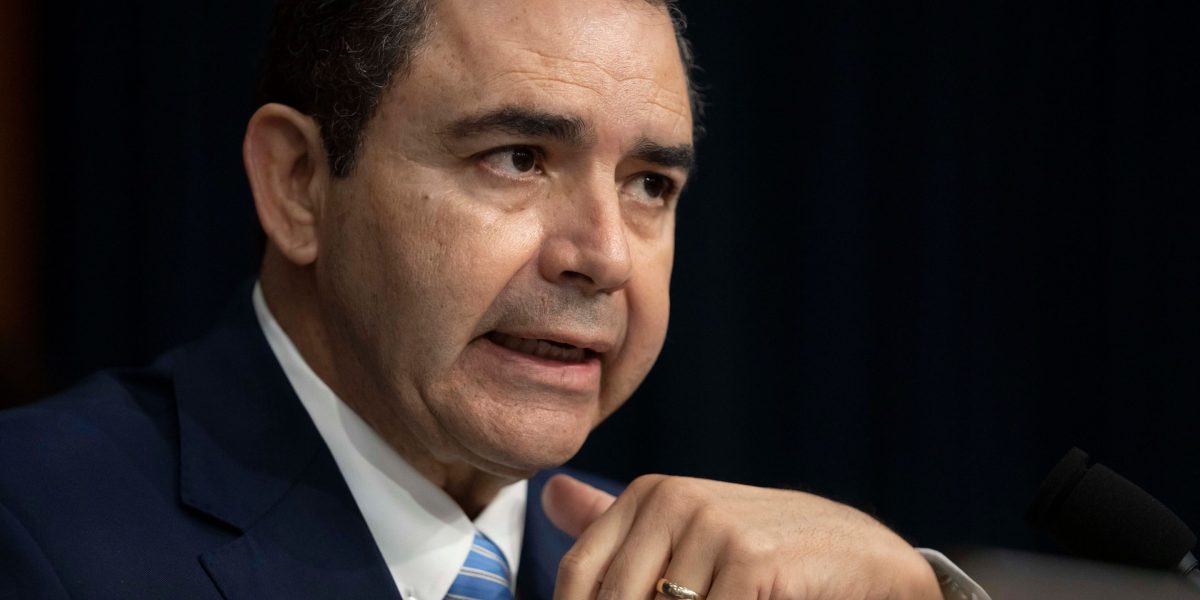
Trump slams Democratic congressman as disloyal for not switching parties after pardon

Published

on


Trump blasted Cuellar for “Such a lack of LOYALTY,” suggesting the Republican president might have expected the clemency to bolster the GOP’s narrow House majority heading into the 2026 midterm elections.

Cuellar, in a television interview Sunday after Trump’s social media post, said he was a conservative Democrat willing to work with the administration “to see where we can find common ground.” The congressman said he had prayed for the president and the presidency at church that morning “because if the president succeeds, the country succeeds.”

Citing a fellow Texas politician, the late President Lyndon Johnson, Cuellar said he was an American, Texan and Democrat, in that order. “I think anybody that puts party before their country is doing a disservice to their country,” he told Fox News Channel’s “Sunday Morning Futures.”

Trump noted on his Truth Social platform that the Democratic President Joe Biden’s administration had brought the charges against Cuellar and that the congressman, by running once more as a Democrat, was continuing to work with “the same RADICAL LEFT” that wanted him and his wife in prison — “And probably still do!”

“Such a lack of LOYALTY, something that Texas Voters, and Henry’s daughters, will not like. Oh’ well, next time, no more Mr. Nice guy!” Trump said. Cuellar’s two daughters, Christina and Catherine, had sent Trump a letter in November asking that he pardon their parents.

Trump explained his pardon he announced Wednesday as a matter of stopping a “weaponized” prosecution. Cuellar was an outspoken critic of Biden’s immigration policy, a position that Trump saw as a key alignment with the lawmaker.

Cuellar said he has good relationships within his party. “I think the general Democrat Caucus and I, we get along. But they know that I’m an independent voice,” he said.

A party switch would have been an unexpected bonus for Republicans after the GOP-run Legislature redrew the state’s congressional districts this year at Trump’s behest. The Texas maneuver started a mid-decade gerrymandering scramble playing out across multiple states. Trump is trying to defend Republicans’ House majority and avoid a repeat of his first term, when Democrats dominated the House midterms and used a new majority to stymie the administration, launch investigations and twice impeach Trump.

Yet Cuellar’s South Texas district, which includes parts of metro San Antonio, was not one of the Democratic districts that Republicans changed substantially, and Cuellar believes he remains well-positioned to win reelection.

Federal authorities had charged Cuellar and his wife with accepting thousands of dollars in exchange for the congressman advancing the interests of an Azerbaijan-controlled energy company and a bank in Mexico. Cuellar was accused of agreeing to influence legislation favorable to Azerbaijan and deliver a pro-Azerbaijan speech on the floor of the U.S. House.

Cuellar has said he his wife were innocent. The couple’s trial had been set to begin in April.

In the Fox interview, Cuellar insisted that federal authorities tried to entrap him with “a sting operation to try to bribe me, and that failed.”

Cuellar still faces a House Ethics Committee investigation.


Source link

Continue Reading

Business

Procurement execs often don’t understand the value of good design, experts say

Published

on


Behind every intricately designed hotel or restaurant is a symbiotic collaboration between designer and maker.

But in reality, firms want to build more with less—and even though visions are created by designers, they don’t always get to see them to fruition. Instead, intermediaries may be placed in charge of procurements and overseeing the financial costs of executing designs.

“The process is not often as linear as we [designers] would like it to be, and at times we even get slightly cut out, and something comes out on the other side that wasn’t really what we were expecting,” said Tina Norden, a partner and principal at design firm Conran and Partners, at the Fortune Brainstorm Design forum in Macau on Dec. 2.

“To have a better quality product, communication is very much needed,” added Daisuke Hironaka, the CEO of Stellar Works, a furniture company based in Shanghai. 

Yet those tasked with procurement are often “money people” who may not value good design—instead forsaking it to cut costs. More education on the business value of quality design is needed, Norden argued.

When one builds something, she said, there are both capital investment and a lifecycle cost. “If you’re spending a bit more money on good quality furniture, flooring, whatever it might be, arguably, it should last a lot longer, and so it’s much better value.”

Investing in well-designed products is also better for the environment, Norden added, as they don’t have to be replaced as quickly.

Attempts to cut costs may also backfire in the long run, said Hironaka, as business owners may have to foot higher maintenance bills if products are of poor design and make.

AI in interior and furniture design

Though designers have largely been slow adopters of AI, some luminaries like Daisuke are attempting to integrate it into their team’s workflow.

AI can help accelerate the process of designing bespoke furniture, Daisuke explained, especially for large-scale projects like hotels. 

A team may take a month to 45 days to create drawings for 200 pieces of custom-made furniture, the designer said, but AI can speed up this process. “We designed a lot in the past, and if AI can use these archives, study [them] and help to do the engineering, that makes it more helpful for designers.” 

Yet designers can rest easy as AI won’t ever be able to replace the human touch they bring, Norden said. 

“There is something about the human touch, and about understanding how we like to use our spaces, how we enjoy space, how we perceive spaces, that will always be there—but AI should be something that can assist us [in] getting to that point quicker.”

She added that creatives can instead view AI as a tool for tasks that are time-consuming but “don’t need ultimate creativity,” like researching and three-dimensionalizing designs.

“As designers, we like to procrastinate and think about things for a very long time to get them just right, [but] we can get some help in doing things faster.”


Source link

Continue Reading

Business

Binance has been proudly nomadic for years. A new announcement suggests it’s chosen an HQ

Published

on


For years, Binance has dodged questions about where it plans to establish a corporate headquarters. On Monday, the world’s largest crypto exchange made an announcement that indicates it has chosen a location: Abu Dhabi, the capital of the United Arab Emirates.

In its announcement, Binance reported that it has secured three global financial licenses within Abu Dhabi Global Market, a special economic zone inside the Emirati city. The licenses regulate three different prongs of the exchange’s business: its exchange, clearinghouse, and broker dealer services. The three regulated entities are named Nest Exchange Limited, Nest Clearing and Custody Limited, and Nest Trading Limited, respectively.

Richard Teng, the co-CEO of Binance, declined to say whether Abu Dhabi is now Binance’s global headquarters. “But for all intents and purposes, if you look at the regulatory sphere, I think the global regulators are more concerned of where we are regulated on a global basis,” he said, adding that Abu Dhabi Global Market is where his crypto exchange’s “global platform” will be governed.

A company spokesperson declined to add more to Teng’s comments, but did not deny Fortune’s assertion that Binance appears to have chosen Abu Dhabai as its headquarters.

Corporate governance

The Abu Dhabi announcement suggests that Binance, which has for years taken pride in branding itself as a company with no fixed location, is bowing to the practical considerations that go with being a major financial firm—and the corporate governance obligations that entails.

When Changpeng Zhao, the cofounder and former CEO of Binance, launched the company in 2017, he initially established the exchange in Hong Kong. But, weeks after he registered Binance in the city, China banned cryptocurrency trading, and Zhao moved his nascent trading platform. Binance has since been itinerant. “Wherever I sit is going to be the Binance office,” Zhao said in 2020.

The location of a company’s headquarters impacts its tax obligations and what regulations it needs to follow. In 2023, after Binance reached a landmark $4.3 billion settlement with the U.S. Department of Justice, Zhao stepped down as CEO and pleaded guilty to failing to implement an effective anti-money laundering program.

Teng took over and promised to implement the corporate structures—like a board of directors—that are the norm for companies of Binance’s size. Teng, who now shares the CEO role with the newly appointed Yi He, oversaw the appointment of Binance’s first board in April 2024. And he’s repeatedly telegraphed that his crypto exchange is focused on regulatory compliance.

Binance already has a strong footprint in the Emirates. It has a crypto license in Dubai, received a $2 billion investment from an Emirati venture fund in March, and, that same month, said it employed 1,000 employees in the country. 


Source link

Continue Reading

Business

Leaders in Congress outperform rank-and-file lawmakers on stock trades by up to 47% a year

Published

on


Stocks held by members of Congress have been beating the S&P 500 lately, but there’s a subset of lawmakers who crush their peers: leadership.

According to a recent working paper for the National Bureau of Economic Research, congressional leaders outperform back benchers by up to 47% a year.

Shang-Jin Wei from Columbia University and Columbia Business School along with Yifan Zhou from Xi’an Jiaotong-Liverpool University looked at lawmakers who ascended to leadership posts, such as Speaker of the House as well as House and Senate floor leaders, whips, and conference/caucus chairs.

Between 1995 and 2021, there were 20 such leaders who made stock trades before and after rising to their posts. Wei and Zhou observed that lawmakers underperformed benchmarks before becoming leaders, then everything suddenly changed.

“Importantly, whilst we observe a huge improvement in leaders’ trading performance as they ascend to leadership roles, the matched ‘regular’ members’ stock trading performance does not improve much,” they wrote.

Leadership’s stock market edge stems in part from their ability to set the regulatory or legislation agenda, such as deciding if and when a particular bill will be put to a vote. Setting the agenda also gives leaders advanced knowledge of when certain actions will take place.

In fact, Wei and Zhou found that leaders demonstrate much better returns on stock trades that are made when their party controls their chamber.

In addition, being a leader also increases access to non-public information. The researchers said that while companies are reluctant to share such insider knowledge, they may prioritize revealing it to leaders over rank-and-file lawmakers.

Leaders earn higher returns on companies that contribute to their campaigns or are headquartered in their states, which Wei and Zhou said could be attributable to “privileged access to firm-specific information.”

The upper echelon also influences how other members of Congress vote, and the paper found that a leader’s party is much more likely to vote for bills that help firms whose stocks the leader held, or vote against bills that harmed them. And stocks owned by leadership tend to see increases in federal contract awards, especially sole-source contracts, over the following one to two years.

“These results suggest that congressional leaders may not only trade on privileged knowledge, but also shape policy outcomes to enrich themselves,” Wei and Zhou wrote.

Stock trades by congressional leaders are even predictive, forecasting higher occurrences of positive or negative corporate news over the following year, they added. In particular, stock sales predict the number of hearings and regulatory actions over the coming year, though purchases don’t.

Investors have long suspected that Washington has a special advantage on Wall Street. That’s given rise to more ETFs with political themes, including funds that track portfolios belonging to Democrats and Republicans in Congress.

And Paul Pelosi, former House Speaker Nancy Pelosi’s husband, even has a cult following among some investors who mimic his stock moves.

Congress has tried to crack down on members’ stock holdings. The STOCK Act of 2012 requires more timely disclosures, but some lawmakers want to ban trading completely.

A bipartisan group of House members is pushing legislation that would prohibit members of Congress, their spouses, dependent children, and trustees from trading individual stocks, commodities, or futures.

And this past week, a discharge petition was put forth that would force a vote in the House if it gets enough signatures.

“If leadership wants to put forward a bill that would actually do that and end the corruption, we’re all for it,” said Rep. Anna Paulina Luna, R-Fla., on social media on Tuesday. “But we’re tired of the partisan games. This is the most bipartisan bipartisan thing in U.S. history, and it’s time that the House of Representatives listens to the American people.”


Source link

Continue Reading

Trending

Copyright © Miami Select.