Connect with us

Business

This pastor fills up arenas by not sugarcoating the Bible

Published

on


After Atlanta pastor Philip Anthony Mitchell stopped dwelling on growing his congregation about three years ago, its attendance surged. Now, lines packed with young adults snake outside 2819 Church, some arriving as early as 5:30 a.m. to secure a spot for Sunday worship.

Christian rap and contemporary music blast like a block party as volunteers cheer into megaphones for around 6,000 weekly churchgoers — up from less than 200 in 2023, the church reports. Inside the sanctuary, the atmosphere turns serious. Many drawn to 2819’s riveting worship are hungry for Mitchell’s animated intensity and signature preaching: No sugarcoating the Bible.

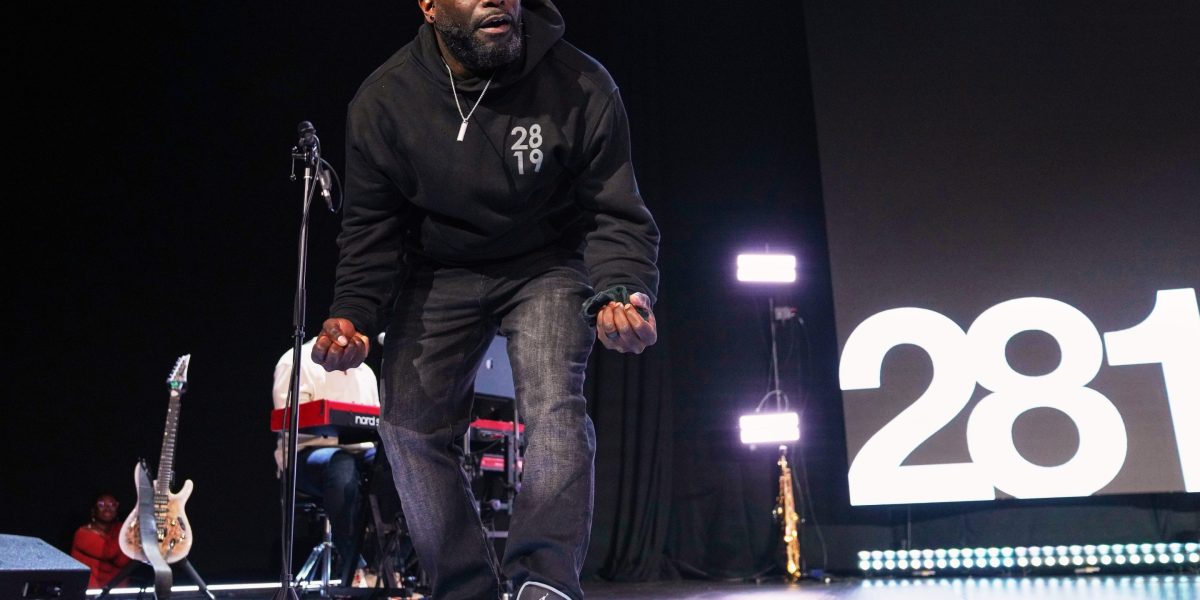
After spirited prayers and songs leave many crying, Mitchell ambles onstage in his all-black uniform, sometimes in quiet contemplation or tears, before launching into a fiery sermon. His messages, unpolished and laden with challenges to revere God and live better, often spread quickly online. A recent prayer event drew far more people than State Farm Arena could handle, with many flying in.

Crying, shouting, storming across the platform and punching the air, Mitchell preaches with his whole body — and an urgency to bring people to faith before they die or what he calls Jesus’ impending return to Earth.

“It is life or death for me,” Mitchell told The Associated Press, comparing preaching to the front lines of war. “There are souls that are hanging in the balance. … I think about the fact that in that room somebody might hear the Gospel, and that might be their last opportunity.”

The church — whose name references Matthew 28:19, a Bible verse commanding believers to go “make disciples of all the nations” — is nondenominational and theologically conservative, with beliefs opposing abortion and in support of marriage only between a man and a woman.

The congregation’s growth has attracted people of many races and ages, but it’s predominantly young Black adults. Their youth is notable since Americans ages 18 to 24 are less likely than older adults to identify as Christian or attend religious services regularly, according to Pew Research Center.

Sharp sermons and moving worship

Warren Bird, an expert on fast-growing churches, believes the right leader is key to a church’s growth — along with God’s help — and described Mitchell as “speaking a language” that connects with young people who other pastors haven’t reached.

Churchgoers say Mitchell’s message resonates because he carefully walks them through scripture and talks candidly about his spiritual transformation, including his past dealing drugs, paying for abortions and attempting suicide.

“I’m still a little rough around the edges, right? I still got a little hood in me,” said Mitchell, who still speaks with a regional New York accent.

Many at 2819 want more than motivational speeches and say Mitchell’s sermons are counterweights to the feel-good American preaching he criticizes.

“I’m preaching without watering that down, without filtering out things that we think might be too controversial,” said Mitchell, who wants people to mature spiritually and insists they can’t deal with sin and its consequences without Jesus.

“I think that there is a generation that is gravitating towards that authenticity and truth,” he said. “As a result of that, we are seeing lives being radically transformed.”

Christian podcaster Megan Ashley said she brought a friend to 2819 who had stepped away from her faith, and Mitchell had an impact. The friend told Ashley, “When he speaks, I believe him.”

The tougher messages might hurt some people’s feelings, said Donovan Logan, 23.

“But that’s what it’s supposed to do. If you don’t come to church and want to change, then that’s not the church you’re supposed to be going to,” Logan said.

Elijah McCord, 22, said Mitchell’s sermons about sin touch on what’s happening around him in Atlanta, and Mitchell’s story shows that “there’s life in what God has commanded.” He also values Mitchell’s pleadings to wait until marriage to have sex.

“He biblically talks about sin and repentance and how there’s actually hope in the Gospel,” McCord said.

Churchgoers say 2819’s draw goes beyond Mitchell. It’s the entire worship experience.

Passing the dancing greeters, the Sunday crowd enters the dark auditorium. It’s permeated with prayer and bold instrumental music before the service, which 2819 calls a gathering, officially begins, with hands already lifted amid shouts of praise. Tissue boxes sit at the end of aisles, ready to aid those moved to tears.

“The worship is crazy. The Holy Spirit is just there. Like, tangible presence. You feel it!” said Desirae Dominguez, 24.

Mitchell feels ‘ill-equipped’ to lead 2819

Mitchell spent 10 years preaching, racking up unfruitful notes from church growth conferences, and eventually started struggling with depression. During that time, he took a transformative trip to Israel where he said encounters with God and other Christians changed him. Then, in 2023, he changed the church’s name to 2819.

Mitchell, who has spent three years preaching just from the Book of Matthew alone, said God told him to preach without bringing prepared notes onstage. Although he attended Bible college, he sometimes doubts himself because of his past.

“I shed a lot of tears because I feel often ill-equipped, undeserving,” said Mitchell. “I would not have called me if I was God to steward something like this, and sometimes I don’t know why my preaching is reaching (people). … I’m still shocked myself.”

When preparing to preach, “I’m thinking about the brokenness of the people in the room, the troubled marriages, the one who is suicidal. I’m thinking about the young lady who’s battling crippling insecurities and don’t know that she has a father up there that loves her more than any man she’s going to find down here.”

When not preaching, Mitchell’s demeanor is quieter. He and his staff are “here to serve,” he often says.

His large online platform exposes him and sometimes his family to public critique, pushback, and even threats. Some accuse him of self-righteousness or say he’s too harsh. He also issued a public apology earlier this year for comments in a sermon about obeying authority that were seen as dismissive of police brutality.

At times, he says he is deeply affected by criticism and said he repents for some of what critics decried. But Mitchell also finds solace in better understanding Jesus by enduring it.

Staff constantly adjusts for growth

The church recently moved into its own building, having outgrown the charter school where they held the services, and added a third one. On the first two Sundays at the new location, they added an impromptu fourth gathering because so many people came.

The staff faced similar conundrums at Access, the church’s October prayer event that drew an estimated 40,000 people. State Farm Arena was filled to capacity, as was an overflow space in a nearby convention center, leaving thousands outside, the church reported.

“We’re constantly tinkering. We’re constantly fixing things,” said Tatjuana Phillips, 2819’s ministries director.

Logistical challenges, such as packed parking lots and swamped staff, are common at fast-growing churches, said Bird, the church growth expert.

Despite its size, the church encourages community through its small groups, called “squads,” that give about 1,700 people a place to discuss sermons and support each other’s personal growth. Staff also engage with about 75,000 people weekly who watch gatherings online.

The long lines also yield friendships. Ashley Grimes, 35, said that’s where she’s “met so many brothers and sisters in Christ that I now get to do life with.”

Many of those new friends can be found shuffling into the church’s auditorium on Sundays while volunteers, called servant leaders, pray over each seat before Mitchell preaches.

On a recent Sunday, Mitchell told the crowd that they can turn to Jesus regardless of what they’ve done. It worked for him. God, he said, “used failure to transform my life.”


Source link

Continue Reading

Business

Exelon CEO: ‘Warning lights are on’ for U.S. grid resilience, utility prices amid AI demand surge

Published

on


The U.S. must invest in power generation of all kinds, including renewables, and focus on improving efficiencies to keep the grid from breaking down and utility prices from soaring out of control, said Calvin Butler, president and CEO of the major utility Exelon.

While now is not yet the time to panic, it is time for immediate action to meet surging demand from the AI boom and electrification, and to keep everyday Americans from drowning in costs from spiking utility bills, said Butler, who also chairs the Edison Electric Institute, which represents investor-owned electric utilities nationwide.

“The warning lights are on. You’re driving your car and the check-engine light is on. You’re like, ‘I’m going to keep pushing this.’ And no one is going to pay attention until it breaks down,” Butler said Tuesday at Fortune’s Brainstorm AI conference in San Francisco.

The fear is that the grid will break down in different regions on their hottest and coldest days. “And people are going to suffer. You have to fix it now,” said Butler, whose Exelon (No. 192 on the Fortune 500) services communities from Chicago to Washington, D.C.

After nearly 15 years of flat demand, U.S. electricity generation growth is expected to hit 2.4% in 2025 and rise by close to 2% next year as well, the U.S. Department of Energy said Dec. 9.

Residential electricity prices have skyrocketed about 30% since 2021. As of the end of September, electricity costs are up nearly 7.5% in 2025 from the prior year, and are projected to continue rising in 2026, according to the DOE.

Electricity and natural gas for heating and cooking are now the leading pressures on inflation in 2025, even exceeding food and grocery costs, according to the latest Consumer Price Index data. Utility bills have surpassed the price at the pump and the cost of eggs as a top political bellwether in 2025 and heading into next year’s congressional midterm elections.

Renewables are projected to account for 25% of U.S. electricity generation in 2026 for the first time ever, trailing only natural gas as a fuel for power, the DOE said Dec. 9.

“We need every electron to make a difference,” Butler said, citing the need for everything from renewable energy to nuclear power and natural gas. Butler has bemoaned the Trump administration’s attacks on wind and solar this year.

“We’re 5% of the economy,” Butler said of the utility and power sector, “but we power the next 95%.”

Exelon is doing its part, he said. Exelon and NextEra Energy partnered Dec. 8 to build a new, 220-mile power transmission system through parts of Pennsylvania and West Virginia to increase grid reliability, especially in areas where data center campuses are growing.

The concern is that utilities need to serve the wealthiest and the poorest of customers in cities that have huge wealth gaps and high poverty rates. Keeping prices lower is increasingly harder when power generation and wholesale electricity prices continue to rise.

So, what’s going to happen to prices next year? “They’re going to go up,” Butler said.

Read more from Fortune Brainstorm AI:

Cursor developed an internal AI help desk that handles 80% of its employees’ support tickets, says the $29 billion startup’s CEO

OpenAI COO Brad Lightcap says ‘code red’ will force the company to focus, as the ChatGPT maker ramps up enterprise push

Amazon robotaxi service Zoox to start charging for rides in 2026, with ‘laser focus’ on transporting people, not deliveries, says cofounder


Source link

Continue Reading

Business

‘Fodder for a recession’: Top economist Mark Zandi warns about so many Americans ‘already living on the financial edge’ in the K-shaped economy 

Published

on


Mark Zandi is worried that the labor market no longer has a buffer.

So many Americans are “already living on the financial edge,” the chief economist for Moody’s Analytics told Fortune. If they start to pull back, that’s “fodder for a recession.”

The stark assessment comes as hiring has stalled, unemployment is rising – especially for the most vulnerable workers – and layoff announcements are piling up. To Zandi, the next stage is already visible: “If we actually do see layoffs pick up,” he told Fortune, “then it certainly would be a jobs recession.”

Zandi reached that assessment before the government released its long-delayed JOLTS report Tuesday, but the official numbers largely confirm the pullback he has been tracking through private data. Since the summer, job openings have risen by only a few hundred thousand and remain far below the highs seen in the frenzy of the pandemic. Layoffs upticked slightly, while quit rates fell, a sign that workers are increasingly hesitant to leave their current positions. Hiring, meanwhile, has held at 3.2%, a level consistent with employers who are not actively slashing staff but are no longer expanding their workforces either: a “low hire, low fire” market. 

If the cooling in the official data looks slow, the private indicators tell a sharper story. ADP’s November report found that private employers cut 32,000 jobs, the steepest decline in more than two years. Nearly all of those losses came from small businesses, which eliminated 120,000 positions. Larger employers moved in the opposite direction and kept hiring.

For Zandi, the pattern is not random. He sees it as the continuation of a break that appeared earlier in the year, when the administration escalated reciprocal tariffs.

 “If you look at when job growth really came to a standstill, it is back soon after Liberation Day,” he said. 

Because these firms often lack the financial cushions that larger corporations can draw upon, payroll becomes the most immediate and often the only mechanism through which they can respond to rising input costs. The result, Zandi argues, is a labor market in which the earliest fractures appear among precisely the kinds of employers most sensitive to policy and price shifts. Those fractures then begin to ripple outward, first through hiring freezes and only later, if conditions worsen, through broader layoffs.

Layoffs are coming, Zandi warns

So for Zandi, if ADP offers a snapshot of the present, the announcement data from Challenger, Gray & Christmas hints at what may lie ahead. Employers have announced 1.1 million layoffs this year, a figure surpassed only during the pandemic shock of 2020 and the depths of the Great Recession. These announcements are global and not all will materialize as U.S. cuts, Zandi advised, yet he considers their scale meaningful because they reflect decisions made months in advance of actual separations. 

“That would suggest that there are layoffs coming,” he said. “They seemingly have not occurred yet.” The disconnect between rising layoff announcements and historically low unemployment-insurance claims feels increasingly “incongruous” to him, and he suspects one reason may be that early cuts are falling on higher-income workers who receive severance or wait longer before filing for benefits, obscuring the first phase of the weakening.

Pressure is also building in pockets of the labor market that are typically harbingers of broader stress. Unemployment has risen for young workers and for Black workers, both groups that tend to see deterioration earlier in the cycle, Zandi said. Industries that rely heavily on foreign-born labor—including construction, logistics and agriculture—are grappling with a tighter supply of workers due to deportations, placing additional strain on small firms. 

Meanwhile, early research on AI adoption suggests that entry-level hiring in technology and information services is already being reshaped, a development Zandi believes may be understated in traditional data sets but is nonetheless starting to influence the distribution of job opportunities. All of these dynamics contribute to what he sees as a labor market that is weakening in slow but structurally significant ways.

What has kept the labor market from slipping into outright contraction is the continued strength of spending among higher-income households, even as borrowing costs remain elevated and prices have yet to fully ease. That persistence, despite rising layoff announcements and weakening hiring, reflects how insulated wealthier consumers remain after a year of strong equity gains fueled in part by the AI boom. It is also the clearest sign that the “K-shaped economy” has not dissipated but deepened, with affluent households buoyed by financial markets while lower- and middle-income workers face mounting strain

Zandi regards this spending as one of the last buffers preventing the slowdown from becoming self-reinforcing. Lower- and middle-income households remain stretched, however, and he warns that any further erosion in hiring could push them to retrench. Because these households account for a large share of day-to-day consumer activity, even a modest pullback could turn the current pattern of weak hiring into a contraction.

A pivotal moment for the Federal Reserve

The Federal Reserve is debating over an interest rate cut Monday and Tuesday into precisely this environment, a choice that reflects the central bank’s growing concern that the labor market could deteriorate more quickly in early 2026 if not supported now. 

The chances of the Fed delivering its third interest rate cut of the year tomorrow are 90%, according to the CME FedWatch Fed funds futures index. Economists expect the Fed to deliver a kind of hawkish cut, a move that acknowledges the weakness in hiring but refrains from promising a sustained cutting cycle.

That’s because the tension inside the committee is unusually pronounced. Bank of America economist Aditya Bhave wrote in a research note that Powell is confronting “the most divided committee in recent memory.” Some officials believe unemployment risks are rising and see a compelling case for further accommodation. Others remain convinced that the economy retains enough underlying strength that aggressive easing would be premature and potentially inflationary. 

For the Fed, the challenge is to articulate a strategy that acknowledges the unmistakable weakening Zandi has been warning about without assuming that the slowdown has already reached a stage requiring an aggressive response. 

For Zandi, the concern is more immediate: that the softening now visible in small-business payrolls, layoff announcements and early demographic stress will eventually coalesce into the layoffs he believes are coming.

“If we’re not in a jobs recession, we’re close,” Zandi said.


Source link

Continue Reading

Business

Jamie Dimon taps Jeff Bezos, Michael Dell and Ford CEO Jim Farley to advise JPMorgan’s $1.5 trillion national-security initiative

Published

on


Jamie Dimon’s JPMorganChase just unveiled a list of business leaders and retired government officials that will make up a new advisory team to guide the investment bank’s $1.5 trillion national-security initiative. 

The external advisory council, announced on Monday, features prominent tech business leaders Jeff Bezos and Michael Dell as well as Ford CEO Jim Farley, alongside a number of national security and defense experts. 

JPMorganChase first announced its national-security push—coined the Security and Resilience Initiative (SRI)—in October by saying it would first invest up to $10 billion in direct equity and venture capital to companies it characterizes as paramount to U.S. national security.

Dimon also said on Monday he poached one of Warren Buffet’s personally selected investors to head the investment fund starting in January.

Both of the announcements are initial steps to realizing the company’s national-security pledge, which will span the next 10 years.

The council will be chaired by Dimon himself, and will “convene periodically” to “help spur growth and innovation in industries critical to the United States’ national security and economic resiliency,” the company said in its press release.

“We are humbled by the extraordinary group of leaders and public servants who have agreed to join our efforts as senior advisors to the SRI,” Dimon said in the Monday announcement. “With their help, we can ensure that our firm takes a holistic approach to addressing key issues facing the United States—supporting companies across all sizes and development stages through advice, financing and equity capital.”

Here is a list of the advisory council members: 

Business leaders

  1. Jeff Bezos, executive chairman and founder of Amazon and founder of Blue Origin

Bezos previously partnered with Dimon and Warren Buffett on the not-for-profit Haven health‑care venture in 2018, which was backed by Amazon, JPMorgan, and Berkshire Hathaway. Dimon has said the two “hit it off” in 1999, and Bezos even discussed hiring Dimon as Amazon’s president before Dimon chose to stay in banking.

  1. Michael Dell, CEO of Dell Technologies

Dell worked closely with Dimon and JPMorgan when the bank led the multibillion‑dollar financing for Dell’s $67 billion takeover of tech giant EMC in 2015, the largest tech deal ever at the time.

  1. Jim Farley, CEO of Ford Motor Company

Farley has publicly warned about U.S. dependence on China for chips and rare earths, arguing it is a strategic vulnerability. In a third-quarter earnings call in October, he told investors he had discussed these issues with U.S. officials as a chip shortage caused by China threatened to impact the automaker. 

  1. Alex Gorsky, former CEO of Johnson & Johnson

Gorsky, most recently the company’s former executive chairman, oversaw the company’s expansion and helped steer J&J through the Covid‑19 vaccine rollout as CEO.

  1. Phebe Novakovic, CEO of General Dynamics

Novakovic previously worked in the U.S. government in roles at the Central Intelligence Agency and the Department of Defense before moving to the private sector in 2001. After working her way up at General Dynamics, she now heads one of the Pentagon’s major defense contractors.

  1. Todd Combs, Berkshire Hathaway investment manager, CEO of GEICO

Combs is a longtime Berkshire Hathaway investment manager and CEO of Geico who left Geico this week and is leaving his Berkshire role as well to lead JPMorganChase’s SRI Strategic Investment Group and join the advisory council in early 2026. For years, he was one of Warren Buffett’s top stock pickers.

  1. Paul Ryan, Partner at Solamere Capital, former Speaker of the U.S. House of Representatives

Ryan is a partner at private-equity firm Solamere Capital and formerly served as Speaker of the U.S. House of Representatives from 2015 to 2019, where he was a key figure on fiscal and economic policy. He previously chaired both the House Budget Committee and the Ways and Means Committee, making him a central Republican figure on fiscal and economic policy and tax legislation.

National security experts

  1. Condoleezza Rice, former U.S. Secretary of State

Rice is a former U.S. Secretary of State under George W. Bush from 2005 to 2009 and, prior to that, was National Security Adviser. She played a central role in U.S. foreign policy and national‑security decision-making in the 2000s.

  1. Robert Gates, former U.S. Secretary of Defense

Gates is a former CIA director under former president George H.W. Bush from 1991 to 1993 and former U.S. Secretary of Defense, with a long career in national security and intelligence under both Republican and Democratic presidents.

  1. Chris Cavoli, retired general

Cavoli is a retired U.S. Army general who most recently served as Supreme Allied Commander Europe and Commander of U.S. European Command, overseeing NATO forces and U.S. military operations in Europe.

  1.  Ann Dunwoody, retired Commanding General of U.S. Army Material Command

Dunwoody is a retired four‑star general and former Commanding General of U.S. Army Materiel Command. She’s the first woman in U.S. history to achieve the rank of four‑star general.

  1.  Paul Nakasone, retired general and former NSA Director

Nakasone is a retired four‑star Army general who led the U.S. Cyber Command and served as director of the National Security Agency and chief of the Central Security Service from 2018 to 2024.


Source link

Continue Reading

Trending

Copyright © Miami Select.