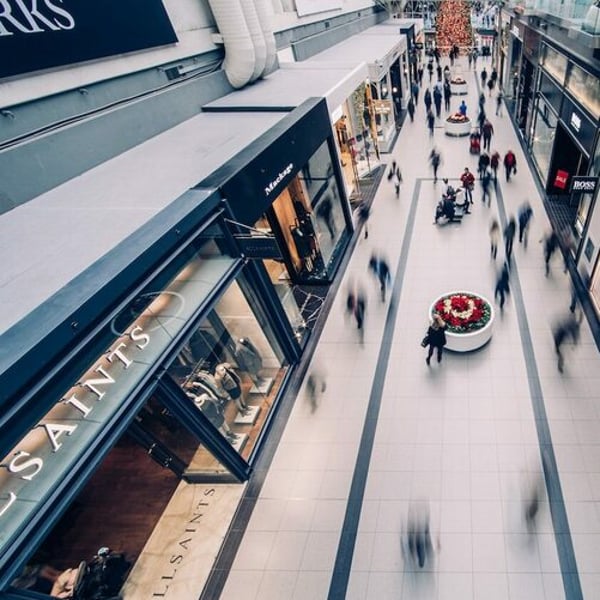
November’s retail sales, in discretionary categories proved unexciting — that’s the conclusion to be drawn from the latest monthly High Street Sales Tracker (HSST) from accountancy and business advisory firm BDO.
Photo: Pexels/Public domain
It said that total like-for-like retail sales in-store and online grew by 3.4% in November, while stores recorded sales growth of just 1.3% compared to November 2024.
But overall, discretionary spend growth remained below inflation meaning sales volumes were down.
And coming after those sales fell 5.8% a year ago, it’s clear that they haven’t yet even recovered that lost ground.
In-store specifically, sales grew by just 1.3%, as mentioned, compared to a very poor base of a 5.5% fall in November 2024. This is also well below the rate of inflation which means that sales volumes are significantly down.
And sales growth this time was primarily driven by online, which increased by 9.9% compared to a negative 7.8% for the same month last year, reflecting the continued struggles of physical stores to attract consumer spending, but also online spending barely getting back to where it was in November 2023.
Worse for those who invested a lot in Black Friday promotions is that while the event “failed to drive any meaningful sales growth for retailers or get shoppers spending in stores in November”, Black Friday week itself saw the lowest sales growth during the month, at just 0.38% above the same week last year.
The intense discounting during the month will, of course have put further pressure on margins.
BDO’s Sophie Michael said: “While retailers may have thought that consumers were holding back until the budget, which was unhelpfully late in the Golden Quarter, the expected surge in Black Friday discretionary spending just hasn’t materialised.
“Retailers are under intense pressure to compete for every pound spent on non-essentials, and persistent food inflation is making this battle all the tougher, leaving consumers with less money to spend in discretionary categories. Ultimately this Christmas may come down to a battle between feasting and gifting – will consumers prioritise filling their festive tables or buying gifts and filling stockings?”
She also thinks it will be “tempting for retailers to continue the heavy discounting we saw in November, to boost sales and clear stock before new product lines come through in January, but we know that this only erodes margins. Margins and profits are already under huge pressure, and we’ve seen in November that discounts are not enough to get shoppers into stores”.
Gant has a new CEO as of this month. The Swedish-but-with-American-roots brand has named Fredrik Malm as its chief executive, effective December 1.
Gant CEO Fredrik Malm
It’s an internal appointment with Malm having joined Gant in 2024 as EVP Commercial, Brand & Product. He succeeds Patrik Söderström, who’d led the company for six years.
Before joining the firm, Malm was CEO of SNS, and had been president Europe & International at Coach, as well as president of sales EMEA at Ralph Lauren, and retail director at ECCO.
Gant has been owned by privately-owned Swiss business MF Brands Group (which also owns Lacoste, Tecnifibre and Aigle) since 2008. And MF’s CEO Thierry Guibert said of Gant’s new leader: “Fredrik has brought valuable and extensive leadership experience from global premium fashion and lifestyle brands.
“I have full confidence in his ability to support Gant in its next phase of development, which will notably involve the continued elevation of the collections and an accelerated retailisation across both physical and digital channels.
“I would also like to deeply thank Patrik Söderström for his commitment alongside us over the past 10 years. He has played a pivotal role in transforming and elevating the brand while delivering strong financial performances over the years.”
Gant has been expanding this year, and in late May it reopened its Regent Street, London flagship. It said the refurbishment of the 6,300 sq m space “represents a key milestone in the brand’s global retail investments in the UK and worldwide”. Söderström said at the time that the reopening “kicks off a global initiative to elevate our retail experience”.
The company has also been focusing on its licenses and in June announced the early renewal of its exclusive licensing deal for the design, manufacture, and global distribution of its eyewear with Marcolin.
Lawyers for Chinese online platform Shein return to a Paris court on Friday for a hearing on the French government’s request to suspend the firm’s website for three months, after childlike sex dolls and banned weapons were discovered on its marketplace.
Customers queue to enter the first physical space of Chinese online fast-fashion retailer Shein on the day of its opening inside the Le BHV Marais department store, the Bazar de l’Hotel de Ville, in Paris, France, November 5, 2025 – REUTERS/Sarah Meyssonnier/File Photo
Shein disabled its marketplace- where third-party sellers list their products- in France on November 5, after authorities found the illegal items for sale, but its main site selling Shein-branded clothing remains accessible. The French state wants the website suspended for a minimum of three months in the country, which it argues is needed for Shein to prove that its contents comply with the law.
It has invoked Article 6.3 of France’s digital economy law, which gives a judge powers to prescribe measures with the aim of preventing or halting harm caused by online content. France has also summoned major internet service providers Bouygues Telecom, Free, Orange, and SFR to the hearing, requesting they block Shein’s website. The court will have to decide whether a suspension is warranted, and whether it is in line with European Union law.
In a statement last week, the Paris prosecutor’s office said a three-month suspension could be deemed “disproportionate” under the case law of the European Court of Human Rights if Shein could prove it has stopped all sales of illegal goods. However, the prosecutor said it “fully backed” the government’s demand that Shein provide evidence of measures taken to end those sales.
France’s move comes amid broader scrutiny of Chinese giants such as Shein and Temu under the EU’s Digital Services Act, reflecting concerns about consumer safety, illegal product sales and unfair competition. Meanwhile in the US, Texas Attorney General Ken Paxton said on Monday he is investigating Shein to determine whether the fast fashion retailer violated state law related to unethical labour practices and the sale of unsafe consumer products.
China’s HongShan Capital Group (HSG) has sent a 2.5 billion euro ($2.91 billion) offer to private equity Permira to buy Italian luxury sneaker maker Golden Goose, with the aim of signing the deal by Christmas, daily la Repubblica reported on Friday.
Golden Goose is known for its luxury sneakers – goldengoose.com
Details still need to be defined but the offer gives the luxury group an enterprise value of 10 times the core profit expected by the end of the year, debt included, the newspaper said. Golden Goose’s revenues totalled 655 million euros in 2024, with an adjusted core profit of 227 million euros.
HSG has asked veteran fashion industry executive Marco Bizzarri to become Golden Goose’s future chairman, la Repubblica said, adding that the Chinese private equity aims to expand Golden Goose’s directly-managed stores, particularly in Asia, and plans to list the group in the medium-term.
Last year the Venice-based company, which sells sneakers for more than 500 euros a pair, shelved plans for an initial public offering on the Milan Bourse, citing market volatility caused by political uncertainty in Europe.