Connect with us

Politics

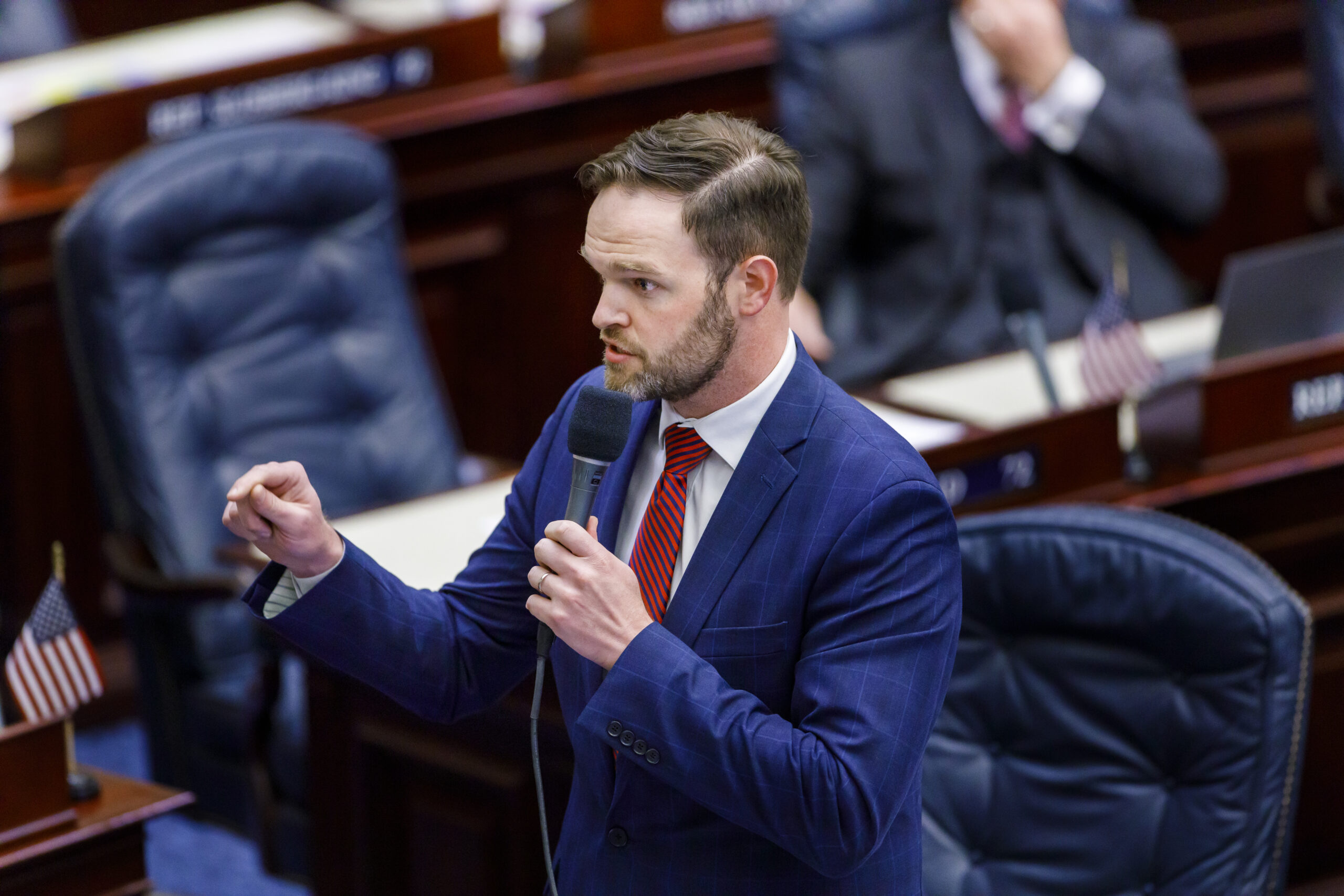
Alex Andrade questions state agency’s repayment in Hope Florida scandal
Published

on


A state agency is repaying the federal government a portion of $10 million of the Medicaid money that had been diverted to Hope Florida and spent on political purposes, said Rep. Alex Andrade, a fierce critic of First Lady Casey DeSantis’ charity.

In Andrade’s views, it deepens the financial impact of Hope Florida’s scandal.

Instead of $10 million in taxpayer money wasted, the cost is now $16 million, Andrade said.

“It means James stole $16 million from taxpayers,” said Andrade, taking a shot at Attorney General James Uthmeier, who previously chaired the Keep Florida Clean committee that received millions of dollars tied to the tainted Hope Florida funds. Uthmeier has defended himself, arguing that what he did was legal and the right thing to do to fight last year’s recreational medical marijuana initiative.

Andrade said he views the repayment to the feds as the Florida Agency for Health Care Administration (AHCA) admitted that the $10 million was truly Medicaid dollars.

“That is incorrect,” wrote AHCA Deputy Chief of Staff Mallory McManus in an email to Florida Politics when asked about Andrade’s claims.

She did not respond to a request to elaborate and provide more details.

The $10 million under scrutiny was part of a $67 million settlement from state Medicaid contractor Centene.

Earlier, Gov. Ron DeSantis described the $10 million as “a cherry on top” in the settlement, arguing it wasn’t truly from Medicaid money.

“When you do settlements, you can try to get as much money as you can, but this was in addition to what they were getting,” DeSantis said in April.

Andrade argued Thursday that new state records prove otherwise.

Under the Federal Medical Assistance Program (FMAP), 57.2% out of every $1 spent on Medicaid in Florida comes from the federal government, said Andrade, who chairs the House Health Care Budget Subcommittee that probed Hope Florida earlier this year.

“The rule says when you recoup from a Medicaid claim, when you collect it back from someone who didn’t deserve it in the first place, you got to send it back to the feds. You got to send that 57.2% back to the feds,” he said.

Andrade said he has been waiting to see how much ACHA would repay to the federal government, based on the math, from the $67 million settlement that sparked the scandal.

“If ACHA really does believe that only $57 million of the Centene settlement was Medicaid money, they would pay the feds back $32 million,” Andrade said. “If ACHA knows that the full $67 million in the settlement was all Medicaid money, then ACHA would pay the feds back $38 million.”

Andrade said he finally got an answer from last month’s posted payments: $38 million.

“It is exactly the FMAP share if all $67 million was Medicaid money,” he said. “If it wasn’t Medicaid money, then we just gave the feds back $6 million and everybody at AHCA is incompetent and just wasted $6 million in state money.”

Andrade contacted AHCA for clarification on the FMAP calculation, but said he has not heard back.

___

Staff writer A.G. Gancarski contributed to this report.


Source link

Continue Reading

Politics

FICPA backs bills modernizing accountant licensure during ‘CPA Day at the Capitol’

Published

on


‘Our priority legislation aims to make Florida into a national model for effective, efficient CPA licensure.’

The Florida Institute of Certified Public Accountants drew more than 150 CPAs to Tallahassee this week for its annual CPA Day at the Capitol, marking the largest advocacy event in the organization’s history.

FICPA was at the Capitol to support the Institute’s priority legislation for 2026, HB 333 by Rep. Omar Blanco and SB 364 by Sen. Joe Gruters, who is a CPA by trade.

The bills focus on modernizing Florida’s CPA licensure system. FICPA leaders say the proposed updates would make the state’s regulatory framework more efficient and accessible while maintaining professional standards.

The legislation outlines four significant changes: creating three new pathways to licensure, establishing automatic mobility for CPAs licensed in other states, streamlining Florida’s licensure-by-endorsement process and implementing broader efficiencies aimed at strengthening the state’s position as “a leader in pro-business licensing.”

“Our priority legislation aims to make Florida into a national model for effective, efficient CPA licensure,” said Shelly Weir, FICPA’s President and CEO. “We are grateful to our bill sponsors for their leadership, and we are excited to work with both chambers to see this landmark legislation pass through the Florida House and Senate.”

SB 364 is on the agenda for the Senate Regulated Industries Committee’s meeting on Dec. 9. If approved, the bill would move to its second and final stop in Senate Rules. The House companion is awaiting a hearing in the Industries & Professional Activities Subcommittee.


Source link

Continue Reading

Politics

Insurance market stabilizing, but work remains

Published

on


Florida’s Insurance Commissioner says the state’s three-year-old property insurance reforms are continuing to push the market toward stability, but there’s still work to be done on litigation, accountability and claims handling.

In an interview with Florida Politics, Michael Yaworsky said overall litigation is down about 30% since lawmakers approved the property insurance reforms in a late 2022 Special Session and an extensive tort law rewrite in the 2023 Regular Session.

But he noted that lawsuits remain “much higher than every other state,” a gap he acknowledged continues to drive costs even after the reforms. For now, he said, regulators want to stay the course and let the reforms continue to work through the system rather than pursue another round of statutory changes.

“One of the things about insurance is that even when you’re making great moves, (regulatory changes) can drive uncertainty. And uncertainty is a major cost driver in insurance. So our goal would be to let these changes bake in on the litigation front before we move again,” said Yaworsky, who is set to deliver the keynote address at the Florida Chamber’s 2025 Annual Insurance Summit.

Even as the state sees new carriers enter the market and existing companies file for decreases, Yaworsky said the work of stabilizing the system is only partly legislative. The other half is enforcement. He pointed to what he said was a roughly 700% increase in fines and penalties against insurers this year — part of a broader “insurer accountability” push that passed shortly after the torts rewrite.

That effort has been visible in recent months. In September, Yaworsky’s office fined eight carriers more than $2 million for misconduct tied to Hurricane Ian and Hurricane Idalia claims, including using unappointed adjusters, failing to acknowledge claims, and failing to pay interest owed. At the time, Yaworsky said that while capital was returning to the market, insurers “must also be worthy of doing business in our state.” Two additional companies remain under investigation.

Regulators are also preparing for a new frontier in oversight: artificial intelligence. Yaworsky said OIR is developing guardrails around AI-driven underwriting and claims decisions, stressing that carriers must maintain a meaningful “human-in-the-loop concept” to prevent improper denials and ensure consumers can understand how decisions are made.

“You don’t want a machine, no matter how brilliant it is thought to be, to be the one that’s denying your claim and doing it wrongly,” Yaworsky said.

Skeptics of Florida’s improving outlook often point to the concentration of smaller domestic insurers and longstanding concerns about credit ratings in the state. A Wall Street Journal article earlier this year highlighted the ratings company Demotech, which has given high marks to small carriers that later failed.

Yaworsky pushed back on that critique, arguing that financial strength reviews come from his agency — not ratings agencies — and that OIR employs more than 100 analysts who review insurers and their holding companies daily. Rating requirements, he said, matter primarily for Fannie Mae and Freddie Mac mortgage compliance, not for solvency determinations.

“We don’t give a lot of weight to ratings agencies … it’s not something that we look at on a day-to-day basis,” he said. He also noted that more than 60% of companies writing in Florida now carry ratings from multiple agencies, which OIR encourages.

“But from our standpoint, we’re doing a complete and thorough examination on our own of the financial welfare of companies, and that’s consistent across the country.”

Competition, he said, is also expanding as litigation levels out. Yaworsky pointed to several carriers filing for decreases this year and national brands increasing their presence. Some homeowners are again receiving multiple quotes, a shift from the “one option and take it or leave it” market many faced two years ago.

One recent example: Heritage Property & Casualty received approval this Fall for an average 3.3% statewide decrease, with cuts approaching 10% in some counties. But that filing reflects one company’s rate structure — not a universal trend — and Yaworsky acknowledged that statewide averages can obscure individual outcomes.

“A 0% statewide increase is truly a zero,” he said, “but if the average is a negative-1%, roughly half of policyholders will be above that and half will be below.”

In practice, that means some homeowners will see decreases while others continue to face higher premiums depending on location, risk profile and carrier performance.

For those still struggling with high costs, Yaworsky encouraged homeowners to shop aggressively, and to expect their agents to shop for them — and if they aren’t, then perhaps it’s time to shop for a new agent.

“We have a lot of great agents out there, and if their agent isn’t checking in twice a year, telling that consumer, ‘I’ve run the numbers and I’ve looked for other options for you,’ … then they really should talk to a new agent,” Yaworsky said.

He also emphasized the role of mitigation and storm hardening, noting that homeowners who make meaningful improvements to their property can see a dramatic reduction in their bill. The My Safe Florida Home program, which provides grants to help homeowners pay for storm-hardening enhancements, is one avenue OIR encourages Floridians to pursue.

“We think it’s good number one, because you save money on your insurance policy, but also it makes your house a lot stronger during a potential catastrophic event, and you’re less likely to suffer a severe loss,” Yaworsky said.


Source link

Continue Reading

Politics

AFP launches campaign touting early progress from insurance reforms

Published

on


‘Newer insurers are writing property insurance policies in the state and litigation costs are declining.’

The Americans for Prosperity Foundation is launching a statewide mail and digital education campaign touting early signs of stabilization in Florida’s property insurance market following a series of reforms.

The organization says the materials are designed to help Floridians understand how recent legislative changes — including curbing excessive litigation, eliminating one-way attorney fees and adding consumer protections — are contributing to a more competitive market for homeowners, families and small businesses.

“Florida’s property insurance crisis called for meaningful reforms,” said Skylar Zander, state director for Americans for Prosperity-Florida.

“We are now seeing that the market has stabilized. Newer insurers are writing property insurance policies in the state, and litigation costs are declining. We are even seeing many Florida homeowners receiving rate decreases to their premiums, helping to ease costs and bring some financial relief to Florida families.”

State lawmakers approved major insurance reforms in 2022 and 2023 as multiple carriers entered receivership or pulled out of Florida, litigation costs soared, and homeowners faced rapid premium increases.

AFP says its new campaign highlights how those changes are already showing results, including reduced legal expenses and more companies returning to the market.

The Foundation plans to continue its education effort, saying the reforms have fostered what it describes as a more stable and sustainable property insurance system.

A sample mailer is below.


Source link

Continue Reading

Trending

Copyright © Miami Select.