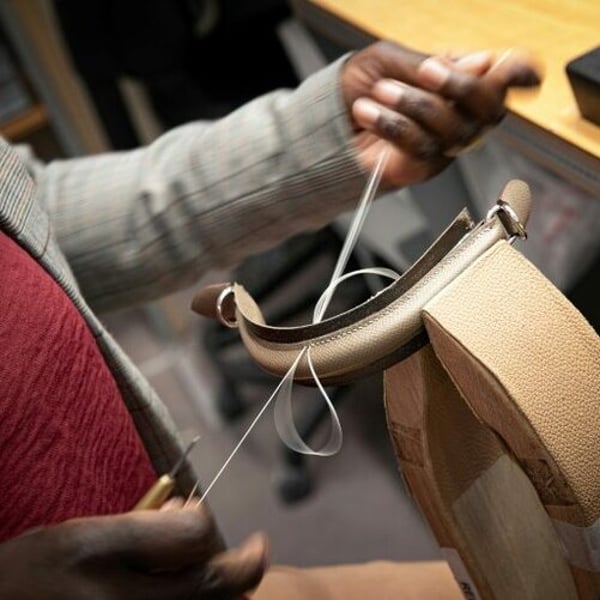
Italian police on Wednesday visited the headquarters of 13 high-end fashion firms, asking them to hand over documents on governance and supply-chain controls as part of an investigation into alleged worker abuse at fashion subcontractors, judicial documents showed.
Italy is looking into luxury production – AFP
The brands that received document production orders are Dolce & Gabbana, Versace, Prada, Adidas Italy , Off-White Operating, Missoni, Ferragamo, Givenchy Italia, Alexander McQueen Italia, Kering‘s Gucci and Yves Saint Laurent Manifatture , Cris Conf. (Pinko), and Coccinelle. None of these companies is under investigation and prosecutors have not sought to impose court-appointed administration for any of them, according to the orders seen by Reuters.
The 13 groups did immediately respond to a Reuters request for comment. In the past two years, five other high-end fashion groups have been placed under such administration and the same measure has been requested for a sixth, in a string of cases that have tainted the image of some of the biggest names in the industry.
The 13 brands were drawn into the probe because, during dozens of searches of Chinese-owned workshops which led Milan prosecutors to request or impose judicial administration on the six companies, police also found garments and subcontracting documents relating to these other labels. The operation on Wednesday was led by the Carabinieri labour unit in Milan, supported by officers in the cities of Florence, Parma, and Varese.
Prosecutors did not seek court-appointed administration for the 13 because only smaller quantities of their products were found in the Chinese workshops inspected, the documents show. The purpose of the requests, according to the judicial documents reviewed by Reuters, is to allow prosecutors to assess how far the 13 companies were involved in the use of exploited labour and whether their compliance and governance models are adequate to prevent abuse.
Once the requested material is handed over, the 13 companies will be allowed to address any issues identified on their own initiative by adjusting their organisational models. If they fail to do so, Milan prosecutors reserve the right to take further preventive or precautionary measures, the documents show.
Investigations by Italian magistrates have exposed widespread exploitation of workers in the fashion and luxury supply chain. Italian industry minister Adolfo Urso said in October the government had put forward a bill to create legal certification of fashion companies.
Under the initiative, brands, including those targeted by legal actions, could obtain pre-emptive third-party certification of their supply chains’ legal compliance. “With this measure, it will be possible to secure Italy’s fashion supply chain, a source of pride for ‘Made in Italy‘, and protect its reputation worldwide,” Urso said.
Italy is home to thousands of small manufacturers that make up 50%-55% of global luxury goods production, consultancy Bain has calculated. In May, Italy’s fashion brands signed an accord with legal and political authorities to fight worker exploitation.
The production orders list a very long series of documents that prosecutors want to examine. They start with governance material: full historical company registry extracts for the 13 groups, intercompany service agreements and intercompany relationships, corporate organisation charts, job descriptions for staff involved in supplier selection, management and monitoring, and minutes of board and statutory auditors’ meetings from 2023 to date. They then move to internal control systems: procedures for accrediting and monitoring suppliers, and operating practices and instructions on monitoring contractors.
Next comes risk assessment: the organisation, management and control model, minutes of the supervisory body, code of conduct, whistleblowing reports register, a list of disciplinary sanctions from 2023 to date, and training records. Finally, they look at audit activity: the audit function’s work plan and findings, lists of suppliers and subcontractors, copies of contracts signed with the workshops under investigation, and any product-tracking systems.
The world’s largest fashion retailer staged a stock-market comeback this week as Inditex SA’s push to differentiate itself from fierce ultra-low-price competition shows signs of bearing fruit.
Inside a Zara store – Zara
The owner of Zara, Bershka, and Massimo Dutti has seen its shares jump 14%, putting them on track for their best week in five years. Strong third-quarter results, coupled with accelerating November sales, were seen as evidence of the company’s resilience against weaker consumer sentiment.
This week’s surge put the stock on course for an annual gain, after what had previously looked like a lacklustre 2025. Inditex- whose second-largest market is the US- had been punished for its exposure to tariffs and a weaker greenback, amid concerns about softening consumer demand and intensifying competition from Chinese fast-fashion firms.
While its 10% rise this year trails the 50% jump for UK retailer Next Plc and the 19% gain at Sweden’s Hennes & Mauritz AB, Inditex is now outperforming the broader European retail sector. Analysts have welcomed the firm’s push to steer its Zara and Massimo Dutti brands further into the premium segment as it seeks to outmuscle competitors such as Shein and Temu. “The strategy is not to chase ultra-low prices, but to deliver premium-looking products at a good-value price point,” Alphavalue analyst Jie Zhang wrote in a note.
After this week’s rally, Inditex is trading at a substantially higher valuation than peers at 26 times forward earnings- on par with luxury behemoth LVMH. The firm’s strong third-quarter earnings reinforce “the quality of the business and will make investors question whether the right peer group for this company is luxury rather than retail in our view,” said Deutsche Bank AG analyst Adam Cochrane.
Inditex’s latest trading update spurred upward earnings revisions and price target upgrades, with more bullishness among brokers likely to follow, as the current consensus 12-month forward price target doesn’t leave any room for further upside. “These growth levels should provide reassurance of the continued opportunity for outperformance, including into 2026,” said JPMorgan & Chase Co. analyst Georgina Johanan.
A partnership between Agromethod Labs and CITEVE is advancing hydroponic cotton cultivation, a project that could make Portugal the only country in Europe to host the entire cotton value chain, from fibre to clothing.
Agromethod Labs was founded earlier this year with the mission of developing more sustainable, future-oriented agricultural solutions. Its founder, Raquel Maria, a chemist by training with a long track record in academic research, explains that the impetus to create thestart-upstemmed from a personal concern.
“Academia allows us to change the world on a small scale. I felt it was time to bring that knowledge into the real world and have a greater impact on future generations,” she told Portugal Têxtil.
Although Agromethod Labs works across several fields, cotton quickly stood out, building on previous research, notably by researcher Filipe Natálio, currently at the Applied Biomolecular Sciences Unit (UCIBIO) of the School of Science and Technology at Universidade Nova de Lisboa (NOVA FCT). “But we want to continue working on other types of crops and other seeds. Agromethod Labs is bigger than cotton,” she says.
Approaching CITEVE marked a turning point. According to the founder, the hydroponic cotton project “was very much on paper” and required initial investment and a solid technological partner. “CITEVE was decisive. It came along at the right time and finally gave us the opportunity to get started with something that we had already thought about extensively, but which was not yet in a position to move forward,” she says.
The collaboration has made it possible to implement a functional mini pilot, already with measurable results, and to prepare the next phase: a larger-scale pilot that will incorporate vertical farming to maximise the production area.
Advantages and challenges
Hydroponic cultivation offers significant advantages, notes Raquel Maria. “We can grow anywhere in the world, without reliance on sunlight and without geographical limitations,” she explains. It also enables continuous production. “We are no longer limited to a single annual harvest. We can get three or four harvests a year,” she says.
Early results also show improvements in the fibre. “We have obtained cotton with better mechanical properties and greater whiteness, which can reduce some stages in textile processing,” says Raquel Maria.
Even so, the founder of Agromethod Labs recognises that there are challenges, particularly in terms of costs, since this cultivation technique is more expensive. However, incorporating vertical farming in the new pilot could help. “If we double the production area, we can get closer to the economic viability we want,” she believes. Considering the higher costs and added value of the fibre, the raw material produced “in the initial phase will be directed to specialised markets,” she says.
The small-scale production carried out in a room at CITEVE has already made it possible to produce yarn from hydroponic cotton. The next symbolic goal will be “to make a T-shirt and be able to say that it was made with cotton produced in Portugal would be wonderful,” confesses Raquel Maria.
With expansion planned for the next six months, the aim will be to significantly increase production and take an important step closer to the market. According to the founder of Agromethod Labs, the Portuguese textile industry has already started to show enthusiasm. “There have been several expressions of interest. We are completely open to collaborating with Portuguese companies,” she says.
However, the ambition goes beyond fibre production. “Portugal could be the only country in Europe to have the entire value chain- from raw material to end product- in a single territory. That would be a milestone for the country,” concludes Raquel Maria.
This article is an automatic translation. Click here to read the original article.
Dancing in the Clouds: the 2026 colour designated by the Pantone Color Institute is Pantone 11-4201 Cloud Dancer: “A neutral shade of white that fosters calm, clarity, and a creative breathing space in a world full of noise.”
Pantone 2026
Pantone’s website crashed as the countdown ended, while the announcement on social media showed a woman dressed in white, gazing dreamily at a cloud-filled sky.
Since 1999, beginning with Cerulean Blue, Pantone’s global experts have been naming the Color of the Year, the shade they believe will become prevalent across fashion, food, design, and entertainment; in 2026, that mantle falls to Cloud Dancer.
Cloud Dancer is a blank canvas on which to begin anew, explained Leatrice Eiseman, executive director of the Pantone Color Institute: “An invitation to open new paths and new ways of thinking.”
The mood is clearly one of serenity and an invitation to open new chapters; the election in New York of the young mayor Zohran Mamdani could be an example of this new philosophy. And yet, given the recent political climate in the US under Donald Trump, some, such as New York Times fashion editor Vanessa Friedman, have raised the possibility of MAGA and anti-DEI instrumentalisation, since the white of 2026 has ‘wiped out’ the 2025 colour, Mocha Mousse, a light brown between cappuccino and chocolate.
“Skin tones did not influence this at all,” Laurie Pressman, president of the Pantone Institute, was quick to point out, noting that Pantone has already received similar questions about other recent choices. “With Peach Fuzz in 2024 and then with Mocha Mousse 2025, we were asked whether the choice had anything to do with race or ethnicity. That’s not how it works. We try to understand what people are looking for and which colour can hopefully provide an answer.” And so Pressman invites us to look beyond metaphors: “It’s a softer white,” she said, describing the hue. “It isn’t a pure white, it isn’t a technical white, it isn’t that optically very bright white that, if we think back to the post-Covid period, people were seeking. This is deliberately an unbleached white, a very natural-looking white.”
Meanwhile, the launch of Cloud Dancer has attracted a host of brands eager to keep pace: Hasbro’s Play-Doh has created a tub of Play-Doh in this hue, while Post-it has released pads in the same shade as part of its Neutrality Collection; and the Mandarin Oriental luxury hotel chain will centre its afternoon tea and spa experiences on this minimalist colour. Spotify has also come on board, in its first collaboration with Pantone, creating a multisensory experience that translates “the emotion of colour” into sound through personalised playlists.
This article is an automatic translation. Click here to read the original article.