Connect with us

Business

‘You’re going to be screaming into the void. You’re going to be useless’: 21-year-old aspiring journalist reveals Gen Z hatred, apathy about media

Published

on


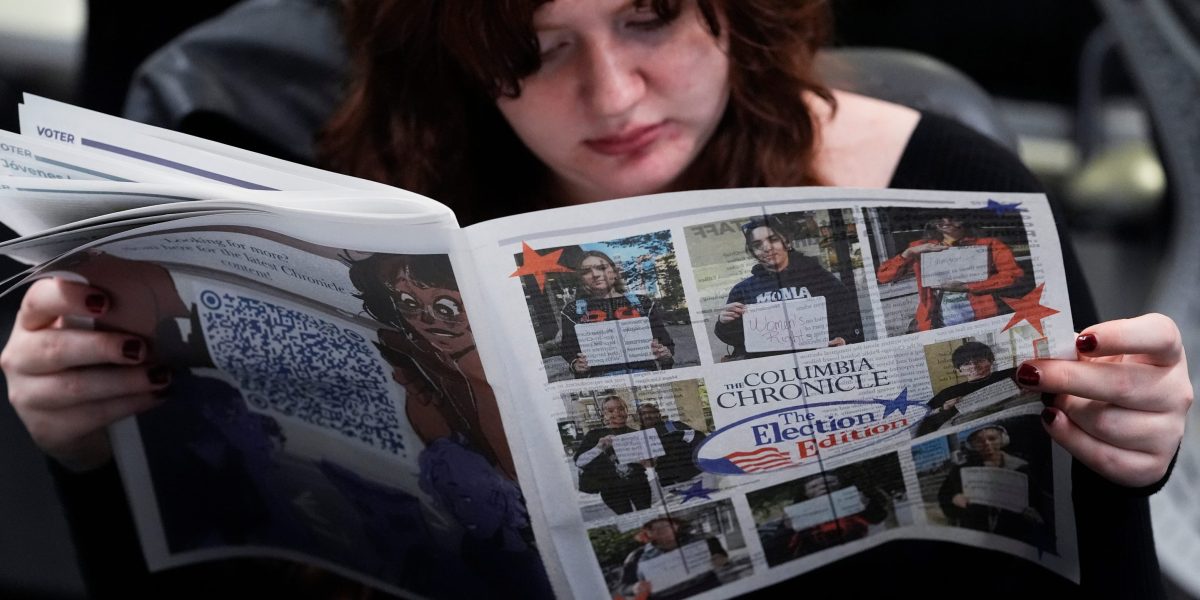
Cat Murphy, a college student, has wanted to be a journalist since she was 11. Many of her friends don’t understand why.

When they engage with the news — if they do — they hear a cacophony of voices. They don’t know who to believe. Reporters are biased. They make mistakes. Besides, why would you hitch your future to a dying industry?

“There is a lot of commentary — ‘Oh, good for you. Look what you’re walking into. You’re going to be screaming into the void. You’re going to be useless,’” said Murphy, a 21-year-old graduate student at the University of Maryland’s journalism school.

She is undeterred. And it’s also why she’s not surprised by the findings of a study this fall that documented negative attitudes toward the news media among 13- to 18-year-old Americans. The press rarely fares well in surveys of adults, but it’s sobering to see the same disdain among people whose opinions about the world are still forming.

Words to describe the news media today

Asked by the News Literacy Project for one word to describe today’s news media, 84% of teens responded with something negative — “biased,” “crazy,” “boring,” “fake, ”bad,” “depressing,” “confusing,” “scary.”

More than half of the teens surveyed believe journalists regularly engage in unethical behaviors like making up details or quotes in stories, paying sources, taking visual images out of context or doing favors for advertisers. Less than a third believe reporters correct their errors, confirm facts before reporting them, gather information from multiple sources or cover stories in the public interest — practices ingrained in the DNA of reputable journalists.

To some degree, teens reflect the attitudes they’re exposed to, particularly when the most prominent politician of their age has made “fake news” a mantra. Experts say few teens follow news regularly or learn in school about the purpose of journalism.

Journalists don’t help themselves with mistakes or ethical lapses that make headlines. Opinionated reporters or commentators in an era of political division make readers wonder what to believe.

“Some of this (attitude) is earned, but much of it is based on misperception,” said Peter Adams, senior vice president of research and design for the Washington-based News Literacy Project.

Never picking up the news habit

There are ways to turn things around, but it will take work.

Many of Lily Ogburn’s classmates get their information from social media. Their parents didn’t watch or read news reports as they grew up, so they didn’t pick up the habit, said Ogburn, a senior at Northwestern University’s journalism school.

Ogburn is the former editor-in-chief at the well-regarded Daily Northwestern student newspaper. The newspaper’s 2023 reports on alleged hazing and racism within the school’s football program led to the ouster of its coach. Still, she found some students don’t understand the newspaper’s role; they believe it exists to protect people in power rather than hold them accountable.

She frequently had to explain what she did to classmates. “There’s a lot of mistrust toward journalists,” she said. But it has firmed her resolve to stick with the profession.

“I want to be a journalist that people trust,” Ogburn said, “and I want to report news that makes people believe and trust in the media.”

The news industry’s financial troubles over the past two decades have hollowed out newsrooms and left fewer journalists on duty. Along with not seeing much legitimate journalism, young people frequently don’t experience it through popular culture — unlike a previous generation, which learned in detail how Washington Post reporters Robert Woodward and Carl Bernstein exposed the Watergate scandal in the Academy Award-winning movie “All the President’s Men.”

When the News Literacy Project asked, two-thirds of teens couldn’t think of anything when asked what movies or TV shows come to mind when they think about journalism. Those who had answers most frequently cited the “Spider-Man” franchise or the movie “Anchorman: The Legend of Ron Burgundy.” Neither portrayal was particularly flattering.

Upon retiring as editor of Newsday, Howard Schneider helped develop the State University of New York system’s first School of Journalism. But instead of teaching future writers, editors or producers, he became drawn to teaching non-journalists about being news consumers.

Now the executive director of SUNY Stony Brook’s Center for News Literacy, Schneider wasn’t surprised about any of the recent survey’s findings, either.

“The negativity, the feeling that news is biased, is just a reflection of how their parents feel,” Schneider said. “The more exposed to news, legitimate news, the more their attitudes turn positive.”

He has developed news literacy programs for school districts. “Students will say, ‘I get my news from YouTube,’” he said. “I say, ‘No, you don’t,’” and explains where the news originates and how to be discerning about what they see.

Lessons from a news literacy class

That’s one of the lessons that 16-year-old Brianne Boyack has taken from her course in news literacy at Brighton High School in Cottonwood Heights, Utah. She had little trust in news going in, but has learned the importance of double-checking sources when she sees something interesting and seeking outlets she’s found reliable.

Her classmate, Rhett MacFarlane, applied what he learned in class to investigate when a friend told him the Louvre was robbed in Paris.

“I’ve learned that there is definitely fact-checking (in journalism),” MacFarlane, also 16, told The Associated Press. “You guys are professionals and you have to tell the truth or you’d be fired. I thought you guys just did whatever you wanted and chose what to say about a topic.”

Still, news literacy programs in schools are relatively rare. Schools already have a lot of subjects to cover to prepare students for the future. And, remember, journalists don’t have the best reputations. It can be hard for educators to stick their necks out for them.

“There’s an inertia here,” Schneider said, “and this is an urgent issue.”

At the University of Maryland, Murphy said she didn’t think there was an inherent hatred toward journalists among her fellow students. “They don’t have any experience reading journalism,” she said.

That’s where she sees the journalism industry needing to make more of an effort. One of the things she finds most frustrating about her chosen field is a resistance to change, particularly an unwillingness or inability to make meaningful use of social media.

“There’s very little movement in the direction of going to where people are, as opposed to expecting them to come to where you are,” Murphy said. “The only way to turn it around is going to be to switch to doing things that captivate people today, as opposed to captivating people 20 years ago.”


Source link

Continue Reading

Business

Netflix to buy Warner Bros. in $72 billion cash, stock deal

Published

on


Netflix Inc. agreed to buy Warner Bros. Discovery Inc., marking a seismic shift in the entertainment business as a Silicon Valley-bred streaming giant tries to swallow one of Hollywood’s oldest and most revered studios.

Under terms of the deal announced Friday, Warner Bros. shareholders will receive $27.75 a share in cash and stock in Netflix, valuing the business at $82.7 billion including debt. The total equity value of the deal is $72 billion. Warner Bros. will spin off cable networks such as CNN and TNT into a separate company before concluding the sale of its studio and HBO to Netflix. 

Media mergers of this scale have a rocky history and this one is expected to bring intense regulatory scrutiny in the US and Europe. The deal combines two of the world’s biggest streaming providers with some 450 million subscribers. Warner Bros.’ deep library of programming gives Netflix content to sustain its lead over challengers like Walt Disney Co. and Paramount Skydance Corp. 

The acquisition, which confirmed a Bloomberg report Thursday, presents a strategic pivot for Netflix, which has never made a deal of this scope in its 28-year history. With the purchase, Netflix becomes owner of the HBO network, along with its library of hit shows like The Sopranos and TheWhite Lotus. Warner Bros. assets also include its sprawling studios in Burbank, California, along with a vast film and TV archive that includes Harry Potter and Friends. 

“I know some of you are surprised we are making this acquisition,” Netflix co-Chief Executive Officer Ted Sarandos said on a call with analysts Friday. He noted that Netflix has traditionally been known to be builders, not buyers. “But this is a rare opportunity that will help us achieve our mission to entertain the world.”

Netflix shares were down 3.5% Friday afternoon in New York. They have declined about 17% since the streaming leader emerged as an interested party in October. Some investors and analysts have interpreted this deal to mean Netflix was worried it couldn’t expand its current business, a theory co-CEO Greg Peters dismissed.

Warner Bros. stock was up about 5.2% midday in New York. It has almost doubled since reports of deal talks with Paramount emerged in September. Play Video

The news concludes a flurry of dealmaking over the past few months that began with a series of bids by Paramount. That prompted interest from Comcast Corp. and Netflix, who were both chasing just the studios and streaming business. All three submitted sweetened bids earlier this week, with Paramount ultimately offering $30 a share for all of Warner Bros. Discovery, arguing that its proposal offered a smoother path to regulatory approval. Netflix won out in the end although significant hurdles remain before the deal can close, which the company expects it can do in the next 18 months.

Paramount could still try to raise its bid, take its offer directly to shareholders or sue to try and block the Netflix deal. The company had no comment.

California Republican Darrell Issa wrote a note to US regulators objecting to any potential Netflix deal, saying it could result in harm to consumers. Netflix has argued that one of its biggest competitors, however, is Alphabet Inc.’s YouTube, and that bundling offerings could lower prices for subscribers. Netflix accounts for between 8% and 9% of TV viewing in the US each month, according to Nielsen. It accounts for closer to 20% or 25% of streaming consumption.

Analysts at Oppenheimer said platforms such as Reels, TikTok and YouTube competing for viewers’ time should help the deal pass antitrust review. 

It was 15 years ago that Time Warner CEO Jeff Bewkes, who oversaw Warner Bros. and HBO, shrugged off the threat posed by Netflix, comparing the then fledgling company to the Albanian Army. As Netflix began to invest in original programming, Sarandos declared that Netflix wanted to become HBO before HBO figured out streaming.

Sarandos succeeded and Netflix led the streaming takeover of Hollywood while HBO struggled to respond to the rise of on demand viewing and the decline of cable. Bewkes agreed to sell Time Warner to AT&T in 2016, the beginning of a decade of turmoil for HBO and Warner Bros., storied brands that are about to have their fourth owner in a decade.

Warner Bros. put itself up for sale in October after receiving three acquisition offers from Paramount, which were rejected, opening the door for Netflix and Comcast. Peters said he didn’t see the logic of these big transactions at Bloomberg’s Screentime conference in October, but Sarandos privately pushed for the deal.

The bidding got contentious, with Paramount accusing Warner Bros. of operating an unfair process that favored Netflix. The Netflix offer topped Paramount’s when combining the money for the studio and streaming business with the estimated value of the networks. The two sides agreed to the deal Thursday night. 

Under terms of the agreement, Warner Bros. shareholders will receive $23.25 in cash and $4.50 in Netflix common stock. Moelis & Co. is Netflix’s financial adviser. Wells Fargo is acting as an additional financial advisor and, along with BNP Paribas and HSBC Holdings, is providing $59 billion in debt financing, according to a regulatory filing, one of the largest ever loans of its kind. Allen & Co., JPMorgan Chase & Co. and Evercore are serving as financial advisers to Warner Bros. Discovery.

Netflix agreed to pay Warner Bros. a termination fee of $5.8 billion if the deal falls apart or fails to get regulatory approval. “We’re highly confident in the regulatory process,” Sarandos said Friday.

In addition to streaming overlap, regulators will also likely look at the impact on theatrical releases, which Netflix has traditionally eschewed in favor of prioritizing content on its platform.

Netflix said it will continue to release Warner Bros. movies in theaters and produce the studio’s TV shows for third parties — two major changes in how it does business. The company was a little short on details of exactly how it will integrate the different businesses, but Netflix said it expects to maintain Warner Bros.’ current operations and build on its strengths.

The deal will allow Netflix to “significantly expand” US production capacity and invest in original content, which will create jobs and strengthen the entertainment industry, the company said. The combination is also expected to create “at least $2 billion to $3 billion” in cost savings per year by the third year.

Warner Bros. Discovery CEO David Zaslav was the architect of combining Warner Bros. and Discovery in 2022, a deal he hoped would create a viable competitor to Netflix. But the company’s share price tanked in response to a series of public miscues and the continued decline of the cable network business. 

While performance rebounded a bit over the last year, the company never quite became the streaming dynamo Zaslav envisioned. He’ll continue to run the company through its spinoff and sale. The two companies haven’t yet agreed on him having any role at Netflix.

The traditional TV business is in the midst of a major contraction as viewers shift to streaming, the world that Netflix dominates. In the most recent quarter, Warner Bros. cable TV networks division reported a 23% decline in revenue, as customers canceled their subscriptions and advertisers moved elsewhere.


Source link

Continue Reading

Business

Mark Zuckerberg renamed Facebook for the metaverse. 4 years and $70B in losses later, he’s moving on

Published

on


In 2021, Mark Zuckerberg recast Facebook as Meta and declared the metaverse — a digital realm where people would work, socialize, and spend much of their lives — the company’s next great frontier. He framed it as the “successor to the mobile internet” and said Meta would be “metaverse-first.”

The hype wasn’t all him. Grayscale, the investment firm specializing in crypto, called the Metaverse a “trillion-dollar revenue opportunity.” Barbados even opened up an embassy in Decentraland, one of the worlds in the metaverse. 

Five years later, that bet has become one of the most expensive misadventures in tech. Meta’s Reality Labs division has racked up more than $70 billion in losses since 2021, according to Bloomberg, burning through cash on blocky virtual environments, glitchy avatars, expensive headsets, and a user base of approximately 38 people as of 2022.

For many people, the problem is that the value proposition is unclear; the metaverse simply doesn’t yet deliver a must-have reason to ditch their phone or laptop. Despite years of investment, VR remains burdened by serious structural limitations, and for most users there’s simply not enough compelling content beyond niche gaming.

A 30% budget cut 

Zuckerberg is now preparing to slash Reality Labs’ budget by as much as 30%, Bloomberg said. The cuts—which could translate to $4 billion to $6 billion in reduced spend—would hit everything from the Horizon Worlds virtual platform to the Quest hardware unit. Layoffs could come as early as January, though final decisions haven’t been made, according to Bloomberg. 

The move follows a strategy meeting last month at Zuckerberg’s Hawaii compound, where he reviewed Meta’s 2026 budget and asked executives to find 10% cuts across the board, the report said. Reality Labs was told to go deeper. Competition in the broader VR market simply never took off the way Meta expected, one person said. The result: a division long viewed as a money sink is finally being reined in.

Wall Street cheered. Meta’s stock jumped more than 4% Thursday on the news, adding roughly $69 billion in market value.

“Smart move, just late,” Craig Huber of Huber Research told Reuters. Investors have been complaining for years that the metaverse effort was an expensive distraction, one that drained resources without producing meaningful revenue.

Metaverse out, AI in

Meta didn’t immediately respond to Fortune’s request for comment, but it insists it isn’t killing the metaverse outright. A spokesperson told the South China Morning Post that the company is “shifting some investment from Metaverse toward AI glasses and wearables,” point­ing to momentum behind its Ray-Ban smart glasses, which Zuckerberg says have tripled in sales over the past year.

But there’s no avoiding the reality: AI is the new obsession, and the new money pit.

Meta expects to spend around $72 billion on AI this year, nearly matching everything it has lost on the metaverse since 2021. That includes massive outlays for data centers, model development, and new hardware. Investors are much more excited about AI burn than metaverse burn, but even they want clarity on how much Meta will ultimately be spending — and for how long.

Across tech, companies are evaluating anything that isn’t directly tied to AI. Apple is revamping its leadership structure, partially around AI concerns. Microsoft is rethinking the “economics of AI.” Amazon, Google, and Microsoft are pouring billions into cloud infrastructure to keep up with demand. Signs point to money-losing initiatives without a clear AI angle being on the chopping block, with Meta as a dramatic example.

On the company’s most recent earnings call, executives didn’t use the word “metaverse” once.


Source link

Continue Reading

Business

Robert F. Kennedy Jr. turns to AI to make America healthy again

Published

on


HHS billed the plan as a “first step” focused largely on making its work more efficient and coordinating AI adoption across divisions. But the 20-page document also teased some grander plans to promote AI innovation, including in the analysis of patient health data and in drug development.

“For too long, our Department has been bogged down by bureaucracy and busy-work,” Deputy HHS Secretary Jim O’Neill wrote in an introduction to the strategy. “It is time to tear down these barriers to progress and unite in our use of technology to Make America Healthy Again.”

The new strategy signals how leaders across the Trump administration have embraced AI innovation, encouraging employees across the federal workforce to use chatbots and AI assistants for their daily tasks. As generative AI technology made significant leaps under President Joe Biden’s administration, he issued an executive order to establish guardrails for their use. But when President Donald Trump came into office, he repealed that order and his administration has sought to remove barriers to the use of AI across the federal government.

Experts said the administration’s willingness to modernize government operations presents both opportunities and risks. Some said that AI innovation within HHS demanded rigorous standards because it was dealing with sensitive data and questioned whether those would be met under the leadership of Health Secretary Robert F. Kennedy Jr. Some in Kennedy’s own “Make America Health Again” movement have also voiced concerns about tech companies having access to people’s personal information.

Strategy encourages AI use across the department

HHS’s new plan calls for embracing a “try-first” culture to help staff become more productive and capable through the use of AI. Earlier this year, HHS made the popular AI model ChatGPT available to every employee in the department.

The document identifies five key pillars for its AI strategy moving forward, including creating a governance structure that manages risk, designing a suite of AI resources for use across the department, empowering employees to use AI tools, funding programs to set standards for the use of AI in research and development and incorporating AI in public health and patient care.

It says HHS divisions are already working on promoting the use of AI “to deliver personalized, context-aware health guidance to patients by securely accessing and interpreting their medical records in real time.” Some in Kennedy’s Make America Healthy Again movement have expressed concerns about the use of AI tools to analyze health data and say they aren’t comfortable with the U.S. health department working with big tech companies to access people’s personal information.

HHS previously faced criticism for pushing legal boundaries in its sharing of sensitive data when it handed over Medicaid recipients’ personal health data to Immigration and Customs Enforcement officials.

Experts question how the department will ensure sensitive medical data is protected

Oren Etzioni, an artificial intelligence expert who founded a nonprofit to fight political deepfakes, said HHS’s enthusiasm for using AI in health care was worth celebrating but warned that speed shouldn’t come at the expense of safety.

“The HHS strategy lays out ambitious goals — centralized data infrastructure, rapid deployment of AI tools, and an AI-enabled workforce — but ambition brings risk when dealing with the most sensitive data Americans have: their health information,” he said.

Etzioni said the strategy’s call for “gold standard science,” risk assessments and transparency in AI development appear to be positive signs. But he said he doubted whether HHS could meet those standards under the leadership of Kennedy, who he said has often flouted rigor and scientific principles.

Darrell West, senior fellow in the Brooking Institution’s Center for Technology Innovation, noted the document promises to strengthen risk management but doesn’t include detailed information about how that will be done.

“There are a lot of unanswered questions about how sensitive medical information will be handled and the way data will be shared,” he said. “There are clear safeguards in place for individual records, but not as many protections for aggregated information being analyzed by AI tools. I would like to understand how officials plan to balance the use of medical information to improve operations with privacy protections that safeguard people’s personal information.”

Still, West, said, if done carefully, “this could become a transformative example of a modernized agency that performs at a much higher level than before.”

The strategy says HHS had 271 active or planned AI implementations in the 2024 financial year, a number it projects will increase by 70% in 2025.


Source link

Continue Reading

Trending

Copyright © Miami Select.