Connect with us

Politics

Venezuelan leader Nicolas Maduro may seem desperate. But his loyalty vs punishment strategy is hard to crack
Published

on


English phrases once bothered Venezuelan President Nicolás Maduro so much that he urged his State of the Union address audience to phase out words like skatepark and fashion.

But as the White House now ponders whether the U.S. military should strike Venezuela, Maduro is embracing English, singing John Lennon’s Imagine, advocating for peace and dancing to a remix of his latest English catchphrase, “No War, Yes Peace.”

While his turnaround is seen as a sign of desperation by supporters of Venezuela’s political opposition, whose leaders have repeatedly told their backers in Washington that the threat of military action would crack Maduro’s inner circle, months of pressure have yet to produce defections or a government transition.

Behind this knack for staying in power is a system that punishes disloyal associates harshly and allows loyal ministers, justices, military leaders and other officials to enrich themselves.

“The Bolivarian Revolution possesses a remarkable ability: the capacity for cohesion in the face of external pressure,” Ronal Rodríguez, a researcher at the Venezuela Observatory in Colombia’s Universidad del Rosario, said referring to the political movement, also known as Chavismo, that Maduro inherited from the late President Hugo Chávez. “When pressure comes from abroad, they manage to unite, defend and protect themselves.”

Underpinning the loyalty-or-punishment principle are corruption networks blessed by Chávez and Maduro that give the loyal permission to get richer. The policy has vexed previous efforts to unseat Maduro and has helped him and his close associates to skirt economic sanctions, obtain U.S. presidential pardons and claim an electoral victory they resoundingly lost.

Rodríguez explained that prison and torture can be part of the punishment, which is usually harsher for accused wrongdoers with military affiliation. The strategy has been crucial for an authoritarian Maduro to keep control of the military, which he lets traffic drugs, oil, wildlife and myriad goods in exchange for coup-proof barracks.

“This has been a very effective tool because Chavismo has always been able to eliminate those actors who at some point try to rise up, and it has been able to expose corrupt practices from all sorts of actors,” Rodríguez said.

Venezuela’s political opposition, led by Nobel Peace Prize winner María Corina Machado, had banked on the military’s support to dislodge Maduro after credible evidence showed that he lost the 2024 presidential election. But Defense Minister Vladimir Padrino López and other military leaders stood by Maduro, just like they did in 2019 during a barracks revolt by a cadre of soldiers who swore loyalty to Juan Guaidó, the opposition leader recognized at the time by the first Trump administration as Venezuela’s rightful leader.

Since returning to office, U.S. President Donald Trump has increased the pressure on Maduro and his allies, including by doubling to $50 million the reward for information that leads to his arrest on narcoterrorism charges. A 2020 indictment accused Maduro of leading the Cartel de los Soles, which the U.S. State Department on Monday designated as a foreign terrorist organization.

Maduro denies the accusations.

On Saturday, Trump said that the airspace “above and surrounding” the South American country should be considered as “closed in its entirety.” Maduro’s government responded by accusing Trump of making a ”colonial threat,” rallying supporters behind what it called an assault on national sovereignty.

In early September, the U.S. military began blowing up boats that the Trump administration has accused of transporting drugs in the Caribbean Sea and eastern Pacific Ocean, killing more than 80 people.

Many, including Maduro himself, see the U.S. military moves as an effort to end Chavismo’s hold on power. The opposition only added to this perception by reigniting its promise to remove Maduro from office.

Two weeks after the first boat strike, Chavismo’s loyalty was tested directly when Maduro’s pilot rebuffed efforts from the U.S. to join a plot to capture the Venezuelan leader and deliver him into custody to face the charges.

“We Venezuelans are cut from a different cloth,” said Bitner Villegas, a member of the elite presidential honor guard, wrote to a retired U.S. officer trying to recruit him. “The last thing we are is traitors.”

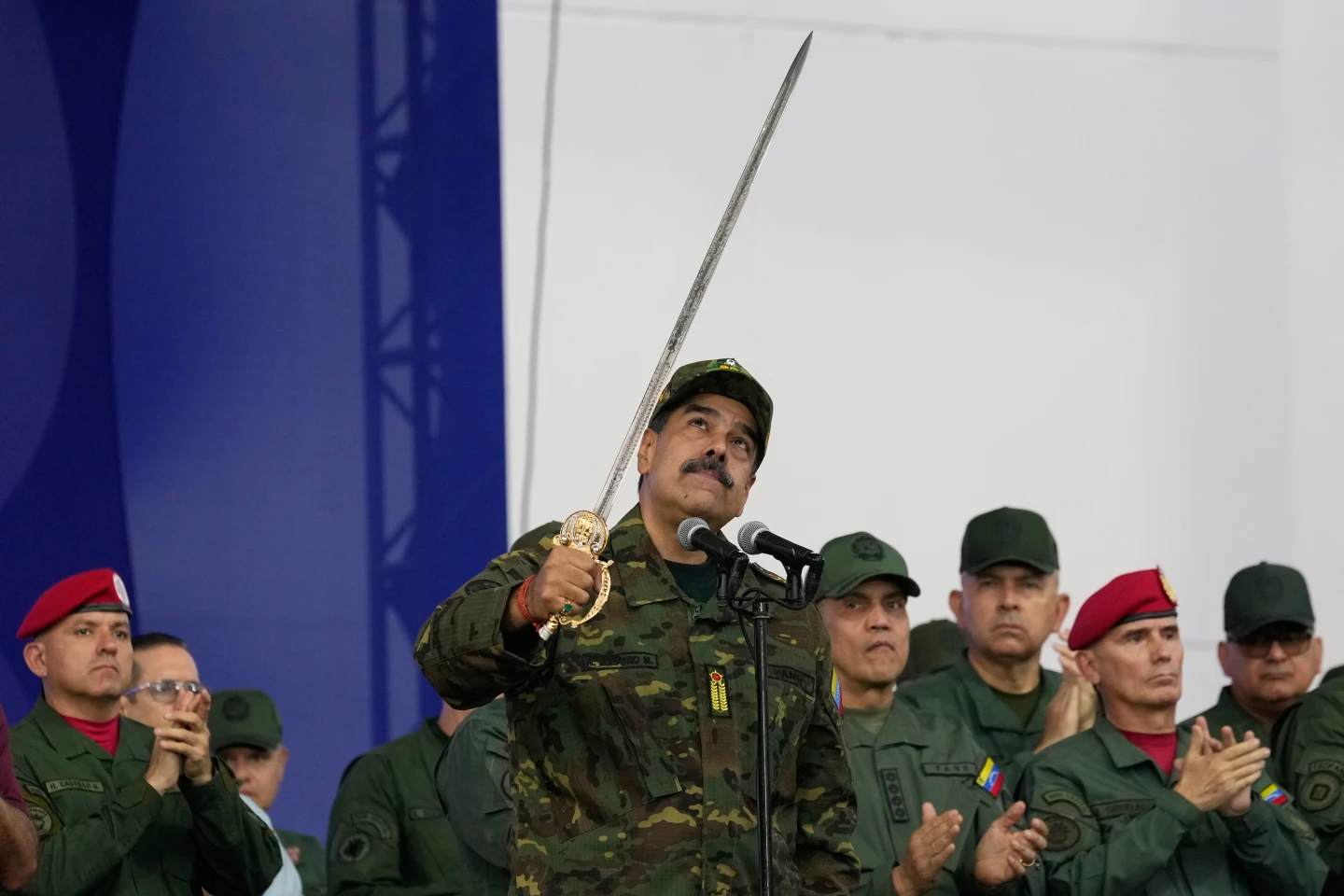
On Tuesday, ruling party supporters marched in Caracas to demonstrate what they described as the “anti-imperialist spirit” of Chavismo. The march ended in a ceremony in which Maduro raised a jeweled sword that belonged to South American independence hero Simón Bolívar and guided attendees, including Cabinet ministers, to swear in God’s name to defend peace and freedom.

Susan Shirk, a research professor at the University of California, San Diego, said authoritarian leaders have a “fetish for unity” and like public displays of loyalty to prevent splits among leadership and social upheaval. She explained that division can lead people to believe that the risk of protesting has lessened.

U.S. Defense Secretary Pete Hegseth has said the designation of Cartel de los Soles provides Trump with additional options for dealing with Maduro. Hegseth hasn’t provided details on those options, but administration officials have signaled that they have trouble seeing a situation in which Maduro is still in power as an acceptable endgame.

David Smilde, a Tulane University professor who has studied Venezuela for more than three decades, said that only people who don’t understand Chavismo would think that a show of force will cause a government change.

“This is exactly the type of thing that unifies them,” Smilde said of the deployment of U.S. military forces. “They also talk about the $50 million reward, but what military officer in their right mind would trust the U.S. government? And more broadly, if the whole premise of the operation is that the Venezuelan armed forces are a drug cartel, what motivation could they possibly have to turn on Maduro and participate in regime change?”

Maduro’s entire presidency has been marked by a political, social and economic crisis that has pushed millions into poverty and driven more than 7.7 million people to migrate. The crisis has also caused support for the ruling party to plummet across the country.

With loyalty keeping his inner circle intact despite mounting U.S. pressure, Maduro has also sought to maintain his diminished base through the long-established practices that include organizing marches in the capital.

Zenaida Quintero, a school porter, has seen the country come undone under Maduro’s watch, with vivid memories of the severe food shortages that Venezuelans experienced in the late 2010s. Her support for Maduro, however, hasn’t wavered, and her commitment comes down to one fact: He was handpicked by Chávez to lead the Bolivarian Revolution.

Quintero, 60, said that Maduro, like Chávez, won’t abandon his supporters.

“I trust him,” Quintero said of Maduro. “We have to remain united. We have to defend ourselves.”

___

Republished with permission of The Associated Press.


Source link

Continue Reading

Politics

Last Call for 1.19.26 – A prime-time read of what’s going down in Florida

Published

on


Last Call – A prime-time read of what’s going down in Florida politics.

First Shot

Did Christina Pushaw break the law by asking gubernatorial candidate James Fishback to delete text messages the two exchanged in recent months?

Maybe.

Pushaw, who earns a $179,000 tax-funded salary as a senior management analyst for Gov. Ron DeSantis, all but confirmed the authenticity of texts between her and Fishback in which she appears to have written, “I need you to confirm that you deleted everything with my name on it.”

The exchange has raised questions about whether she solicited the destruction of public records, which would be illegal if the messages involved her government duties, but likely not if they were strictly campaign-related, as she says.

Fishback posted a screenshot of the exchange following a public blowup between the two after they, according to Pushaw, spoke “frequently” since October about Fishback’s campaign.

On X, Pushaw accused Fishback of deception, writing: “Thanks for proving my point that you have no qualms about lying and revealing private messages. I truly believed that we were friends, and I feel sickened and violated by this betrayal.”

Pushaw, who has worked for DeSantis as both a campaign and government staffer, says she was never paid for advising Fishback and never told the Governor about her communications with Fishback.

In a brief phone interview on Monday, she said none of her messages with Fishback touched her state job.

“I never talked to him about government business,” she said. She declined to explicitly confirm the authenticity of Fishback’s screenshots, including one that referenced her government position.

Read more on Florida Politics.

Evening Reads

—“Donald Trump ties Greenland takeover bid to Nobel Prize in text to Norway leader” via Ellen Francis and Steve Hendrix of The Washington Post

—”Trump’s letter to Norway should be the last straw” via Anne Applebaum of The Atlantic

—”Trump’s Greenland move is one of the dumbest political decisions I have ever seen” via Chris Cillizza of So What

—”The race to build the DeepSeek of Europe is on” via Joel Khalili of WIRED

—”Three maps tell a tale of the 2026 Midterms.” via Ashley Cai and Shane Goldmacher of The New York Times

—”Orlando Sentinel 150: Remembering MLK’s only visit to Orlando in 1964” via the Orlando Sentinel

—“Jeff Brandes: Six ideas Legislature can’t afford to ignore in 2026” via Jeff Brandes for Florida Politics

—”The Indiana-Miami CFP game is the Hollywood tangle we didn’t know we needed” via Steven Zeitchik of The Hollywood Reporter

—”‘It shaped my DNA’: The very Miami story of Mario Cristobal” via Andrea Adelson of ESPN

—”Two other Hoosiers from Miami are coming home, too — and could play a big role” via David J. Neal and Jordan McPherson of the Miami Herald

Quote of the Day

“I didn’t vote for this weather.”

Marc Caputo on a frigid morning in Miami.

Put it on the Tab

Look to your left, then look to your right. If you see one of these people at your happy hour haunt, flag down the bartender and put one of these on your tab. Recipes included, just in case the Cocktail Codex fell into the well.

Even though it’s booze-free, the Duval delegation could use a Cortisol Cocktail to calm their nerves after a bomb threat landed in their inboxes.

Disney and Universal are getting an Investigators Rite, courtesy of Central Florida Democrats, who are requesting they look into a company that operates independent restaurants on their properties.

Someone should’ve sent an Out of Office for Attorney General James Uthmeier, because he picked an odd day to drop his latest opinion.

Breakthrough Insights

Tune In

Miami plays for national title at home

The Miami Hurricanes try for the program’s first national championship since 2001 when they face top-seeded Indiana at Hard Rock Stadium tonight (7:30 p.m. ET, ESPN).

Miami entered the College Football Playoff as the 10th seed and knocked off Texas A&M, Ohio State, and Ole Miss to reach the finals. The Hurricanes (13-2) have benefitted from a defense that has limited opponents to 14 points per game this season. Defensive end Rueben Bain Jr. was named the ACC defensive player of the year and is a likely Top 10 pick in the NFL Draft.

Indiana (15-0) has enjoyed the greatest season in program history. In the second season under Curt Cignetti, the Hoosiers have not only won more games than they ever have in a season, but also more than the program ever did in two consecutive seasons combined before Cignetti’s arrival.

The Hoosiers are led by Heisman Trophy-winning quarterback Fernando Mendoza.

The two programs have met twice in history, with Indiana winning the first meeting in 1964 and the Hurricanes taking the return match in 1966. The two programs have not met since.

The last time a college football team won the national championship by winning a game on its home field was the Hurricanes, who won the Orange Bowl following the 1987 season to win the program’s second of five national championships.

___

Last Call is published by Peter Schorsch, assembled and edited by Phil Ammann and Drew Wilson, with contributions from the staff of Florida Politics.


Source link

Continue Reading

Politics

James Fishback ordered to turn over Azoria stock, luxury items to pay $229K court judgment

Published

on


Gubernatorial candidate James Fishback’s legal woes are deepening.

A federal magistrate Judge has ordered Fishback, the founder and CEO of Azoria Capital, to turn over company stock certificates and a slate of luxury purchases to the U.S. Marshals Service by the end of the month as payment on a $229,000 judgment to his former employer, Greenlight Capital.

U.S. Magistrate Judge Martin Fitzpatrick of the Northern District of Florida granted two unopposed motions by Greenlight after Fishback failed to respond by a court-ordered deadline.

It’s the latest escalation in a dispute between Greenlight and Fishback, a former analyst for the hedge fund who has made more headlines recently for his race-baiting rhetoric in the Governor’s race, allegations of grooming, multistate voter registration and public blowup with Gov. Ron DeSantis adviser Christina Pushaw.

Greenlight told the court that Fishback still owes it money under a June 2025 court order. The firm asked the court in late November to compel Fishback to surrender his stock or share certificates in Azoria Capital, Inc., a Delaware corporation Greenlight described as founded by Fishback and controlled by him at “75% or more.”

Because Fishback did not oppose the request, the court granted it and directed him to “locate, obtain, and turn over” all Azoria stock and/or share certificates to the U.S. Marshals Service by Jan. 30.

The Marshals Service, in turn, is ordered to sell the stock for the benefit of Greenlight as the judgment creditor. Fitzpatrick warned Fishback that federal courts have inherent authority to enforce orders and cautioned that ignoring the directive could place him “in danger of being held in contempt of court.”

Fitzpatrick also granted a second motion by Greenlight seeking the turnover of personal property belonging to Fishback. The firm alleged that Fishback claimed he lacked means to pay the $229,000 judgment while making more than $37,000 in debit card purchases over 16 months through a previously undisclosed JPMorgan Chase account.

The court summarized transactions at retailers including eBay, Nordstrom, Burberry, Bucherer and others, but noted it did not know what exactly Fishback purchased. Still, Fitzpatrick described the spending as “extravagant” and found that Fishback, by not responding by the deadline, waived his chance to argue the items were exempt or not personal property.

Under the order, Fishback must turn over 43 items listed in the motion paper, along with a list, to the Marshals Service by Jan. 30. The Marshals must hold the items for 30 days, allowing Greenlight’s lawyers to retrieve and sell them as partial satisfaction of the judgment.

Fishback worked at Greenlight from 2021 to 2023, after which he and the company became embroiled in a very public dispute over how he described his role there. He said he was “head of macro” for Greenlight, while the New York hedge fund insisted no such title ever existed and that the loftiest role Fishback held was as a research analyst.

Greenlight alleged that Fishback misrepresented his position to boost credibility and attract investors for Azoria. Fishback, meanwhile, argued Greenlight’s denial harmed him with potential backers and pointed to internal communications he says support his version of events.

He did, however, admit to sharing confidential Greenlight portfolio information and agreed to pay costs to resolve a separate lawsuit.

Trustees of a white-label exchange-traded fund (ETF) under Tidal Financial Group also voted in October to liquidate two Azoria ETFs — SPXM and TSLV, which together held about $40 million in assets — after Fishback admitted to sharing the information.

Between when he launched his campaign on Nov. 24 and Dec. 31, when fourth-quarter bookkeeping closed, Fishback reported raising less than $19,000 through his campaign account and nothing through an affiliated political committee.

Fishback is seeking the Republican nomination for Governor. The race’s poll-tested front-runner, U.S. Rep. Byron Donalds, amassed $45 million last quarter.


Source link

Continue Reading

Politics

Anna Eskamani hits $1M fundraising milestone for Orlando Mayor race

Published

on


Rep. Anna Eskamani says she has raised more than $1 million so far as she tries to become the next Orlando Mayor.

The Orlando Democrat says she hit the milestone last week as lawmakers returned to Tallahassee for the start of the 2026 Legislative Session.

Term-limited in the House, Eskamani is running in 2027 to replace Orlando Mayor Buddy Dyer, who is not running for re-election.

“This campaign is powered by everyday Orlandoans who believe our city can be more affordable, more connected, and safer for everyone,” Eskamani said in a statement.

“Raising over one million dollars from thousands of grassroots donors sends a clear message: people are ready for leadership that listens, leads with integrity, solves problems, and puts community first. Together, we’re building a movement that reflects the heart of Orlando and delivers real results for working families.”

Her campaign has given out 900 yard signs and knocked on more than 33,000 doors in the city, according to a press release.

So far, no other established candidates have filed to run against Eskamani, although she has drawn her first competitor on the ballot: Abdelnasser Lutfi.

Lutfi, who filed to run for Mayor in late December, was not immediately available when reached for comment Monday afternoon.

Eskamani and Lutfi are running to replace Dyer, the longest-serving Mayor in Orlando’s history. Dyer was first elected in 2003.

Eskamani also said she is launching a podcast called “Twinning with Anna and Ida” with her twin sister. 

Every episode will unpack economic public policy issues that are critically important to everyone, but aren’t always well understood by the vast majority of people — often because they have been made intentionally opaque by politicians and the corporations who fund them to benefit from the complex system,” a press release said.

“But they will also have some fun along the way, from exposing a ‘grift of the month’ in Florida politics to exploring the punk rock scene in Orlando.”


Source link

Continue Reading

Trending

Copyright © Miami Select.