Connect with us

Business

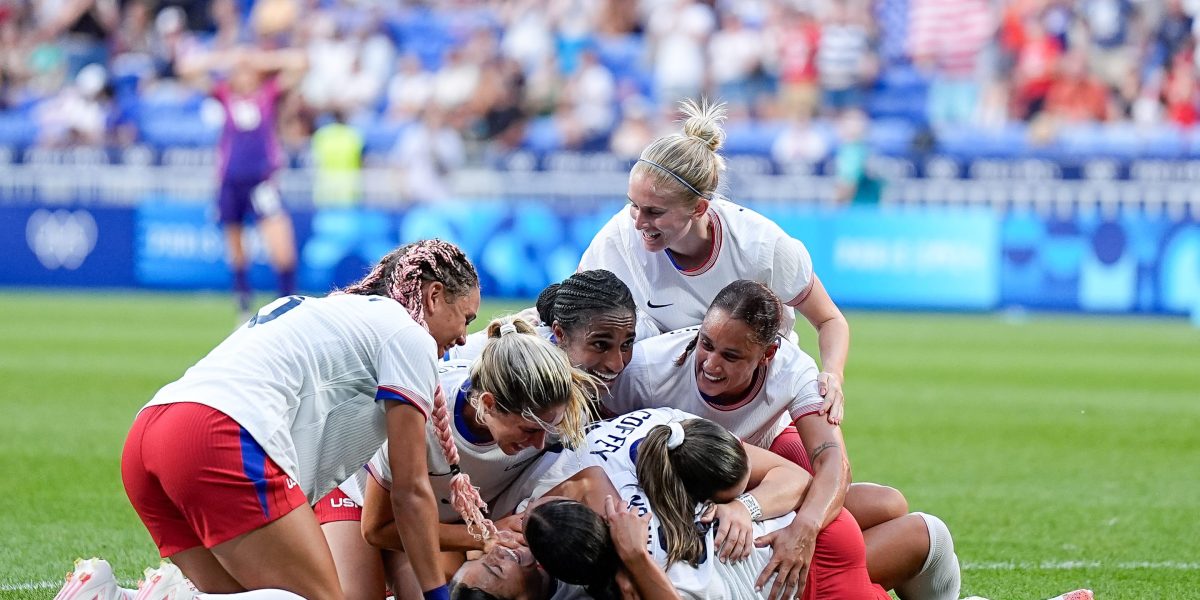
50 years after Title IX, women’s soccer is surging thanks to brand deals boosting visibility: ‘What’s been proven is people love women’s sports’

Published

on


With two World Cup wins, an Olympic bronze medal, and experience in multiple pro leagues around the world, Christen Press is one of the most prolific soccer players of the time. But fans would be hard-pressed to find digital evidence of her early career highlights from when she competed in Women’s Professional Soccer (WPS), the precursor to the National Women’s Soccer League (NWSL) that folded in 2012.

“If you go back and try to find highlights from my first years as a pro, you can’t,” Press told Marketing Brew. “You can find US Women’s National Team (USWNT) highlights always, but that’s what you’ll find. It was like that was my only job.”

Now, highlights of Press—or, really, any other pro women’s soccer player—are abundantly available, just one indication of just how much the landscape of women’s sports has shifted in the last few decades. More than 50 years after the passage of Title IX made it possible for more girls to succeed in sports in grade school, the talent pool of women athletes is deeper than ever, media outlets are showing women’s sporting events in prime time to record-breaking audiences, and major brands are funneling sponsorship dollars into the ecosystem.

Sport to sport, it’s not exactly clear what should be credited with kicking off the boom. But does it matter? Thirteen years after the founding of the NWSL, women’s professional soccer seems here to stay in more ways than one, with two of the biggest revenue drivers in sports—media rights and sponsorships—abundant enough to prop up two pro properties.

Ready for prime time

One of the biggest changes in the women’s soccer ecosystem in recent years has been media coverage of the sport. In the days of the WPS, and even more recently, fans often struggled to find games on TV aside from international tournaments like the World Cup and the Olympics every couple of years.

“When I started playing in the WPS and my first days of the NWSL, I was playing in front of a couple hundred people on bleachers in high schools and colleges,” Press remembered.

It wasn’t until 2022 when CBS Sports aired the NWSL Championship in prime time for the first time, but when it did, the game became the most-watched NWSL match in history, with 915,000 viewers, a 71% increase from 2021, per CBS. (The 2024 Championship beat that record, averaging 967,900 viewers, according to the NWSL.)

The deal for prime-time coverage in part came about thanks to Ally Financial, a years-long sponsor of the NWSL and many other women’s sports properties, which played a key role in conversations with the league and the network.

“You’ve got this vicious cycle that’s never going to be broken unless the brands jump in and kind of force systemic change,” Ally CMO Andrea Brimmer told Marketing Brew at the time. “It takes the brands sitting at the table to demonstrate that they’re willing to come in, that they’ve got the money to invest, but that they need the networks to think differently about the way that they’re selling media and the way that they are giving women’s sports timeslots and the platforms that they deserve.”

The NWSL’s current four-year media rights deal, signed in 2023, indicates a much different approach from networks and streamers, spanning coverage across CBS Sports, ESPN, Prime Video, and Scripps Sports; it’s reportedly worth $240 million. As of the mid-point of the current NWSL season, livestreams of matches were up 34% year over year, with 1.2 billion minutes viewed, according to the league. Women’s soccer fans can also watch pros play on Peacock, which holds the media rights to the Gainbridge Super League, a new pro women’s soccer league that kicks off its second season on August 23.

New media

While major media outlets play a big role in whether women’s soccer is widely available to audiences, the ecosystem has also been thriving thanks to athletes taking matters into their own hands, leveraging channels like social media and podcasts to increase visibility of the sport.

“Social media completely changed the landscape for women’s sports in a really powerful way, because before, you had all these legacy media channels that really acted as middlemen,” said Tobin Heath, an NWSL and USWNT icon who announced her retirement in July. “Once a year you’d get this terrible window, never prime time, and always it was through a lens of what the patriarchy wanted to see in women’s sports, which was obviously extremely narrow and really didn’t represent our sport’s culture at all.”

That frustration led Heath and Press, who are married, to found Re—Inc, a sports media company that publishes newsletters and podcasts meant to represent “gal culture,” which Heath described as an answer to “bro culture.” Their podcast, The Re—Cap Show, joined the Audacy network for distribution and global ad sales in July, part of a larger wave of growing interest in women’s sports podcasts.

Heath and Press aren’t the only soccer icons who have carved out their own media channels. Former USWNT co-captain Alex Morgan has Togethxr, the media and commerce company she started with Olympic snowboarder Chloe Kim, Olympic swimmer Simone Manuel, and basketball legend Sue Bird. Bird also founded production company A Touch More alongside her partner, Megan Rapinoe, another retired USWNT co-captain.

Through these platforms, the players can bypass legacy media companies and engage directly with fans on their own terms, which wasn’t always an option for athletes. Brandi Chastain, whose penalty kick delivered the USWNT the World Cup in 1999 and who went on to work with brands including NikeGatorade, and Bud Light, said she sometimes thinks about what her sponsorship roster could have looked like had she been playing in 2025.

“In terms of brands and branding, gosh, I think there’s a part of me that wishes that there were all these resources that existed,” she said.

Brand ball

As the audience for women’s soccer has grown, so too has its list of sponsors. This year, the NWSL kicked off its 13th season with 13 sponsors, including first-time brands E.l.f. Beauty and Alex Cooper’s Unwell Hydration. E.l.f.’s involvement represents a broader trend of beauty brands, which haven’t historically invested much in sports, leaning into sports sponsorship opportunities across leagues, including the NFL and WNBA. In August, E.l.f. further upped its investment in women’s soccer by signing NWSL players Melanie Barcenas, Abby Dahlkemper, Lo’eau LaBonta, and Jaedyn Shaw to its talent roster.

For brands, women’s sports are particularly compelling because the audience tends to encompass different consumers than men’s sports audiences, Super League President Amanda Vandervort told Marketing Brew. In pro basketball, for example, only 5% of Golden State Valkyries season-ticket holders also have Warriors season tickets, despite the teams sharing both an arena and a sport, a standout stat for founding partner JPMorganChase.

“There’s so many communities who haven’t had access to women’s pro soccer, and when you add that to the growing interest, the demographics and behaviors of our fans, and the opportunity for brands and sponsors to get in front of a whole new audience, it just makes business sense,” Vandervort said. “Now, we’re having real conversations about the return on the investment in women’s professional soccer.”

This year, the Super League announced Gainbridge had purchased the league’s naming rights, and it’s only seen an uptick in inbound interest since then, according to Vandervort. The league also has several endemic sponsors, including kit provider Capelli Sport and ball manufacturer Select.

In the NWSL, jersey sponsorships are breaking records at breakneck speed. Last year, Bay FC reportedly had the biggest back-of-jersey deal in the league with Trader Joe’s, and in February, Gotham FC and Dove reportedly broke the record again. Days later, the Portland Thorns and Ring were said to have agreed to the biggest deal in league history, exceeding $2.6 million.

“It’s not just about the dollars,” Matt Soloff, SVP, partnerships and business development at the NWSL, told us. “It’s about leaning into brands that want to lean into us at the highest level.”

Amazon, for instance, has a wide-ranging relationship with the NWSL that includes streaming rights to Friday night games and a playoff match on Prime Video, as well as an exclusive retail sponsorship for Amazon and the presenting sponsorship of the league’s Best XI Awards for Amazon Prime. The company also worked with the league and other media partners, including Togethxr, for a docuseries about the 2024 season.

It was the “rabid fanbase and the growth” of the league that made it stand out to a sponsor as big as Amazon, according to Deb Curtis, global director of marketing for Amazon Prime.

“The growth and the excitement around women’s sports, and obviously the NWSL, is incredibly energizing,” Curtis said. “Fandom fuels growth, and so we see our role as being able to go deeper. People know our brand, so how can our brand help to enhance that experience?”

Brand sponsorship dollars can also be invested back into the leagues, creating a virtuous cycle for women’s soccer.

For some players who have seen the industry shift in real time, it feels like vindication.

“What’s been proven is people love women’s sports,” Heath said. “That’s just the truth, and also, they love women’s athletes as people. Brands love women’s athletes. They’re more approachable. They’re better at marketing.”

This report was originally published by Marketing Brew.


Source link

Continue Reading

Business

Exclusive: U.S. businesses are getting throttled by the drop in tourism from Canada: ‘I can count the number of Canadian visitors on one hand’

Published

on


From Washington state to northern New England, American businesses that have long depended on Canadian visitors are seeing traffic dry up — and with it, a crucial source of revenue.

A new report shared exclusively with Fortune by the Joint Economic Committee (JEC) – Minority, a congressional standing committee dating back to 1946 responsible for documenting the economic conditions of the U.S., details how a sharp drop in Canadian tourism is hitting every U.S. state along the northern border. The findings come as President Trump has proposed annexing Canada, imposed several rounds of tariffs on Canadian goods, and repeatedly broken off trade talks with Ottawa, contributing to a chill in cross-border travel and spending.

From January to October 2025, the number of passenger vehicles crossing the U.S.-Canada border fell by nearly 20% compared with the same period in 2024, according to the JEC analysis, which draws on U.S. Customs and Border Protection travel statistics. In some border states, the decline reached 27%, a shift that local tourism agencies say is showing up in fewer tourists, more hotel vacancies, and weaker sales.

“Going back for generations, Canadians have visited New Hampshire and many other states along the U.S.-Canada border to see family or friends, stay in our hotels, share a meal at our restaurants, and shop at our stores,” said U.S. Senator Maggie Hassan (D-NH), Ranking Member of the Joint Economic Committee. “However, in the wake of President Trump’s reckless tariffs and needless provocations, fewer and fewer Canadians are making trips to the United States, putting many American businesses in jeopardy and straining the close ties that bind our two nations.”

Canadians have historically been among the most important international visitors to the U.S., both in sheer numbers and in spending. Analysts and tourism officials note that rising prices, a weaker Canadian dollar, and heightened political tensions have nudged many travelers to choose domestic trips within Canada or alternative international destinations instead. For U.S. border communities, that shift is being felt in real time.

“These are more than numbers; they represent missed revenue for local businesses, reduced hotel demand, and fewer dollars supporting jobs and investment in our community,” said Shirley Hughes, president and CEO of Visit Fargo-Moorhead in Fargo, North Dakota, and Moorhead, Minnesota.

In northern New Hampshire, the absence of Canadian license plates is especially stark. “Being only eight miles from the border, normally Canadians make up anywhere from 15-25% of visitors. Now, I can probably count the number of Canadian visitors on one hand. I’m just trying to plug along and keep my nose above the waterline,” said Elizabeth Guerin, owner of the Fiddleheads gift shop in Colebrook, New Hampshire.

The impact stretches beyond retail and lodging into wineries and attractions that rely on cross-border regulars.

“The drop in visits from Canadian tourists has had a noticeable impact on our bottom line. With Canadians making up about 10% of our business, fewer cross-border travelers mean fewer tastings, tours, and wine sales — a ripple effect that touches our entire operation, underscoring how important cross-border tourism is to our business model,” said Scott Osborn, president and co-owner of Fox Run Vineyards in Penn Yan, New York.

Some operators worry the damage will outlast any eventual thaw in U.S.–Canada trade relations, as Canadian travelers form new habits elsewhere.

“This is long-lasting damage to a relationship and emotional damage takes time to heal. While people aren’t visiting Vermont, they’ll be finding new places to visit, making new memories, building new family traditions, and we will not recapture all of that,” said Christa Bowdish, owner of the Old Stagecoach Inn in Waterbury, Vermont.

On the West Coast, festival organizers are also feeling the pinch.

“Since March of this year, we have not only seen Canadian traffic drop drastically, but we have also seen a drop in our number of attendees at our festival this year in late September. We knew that after March, we could not rely on our Canadian business because of fear at the border and lack of understanding of what is happening with tariffs and Canada drawing a strong line of promoting Canada first,” said Kevin Coleman, executive director of SeaFeast in Bellingham, Washington.

For businesses up and down the northern border, the question now is not just when Canadians will return in force, but how much of that lost business can ever be won back.

For this story, Fortune journalists used generative AI as a research tool. An editor verified the accuracy of the information before publishing. 


Source link

Continue Reading

Business

Activist investors are targeting female CEOs—and it’s costing Corporate America

Published

on


Good morning. When Victoria’s Secret reported stellar quarterly results last week, shares shot up 14% and likely gave Hillary Super some breathing room from the activist investors pushing the lingerie company to, among other things, consider whether the CEO of 16 months is up to the task of turning it around.

Of course, the potential of having to deal with an activist investor’s campaign goes with the territory of being a CEO, especially at a company that has been struggling. But Super’s saga is a reminder that women CEOs remain much likelier than their male counterparts to be targeted by activist investors.

This year, according to a report last week by the Conference Board, women have made up 8% of the CEOs in the Russell 3000 index but accounted for 15% of activist campaigns specifically targeting chief executives. Other women to have recently confronted activists: Cracker Barrel’s Julie Masino, who survived a campaign, and Vail Resorts’ Kirsten Lynch, who did not. 

What makes the Conference Board report especially frustrating is that it adds more proof points to an old, seemingly intractable trend.

In 2015, the New York Times’ DealBook pondered “Do Activist Investors Target Female CEOs?” while Fortune’s Pattie Sellers asked “Does Nelson Peltz have a problem with women?” In 2017, Harvard Law School found that women CEOs had almost a 50% higher probability than men of becoming the target of shareholder activism.

Why? One reason, the Conference Board theorized, is rooted in a stereotype that women are more cooperative. It’s also conceivable that the trend reflects the glass cliff phenomenon in which women often take the helm of companies in decline. But there is almost certainly some bias at play. The Conference Board research showed that women targeted by activists face the same odds of being canned whether they turn things around or not, while male CEOs are less likely to be ousted when results improve.

Some of the most prominent women chief executives ever have tangled with activists: PepsiCo’s ex-CEO Indra Nooyi, ex-Yahoo CEO Marissa Mayer, ex-DuPont CEO Ellen Kullman, ex-Mondelez CEO Irene Rosenfeld, ex-HP CEO Meg Whitman, and Mary Barra, still at GM. Michelle Gass, now thriving as CEO of Levi Strauss & Co, dealt with not one but three activist campaigns as she tried to fix Kohl’s.

Everyone should be held accountable when their company is failing or on a bad path. But it is worth wondering what this extra hurdle women CEOs face is costing us. Activist campaigns are bruising to the company but also to a CEO’s reputation. Does this mean boards might be more likely to avoid naming a woman to lower the odds of an activist campaign, or that fewer women will throw their hat in the ring?

Either way, it seems the phenomenon could needlessly be costing corporate America some much needed talent.—Phil Wahba

Contact CEO Daily via Diane Brady at diane.brady@fortune.com

Top news

Fed watch

All eyes will be on the Fed meeting today even though an interest rate cut is all but certain. Instead, investors will focus on Chair Jerome Powell’s tone and whether he characterizes Fed policy as “in a good place;” doing so would imply that a January cut is unlikely. 

Fed chair watch 

Meanwhile, President Donald Trump has narrowed down the candidates to replace Powell as Fed chair. The frontrunner is National Economic Council Director Kevin Hassett, but to clinch the job he’ll reportedly have to outshine three other contenders in the final round of interviews, suggesting he’s not a shoo-in for the job. 

Trump’s affordability tour

In his first in a series of speeches about “affordability,” President Trump mocked the term and insisted that Americans are doing better than ever. In reality, U.S. inflation is close to 3%, about where it was when Trump’s predecessor Joe Biden left office. 

Miami’s mayoral race

As Trump railed against affordability, Eileen Higgins, a Democrat, defeated Trump’s favored candidate in Miami’s mayoral race with a campaign focused in part on affordable housing. She’s the first Democrat to occupy Miami’s City Hall in three decades (and the first-ever woman), giving Democrats another jolt of momentum ahead of the 2026 midterms. 

Taiwan’s chip action

Taiwan is invoking a national security law to protect the trade secrets of its homegrown chipmaker TSMC and has used it to indict a TSMC supplier for allegedly letting a former employee steal details about TSMC’s top chips. 

Layoffs hit 1.1 million

Recruitment firm Challenger, Gray & Christmas has calculated the number of layoffs so far this year at 1.1 million, the sixth time since 1993 that layoffs have been that high. Technology was the hardest hit sector with 150,000 layoffs.

Americans ‘living on the financial edge’

Moody’s Analytics Chief Economist Mark Zandi told Fortunethat many Americans are “already living on the financial edge,” and that a drop in their spending could lead to a recession. If layoffs increase, then Zandi estimates that a “jobs recession” is certain. 

Sam Altman worries about ‘rate of change’

During an appearance on The Tonight Show with Jimmy Fallon, OpenAI CEO Sam Altman admitted that he’s worried about “the rate of change that’s happening in the world right now.” He added that the “rate at which jobs will change over may be pretty fast,” with hopes that “much better jobs” will follow. 

The markets

S&P 500 futures were up 0.05% this morning. The last session closed down 0.09%. STOXX Europe 600 was down 0.19% in early trading. The U.K.’s FTSE 100 was up 0.14% in early trading. Japan’s Nikkei 225 was down 0.1%. China’s CSI 300 was down 0.14%. The South Korea KOSPI was down 0.21%. India’s NIFTY 50 is down 0.32%. Bitcoin is up at $93K.

Around the watercooler

New contract shows Palantir is working on a tech platform for another federal agency that works with ICE by Jessica Mathews

Jamie Dimon taps Jeff Bezos, Michael Dell, and Ford CEO Jim Farley to advise JPMorgan’s $1.5 trillion national security initiative by Nino Paoli

Trump’s $12 billion farmer bailout is a ‘Band-Aid on a bigger wound’ the American agriculture industry is still reeling from by Sasha Rogelberg

Exelon CEO: The ‘warning lights are on’ for U.S. electric grid resilience and utility prices amid AI demand surge by Jordan Blum

CEO Daily is compiled and edited by Joey Abrams, Claire Zillman and Lee Clifford.


Source link

Continue Reading

Business

5 VCs sounds off on the AI question du jour

Published

on


The views seem to range from bubble-wary to bubble-dismissive. We hashed it all out over eggs and sausages at Fortune’s IRL Term Sheet Breakfast at Brainstorm AI in San Francisco yesterday. This is Amanda Gerut, Fortune’s West Coast news editor, pinch-hitting for my colleague Allie Garfinkle.

Allie hosted five VCs with funds ranging in size from $5 million to $25 billion and views varied across the panel. This group alone is collectively going to deploy anywhere from tens to hundreds of millions over the next decade into companies with AI as a backdrop and these investments will either prove spectacularly right or wrong.

Here’s a roll call:

Jenny Xiao, partner at Leonsis Capital and former researcher at OpenAI, came in with a nuanced take. There’s something of a bubble, but it’s “relatively contained” in the infrastructure layer with overinvestment primarily in data centers, GPUs and in large language model companies. But right now, there’s actually underinvestment in the application layer because there are so many ways AI can make an impact in various enterprises, Xiao said. 

Vanessa Larco, former partner at New Enterprise Associates (NEA) and co-founder of new venture firm Premise, has a contrarian view. “Everyone thinks enterprise is safer,” Larco said. “But I actually think the consumer might, this time around in the current environment, be what survives.” Larco’s reasoning is that if a consumer adopts your AI product, it’s because you’re giving them something faster, “radically cheaper, or much easier to use.” Once you’ve done that and built a brand, it’s very hard for people to quit you. 

Rob Biederman, managing partner at Asymmetric Capital Partners and chairman of Catalant Technologies, had a sobering view. “In every boom, 99% or 99.9% of companies fail, and one or two of them become Amazon or Google,” said Biederman, who had to dash off to catch a flight. Only companies that can systematically create value for customers, which most of them aren’t doing right now, will survive. 

Aaron Jacobson, partner at NEA, said the history of technological innovation “is always overhyped in the near term and underhyped in the long term, and that will be true of AI.” So at some point there will be a correction and there will be cycles of pain around valuation and funding, “but ultimately, in 10 years, we’re going to have a lot of really big, impactful companies.”

Daniel Dart, founder and general partner of Rock Yard Ventures, had the boldest counter to fears about a bubble. He sees a total addressable market we can’t yet imagine. People think self-driving Waymos will replace Ubers, but Dart sees elementary schools and elderly care centers with Waymos waiting out front and that proves to him we’re still in the early innings. 

“You’re really going to tell me there aren’t going to be any trillion-dollar companies in 2030 or 2034? No one here is going to take that bet,” said Dart. “There is going to be so much value creation that it’s like the birth of fire.”

See you tomorrow,

Amanda Gerut
Email:
Amanda.gerut@fortune.com
Submit a deal for the Term Sheet newsletter here.

Joey Abrams curated the deals section of today’s newsletter.Subscribe here.

Venture Deals

Saviynt, an El Segundo, Calif.-based identity security platform, raised $700 million in series B funding. KKR led the round and was joined by SixthStreetGrowth, TenEleven and existing investor CarrickCapitalPartners.

fal, a San Francisco-based AI-generated media platform, raised $140 million in Series D funding. Sequoia led the round and was joined by KleinerPerkins, NVentures, and AlkeonCapital.

Radial, a New York City-based network designed to help patients access advanced mental health treatments, raised $50 million in Series A funding. GeneralCatalyst led the round and was joined by SolariCapital, SLHealthCapital, FounderCollective, BoxGroup, ScrubCapital, and DiedevanLamoen.

Relation, a London, U.K.-based developer of medicines for immunology, metabolic, and bone diseases, raised $26 million in funding from NVentures, DCVC, and MagneticVentures.

Aradigm, a New York City-based benefits platform for cell and gene therapies, raised $20 million in Series A funding. FristCresseyVentures led the round and was joined by AndreessenHorowitz and MorganHealth

PrimeSecurity, a Tel Aviv, Israel and New York City-based AI-powered platform designed to detect and mitigate risks during software design, raised $20 million in Series A funding. ScaleVenturePartners led the round and was joined by FoundationCapital, FlybridgeVentures, and others.

Algori, a Madrid, Spain-based AI-powered shopper insights platform for the fast-moving consumer goods industry, raised €3.6 million ($4.2 million) in funding from RedBullVentures, Co-invest Capital, AttaPoll, and others.

EmpromptuAI, a San Francisco-based platform designed to help transition SaaS products into AI-native systems, raised $2 million in pre-seed funding. PrecursorVentures led the round and was joined by AlumniVentures, FoundersEdge, RogueWomenVC, and others.

Private Equity

AppDirect, backed by CDPQ, acquired vComSolutions, a San Ramon, Calif.-based IT management platform, at an enterprise valuation of more than $100 million.

JensenHughes, backed by GryphonInvestors, acquired SafetyManagementServices, a West Jordan, Utah-based fire and life safety company. Financial terms were not disclosed.

NewStateCapitalPartners acquired a majority stake in Harrell-Fish, a Bloomington, Ind.-based mechanical installation and maintenance services provider. Financial terms were not disclosed.

PestCoHoldings, a portfolio company of ThompsonStreetCapital, acquired SouthwestExterminating, a Houston, Texas-based pest control provider. Financial terms were not disclosed.

ProsperityPartners, backed by UnityPartners, acquired a majority stake in Farkouh, Furman & Faccio, a New York City-based provider of tax, attest, accounting and business consulting services. Financial terms were not disclosed.

SEVA acquired a minority stake in Pronto, a Lehi, Utah-based team communications platform designed for front–line employers and higher education institutions. Financial terms were not disclosed.

Exits

ArclineInvestmentManagement acquired Altronic, a Girard, Ohio-based supplier of ignition, control, and instrumentation systems for critical infrastructure power systems, from HOERBIGERGroup. Financial terms were not disclosed.

BerkshirePartners agreed to acquire UnitedFlowTechnologies, an Irving, Texas-based process and equipment solutions company for water and wastewater systems, from H.I.G.Capital. Financial terms were not disclosed.

BessemerInvestors acquired Xanitos, a Newtown Square, Penn.-based provider of environmental services, patient transport, patient observation, and linen services, from AngelesEquityPartners. Financial terms were not disclosed.

ShareRockPartners acquired a majority stake in AMAGTechnology, a Hawthorne, Calif.-based physical security solutions provider, from AlliedUniversal.


Source link

Continue Reading

Trending

Copyright © Miami Select.