Connect with us

Business

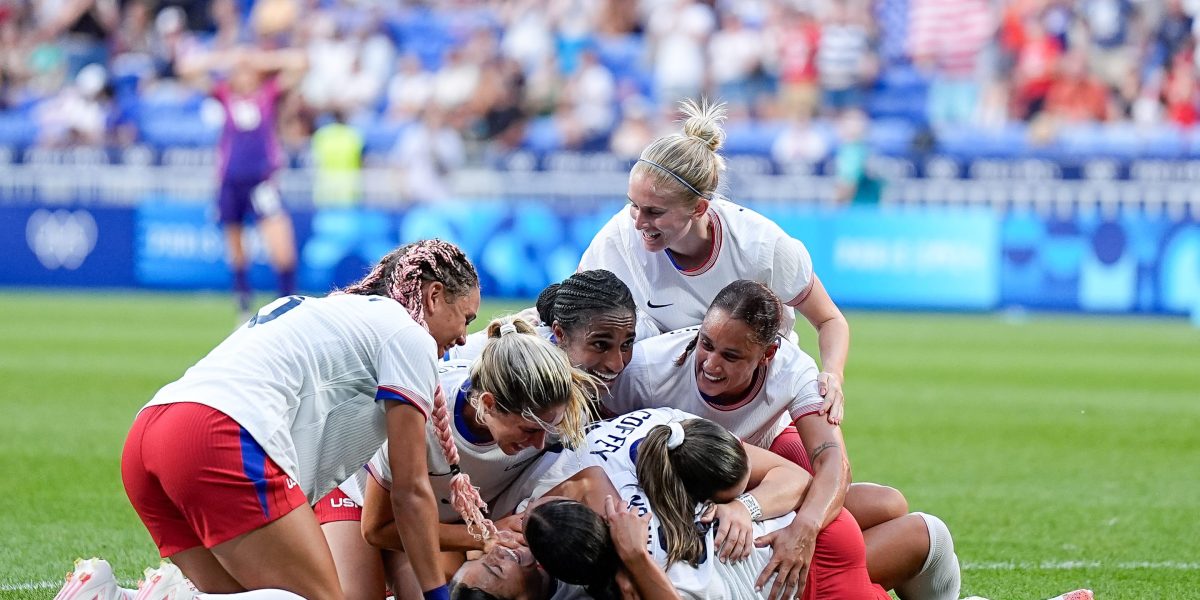
50 years after Title IX, women’s soccer is surging thanks to brand deals boosting visibility: ‘What’s been proven is people love women’s sports’

Published

on


With two World Cup wins, an Olympic bronze medal, and experience in multiple pro leagues around the world, Christen Press is one of the most prolific soccer players of the time. But fans would be hard-pressed to find digital evidence of her early career highlights from when she competed in Women’s Professional Soccer (WPS), the precursor to the National Women’s Soccer League (NWSL) that folded in 2012.

“If you go back and try to find highlights from my first years as a pro, you can’t,” Press told Marketing Brew. “You can find US Women’s National Team (USWNT) highlights always, but that’s what you’ll find. It was like that was my only job.”

Now, highlights of Press—or, really, any other pro women’s soccer player—are abundantly available, just one indication of just how much the landscape of women’s sports has shifted in the last few decades. More than 50 years after the passage of Title IX made it possible for more girls to succeed in sports in grade school, the talent pool of women athletes is deeper than ever, media outlets are showing women’s sporting events in prime time to record-breaking audiences, and major brands are funneling sponsorship dollars into the ecosystem.

Sport to sport, it’s not exactly clear what should be credited with kicking off the boom. But does it matter? Thirteen years after the founding of the NWSL, women’s professional soccer seems here to stay in more ways than one, with two of the biggest revenue drivers in sports—media rights and sponsorships—abundant enough to prop up two pro properties.

Ready for prime time

One of the biggest changes in the women’s soccer ecosystem in recent years has been media coverage of the sport. In the days of the WPS, and even more recently, fans often struggled to find games on TV aside from international tournaments like the World Cup and the Olympics every couple of years.

“When I started playing in the WPS and my first days of the NWSL, I was playing in front of a couple hundred people on bleachers in high schools and colleges,” Press remembered.

It wasn’t until 2022 when CBS Sports aired the NWSL Championship in prime time for the first time, but when it did, the game became the most-watched NWSL match in history, with 915,000 viewers, a 71% increase from 2021, per CBS. (The 2024 Championship beat that record, averaging 967,900 viewers, according to the NWSL.)

The deal for prime-time coverage in part came about thanks to Ally Financial, a years-long sponsor of the NWSL and many other women’s sports properties, which played a key role in conversations with the league and the network.

“You’ve got this vicious cycle that’s never going to be broken unless the brands jump in and kind of force systemic change,” Ally CMO Andrea Brimmer told Marketing Brew at the time. “It takes the brands sitting at the table to demonstrate that they’re willing to come in, that they’ve got the money to invest, but that they need the networks to think differently about the way that they’re selling media and the way that they are giving women’s sports timeslots and the platforms that they deserve.”

The NWSL’s current four-year media rights deal, signed in 2023, indicates a much different approach from networks and streamers, spanning coverage across CBS Sports, ESPN, Prime Video, and Scripps Sports; it’s reportedly worth $240 million. As of the mid-point of the current NWSL season, livestreams of matches were up 34% year over year, with 1.2 billion minutes viewed, according to the league. Women’s soccer fans can also watch pros play on Peacock, which holds the media rights to the Gainbridge Super League, a new pro women’s soccer league that kicks off its second season on August 23.

New media

While major media outlets play a big role in whether women’s soccer is widely available to audiences, the ecosystem has also been thriving thanks to athletes taking matters into their own hands, leveraging channels like social media and podcasts to increase visibility of the sport.

“Social media completely changed the landscape for women’s sports in a really powerful way, because before, you had all these legacy media channels that really acted as middlemen,” said Tobin Heath, an NWSL and USWNT icon who announced her retirement in July. “Once a year you’d get this terrible window, never prime time, and always it was through a lens of what the patriarchy wanted to see in women’s sports, which was obviously extremely narrow and really didn’t represent our sport’s culture at all.”

That frustration led Heath and Press, who are married, to found Re—Inc, a sports media company that publishes newsletters and podcasts meant to represent “gal culture,” which Heath described as an answer to “bro culture.” Their podcast, The Re—Cap Show, joined the Audacy network for distribution and global ad sales in July, part of a larger wave of growing interest in women’s sports podcasts.

Heath and Press aren’t the only soccer icons who have carved out their own media channels. Former USWNT co-captain Alex Morgan has Togethxr, the media and commerce company she started with Olympic snowboarder Chloe Kim, Olympic swimmer Simone Manuel, and basketball legend Sue Bird. Bird also founded production company A Touch More alongside her partner, Megan Rapinoe, another retired USWNT co-captain.

Through these platforms, the players can bypass legacy media companies and engage directly with fans on their own terms, which wasn’t always an option for athletes. Brandi Chastain, whose penalty kick delivered the USWNT the World Cup in 1999 and who went on to work with brands including NikeGatorade, and Bud Light, said she sometimes thinks about what her sponsorship roster could have looked like had she been playing in 2025.

“In terms of brands and branding, gosh, I think there’s a part of me that wishes that there were all these resources that existed,” she said.

Brand ball

As the audience for women’s soccer has grown, so too has its list of sponsors. This year, the NWSL kicked off its 13th season with 13 sponsors, including first-time brands E.l.f. Beauty and Alex Cooper’s Unwell Hydration. E.l.f.’s involvement represents a broader trend of beauty brands, which haven’t historically invested much in sports, leaning into sports sponsorship opportunities across leagues, including the NFL and WNBA. In August, E.l.f. further upped its investment in women’s soccer by signing NWSL players Melanie Barcenas, Abby Dahlkemper, Lo’eau LaBonta, and Jaedyn Shaw to its talent roster.

For brands, women’s sports are particularly compelling because the audience tends to encompass different consumers than men’s sports audiences, Super League President Amanda Vandervort told Marketing Brew. In pro basketball, for example, only 5% of Golden State Valkyries season-ticket holders also have Warriors season tickets, despite the teams sharing both an arena and a sport, a standout stat for founding partner JPMorganChase.

“There’s so many communities who haven’t had access to women’s pro soccer, and when you add that to the growing interest, the demographics and behaviors of our fans, and the opportunity for brands and sponsors to get in front of a whole new audience, it just makes business sense,” Vandervort said. “Now, we’re having real conversations about the return on the investment in women’s professional soccer.”

This year, the Super League announced Gainbridge had purchased the league’s naming rights, and it’s only seen an uptick in inbound interest since then, according to Vandervort. The league also has several endemic sponsors, including kit provider Capelli Sport and ball manufacturer Select.

In the NWSL, jersey sponsorships are breaking records at breakneck speed. Last year, Bay FC reportedly had the biggest back-of-jersey deal in the league with Trader Joe’s, and in February, Gotham FC and Dove reportedly broke the record again. Days later, the Portland Thorns and Ring were said to have agreed to the biggest deal in league history, exceeding $2.6 million.

“It’s not just about the dollars,” Matt Soloff, SVP, partnerships and business development at the NWSL, told us. “It’s about leaning into brands that want to lean into us at the highest level.”

Amazon, for instance, has a wide-ranging relationship with the NWSL that includes streaming rights to Friday night games and a playoff match on Prime Video, as well as an exclusive retail sponsorship for Amazon and the presenting sponsorship of the league’s Best XI Awards for Amazon Prime. The company also worked with the league and other media partners, including Togethxr, for a docuseries about the 2024 season.

It was the “rabid fanbase and the growth” of the league that made it stand out to a sponsor as big as Amazon, according to Deb Curtis, global director of marketing for Amazon Prime.

“The growth and the excitement around women’s sports, and obviously the NWSL, is incredibly energizing,” Curtis said. “Fandom fuels growth, and so we see our role as being able to go deeper. People know our brand, so how can our brand help to enhance that experience?”

Brand sponsorship dollars can also be invested back into the leagues, creating a virtuous cycle for women’s soccer.

For some players who have seen the industry shift in real time, it feels like vindication.

“What’s been proven is people love women’s sports,” Heath said. “That’s just the truth, and also, they love women’s athletes as people. Brands love women’s athletes. They’re more approachable. They’re better at marketing.”

This report was originally published by Marketing Brew.


Source link

Continue Reading

Business

Binance has been proudly nomadic for years. A new announcement suggests it’s chosen an HQ

Published

on


For years, Binance has dodged questions about where it plans to establish a corporate headquarters. On Monday, the world’s largest crypto exchange made an announcement that indicates it has chosen a location: Abu Dhabi, the capital of the United Arab Emirates.

In its announcement, Binance reported that it has secured three global financial licenses within Abu Dhabi Global Market, a special economic zone inside the Emirati city. The licenses regulate three different prongs of the exchange’s business: its exchange, clearinghouse, and broker dealer services. The three regulated entities are named Nest Exchange Limited, Nest Clearing and Custody Limited, and Nest Trading Limited, respectively.

Richard Teng, the co-CEO of Binance, declined to say whether Abu Dhabi is now Binance’s global headquarters. “But for all intents and purposes, if you look at the regulatory sphere, I think the global regulators are more concerned of where we are regulated on a global basis,” he said, adding that Abu Dhabi Global Market is where his crypto exchange’s “global platform” will be governed.

A company spokesperson declined to add more to Teng’s comments, but did not deny Fortune’s assertion that Binance appears to have chosen Abu Dhabai as its headquarters.

Corporate governance

The Abu Dhabi announcement suggests that Binance, which has for years taken pride in branding itself as a company with no fixed location, is bowing to the practical considerations that go with being a major financial firm—and the corporate governance obligations that entails.

When Changpeng Zhao, the cofounder and former CEO of Binance, launched the company in 2017, he initially established the exchange in Hong Kong. But, weeks after he registered Binance in the city, China banned cryptocurrency trading, and Zhao moved his nascent trading platform. Binance has since been itinerant. “Wherever I sit is going to be the Binance office,” Zhao said in 2020.

The location of a company’s headquarters impacts its tax obligations and what regulations it needs to follow. In 2023, after Binance reached a landmark $4.3 billion settlement with the U.S. Department of Justice, Zhao stepped down as CEO and pleaded guilty to failing to implement an effective anti-money laundering program.

Teng took over and promised to implement the corporate structures—like a board of directors—that are the norm for companies of Binance’s size. Teng, who now shares the CEO role with the newly appointed Yi He, oversaw the appointment of Binance’s first board in April 2024. And he’s repeatedly telegraphed that his crypto exchange is focused on regulatory compliance.

Binance already has a strong footprint in the Emirates. It has a crypto license in Dubai, received a $2 billion investment from an Emirati venture fund in March, and, that same month, said it employed 1,000 employees in the country. 


Source link

Continue Reading

Business

Leaders in Congress outperform rank-and-file lawmakers on stock trades by up to 47% a year

Published

on


Stocks held by members of Congress have been beating the S&P 500 lately, but there’s a subset of lawmakers who crush their peers: leadership.

According to a recent working paper for the National Bureau of Economic Research, congressional leaders outperform back benchers by up to 47% a year.

Shang-Jin Wei from Columbia University and Columbia Business School along with Yifan Zhou from Xi’an Jiaotong-Liverpool University looked at lawmakers who ascended to leadership posts, such as Speaker of the House as well as House and Senate floor leaders, whips, and conference/caucus chairs.

Between 1995 and 2021, there were 20 such leaders who made stock trades before and after rising to their posts. Wei and Zhou observed that lawmakers underperformed benchmarks before becoming leaders, then everything suddenly changed.

“Importantly, whilst we observe a huge improvement in leaders’ trading performance as they ascend to leadership roles, the matched ‘regular’ members’ stock trading performance does not improve much,” they wrote.

Leadership’s stock market edge stems in part from their ability to set the regulatory or legislation agenda, such as deciding if and when a particular bill will be put to a vote. Setting the agenda also gives leaders advanced knowledge of when certain actions will take place.

In fact, Wei and Zhou found that leaders demonstrate much better returns on stock trades that are made when their party controls their chamber.

In addition, being a leader also increases access to non-public information. The researchers said that while companies are reluctant to share such insider knowledge, they may prioritize revealing it to leaders over rank-and-file lawmakers.

Leaders earn higher returns on companies that contribute to their campaigns or are headquartered in their states, which Wei and Zhou said could be attributable to “privileged access to firm-specific information.”

The upper echelon also influences how other members of Congress vote, and the paper found that a leader’s party is much more likely to vote for bills that help firms whose stocks the leader held, or vote against bills that harmed them. And stocks owned by leadership tend to see increases in federal contract awards, especially sole-source contracts, over the following one to two years.

“These results suggest that congressional leaders may not only trade on privileged knowledge, but also shape policy outcomes to enrich themselves,” Wei and Zhou wrote.

Stock trades by congressional leaders are even predictive, forecasting higher occurrences of positive or negative corporate news over the following year, they added. In particular, stock sales predict the number of hearings and regulatory actions over the coming year, though purchases don’t.

Investors have long suspected that Washington has a special advantage on Wall Street. That’s given rise to more ETFs with political themes, including funds that track portfolios belonging to Democrats and Republicans in Congress.

And Paul Pelosi, former House Speaker Nancy Pelosi’s husband, even has a cult following among some investors who mimic his stock moves.

Congress has tried to crack down on members’ stock holdings. The STOCK Act of 2012 requires more timely disclosures, but some lawmakers want to ban trading completely.

A bipartisan group of House members is pushing legislation that would prohibit members of Congress, their spouses, dependent children, and trustees from trading individual stocks, commodities, or futures.

And this past week, a discharge petition was put forth that would force a vote in the House if it gets enough signatures.

“If leadership wants to put forward a bill that would actually do that and end the corruption, we’re all for it,” said Rep. Anna Paulina Luna, R-Fla., on social media on Tuesday. “But we’re tired of the partisan games. This is the most bipartisan bipartisan thing in U.S. history, and it’s time that the House of Representatives listens to the American people.”


Source link

Continue Reading

Business

Macron warns EU may hit China with tariffs over trade surplus

Published

on


French President Emmanuel Macron warned that the European Union may be forced to take “strong measures” against China, including potential tariffs, if Beijing fails to address its widening trade imbalance with the bloc.

“I’m trying to explain to the Chinese that their trade surplus isn’t sustainable because they’re killing their own clients, notably by importing hardly anything from us any more,” Macron told Les Echos newspaper in an interview published on Sunday.

“If they don’t react, in the coming months we Europeans will be obliged to take strong measures and decouple, like the US, like for example tariffs on Chinese products,” he said, adding that he had discussed the matter with European Commission President Ursula von der Leyen.

Macron has just returned from a three-day state visit in China, where he pressed for more investment as Paris seeks to recalibrate its relationship with the world’s second-largest economy. France’s goods trade deficit with China reached around €47 billion ($54.7 billion) last year, according to the French Treasury. Meanwhile, China’s goods trade surplus with the EU swelled to almost $143 billion in the first half of 2025, a record for any six-month period, according to data released by China earlier this year.

Tensions between France and China escalated last year after Paris backed the EU’s decision to impose tariffs on Chinese electric vehicles. Beijing retaliated by imposing minimum price requirements on French cognac, sparking fears among pork and dairy producers that they could be targeted next.

‘Life or Death’

Macron said the US approach to China was “inappropriate” and had worsened Europe’s position by diverting Chinese goods toward the EU market.

“Today, we’re stuck between the two, and it’s a question of life or death for European industry,” Macron said, while noting that Germany — Europe’s biggest economy — doesn’t entirely share France’s stance.

In addition to Europe needing to become more competitive, the European Central Bank too has a role to play in strengthening the EU’s single market, Macron said, arguing that monetary policy should take growth and jobs into account, not just inflation, he said.

He also said the ECB’s decision to continue selling the government bonds it holds risks pushing up long-term interest rates and weighing on economic activity.

“Europe must — and wants to — remain a zone of monetary stability and credible investment,” Macron said.


Source link

Continue Reading

Trending

Copyright © Miami Select.