When Elizabeth Rivera’s phone would ring during the overnight shift, it was usually because the bus didn’t show up again and one of her three kids needed a ride to school.
After leaving early from her job at a Houston-area Amazon warehouse several times, Rivera was devastated — but not surprised — when she was fired.
“Right now, I’m kind of depressed about it,” said Rivera, 42. “I’m depressed because of the simple fact that it’s kind of hard to find a job, and there’s bills I have to pay. But at the same time, the kids have to go to school.”
Rivera is far from the only parent forced to choose between their job and their kids’ education, according to a new poll conducted by The Associated Press-NORC Center for Public Affairs Research and HopSkipDrive, a company that relies on artificial intelligence and a network of drivers using their own vehicles to help school districts address transportation challenges.
Most parents drive their children to school, the survey found, and those responsibilities can have a major impact.
About one-third of parents say taking their kids to school has caused them to miss work, according to the poll. Roughly 3 in 10 say they’ve been prevented from seeking or taking work opportunities. And 11% say school transportation has even caused them to lose a job.
Mothers are especially likely to say school transportation needs have interfered with their jobs and opportunities.
Around 4 in 10 parents with a household income below $100,000 a year said they’ve missed work due to pick-up needs, compared with around 3 in 10 parents with a household income of $100,000 or more.
Meredyth Saieed and her two children, ages 7 and 10, used to live in a homeless shelter in North Carolina. Saieed said the kids’ father has been incarcerated since May.
Although the family qualified for government-paid transportation to school, Saieed said the kids would arrive far too early or leave too late under that system. So, she decided to drop them off and pick them up herself.
She had been working double shifts as a bartender and server at a French restaurant in Wilmington but lost that job due to repeatedly missing the dinner rush for pickups.
“Sometimes when you’ve got kids and you don’t have a village, you’ve got to do what you’ve got to do,” said Saieed, 30. “As a mom, you just find a way around it.”
The latest obstacle: a broken-down car. She couldn’t afford to repair it, so she sold it to a junk yard. She’s hoping this year the school will offer transportation that works better for her family.
Not all kids have access to a school bus
Although about half of parents living in rural areas and small towns say their kids still take a bus to school, that fell to about one-third of parents in urban areas.
A separate AP-NORC/HopSkipDrive survey of school administrators found that nearly half said school bus driver shortages were a “major problem” in their district.
Some school systems don’t offer bus service. In other cases, the available options don’t work for families.
The community in Long Island, New York, where police Officer Dorothy Criscuolo’s two children attend school provides bus service, but she doesn’t want them riding it because they’ve been diagnosed as neurodivergent.
“I can’t have my kids on a bus for 45 minutes, with all the screaming and yelling, and then expect them to be OK once they get to school, be regulated and learn,” said Criscuolo, 49. “I think it’s impossible.”
So Criscuolo drops them off, and her wife picks them up. It doesn’t interfere much with their work, but it does get in the way of Criscuolo’s sleep. Because her typical shift is 7 p.m. to 7 a.m. and her children start at different times at different schools, it’s not uncommon for her to get only three hours of sleep a day during the school year.
The transportation burden falls heavier on moms
Mothers are most often the ones driving their children to and from school, with 68% saying they typically take on this task, compared with 57% of fathers.
Most mothers, 55%, say they have missed work, have lost jobs or were kept from personal or professional opportunities because of school transportation needs, compared with 45% of dads.
Syrina Franklin says she didn’t have a choice. The father of her two high school-age children is deceased, so she has to take them and a 5-year-old grandson to different schools on Chicago’s South Side.
After she was late to work more than 10 times, she lost her job as a mail sorter at the post office and turned to driving for Uber and Instacart to make ends meet.
“Most of the kids, they have people that help out with dropping them off and picking them up,” said Franklin, 41. “They have their father, a grandmother, somebody in the family helps.”
When both parents are able to pitch in, school pickup and drop-off duties can be easier.
Computer programmer Jonathan Heiner takes his three kids to school in Bellbrook, Ohio, and his wife picks them up.
“We are definitely highly privileged because of the fact that I have a very flexible job and she’s a teacher, so she gets off when school gets out,” said Heiner, 45. “Not a lot of people have that.”
Roughly 4 in 10 parents said getting their kids to school would be “much easier” or “somewhat easier” if there were more school bus routes, school-arranged transportation services or improved pedestrian and bike infrastructure near school. Around a third cited a desire for earlier or later start times, or centralized pick-up and drop-off locations for school buses.
Joanna McFarland, the CEO and co-founder of HopSkipDrive, said districts need to reclaim the responsibility of making sure students have a ride to school.
“I don’t think the way to solve this is to ask parents to look for innovative ideas,” McFarland said. “I think we really need to come up with innovative ideas systematically and institutionally.”
In Houston, Rivera is waiting on a background check for another job. In the meantime, she’s found a new solution for her family’s school transportation needs.
Her 25-year-old daughter, who still works at Amazon on a day shift, has moved back into the home and is handling drop-offs for her three younger siblings.
“It’s going very well,” Rivera said.
___
The AP-NORC poll of 838 U.S. adults who are parents of school-age children was conducted June 30-July 11, using a sample drawn from NORC’s probability-based AmeriSpeak Panel, which is designed to be representative of the U.S. population. The margin of sampling error for adults overall is plus or minus 4.6 percentage points.
Good morning. As audit committees confront a rapidly expanding risk landscape, their role in corporate governance is being reshaped. Boards have often turned to current and former CFOs as independent directors, particularly for audit committees, because of their ability to translate complex operational and financial realities into effective oversight.
For example, this month, J. Michael Hansen, former EVP and CFO of Cintas Corporation, was appointed to the audit committee at Paychex. In July, Britt Vitalone, EVP and CFO of McKesson Corporation, was appointed to the audit committee of Align Technology’s board of directors. And in November, Catherine Birkett, CFO of GoCardless, was named chair of the audit and risk committee at Twinkl.
I attended the launch event of the Institute of Internal Auditors’ (IIA) Global Audit Committee Center last week in Washington, D.C., which addressed the challenges and opportunities facing audit committees. The center is designed to be a resource to strengthen the alliance between audit committees of boards and internal audit in a fast-changing risk environment. It offers research, webinars, and events and will ultimately add formal training programs.
“The center has a very strong core belief—well-informed, engaged, and well-supported audit committees are essential to corporate governance,” said Anthony Pugliese, president and CEO of the IIA.
Pugliese emphasized that board audit committees need to turn to internal audit to truly understand what is happening inside an organization. The event drew members from across the U.S. and around the world, including Canada, Europe, Africa, Latin America, and the Middle East, with Abdullah Alshebeili, CEO of the Saudi Authority of Internal Auditors, in attendance.
CFOs, in particular, work with internal audit on risk assessment, internal controls, and audit readiness, and they share information on financial processes and control issues. Finance chiefs also communicate regularly with the board’s audit committee.
AI and analytics reshape how audit committees see risk
During a panel discussion at the event, Ann Cohen, CFO of the IIA, said audit committees are increasingly using AI and advanced technology to connect different types of risk—third-party, financial, operational, cyber, and regulatory. They are using analytics to surface anomalies and emerging risks earlier, support proactive oversight, and run “what if” analyses before risks materialize. “It allows us to be more responsive to risks and provide more robust assurance to stakeholders,” she said.
A major focus is “everyday AI,” said Sarah Francis of the EY Center for Board Effectiveness. “I think audit committees are really also looking at, ‘How do we start to touch, feel, smell, and get used to the products that are out there?’” Directors, many of whom are active executives, are also thinking about how to deploy these tools effectively. “There have to be clear governance frameworks for AI and analytics,” she said, noting that prompts—and the people who craft them—matter. She highlighted the need for experts who can help frame broader questions around ethics within responsible AI frameworks.
Audit committees can and should engage with technology as they work toward a fully defined plan, commented Luke Whorton, executive search and leadership consultant at Spencer Stuart in the firm’s Financial Officer Practice. “How do you create a foundation, but one that’s agile and responsive, because it’s going to continue to change rapidly?” he asked.
“Audit committees need to be curious,” Cohen said. “They need to challenge management on their inputs, on their assumptions and their judgment, and on what they’ve embedded into their AI outputs.”
The committees that challenge assumptions and lean into technology, alongside strong partnerships with internal audit, could be well-positioned to safeguard trust in an uncertain world.
Linda LaGorga will step down as CFO of Entegris, Inc. (NASDAQ: ENTG), an advanced materials science provider, effective Feb. 28. Effective March 1. Mike Sauer, Entegris’ VP, controller and chief accounting officer, will assume the role of interim CFO, in addition to maintaining the responsibilities of his current role. LaGorga will serve as a senior advisor to Entegris through May 15. Entegris has initiated a search process for a permanent CFO with an executive search firm. Sauer has 37 years of experience in finance and accounting roles at Entegris.
Hugo Doetsch was appointed CFO of AuditBoard, a governance, risk, and compliance platform. Doetsch brings over two decades of financial leadership and strategic operating experience to AuditBoard. Most recently, he served as CFO at symplr, an enterprise health care operations software provider. Before that, he was CFO at NetDocuments, a cloud-based content management platform. Doetsch also held senior leadership roles at Ping Identity, where he assisted the company in a 2019 initial public offering.
Big Deal
The 2026 Fortune World’s Most Admired Companies list was released this morning. The annual ranking of corporate reputation is based on a poll of some 3,000 executives, directors, and analysts.
Apple has been No. 1 for 19 consecutive years. Amazon and Microsoft have filled out the top three for seven years in a row. Berkshire Hathaway (No. 6) and Alphabet (No. 8) have each been in the top 10 for well over a decade. Berkshire, the conglomerate nurtured by Warren Buffett, holds the distinction of having been on the All-Star list every single year since it launched in 1998; it shares that honor with Microsoft, Coca-Cola, Toyota Motor, and Johnson & Johnson.
Going deeper
“Who Gets Replaced by AI and Why?” is a report in Wharton’s business journal. New research from Wharton’s Pinar Yildirim explores how AI can impact employee motivation when it is implemented in the wrong part of a team’s workflow. The research addresses topics such as how managers should deploy AI capacity in teams and which positions are most vulnerable to being displaced by AI.
Overheard
“Working closely with David Ellison and this exceptional management team made the decision to resign from the board and jump in fully as CFO an easy one.”
—Dennis K. Cinelli wrote in a LinkedIn post on Tuesday regarding his appointment, effective Jan. 15, as CFO of Paramount, and his resignation from the company’s board. Most recently, Cinelli served as CFO of Scale AI, and he previously held senior finance and operational roles at Uber.
I love watching “Next Man Up” basketball, where the spotlight rotates unpredictably. One night it’s the bench guard dropping 30, the next it’s the role player posting a triple-double.
CapitalG’s Jill Chase—who captained her college basketball team at Williams College—says this logic actually applies to Alphabet’s growth firm. When I ask her what basketball team is most like CapitalG, she lists the WNBA’s Golden State Valkyries.
“Everybody has a different skill set, and everybody is willing to drop anything to help each other win,” said Chase. “It’s a different person every night who wins the game. And I think that’s really consistent with the way CapitalG is building its culture.”
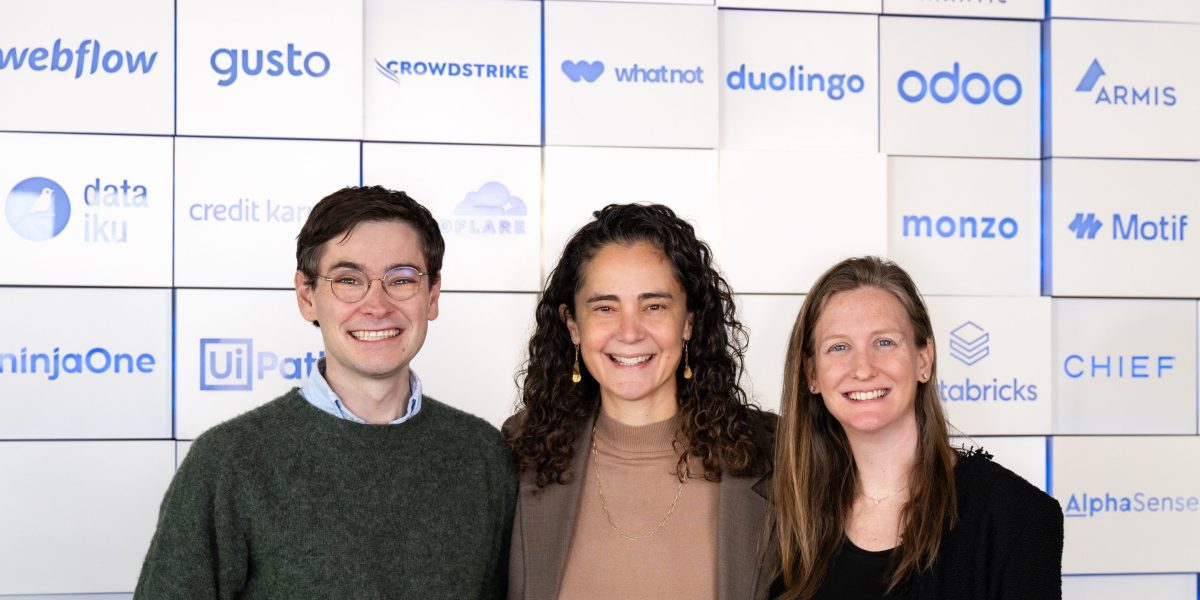
For the first time since the firm was started in 2013, it’s promoting two general partners, Chase and Alex Nichols, Fortune has exclusively learned. Chase, who joined CapitalG in 2020 specifically with a thesis around AI, has backed Abridge, Baseten, Canva, LangChain, Physical Intelligence, and Rippling.
Nichols, meanwhile, joined CapitalG in 2018 as an associate and was promoted to partner just two years ago. He previously worked with managing partner Laela Sturdy on the firm’s investments in Duolingo, Stripe, and Whatnot, and recently led CapitalG’s investment in Zach Dell’s energy startup BasePower. At a moment where there’s mounting angst around data centers and what it will take to power them, Nichols has a surprising take on how AI will affect energy—that both batteries and solar are getting cheaper and better at something like Moore’s Law speed. Those twin cost curves, over time, should actually drive energy prices down.
“I’m actually very optimistic about the future of energy prices,” he said. “You look at the history of energy consumption versus GDP. And cheap energy means more production, more income, and means a higher standard of living.”
At a moment when venture is perhaps more competitive than ever—and there are certainly some solo GPs out there making their mark—there’s an argument that as lines blur between disciplines in an AI-ified world, venture is by necessity a team sport.
Sturdy—who’s been CapitalG’s managing partner since 2023 (and also captained her college basketball team)—and Chase both have clearly taken some learnings from their time on the court. Chase sees venture overall as becoming more team-oriented: “Historically, it used to be like ‘you made general partner, go out and win your deal.’ To me, that’s not the right way to be successful in venture ever.”
Sturdy adds that in basketball, like venture, “We have to look at the scoreboard every once in a while, and you have to get back up when you get crushed… And, of course, coming together is better than playing alone.”
Term Sheet Podcast…This week, I spoke with Exelon CEO Calvin Butler. As resource-hungry data centers continue to sprout across the country, many are questioning whether the nation’s utility network can keep pace with such large-scale demand. Butler says it can. Listen and watch here.
Joey Abrams curated the deals section of today’s newsletter.Subscribe here.
VENTURE CAPITAL
– humans&, a San Francisco-based AI lab, raised $480 million in seed funding. SVAngel and GeorgesHarik led the round and were joined by NVIDIA and others.
– Emergent, a San Francisco-based platform designed for AI software creation, raised $70 million in Series B funding. Khosla Ventures and SoftBank led the round and were joined by Prosus, Lightspeed, Together, and Y Combinator.
– Exciva, a Heidelberg, Germany-based developer of therapeutics designed for neuropsychiatric conditions, raised €51 million ($59 million) in Series B funding. Gimv and EQTLifeSciences led the round and were joined by FountainHealthcarePartners, LifeArcVentures, and others.
– Pomelo, a Buenos Aires, Argentina-based payments infrastructure company, raised $55 million in Series C funding. Kaszek and InsightPartners led the round and were joined by IndexVentures, AdamsStreetPartners, S32, and others.
– Cloover, a Berlin, Germany-based operating system designed for energy independence, raised $22 million in Series A funding. MMCVentures and QEDInvestors led the round and were joined by LowercarbonCapital, BNVTCapital, BoschVentures, and others.
– Statusphere, a Winter Park, Fla.-based influencer marketing technology platform, raised $18 million in Series A funding. VolitionCapital led the round and was joined by HearstLab, 1984Ventures, and HowWomenInvest.
– DominionDynamics, an Ottawa, Canada-based defense technology company, raised $21M CAD ($15.2M USD) in seed funding. Georgian led the round and was joined by BessemerVenturePartners and BritishColumbiaInvestmentManagementCorporation.
– Cosmos, a New York City-based image collection and discovery platform, raised $15 million in Series A funding. ShineCapital led the round and was joined by Matrix and others.
– Mave, a Toronto, Canada-based real estate AI company, raised $5 million in seed funding from StaircaseVentures, RelayVentures, N49P, and AlatePartners.
– Stilla, a Stockholm, Sweden-based developer of an AI designed to accommodate entire teams, raised $5 million in pre-seed funding. GeneralCatalyst led the round and was joined by others.
– AsymmetricSecurity, a London, U.K. and San Francisco-based cyber forensics company, raised $4.2 million in pre-seed funding. SusaVentures led the round and was joined by HalcyonVentures, OverlookVentures, and angel investors.
PRIVATE EQUITY
– ConnectWise, backed by ThomaBravo, acquired zofiQ, a Toronto, Ontario-based agentic AI technology company designed to automate high-service desk operations. Financial terms were not disclosed.
– GrantAvenueCapital acquired 21stCenturyHealthcare, a Tempe, Ariz.-based vitamins, minerals, and supplements company. Financial terms were not disclosed.
– HighlanderPartners acquired Tapatio, a Vernon, Calif.-based hot sauce brand. Financial terms were not disclosed.
– PlatinumEquity acquired CzarnowskiCollective, a Chicago, Ill.-based exhibit and events company. Financial terms were not disclosed.
– UnitedBuildingSolutions, backed by AEIndustrial, acquired DFWMechanicalGroup, a Wylie, Texas-based HVAC solutions company. Financial terms were not disclosed.
IPOS
– PicPay, a Sao Paolo, Brazil-based digital bank, now plans to raise up to $435.1 million in an offering of 22.9 million shares priced between $16 and $19 on the Nasdaq. The company posted $1.7 billion in revenue for the year ended September 30. J&F International and BancoOriginal back the company.
– EthosTechnologies, a San Francisco-based online life insurance provider, plans to raise up to $210 million in an offering of 10.5 million shares priced between $18 and $20. The company posted $344 million in revenue for the year ended Sept. 30. GeneralCatalyst, HeroicVentures, EricLantz, and others back the company.
FUNDS + FUNDS OF FUNDS
– BlueprintEquity, a La Jolla, Calif.-based growth equity firm, raised $333 million for its third fund focused on enterprise software, business-to-business, and tech-enabled services companies.
PEOPLE
– Area 15 Ventures, a Castle Pine, Colo.-based venture capital firm, promoted AdamContos to managing partner.
– BullCityVenturePartners, a Durham, N.C.-based venture capital firm, hired CarlyConnell as a principal.
– HarvestPartners, a New York City-based private equity firm, promoted LucasRodgers to partner, MatthewBruckmann and IanSingleton to principal, and ConnorScro to vice president on the private equity team.
– Wingman Growth Partners, a Greenwich, Conn.-based private equity firm, hired CheriReeve as CFO. She previously served as principal and CFO at AtlasHoldings.
Davos 2026: reading the signals, not the headlines | Fortune
Louisa Loran advises boards and leadership teams on transformation and long-term value creation and currently serves on the boards of Copenhagen Business School and CataCap Private Equity.At Google, Louisa launched a billion-dollar supply chain solutions business, doubled growth in a global industry vertical, and led strategic business transformation for the company’s largest customers in EMEA—working at the forefront of AI, data, and platform innovation. At Maersk, she co-authored the strategy that redefined the brand globally and doubled its share price, helping pivot the company from traditional shipping to integrated logistics. Her career began in the luxury and FMCG space with Moët Hennessy and Diageo, where she built iconic brands and led innovation at the intersection of heritage and digital transformation.






 2 days ago
 22 hours ago
 14 hours ago
 19 hours ago
 2 days ago
 2 days ago


 Politics8 years ago