Connect with us

Business

3 monkeys still on the loose after research transport truck crashes in rural Mississippi

Published

on


The recent escape of several research monkeys after the truck carrying them overturned on a Mississippi interstate is the latest glimpse into the secretive industry of animal research and the processes that allow key details of what happened to be kept from the public.

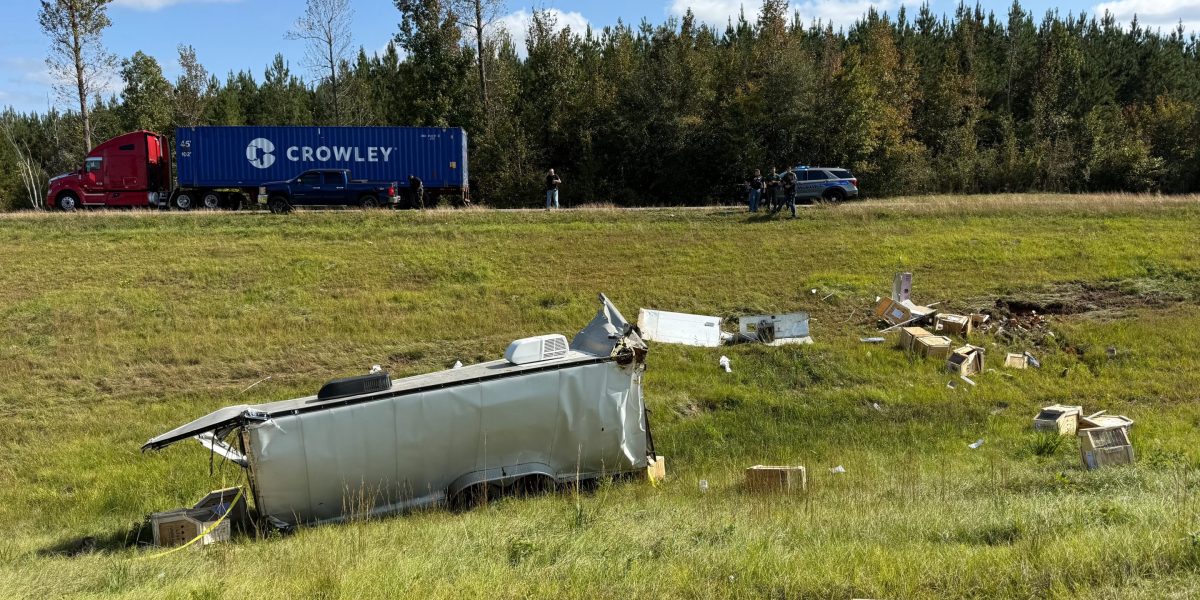
Three monkeys have remained on the loose since the crash on Tuesday in a rural area along Interstate 59, spilling wooden crates labeled “live monkeys” into the tall grass near the highway. Since then, searchers in masks, face shields and other protective equipment have scoured nearby fields and woods for the missing primates. Five of the 21 Rhesus macaques on board were killed during the search, according to the local sheriff, but it was unclear how that happened.

Key details remain shrouded in secrecy

Mississippi authorities have not disclosed the company involved in transporting the monkeys, where the monkeys were headed or who owns them. While Tulane University in New Orleans has acknowledged that the monkeys had been housed at its National Biomedical Research Center in Covington, Louisiana, it said it doesn’t own them and won’t identify who does.

An initial report from the sheriff described the monkeys as “aggressive” and carrying diseases such as herpes, adding to the confusion. Tulane later said the monkeys were free of pathogens, but it is still unclear what kind of research the monkeys were used for.

The questions surrounding the Mississippi crash and the mystery of why the animals were traveling through the South are remarkable, animal advocates say.

“When a truck carrying 21 monkeys crashes on a public highway, the community has a right to know who owned those animals, where they were being sent, and what diseases they may have been exposed to and harbored simply by being caught up in the primate experimentation industry,” said Lisa Jones-Engel, senior science adviser on primate experimentation with People for the Ethical Treatment of Animals.

“It is highly unusual — and deeply troubling — that Tulane refuses to identify its partner in this shipment,” Jones-Engel added.

One thing that is known is that the 2025 Chevrolet Silverado pickup hauling the monkeys was driven by a 54-year-old Cascade, Maryland, man when it ran off the highway into the grassy median area, the Mississippi Highway Patrol said in a statement to The Associated Press. The driver wasn’t hurt, nor was his passenger, a 34-year-old resident of Thurmont, Maryland.

Confidentiality is built into contracts, blocking information

Transporting research animals typically requires legally binding contracts that prohibit the parties involved from disclosing information, Tulane University said in a statement to the AP. That’s done for the safety of the animals and to protect proprietary information, the New Orleans-based university said.

“To the best of Tulane’s knowledge, the 13 recovered animals remain in the possession of their owner and are en route to their original destination,” the statement said.

The crash has drawn a range of reactions — from conspiracy theories that suggest a government plot to sicken people to serious responses from people who oppose experimenting on animals.

“How incredibly sad and wrong,” Republican U.S. Rep. Marjorie Taylor Greene said of the crash.

“I’ve never met a taxpayer that wants their hard-earned dollars paying for animal abuse nor who supports it,” the Georgia congresswoman said in a post on the social platform X. “This needs to end!”

Tulane center has ties to more than 155 institutions worldwide

Tulane’s Covington center has received $35 million annually in National Institutes of Health support, and its partners include nearly 500 investigators from more than 155 institutions globally, the school said in an Oct. 9 news release. The center has been funded by NIH since 1964, and federal grants have been a significant source of income for the institution, it said.

In July, some of the research center’s 350 employees held a ribbon-cutting ceremony to mark the opening of a new 10,000-square-foot office building and a new laboratory at the facility. This fall, the facility’s name was changed from the Tulane National Primate Research Center to the Tulane National Biomedical Research Center to reflect its broader mission, university officials announced.

Research monkeys have escaped before in South Carolina, Pennsylvania

The Mississippi crash is one of at least three major monkey escapes in the U.S. over the past four years.

Last November, 43 Rhesus macaques escaped from a South Carolina compound that breeds them for medical research after an enclosure wasn’t fully locked. Employees from the Alpha Genesis facility in Yemassee, South Carolina, set up traps to capture them. However, some spent two months that winter living in the woods and weathering a rare snowstorm. By late January, the last four escapees were recaptured after being lured back into captivity by peanut butter and jelly sandwiches.

In January 2022, several cynomolgus macaque monkeys escaped when a truck towing a trailer of about 100 of the animals collided with a dump truck on a Pennsylvania highway, authorities said. The monkeys were headed to a quarantine facility in an undisclosed location after arriving at John F. Kennedy International Airport in New York on a flight from Mauritius, an Indian Ocean island nation, authorities said. A spokesperson for the Centers for Disease Control and Prevention said all of the animals were accounted for within about a day, though three were euthanized for undisclosed reasons.


Source link

Continue Reading

Business

SpaceX to offer insider shares at record-setting valuation

Published

on


SpaceX is preparing to sell insider shares in a transaction that would value Elon Musk’s rocket and satellite maker at a valuation higher than OpenAI’s record-setting $500 billion, people familiar with the matter said.

One of the people briefed on the deal said that the share price under discussion is higher than $400 apiece, which would value SpaceX at between $750 billion and $800 billion, though the details could change. 

The company’s latest tender offer was discussed by its board of directors on Thursday at SpaceX’s Starbase hub in Texas. If confirmed, it would make SpaceX once again the world’s most valuable closely held company, vaulting past the previous record of $500 billion that ChatGPT owner OpenAI set in October. Play Video

Preliminary scenarios included per-share prices that would have pushed SpaceX’s value at roughly $560 billion or higher, the people said. The details of the deal could change before it closes, a third person said. 

A representative for SpaceX didn’t immediately respond to a request for comment. 

The latest figure would be a substantial increase from the $212 a share set in July, when the company raised money and sold shares at a valuation of $400 billion.

The Wall Street Journal and Financial Times, citing unnamed people familiar with the matter, earlier reported that a deal would value SpaceX at $800 billion.

News of SpaceX’s valuation sent shares of EchoStar Corp., a satellite TV and wireless company, up as much as 18%. Last month, Echostar had agreed to sell spectrum licenses to SpaceX for $2.6 billion, adding to an earlier agreement to sell about $17 billion in wireless spectrum to Musk’s company.

Subscribe Now: The Business of Space newsletter covers NASA, key industry events and trends.

The world’s most prolific rocket launcher, SpaceX dominates the space industry with its Falcon 9 rocket that launches satellites and people to orbit.

SpaceX is also the industry leader in providing internet services from low-Earth orbit through Starlink, a system of more than 9,000 satellites that is far ahead of competitors including Amazon.com Inc.’s Amazon Leo.

SpaceX executives have repeatedly floated the idea of spinning off SpaceX’s Starlink business into a separate, publicly traded company — a concept President Gwynne Shotwell first suggested in 2020. 

However, Musk cast doubt on the prospect publicly over the years and Chief Financial Officer Bret Johnsen said in 2024 that a Starlink IPO would be something that would take place more likely “in the years to come.”

The Information, citing people familiar with the discussions, separately reported on Friday that SpaceX has told investors and financial institution representatives that it is aiming for an initial public offering for the entire company in the second half of next year.

A so-called tender or secondary offering, through which employees and some early shareholders can sell shares, provides investors in closely held companies such as SpaceX a way to generate liquidity.

SpaceX is working to develop its new Starship vehicle, advertised as the most powerful rocket ever developed to loft huge numbers of Starlink satellites as well as carry cargo and people to moon and, eventually, Mars.


Source link

Continue Reading

Business

U.S. consumers are so strained they put more than $1B on BNPL during Black Friday and Cyber Monday

Published

on


Financially strained and cautious customers leaned heavily on buy now, pay later (BNPL) services over the holiday weekend.

Cyber Monday alone generated $1.03 billion (a 4.2% increase YoY) in online BNPL sales with most transactions happening on mobile devices, per Adobe Analytics. Overall, consumers spent $14.25 billion online on Cyber Monday. To put that into perspective, BNPL made up for more than 7.2% of total online sales on that day.

As for Black Friday, eMarketer reported $747.5 million in online sales using BNPL services with platforms like PayPal finding a 23% uptick in BNPL transactions.

Likewise, digital financial services company Zip reported 1.6 million transactions throughout 280,000 of its locations over the Black Friday and Cyber Monday weekend. Millennials (51%) accounted for a chunk of the sizable BNPL purchases, followed by Gen Z, Gen X, and baby boomers, per Zip.

The Adobe data showed that people using BNPL were most likely to spend on categories such as electronics, apparel, toys, and furniture, which is consistent with previous years. This trend also tracks with Zip’s findings that shoppers were primarily investing in tech, electronics, and fashion when using its services.

And while some may be surprised that shoppers are taking on more debt via BNPL (in this economy?!), analysts had already projected a strong shopping weekend. A Deloitte survey forecast that consumers would spend about $650 million over the Black Friday–Cyber Monday stretch—a 15% jump from 2023.

“US retailers leaned heavily on discounts this holiday season to drive online demand,” Vivek Pandya, lead analyst at Adobe Digital Insights, said in a statement. “Competitive and persistent deals throughout Cyber Week pushed consumers to shop earlier, creating an environment where Black Friday now challenges the dominance of Cyber Monday.”

This report was originally published by Retail Brew.


Source link

Continue Reading

Business

AI labs like Meta, Deepseek, and Xai earned worst grades possible on an existential safety index

Published

on


A recent report card from an AI safety watchdog isn’t one that tech companies will want to stick on the fridge.

The Future of Life Institute’s latest AI safety index found that major AI labs fell short on most measures of AI responsibility, with few letter grades rising above a C. The org graded eight companies across categories like safety frameworks, risk assessment, and current harms.

Perhaps most glaring was the “existential safety” line, where companies scored Ds and Fs across the board. While many of these companies are explicitly chasing superintelligence, they lack a plan for safely managing it, according to Max Tegmark, MIT professor and president of the Future of Life Institute.

“Reviewers found this kind of jarring,” Tegmark told us.

The reviewers in question were a panel of AI academics and governance experts who examined publicly available material as well as survey responses submitted by five of the eight companies.

Anthropic, OpenAI, and GoogleDeepMind took the top three spots with an overall grade of C+ or C. Then came, in order, Elon Musk’s Xai, Z.ai, Meta, DeepSeek, and Alibaba, all of which got Ds or a D-.

Tegmark blames a lack of regulation that has meant the cutthroat competition of the AI race trumps safety precautions. California recently passed the first law that requires frontier AI companies to disclose safety information around catastrophic risks, and New York is currently within spitting distance as well. Hopes for federal legislation are dim, however.

“Companies have an incentive, even if they have the best intentions, to always rush out new products before the competitor does, as opposed to necessarily putting in a lot of time to make it safe,” Tegmark said.

In lieu of government-mandated standards, Tegmark said the industry has begun to take the group’s regularly released safety indexes more seriously; four of the five American companies now respond to its survey (Meta is the only holdout.) And companies have made some improvements over time, Tegmark said, mentioning Google’s transparency around its whistleblower policy as an example.

But real-life harms reported around issues like teen suicides that chatbots allegedly encouraged, inappropriate interactions with minors, and major cyberattacks have also raised the stakes of the discussion, he said.

“[They] have really made a lot of people realize that this isn’t the future we’re talking about—it’s now,” Tegmark said.

The Future of Life Institute recently enlisted public figures as diverse as Prince Harry and Meghan Markle, former Trump aide Steve Bannon, Apple co-founder Steve Wozniak, and rapper Will.i.am to sign a statement opposing work that could lead to superintelligence.

Tegmark said he would like to see something like “an FDA for AI where companies first have to convince experts that their models are safe before they can sell them.

“The AI industry is quite unique in that it’s the only industry in the US making powerful technology that’s less regulated than sandwiches—basically not regulated at all,” Tegmark said. “If someone says, ‘I want to open a new sandwich shop near Times Square,’ before you can sell the first sandwich, you need a health inspector to check your kitchen and make sure it’s not full of rats…If you instead say, ‘Oh no, I’m not going to sell any sandwiches. I’m just going to release superintelligence.’ OK! No need for any inspectors, no need to get any approvals for anything.”

“So the solution to this is very obvious,” Tegmark added. “You just stop this corporate welfare of giving AI companies exemptions that no other companies get.”

This report was originally published by Tech Brew.


Source link

Continue Reading

Trending

Copyright © Miami Select.